Sri Lanka’s Education Reforms: Why Sri Lanka should reject ITGSE’s CSE – Sexual Behaviour & Pleasure content
-
What is ITGSE?
The International Technical Guidance on Sexuality Education (ITGSE) is the UN system’s master-framework for Comprehensive Sexuality Education (CSE).
International Technical Guidance on Sexuality Education (ITGSE) is a global framework formulated by:
- UNESCO (lead agency)
- UNFPA
- UNICEF
- WHO
- UNAIDS
ITGSE Curriculum – Official link https://unesdoc.unesco.org/ark:/48223/pf0000260770
UNESCO article summarizing ITGSE:
ITGSE claims to be “non-binding,” yet it is used as the global benchmark for international compliance under:
- SDG 4.7
- UNFPA & UNICEF education programming
- UN human rights treaty body reviews
- National CSE curriculum audits
UNESCO itself states (ITGSE, Introduction) that countries are expected to “align national curricula with ITGSE’s 8 key concepts and learning objectives” across all age bands. (ITGSE 2018, p. 18)
Meaning: once Sri Lanka accepts ITGSE as the foundation, the full package becomes mandatory in practice—including the most controversial themes such as pleasure, sexual exploration, sexual rights, SOGI, and challenging cultural norms.
UN agencies use ITGSE to influence:
• curriculum reform
• life-skills education
• teacher training
• health & gender modules
• donor-funded “technical assistance”
Once a country accepts any part of ITGSE as a basis for curriculum reform, UN agencies insist that the entire ITGSE structure — including SOGI, Sexual Behaviour, and Sexual Pleasure content — is “core” and must be integrated.
This is how ITGSE becomes a mandatory-in-practice guideline for developing nations.
This is why Sri Lanka cannot compromise & must reject the ITGSE CSE curriculum in full. It is 100 foreign-created.
-
What ITGSE teaches under the theme “Sexual Behaviour & Pleasure”
ITGSE orientation / training materials (shows module language on sexual behaviour / pleasure / masturbation, age bands, learning objectives)
Example orientation report and teaching notes:
- ITGSE orientation report:
An Orientation Workshop on International Technical Guidance on Sexuality Education
- Related teacher/implementation modules (examples of language used in practice):
https://unesdoc.unesco.org/ark:/48223/pf0000183281
Guidelines for CSE kindergarten through 12th grade
https://healtheducationresources.unesco.org/sites/default/files/resources/bie_guidelines_siecus.pdf
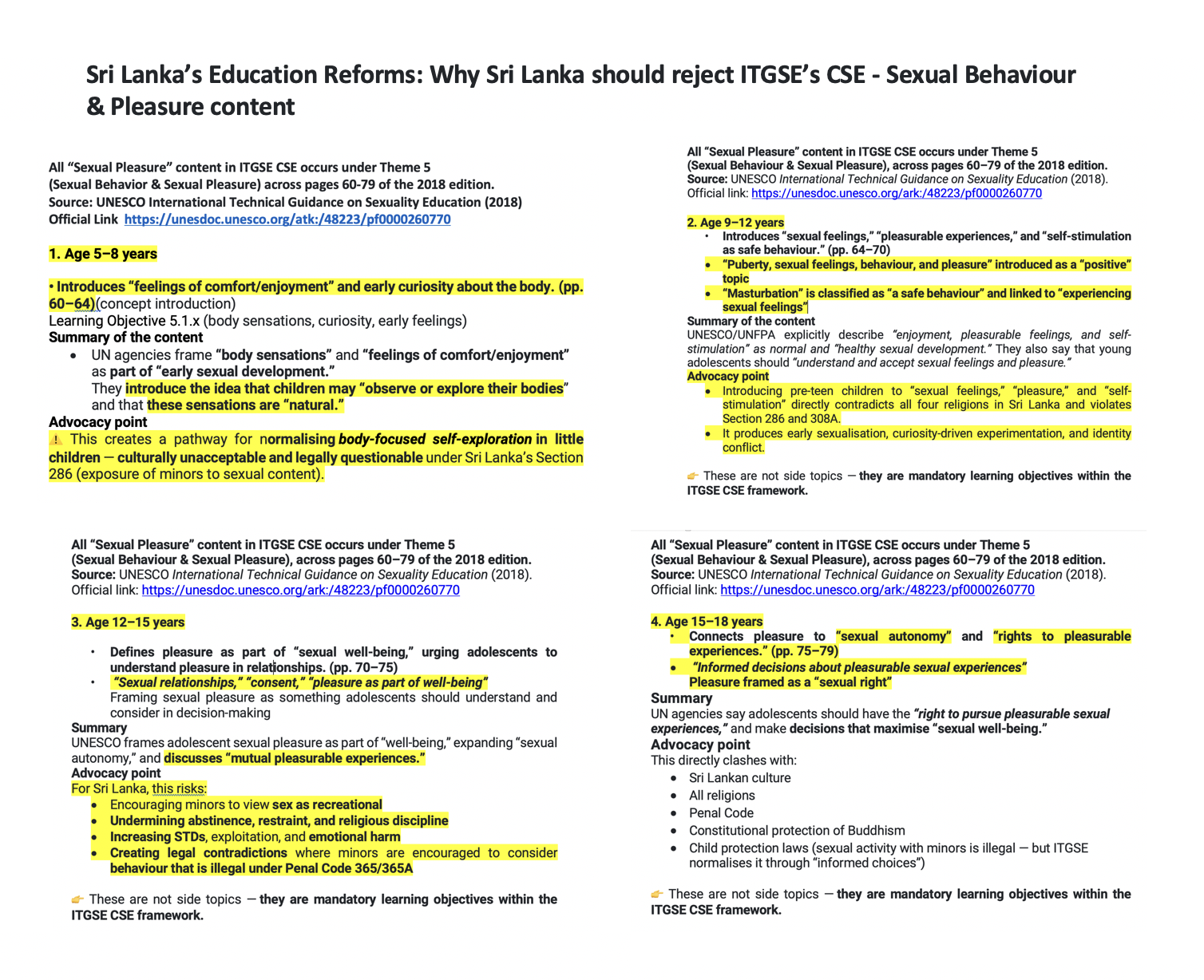
ITGSE Theme 5: Sexual Behaviour & Sexual Pleasure (UNESCO 2018)
Theme 5 appears across:
- 60–79of ITGSE (2018 edition)
- Learning Objectives particularly under1, 5.2, 5.3
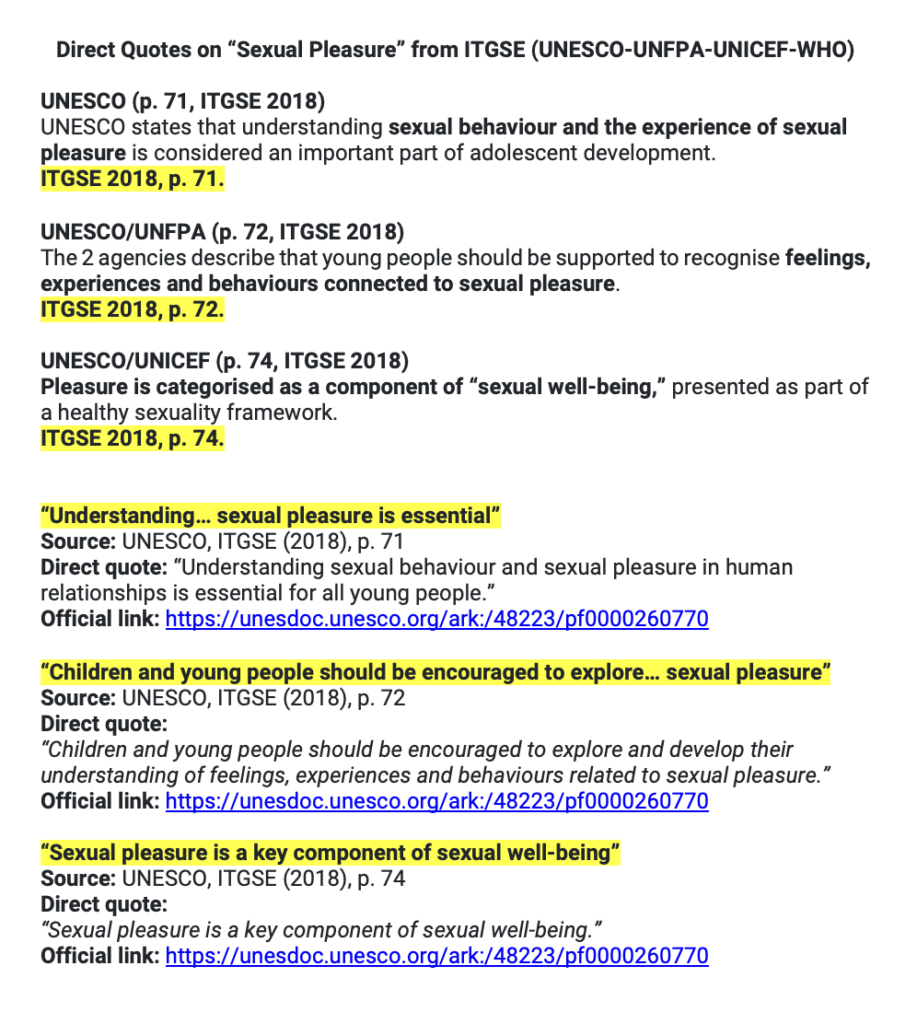
Key excerpts:
“Understanding sexual behaviour and sexual pleasure … is essential for healthy development.”
(ITGSE 2018, p. 71)
“Children and young people should be encouraged to explore feelings, experiences, and behaviours related to sexual pleasure.”
(ITGSE 2018, p. 72)
“Pleasure is a key component of sexual wellbeing.”
(ITGSE 2018, p. 74)
Relevant ITGSE Concepts & References
| Age Band | ITGSE Content on Sexual Behaviour & Pleasure |
| 5–8 | Early introduction to “understanding feelings of pleasure,” body exploration, curiosity about sexuality. |
| 9–12 | “Sexual feelings during puberty,” introduction to “sexual behaviour,” “masturbation as safe behaviour,” and “experiencing pleasure.” |
| 12–15 | Discussion of “sexual relationships,” “sexual decision-making,” “consent,” and “pleasure as part of well-being.” |
| 15–18 | Instructions on “making informed decisions about sexual behaviour,” “rights to pleasurable sexual experiences,” and “affirming sexual autonomy.” |
ITGSE links sexual identity → sexual behaviour → pleasure as a normative developmental pathway.
-
Why Theme 5 Conflicts with Sri Lanka
Unlike topics such as anatomy or health, Theme 5 introduces “sexual pleasure” as an educational objective, which is alien to Sri Lanka’s:
- social norms
- religious teachings
- constitutional values
- Penal Code
- child protection laws
- cultural safeguards of childhood innocence
This theme directly contradicts the established Eastern civilizational philosophy that sexual matters are private, adult, and not topics for minors.
-
Cultural Conflict
Sri Lankan society values:
- Childhood modesty
- Parental authority over sexual matters
- Religious moral frameworks
- Late introduction to sexual concepts
- Decency and restraint
But ITGSE teaches:
- Early sexual awareness
- Early sexual pleasure recognition
- Normalisation of self-stimulation
- Sexual decision-making for minors
- Acceptance of teen sexual relationships
Direct Cultural Clash
- Teaching children (5–12 years) about pleasureand sexual behaviour breaks the cultural norm of preserving childhood innocence.
- Encouraging sexual decision-making among minors promotes behaviour unacceptable in a traditional, modest culture.
- It weakens parent–child bonds, as children begin seeing sexual decisions as “individual rights.”
Outcome at Societal Level
- Mass rejection
- Teachers refusing to deliver content
- Community resistance
- Breakdown of trust in the Ministry of Education
2. Religious Conflict
All four major religions reject sexual pleasure-seeking among minors.
Buddhism
- Preaches restraint (sīla), right conduct, and guarding the senses.
- Teaching pleasurable sexual behaviourto minors is a direct contradiction to Dhamma.
Hinduism
- Encourages brahmacharya (sexual restraint) until adulthood.
- Early pleasure instruction violates dharma.
Islam
- Sexual relations strictly limited to marriage.
- No tolerance for teaching minors sexual pleasure or sexual autonomy.
Christianity
- “Chastity” until adulthood is foundational.
- Sexual pleasure cannot be taught outside marriage.
ITGSE directly contradicts these religious teachings by normalising early sexual exploration, masturbation, and pleasure-seeking.
3. Legal Conflicts
Constitution https://www.parliament.lk/files/pdf/constitution.pdf
- Article 9(Buddhism),
- Articles 10 & 14(1)(e)(freedom of religion / conscience).
Penal Code (text of sections):
LawNet / Lankalaw pages with sections 365 / 365A / 286 / 308A.:
https://www.lawnet.gov.lk/wp-content/uploads/Legislative_html/1956Y1V19C.html
https://www.srilankalaw.lk/p/878-penal-code-ordinance.html?
- Penal Code Sections 286 & 308A
- Section 286prohibits exposing children to sexual material.
- Section 308Aprotects children from emotional/psychological harm.
Teaching minors:
- about sexual behaviour
- about masturbation
- about pleasurable sexual experiences
is legally problematic as it constitutes sexualising a minor.
- Penal Code Sections 365 / 365A
- If sexual behaviour is taught as “normal teenage exploration,” yet some acts are illegal, it creates direct contradiction.
ITGSE forces schools to contradict family, religious & constitutional values.
-
ICCPR Act
Prohibits dissemination of content harmful to:
- public morality
- religious harmony
Pleasure-themed sex education for minors violates both.
-
Child Protection Systems (NCPA / NHRD / CRC)
CRC affirms:
- parental primacy
- cultural & religious protection
ITGSE undermines both by imposing failed Western sexual norms.
-
Outcomes if Implemented in Sri Lanka
- Impact on Children
- Premature sexualisation
- Children introduced to adult concepts at 5–12 years lose innocence early.
- Experimentation
- Teaching “pleasure” leads to increased curiosity and unsafe behaviour.
- Identity confusion
- Linking behaviour to identity increases emotional instability. Preoccupation with the subject impedes studies and career goals.
- Psychological distress
- Children unable to reconcile teachings with religion & family norms.
- Peer pressure escalation
- Teens pressured to “try” sexual experiences because it is “normalised.”
- Increased risk of STDs
Early sexual exploration leads to:
- HIV
- Herpes
- HPV
- Sexually transmitted bacterial infections
- Long-term impact on marriage and family
- Early sexual behaviour correlates with broken relationships, low trust, instability. Some may give up schooling & take to sex work (thus the call to legalize prostitution & promotion of condoms as “safe sex” and campaigns to discourage marriage & having children)
– an entire social re-engineering via schools through this topic will take place.
Impact on Families
- Parents feel betrayed by the school system.
- Loss of parental authority.
- Conflict between parents & teens.
- Breakdown of traditional family structure.
- Those able to afford homeschooling will opt – leaving the vulnerable to become victims of this new teaching agenda
Impact on Society
If a generation is raised on pleasure-driven sexual behaviour:
- weakened family values
- children giving up higher studies / cutting short their inherent talents
- rise in teen pregnancies
- increase in STDs
- erosion of cultural & religious foundations
- imitation of Western sexual culture collapse
- degradation of national identity
- a future of depression, anxiety, regret and self-blame may also lead to unthinkable decisions and self-harm.
Sri Lanka becomes vulnerable to:
- external ideological control
- moral destabilisation
- erosion of sovereignty through educational infiltration
-
Why Sri Lanka must reject CSE-ITGSE
Sri Lanka belongs to an Eastern civilisation that values restraint, modesty, family, religion, and cultural continuity.
This does not mean Sri Lanka rejects Western ideals. But such must be chosen that suits with Sri Lanka’s civilizational culture.
Teaching “sexual behaviour and pleasure” to children:
- sexualises minors
- violates culture
- breaks families
- contradicts law
- harms children
- destabilises national identity
Therefore, ITGSE’s “Sexual Behaviour & Pleasure” content must be firmly rejected in Sri Lanka’s new curriculum reforms without compromise.
Shenali D Waduge