Digital Education Reforms in Sri Lanka: Official Statements & what is kept hidden
- AUTHORITY, MANDATE & LEGAL SEQUENCING (WHERE EVERYTHING BEGINS)
- Appointment of the Digital Transformation Task Force
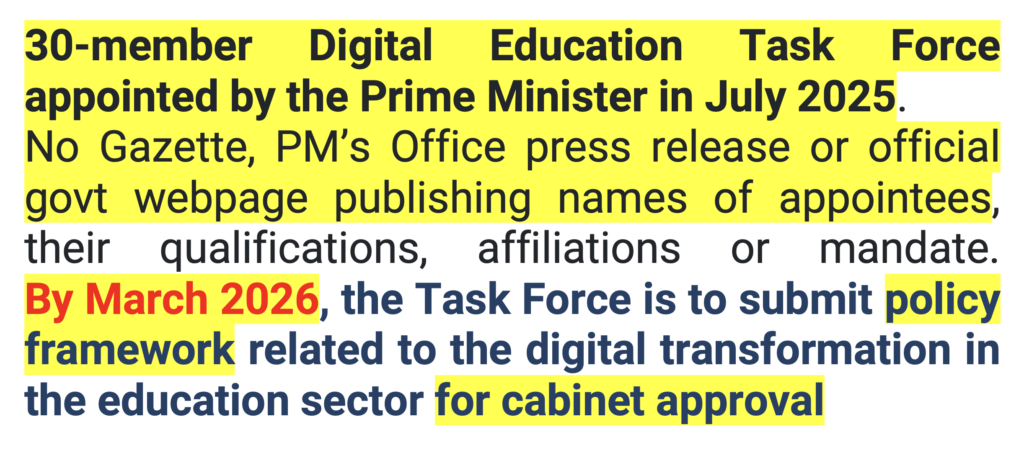
A 30-member Task Force for Digital Transformation in Education was appointed in June–July 2025, reportedly to lead the planning and policy preparation for digital education reform.
The Task Force is expected to submit a comprehensive digital education policy framework to Cabinet by March 2026.
There is no publicly available Gazette notification or formal mandate document
No published legal authority defining:
- exact powers
- scope
- limits
- timelines
- performance indicators
- reporting obligations
- No public disclosure of how its recommendations would bind or guide implementation
This omission itself constitutes a serious transparency and governance gap.
If the Task Force’s mandate is to design policy for Cabinet approval by March 2026,
why is large-scale implementation already underway before the policy exists?
- IMPLEMENTATION BEFORE APPROVAL: POLICY BY ACTION, NOT LAW
While the appointed Task Force is required to present its policy framework in MARCH 2026, on what grounds is the Education Ministry/NIE implementing reforms?
The below has already taken place:
- Circulation of digital learning modules and teacher guidebooks for Grades 1 and 6
- Nationwide teacher-training cascades
- Procurement of digital equipment
- Removal of printed textbooks for Grades 1 and 6
This means:
Delivery has begun before Cabinet approval, before parliamentary debate, and before parental consent.
This reverses constitutional policy sequencing, which should follow:
Law → Policy → Curriculum → Delivery → Assessment
Instead, what is occurring is:
Delivery → Procurement → Training → Justification
III. OFFICIAL OBJECTIVES CLAIMED BY THE MINISTRY
The Ministry of Education states that digital reforms aim to:
- Address teacher shortages
- Equip schools with ICT resources
- Ensure learning continuity during disruptions
- Enhance learning through technology
These objectives are repeatedly cited — yet the enabling conditions required to achieve them have not been verified or disclosed.
The subject Minister makes politically charged public appeals with no substance.
- ROLLOUT TIMELINE & GOVERNANCE CONCERNS
Official statements indicate:
- Reforms to begin in 2026 with Grades 1 and 6
- Expansion to all grades planned by 2029
- Learning modules and teacher guides already circulated
This constitutes implementation in advance of lawful approval, raising constitutional and administrative law concerns regarding:
- Authority
- Consent
- Accountability
- Equal access
- TEACHER TRAINING CLAIMS WITHOUT BASELINE DATA
The Ministry states:
- ~10,000 master trainers trained
- Training cascading to ~136,000 teachers
- Completion expected before full rollout
However, no baseline or disaggregated data has been released on:
- Existing ICT competence of teachers
- Device ownership
- Connectivity access
- Classroom readiness
- Rural–urban–estate disparities
Without baseline data, claims of preparedness remain assertions, not evidence.
- INFRASTRUCTURE TARGETS WITHOUT PUBLIC AUDIT
The Ministry claims that by end-2025 it aims to:
- Connect all schools to the internet
- Ensure each school has at least one smart board and a computer/laptop
Yet no independently verified public audit exists showing:
- School-wise readiness
- Region-wise connectivity
- Electricity reliability
- Availability of technical support staff
In the absence of such audits, these targets cannot be verified and cannot lawfully underpin nationwide curriculum reform.
Legal Implications: Equality & Access
Violation of Constitution Articles 12 & 27.
VII. CURRICULUM DELIVERY CHANGES: TEXTBOOKS REMOVED BY INDICATION, NOT DECLARATION
For Grades 1 and 6:
- Digital modules and teacher guides have been introduced
- Materials are hosted online
- Printed textbooks are not being issued
The Ministry has not clarified:
- Whether this is a pilot or permanent shift
- Whether textbooks will be restored if digital delivery fails
- Whether all grades will eventually lose printed textbooks
- The Ministry has not denied the possibility that textbooks for all grades may be phased out.
This raises serious constitutional equality concerns, particularly for children without digital access.
Statutory Concerns under the Education Ordinance
Violation of Sections 2, 3, 32.
VIII. EXAMS UNCHANGED — CURRICULUM TRANSFORMED
Reforms claim to move:
- Away from rote learning
- Away from exam-centric education
However, National examinations remain unchanged:
- Grade 5 Scholarship
- GCE O/L
- GCE A/L
No explanation has been provided on how students will:
- Revise
- Annotate
- Consolidate learning
- Prepare for high-stakes written exams
Likely consequence:
Increased dependence on private tuition, deepening inequality.
- FOREIGN PARTNERSHIPS & TRANSPARENCY DEFICITS
(Governance issue — not geopolitical)
China-Assisted Digital Education Project
On 14–15 January 2026, Sri Lanka and China jointly unveiled a digital education project involving:
- Education cloud data centre
- Multimedia centres
- Smart classrooms across 500 schools
- Software-defined network systems
- Digital teaching resources, including Chinese language materials
https://english.news.cn/asiapacific/20260115/a3534522fed14629a8dad87ba04971e4/c.html
Unanswered questions:
- Which schools are included?
- How were they selected?
- Will this extend nationwide?
- How is foreign infrastructure integrated into national policy?
- Who governs curriculum authority and data ownership?
There is no publicly available geographic distribution or inclusion criteria.
Data Governance & Sovereignty Risks
Data Protection obligations.
- PROCUREMENT FAILURES & CABINET MISDISCLOSURE
- Independent reporting reveals:
- Procurement of 1,000 smart boards — unused and stored
- Failure to secure a 500-unit China grant before purchase
- Rushed procurement
- Misleading Cabinet submissions
- No connectivity risk planning
This reflects systemic governance failure, not isolated error.
- SUBJECT CONTENT, HISTORY & IDEOLOGICAL AUTHORITY
The Ministry claims:
- Religion and aesthetics remain (integrated)
- History and arts are restructured, not removed
However, there is no transparency on:
- Who defines historical narratives
- Content boundaries
- Ideological safeguards
- Approval mechanisms
Unanswered question:
Whose worldview governs curriculum — and who approved it?
XII. CSE (COMPREHENSIVE SEXUALITY EDUCATION): AUTHORITY & ACCOUNTABILITY
Regardless of one’s view on CSE, the unresolved issue is process and authority.
The Ministry has not clarified:
- Who requested inclusion
- Who approved it
- Whether external agencies influenced content
- Whether foreign agreements carried implicit expectations
No transparency on:
- Age of introduction
- Scope
- Cultural safeguards
- Parental consent or opt-out mechanisms
- Who wanted CSE included — and on whose authority?
Child Protection & Parental Authority
Children & Young Persons Ordinance + constitutional conscience rights.
XIII. CHILD IMPACT, VALUES & PROTECTION
No integrated child-impact assessment has been released covering:
- Cognitive development
- Moral and social development
- Equity and access
- Psychological readiness
Concerns remain regarding:
- Age-inappropriate exposure
- Ideological framing
- Absence of values-based responsibility frameworks
- No disclosed content review or disciplinary mechanism
XIV. WORKFORCE, DROPOUT & SOCIAL CONSEQUENCES
No published assessment exists on whether digital-first learning increases:
- Cognitive overload
- Disengagement
- Dropout risk
Especially among:
- Slower learners
- Children from unstable home environments
The Ministry has not clarified whether reforms are intended to reduce:
- Physical schools
- Teacher recruitment
- Classroom-based pedagogy
- DISCIPLINARY ACTION & COLLECTIVE RESPONSIBILITY
Despite widespread controversy:
- No comprehensive accountability review has been published
- No institutional responsibility acknowledged
Yet decisions involved:
- Minister of Education
- Ministry Secretaries
- NIE leadership
- Curriculum committees
- External advisors
Disciplinary actions (as of early 2026):
- NIE Director General stepped down pending inquiry
- Deputy Director General and others placed on compulsory leave
- CID complaint lodged
Key question:
Does collective responsibility mean collective immunity?
Child Protection & Parental Authority
Children & Young Persons Ordinance + constitutional conscience rights.
XVI. KEY TRANSPARENCY QUESTIONS FOR PARENTS & THE PUBLIC
Authority
- Who are the 30 Task Force members by name, qualification, and institution?
- Curriculum
- Who approved CSE inclusion?
- Who defines history and civics?
Foreign assistance
- How are agreements integrated into national policy?
- Who governs student data?
- Accountability
- What laws govern disciplinary inquiries?
- When will findings be published?
CONCLUSION: THE CORE MESSAGE
Education reform is not:
- A PR exercise
- A political mandate
- A donor-driven experiment
- It is a constitutional responsibility.
It cannot proceed through:
- Task forces without authority
- Curriculum changes without review
- Reforms without parental consent
- Foreign partnerships without transparency
- No loan condition, donor expectation, or non-binding UN recommendation can tamper with Sri Lanka’s children.
Children are the roots of this nation — not programmable robots.
Shenali D. Waduge