Asad Maulana & Channel 4 – In search of Evidence on Easter Sunday attacks
This rebuttal examines whether the Channel 4 documentary establishes its central allegation of high-level state complicity in the Easter Sunday attacks on the basis of independently verifiable evidence, or whether it relies primarily on delayed testimony, anonymous sourcing, and inferential narrative construction.
https://www.youtube.com/watch?v=1QAgPSz4hS4
SECTION 1
THE ENTIRE CHANNEL 4 CASE RESTS ON ASAD MAULANA
Channel 4’s central allegation of high-level complicity in the Easter Sunday attacks rests overwhelmingly on the testimony of a single individual — Asad Maulana.
The documentary itself acknowledges that Maulana was making many of these allegations publicly for the first time in 2023, approximately four years after the Easter Sunday attacks of April 2019.
Before examining the allegations themselves, it is necessary to examine the credibility, consistency, timing, and evidentiary value of the witness upon whom the entire theory depends.
Preliminary Questions Regarding Maulana
- If Maulana claims he knew who organized the attacks, who gave the orders, and who benefited from them, why did he not provide this information to Sri Lankan law enforcement immediately after the attacks?
- Why did these allegations emerge publicly only in 2023, four years after the attacks?
- If he possessed knowledge of a terrorist conspiracy before the attacks, what steps did he take to prevent the loss of life?
- If he possessed knowledge after the attacks, why was this information not provided to investigators immediately?
- If his allegations are true, does his own role require examination as a potential facilitator, intermediary, material witness, or accomplice?
The objective of Channel 4 is also made clear – use Maulana to drive notion of “top-level complicity” in the easter bombings by officials inside the Sri Lankan Govt. Though the innuendos are at the Rajapakse’s, the attacks took place not under the Rajapakse govt but under Wickremasinghe-Sirisena Yahapalana Govt.
INTERNAL CONSISTENCY PROBLEMS IN MAULANA’S ACCOUNT
Contradiction 1
Zaharan was allegedly in hiding and wanted by police.
Yet Maulana claims:
- Direct access to Zaharan.
- Ability to arrange meetings.
- Ability to summon Zaharan to locations.
If Maulana possessed this level of access to a wanted extremist leader, why was this information not disclosed to investigators?
Contradiction 2
Maulana claims:
He remained outside the alleged February 2018 meeting.
Yet:
He claims knowledge of discussions inside.
How does he know what was discussed during a meeting he says he did not attend?
Contradiction 3
Maulana claims:
He did not know details of the alleged plan.
Yet later states:
- He knows who organized the attacks.
- He knows whose orders were followed.
- He knows who benefited.
When exactly did he acquire this knowledge?
- Before the attacks?
Immediately after the attacks?
Or years later?
Contradiction 4
Maulana claims:
He was frightened after the attacks.
Yet:
He remained silent for years.
Why was there no immediate complaint, affidavit, police statement, testimony before a commission, or sworn deposition?
THE PROBLEM OF DELAYED DISCLOSURE
“I Can No Longer Live With What I Know”
Maulana states:
“I can’t carry this my whole life. I want to tell the truth.”
Questions arise:
The alleged meeting occurred in February 2018.
The attacks occurred in April 2019.
The disclosure was made in 2023.
- Why was the information withheld for approximately five years?
- What event occurred in 2023 that suddenly made disclosure possible?
- Why was no disclosure made to Sri Lankan investigators, the Presidential Commission, Parliament, the courts, or foreign law enforcement agencies immediately after the attacks?
Maulana states:
“I have some strong proof they can’t deny.”
Questions:
- What is this proof?
- When was it obtained?
- Has it been independently verified?
- Has it been subjected to forensic examination?
- Why was it not produced immediately after the attacks?
THE CENTRAL CREDIBILITY QUESTION
Before any allegation against any individual can be accepted, the credibility of the witness making the allegation must first be established.
Therefore the following questions arise:
- Are the allegations independently corroborated?
- Are they internally consistent?
- Are they supported by objective records?
- Are they supported by evidence?
- Or do they rely primarily upon recollections first disclosed years after the events?
- Only after examining these questions can the allegations themselves be properly assessed.
LEGAL STATUS OF THE PRIMARY WITNESS: OPEN WARRANT AND ADMISSIBILITY CONCERNS
He is not just a “delayed witness” but a person with outstanding legal issues
Open warrant affects:
- credibility
- motive to shift narrative
- admissibility weight (even if not inadmissible per se)
His statements are uncorroborated hearsay with potential self-protection motive
Section 2 – The Alleged February 2018 Meeting
CAN IT BE VERIFIED?
2.1 Why This Meeting Matters
Everything that follows in Channel 4’s documentary depends on this alleged meeting.
If the meeting cannot be established:
- There is no evidence that Suresh Sallay met Zaharan.
- There is no evidence that Sallay gave instructions.
- There is no evidence that any alleged conspiracy existed.
- The entire theory presented by Channel 4 collapses.
Therefore the first question is not what was discussed.
The first question is:
Did the meeting actually take place?
2.2 Maulana’s Account
Maulana claims:
- In January 2018 Pillayan instructed him to arrange a meeting.
- The meeting took place in February 2018.
- Location was Karadipuval coconut estate.
- Zaharan arrived with several individuals.
- Suresh Sallay attended.
- Maulana introduced Sallay to Zaharan.
- Meeting lasted approximately three hours.
- Maulana remained outside.
- After the meeting Sallay allegedly told him that the Rajapaksas required an unsafe situation in Sri Lanka.
2.3 Objective Facts That Require Verification
Question 1: Was Suresh Sallay even in Sri Lanka?
At the time:
- Sallay was serving in Malaysia.
- He was on a diplomatic posting.
Objective records should exist:
- Immigration records.
- Passport records.
- Airline manifests.
- Diplomatic travel records.
Question:
Has any documentary evidence been produced showing Sallay entered Sri Lanka for this alleged meeting?
Question 2: Did the Venue exist?
Maulana states:
“There was one house on the coconut estate.”
However:
Statements attributed to caretakers reportedly indicate that the house was only constructed around August–September 2018.
Was there a house in February 2018?
- Are there land records?
- Construction records?
- Satellite imagery?
- Witness statements?
If no structure existed, where did the alleged three-hour meeting occur or did it occur?
Question 3: Why Was Maulana Needed?
Maulana claims:
He introduced Sallay to Zaharan.
However:
Allegations by Father Cyril in Oct 2021 claimed Zaharan and Sallay allegedly already knew each other.
Therefore:
- Why was an intermediary required?
- Which version is correct?
Question 4: How Did Maulana Access Zaharan?
Maulana says:
Zaharan was in hiding.
Zaharan was wanted by police.
Yet:
Maulana claims he could contact him.
Arrange meetings.
Bring him to a remote location.
How did Maulana possess this level of access to a wanted extremist leader?
2.4 The Three-Hour Meeting Problem
Maulana says:
He waited outside.
The meeting lasted approximately three hours.
Yet he later claims knowledge of:
- The purpose of the meeting.
- What was discussed.
- The alleged political objective.
Questions:
- How does he know what occurred inside?
- Was the meeting recorded?
- Were there witnesses?
- Did anyone else hear the discussion?
- If he was excluded, his knowledge becomes second-hand.
2.5 The Alleged Statement by Sallay
Maulana claims Sallay later told him:
“The Rajapaksas need an unsafe situation in Sri Lanka.”
Questions:
- Why would a senior intelligence officer reveal a supposedly secret operation to someone who had been excluded from the meeting?
- Was this statement recorded?
- Was it documented anywhere?
- Are there witnesses?
The allegation rests solely on Maulana’s recollection years later.
2.6 Objective Evidence that could verify the February 2018 Meeting
Potential sources include:
- Immigration records.
- Passport records.
- Airline manifests.
- Mobile phone location records.
- Vehicle movement records.
- Telecom records.
- Witness testimony.
- Estate caretaker testimony.
- Construction records.
- Satellite imagery.
- Central Question:
Has any independent evidence been publicly produced that confirms this meeting took place as described?
SECTION 3
THE JANUARY 2019 DISCOVERY: IF AUTHORITIES ALREADY KNEW ABOUT ZAHARAN, WHY WAS HE NOT ARRESTED?
One of the most striking facts presented in the documentary is not the allegation against Suresh Sallay.
It is the admission that by January 2019—three months before the Easter Sunday attacks—law enforcement authorities had already linked Zaharan Hashim and the National Thowheed Jamaath (NTJ) to a significant cache of explosives and a suspected training facility.
If this is correct, a critical question arises:
- Why was Zaharan not apprehended before April 2019?
This question exists independently of any allegation made by Asad Maulana.
The Coconut Estate Discovery
The documentary states that:
- Police investigations led officers to a coconut estate.
- More than 100 kilograms of urea nitrate explosive material were allegedly discovered.
- Two suspects were arrested.
- Investigators linked the location to Zaharan Hashim.
- Investigators linked the occupants to NTJ.
The anonymous former police official states:
“We found out that the safe house or training base was run by Zaharan.”
If this statement is accurate, then by January 2019 investigators had already established:
- The existence of an extremist network.
- A connection to Zaharan Hashim.
- A connection to NTJ.
- Possession of explosive materials.
Existing Arrest Warrants Against Zaharan
Reports indicate that:
- Zaharan was already being sought by law enforcement.
- Warrants had reportedly been issued 2 years prior to the Easter attacks.
- He was already known to security authorities.
If so:
Why did the January 2019 discovery not trigger an immediate nationwide operation to locate him?
The Critical Operational Questions
The documentary focuses heavily on alleged interference by intelligence agencies.
However, a more immediate question arises:
What actions were taken after January 2019?
Specifically:
- Was a nationwide manhunt initiated?
- Were airports and ports alerted?
- Were known associates placed under surveillance?
- Were financial transactions monitored?
- Were communication records examined?
- Were family members questioned?
- Were safe houses identified?
- Were additional arrests made?
The answers to these questions are essential to understanding how Zaharan remained at large.
The “Brick Wall” Narrative
The presenter states:
“Police had enough information to arrest Zaharan and his followers, but at every turn they ran into brick walls.”
This statement raises two separate issues.
Issue 1: Sufficient Evidence
If investigators genuinely possessed enough evidence to arrest Zaharan, then:
- The threat had already been identified.
- The principal suspect had already been identified.
The question then becomes:
- Why was he not apprehended?
Issue 2: Alleged Obstruction
The documentary attributes the failure primarily to intelligence interference.
However:
Even if intelligence reports were inaccurate, investigators still possessed:
- The explosives.
- The suspects.
- The NTJ connection.
- Zaharan’s identity.
Would these facts alone not justify aggressive operational action?
The DMI Letter Presented by Channel 4
The documentary displays a military intelligence document dated 5 December 2018.
Questions arise:
- What direct connection does this document have to the January 2019 raid?
- Does it negate the discovery of explosives?
- Does it negate the NTJ connection?
- Does it negate Zaharan’s status as a wanted individual?
- Even if intelligence assessments were disputed, the physical evidence discovered in January 2019 remained.
Did Investigators Already Know NTJ Was Involved?
The anonymous source states:
“If military intelligence had not misled investigators, CID would have found that NTJ was involved.”
Yet the documentary itself states:
- Explosives were found.
- NTJ members were arrested.
- Zaharan was linked to the site.
This raises a logical question:
If NTJ had already been linked to the location, in what sense had investigators failed to identify NTJ involvement?
Responsibility of Investigative Agencies
The documentary places primary emphasis on intelligence failures.
However, responsibility for criminal investigations also rests with investigative agencies themselves.
Questions therefore arise:
- What investigative steps were taken?
- What follow-up operations occurred?
- What arrests were pursued?
- What recommendations were made?
- What requests were made to courts?
- What requests were made for surveillance authorities?
These questions become particularly important given the January 2019 discoveries.
An Alternative Investigative Question
The documentary focuses on whether intelligence agencies allegedly obstructed investigators.
An equally important question is:
- How did a known extremist leader, already linked to explosives, already associated with NTJ, and already wanted by authorities, remain at large for three additional months?
This question requires examination regardless of whether any allegation against Suresh Sallay is accepted or rejected.
The Central Question
If the January 2019 raid established:
- Zaharan’s connection to the site,
- NTJ involvement,
- Possession of explosives,
- The existence of a training facility,
then the critical question becomes:
What specifically prevented Zaharan Hashim from being apprehended between January and April 2019?
The answer to that question may be more important than many of the allegations advanced later in the documentary.
SECTION 4
EASTER SUNDAY, THE INTELLIGENCE WARNINGS, AND THE ALLEGED TELEPHONE CALL
Having examined the alleged February 2018 meeting and the January 2019 discovery of explosives linked to NTJ, the next question concerns the events immediately surrounding the Easter Sunday attacks themselves.
Channel 4 attempts to connect its broader theory to the attacks through two separate claims:
- The existence of advance intelligence warnings prior to Easter Sunday.
- Maulana’s claim that he received a telephone call from Suresh Sallay on the morning of the attacks.
These issues require separate examination.
The Advance Intelligence Warnings
The documentary states that foreign intelligence agencies warned Sri Lankan authorities that Zaharan Hashim was planning attacks.
According to the documentary:
- Warnings were received from Indian intelligence.
- Specific targets were identified.
- Churches were mentioned as potential targets.
- The warnings were circulated among security officials.
An anonymous source states:
“The date was certain. The location was certain. The attackers were certain.”
If this description is accurate, a critical question arises:
What actions were taken by the security apparatus after the warnings were received?
The focus should not merely be on who received the warnings, but on what operational steps followed.
- Which agencies received the warnings?
- When exactly were they received?
- Who was responsible for acting upon them?
- What preventive measures were ordered?
- What surveillance operations were initiated?
- Were churches warned?
- Were hotels warned?
- Were suspects monitored?
- Were arrests attempted?
These questions are essential in determining whether the failure was one of intelligence collection or operational response.
Ignoring the above & focusing only on Suresh Sallay who had no operational role in service is like presuming he prevented entire security apparatus from taking action on warnings received prior to the attacks.
The Relationship Between the warnings and the January 2019 Discovery
An important issue often overlooked is that the warnings did not emerge in isolation.
By January 2019:
- Explosives had reportedly been discovered.
- NTJ links had reportedly been established.
- Zaharan was reportedly identified as a suspect.
- Existing warrants reportedly existed.
Therefore, the foreign warnings should be viewed together with information already available to investigators.
This raises a broader question:
- Why did multiple warning indicators fail to produce preventive action?
The FBI-Related Claim
The anonymous source further claims:
“The FBI gave us an IP address. The person using that IP address had direct connections to Zaharan.”
The documentary then suggests that the individual was connected to military intelligence.
However, several questions arise.
Independent Verification
- Has the FBI publicly confirmed this claim?
- Was the information presented before a court, commission, or inquiry?
- Was the alleged connection independently verified?
- Was any direct link established to Suresh Sallay?
- Were the findings publicly documented?
The existence of an investigative lead is not necessarily equivalent to proof of involvement.
Without supporting documentation, it is difficult to assess the evidentiary value of this assertion.
THE ALLEGED TELEPHONE CALL
The documentary states that on Easter Sunday morning Maulana received a call from Suresh Sallay.
According to Maulana:
Sallay allegedly instructed him to:
- Go to the Taj Samudra Hotel.
- Meet a particular individual.
- Take possession of that individual’s telephone.
- Transport the individual elsewhere.
Maulana claims he replied that he was in Batticaloa and therefore unable to comply.
This allegation is significant because it is presented as evidence that Sallay allegedly possessed prior knowledge of the attack.
JURISDICTIONAL & ADMISSIBILITY GAP
FOREIGN MEDIA ALLEGATIONS VS DOMESTIC LEGAL STANDARDS
A critical distinction must be made between journalistic presentation of allegations and legally admissible evidence.
Channel 4 is a media organisation and not a judicial body. Its findings do not constitute judicial determinations, nor are its interviews subject to the procedural safeguards of a court of law.
Similarly:
- Interviews conducted by international organisations or human rights bodies do not, in themselves, constitute judicial findings.
- Intelligence briefings or investigative interviews are not equivalent to evidence tested under cross-examination.
- Allegations presented in media reports have not undergone adversarial scrutiny.
- Testimonial evidence requires adversarial testingto establish reliability.
- Absence of cross-examination reduces probative weight, particularly in serious criminal allegations involving state complicity or terrorism.
Accordingly, media-based assertions must be distinguished from evidence that has been judicially examined or formally adjudicated.
However, the claim raises several questions.
The Identification Problem
According to Maulana’s account:
- He was told only that a person would be waiting.
- No name was provided.
- No identifying details were provided.
Questions arise:
- How was Maulana expected to identify the individual?
- How was the individual expected to identify Maulana?
- How would either party recognize the other in a crowded hotel?
The practicality of the alleged instruction requires clarification.
The Telephone Problem
Maulana claims he was instructed to obtain the person’s phone.
Questions include:
Why would an unknown individual surrender a phone to someone he had never met?
Had arrangements already been made?
If arrangements had been made, what evidence exists of those arrangements?
The documentary does not address these questions.
The Timing Problem
The documentary later shows CCTV footage of a suspected attacker at the Taj Samudra Hotel.
The presenter states:
- The individual entered the hotel.
- The individual carried explosives.
- The individual received a phone call.
- Shortly afterward he left the hotel.
The documentary then suggests that this individual may have been the person Sallay allegedly instructed Maulana to meet.
However:
This appears to be an inference rather than evidence.
Questions arise:
- How was the individual’s identity established?
- How was the alleged connection established?
- What evidence links the CCTV footage to Maulana’s claim?
The documentary appears to move from possibility to conclusion without demonstrating the intermediate evidentiary steps.
The Missing Call Records
Perhaps the most important issue concerns objective verification.
The alleged call could potentially be verified through:
- Telephone records.
- International roaming records.
- Mobile tower data.
- Device extraction reports.
- Intelligence intercepts.
- Service provider records.
Questions therefore arise:
Has any such evidence been produced publicly?
Specifically:
- Has any call record been produced?
- Has any telecom provider confirmed the call?
- Has any commission verified the call?
- Has any court examined the records?
- Has any investigative body publicly authenticated the communication?
Without such evidence, the allegation remains dependent primarily on witness recollection.
The Overseas Location Question
The documentary presents the allegation as occurring while Sallay was reportedly outside Sri Lanka.
This creates additional questions:
- Was Sallay physically overseas at the time?
- If so, can roaming records verify the alleged communication?
- Have immigration records been examined?
- Have investigators publicly addressed this issue?
Objective records should be capable of resolving these questions.
Prior Knowledge Versus Proof
The central implication of the telephone-call allegation is that Sallay allegedly possessed prior knowledge of the attack.
However, establishing prior knowledge requires evidence.
Questions include:
- What independent evidence exists beyond Maulana’s statement?
- Was the alleged communication corroborated?
- Was the alleged instruction recorded?
- Was it reported contemporaneously?
- Was it disclosed before 2023?
These questions are important because the allegation serves as one of the documentary’s principal links between Sallay and the attacks themselves.
The Central Question
The documentary invites viewers to conclude that the alleged Easter Sunday telephone call demonstrates foreknowledge and involvement.
However, before such a conclusion can be reached, several foundational questions require answers:
- Did the call occur?
- Has it been independently verified?
- Do objective telecom records support the claim?
- Has any investigative body authenticated the allegation?
- What evidence exists beyond Maulana’s recollection years later?
Until these questions are answered, the allegation remains an assertion requiring verification rather than an established fact.
SECTION 5
POST-ATTACK INVESTIGATIONS, THE ANONYMOUS WITNESS, AND THE ALLEGATIONS AGAINST SURESH SALLAY
After presenting the alleged February 2018 meeting and the alleged Easter Sunday telephone call, Channel 4 introduces a further layer to its narrative.
The documentary relies heavily on an anonymous former official who claims that:
- Investigations were obstructed.
- Police were prevented from pursuing certain leads.
- Military intelligence interfered with inquiries.
- Suresh Sallay played a central role in facilitating the attacks.
These allegations are significant because they move beyond suspicion and imply direct responsibility.
The question therefore becomes:
What evidence is presented to support these conclusions?
THE ANONYMOUS WITNESS
The Problem of Anonymous Testimony
Anonymous sources can sometimes play a legitimate role in investigative journalism.
However, anonymity creates obvious limitations.
The audience cannot independently assess:
- The witness’s identity.
- His qualifications.
- His role in the investigation.
- His access to information.
- His possible biases.
- His motives.
As a result, the credibility of the witness depends heavily upon independent corroboration.
HEARSAY UPON HEARSAY: EVIDENTIARY WEAKNESS OF THE CHAIN
A key concern in the documentary is the nature of the information presented,
- The primary account originates fromAsad Maulana, whose claims are not independently verified and are based on delayed recollection.
- This is then reinforced by ananonymous former police official, whose statements cannot be independently scrutinised or cross-examined.
- Finally, the documentary narrative itself acts as asecondary interpretive layer, drawing conclusions and presenting inferences.
This creates a situation of multiple hearsay layering, where each additional layer further distances the final narrative from verifiable primary evidence.
Opinion Versus Evidence
The anonymous witness makes a number of strong statements.
For example:
- “Gotabaya Rajapaksa controlled Suresh Sallay.”
- “He is responsible for many of Sri Lanka’s problems.”
- “He played a huge role.”
- “He facilitated the attacks.”
These statements raise an important distinction.
Are these factual findings or personal opinions?
- What evidence supports these conclusions?
- What documents support them?
- What witness testimony supports them?
- What investigative findings support them?
Without supporting evidence, such statements remain allegations rather than proven facts.
THE CLAIM OF INVESTIGATIVE OBSTRUCTION
The documentary repeatedly suggests that investigators were prevented from pursuing critical leads.
The anonymous witness claims:
- “The investigation was sabotaged.”
- “Military intelligence misled investigators.”
How & by Whom
- What specifically was sabotaged?
- Which investigation?
- On what date?
- By whom?
- Through what mechanism?
- What evidence demonstrates interference?
General allegations are difficult to evaluate without specific examples.
The Missing Operational Details
If investigators were obstructed, objective evidence should exist.
Examples include:
- Written orders.
- Internal memoranda.
- Investigation reports.
- Transfer orders.
- Witness statements.
- Court filings.
Questions:
- Have any such documents been produced?
- Have they been independently verified?
- Have they been examined by courts or commissions?
THE CLAIM THAT POLICE WERE PREVENTED FROM INTERROGATING SUSPECTS
The documentary suggests that military intelligence prevented investigators from questioning certain individuals.
This raises important questions.
- Who were the suspects?
- What were their names?
- When were they detained?
- Which investigators sought access?
- Who denied access?
- Was the denial documented?
Without identifying the suspects and circumstances, the allegation cannot be independently assessed.
THE ALLEGED ROLE OF SURESH SALLAY
The documentary repeatedly portrays Sallay as the central figure behind the alleged conspiracy.
Yet several questions arise.
If the evidence was so compelling against him:
Why did major investigations not publicly reach the same conclusion?
Questions include:
- Why did the Presidential Commission not identify Sallay as a conspirator?
- Why did Parliamentary inquiries not make such a finding?
- Why did court proceedings not reach such a conclusion?
- Why did earlier CID investigations not publicly identify him as the organizer of the attacks?
However, they are relevant when evaluating the strength of the allegations.
THE ISSUE OF TIMING
A recurring question throughout the documentary concerns timing.
Many of the allegations emerged publicly years after the attacks.
- Why were these allegations not presented immediately?
- Why did they not emerge during earlier investigations?
- Why were they not presented to courts at the earliest opportunity?
- Why did they gain prominence only years later?
The timing of allegations is often relevant when assessing reliability and evidentiary value.
THE TRANSFER OF INVESTIGATORS
The documentary claims:
“All officers connected to the investigation were transferred.”
and suggests this demonstrates a deliberate effort to derail investigations.
- Was every transfer improper?
Or alternatively:
- Were transfers routine?
- Were some officers reassigned?
- Were performance concerns involved?
- Were administrative reasons involved?
The mere existence of transfers does not automatically establish obstruction.
The critical issue is whether specific investigations were halted as a direct result.
THE NEED FOR EVIDENTIARY STANDARDS
The documentary frequently moves from allegations to conclusions.
For example:
- Sallay allegedly knew Zaharan.
Therefore Sallay facilitated the attacks.
- Investigators were transferred.
Therefore investigations were sabotaged.
- Intelligence reports were disputed.
Therefore intelligence agencies orchestrated the attacks.
Each of these conclusions requires evidentiary support.
- What evidence establishes causation?
- What evidence excludes alternative explanations?
- What evidence has been independently verified?
THE LEGAL TEST
A distinction must be made between:
Investigative Leads
- Information requiring further inquiry.
Allegations
- Claims made by witnesses.
Evidence
- Material capable of being independently verified.
Findings
- Conclusions reached after investigation and evaluation.
Many claims presented in the documentary appear to remain within the first two categories.
The question is whether they have progressed to the latter two.
The Importance of Judicial Scrutiny
The allegations discussed by Channel 4 are serious.
They imply:
- Prior knowledge of terrorism.
- Facilitation of terrorism.
- Obstruction of investigations.
- Political conspiracy.
- State complicity in mass murder.
Such allegations ordinarily require rigorous scrutiny.
- Have these allegations been tested under cross-examination?
- Have they been examined in court?
- Have they been subjected to forensic analysis?
- Have they been independently corroborated?
Without such scrutiny, caution is required before treating allegations as established fact.
THE CENTRAL QUESTION
The documentary repeatedly presents Suresh Sallay as the individual allegedly “pulling the strings.”
However, before such a conclusion can be accepted, the following questions require answers:
- What independent evidence directly links him to the planning of the attacks?
- What evidence links him to the execution of the attacks?
- What evidence links him to the suicide bombers?
- What evidence has been independently verified?
- What evidence has survived judicial scrutiny?
- What evidence exists beyond witness allegations and anonymous testimony?
Until those questions are answered, the allegations remain matters requiring investigation rather than established conclusions.
SECTION 6
CHANNEL 4’S JOURNALISTIC METHODOLOGY: INVESTIGATION OR NARRATIVE CONSTRUCTION?
The purpose of this analysis is not to determine who is guilty or innocent.
Rather, it is to examine whether the documentary meets the standards ordinarily expected of investigative journalism when making allegations of state complicity in an act of mass terrorism that killed hundreds of people.
The central question is therefore:
Does the documentary present evidence that allows viewers to reach their own conclusions, or does it guide viewers toward a predetermined conclusion through narrative construction?
THE CENTRALITY OF A SINGLE WITNESS
By its own structure, the documentary’s core allegations depend overwhelmingly upon one witness:
Asad Maulana.
The principal allegations concerning:
- The alleged February 2018 meeting.
- The alleged role of Suresh Sallay.
- The alleged political motive.
- The alleged connection between Zaharan and state actors.
- all originate primarily from Maulana’s account.
This raises an obvious question:
Can a theory of state-sponsored terrorism be established primarily on the basis of one witness whose claims emerged years after the attacks?
A prudent investigative approach would ordinarily seek substantial independent corroboration before presenting such allegations as credible.
THE USE OF ANONYMOUS SOURCES
The documentary also relies heavily on an anonymous former police official.
The audience is unable to independently assess:
- The individual’s identity.
- Their role.
- Their access to information.
- Their reliability.
- Their possible motivations.
While anonymous sources can be legitimate in journalism, the less the audience knows about a source, the greater the need for independent documentary evidence.
- What evidence independently corroborates the anonymous witness?
- Which of his claims have been verified?
- Which remain opinions or personal beliefs?
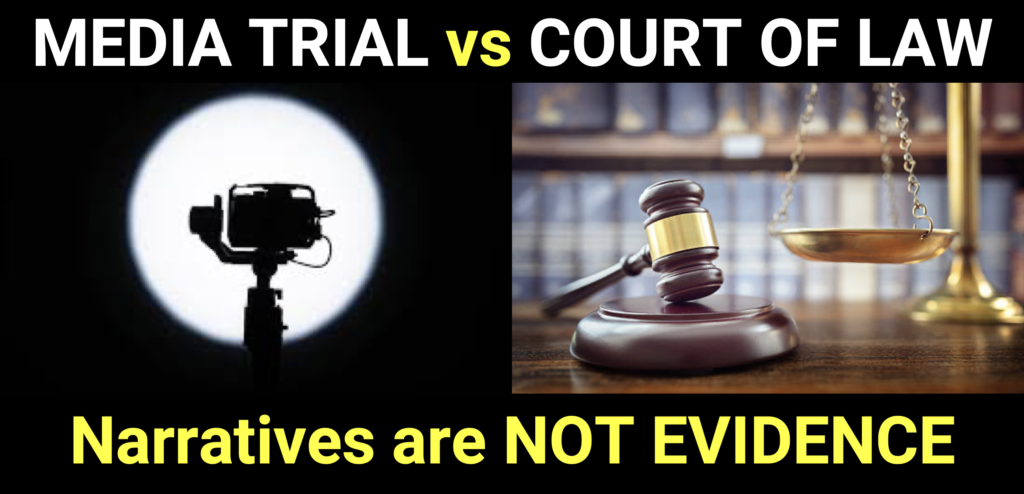
MEDIA TRIAL EFFECT AND PRE-ADJUDICATION REPUTATIONAL PUNISHMENT: THE BULATHWATTE PRECEDENT
A relevant comparative concern arises from the case of a highly decorated officer Major Prabath Bulathwatte of the Tripoli Platoon, who was publicly associated with serious allegations years after the events in question.
Although he was arrested on suspicion and his case was widely reported in media discourse, the judicial process did not ultimately establish final criminal liability.
However, the reputational consequences of early public attribution remained irreversible, demonstrating a critical legal and ethical principle:
- The presumption of innocence is a foundational principle of criminal justice.
• Individuals must not be treated as guilty prior to adjudication.
• Media narratives that imply culpability before judicial determination risk creating irreversible reputational punishment.
This illustrates a broader “media trial effect”, where public perception of guilt is formed before evidence is tested in court.
Media attribution of guilt prior to judicial determination creates irreversible reputational punishment even where legal liability is not established.
This concern is directly relevant to the Channel 4 methodology, where individuals are visually and narratively linked to serious crimes without equivalent emphasis on judicial findings or evidentiary adjudication.
ASYMMETRIC SCRUTINY OF SUBJECTS VERSUS WITNESSES
A further concern arises from the apparent inconsistency in the treatment of different categories of individuals within the documentary.
On one hand, individuals who are the subject of allegations are presented in a manner that strongly implies culpability, despite the absence of judicial findings or tested evidence.
On the other hand, certain key witnesses—despite having unresolved legal issues or open warrants—are treated as credible sources of authoritative information without comparable scrutiny.
This creates an imbalance, where:
- Alleged subjects are implicitly presumed culpable without adjudication, while
- Key witnesses are presumed reliable without equivalent verification.
Such an approach raises concerns relating to the principle of equality.
It also reflects selective evidentiary scrutiny, where credibility thresholds appear to vary depending on the narrative function of the individual within the documentary.
REPETITION OF A POLITICAL MOTIVE
Throughout the documentary, viewers are repeatedly presented with a single overarching explanation:
The attacks were allegedly intended to create instability and facilitate the return of the Rajapaksas to power.
This theory is introduced repeatedly through:
- Visual imagery.
The repetition itself is notable because the documentary devotes comparatively little attention to alternative explanations.
- Were competing theories examined with equal rigor?
- Were ideological motives examined with equal rigor?
- Were extremist motivations examined with equal rigor?
- Were international terrorist influences examined with equal rigor?
A balanced investigation ordinarily examines all plausible explanations before privileging one.
VISUAL ASSOCIATION AND NARRATIVE FRAMING
A notable feature of the documentary is the repeated appearance of Mahinda and Gotabaya Rajapaksa whenever allegations are discussed.
The names “Rajapaksa” and “Rajapaksas” are repeatedly invoked throughout the programme – in fact 57 times
What effect does repeated visual association create?
Even where direct evidence is not being presented, repeated imagery can create an implicit connection in the viewer’s mind.
The issue is not whether such imagery is permissible.
The issue is whether it contributes to objective analysis or to narrative persuasion.
THE ABSENCE OF EQUAL SCRUTINY
Throughout the documentary, allegations made by Maulana are often explored in detail.
However, less attention appears to be devoted to testing those allegations against contrary evidence.
Examples include:
The February 2018 Meeting
Was evidence presented regarding:
- Immigration records?
- Travel records?
- Mobile phone location data?
- Construction timelines for the alleged venue?
The Easter Sunday Telephone Call
Was evidence presented regarding:
- Telecom records?
- Roaming records?
- Call logs?
- Device extractions?
The Alleged Conspiracy
Was evidence presented showing:
- Financial transactions?
- Operational communications?
- Documentary instructions?
- Direct links between alleged conspirators?
These are the kinds of objective records that would ordinarily be expected in support of such serious allegations.
THE QUESTION OF ALTERNATIVE EXPLANATIONS
A recurring concern is whether alternative explanations received adequate attention.
The documentary largely focuses on a political motive.
However, the Easter Sunday attacks were also examined through other lenses, including:
- Religious extremism.
- ISIS-inspired radicalization.
- International jihadist networks.
- Domestic extremist recruitment.
- Intelligence failures.
- Institutional failures.
Questions arise:
- Were these explanations explored proportionately?
- Were they dismissed?
- If dismissed, on what evidentiary basis?
The exclusion of alternative explanations can influence how viewers interpret the evidence presented.
THE DISTINCTION BETWEEN ALLEGATION AND FACT
One of the most important principles of investigative reporting is maintaining a clear distinction between:
Allegation
What a witness claims.
Evidence
What can be independently verified.
Conclusion
What can reasonably be established.
Throughout the documentary, viewers may reasonably ask whether these distinctions are always maintained.
For example:
- Are allegations clearly identified as allegations?
- Are inferences clearly identified as inferences?
- Are viewers informed when claims remain unverified?
These distinctions are particularly important when allegations involve terrorism and state actors.
THE ISSUE OF CORROBORATION
Investigative journalism is strongest when multiple independent sources converge upon the same conclusion.
Questions arise:
- Beyond Maulana, what independent corroboration exists?
- Which allegations have been independently verified?
- Which have been confirmed by documentary evidence?
- Which have been supported by forensic evidence?
- Which have been supported by judicial findings?
The strength of any investigation ultimately depends upon the strength of its corroboration.
WHAT STANDARD SHOULD APPLY?
The allegations contained in the documentary are among the most serious possible:
- State involvement in terrorism.
- Facilitation of mass murder.
- Deliberate destabilization of a country.
- Manipulation of democratic processes.
Given the gravity of such allegations, a high evidentiary threshold would ordinarily be expected.
Was that threshold met?
Were all claims independently verified?
Were contradictory facts adequately examined?
Were competing explanations fairly evaluated?
THE CENTRAL QUESTION
At the conclusion of the documentary, viewers are left with a fundamental question:
Has the documentary established its allegations through independently verified evidence?
Or
Has it primarily presented a theory supported by witness testimony, anonymous sources, and narrative interpretation?
The answer to that question is critical because it determines how the allegations should be viewed:
- As established facts,
- As investigative leads requiring further inquiry,
- Or as unverified assertions that have yet to be tested through judicial and evidentiary scrutiny.
The Easter Sunday attacks remain one of the most tragic events in Sri Lanka’s history.
Any allegation regarding responsibility for those attacks deserves thorough investigation.
However, the seriousness of the allegations also demands rigorous standards of evidence, verification, corroboration, and fairness.
The central issue is therefore not whether questions should be asked.
Questions should always be asked.
The central issue is whether the answers presented are supported by evidence sufficient to transform allegations into established fact.
POTENTIAL DEFAMATION AND PREJUDICIAL NARRATIVE FORMATION IN HIGH-IMPACT ALLEGATIONS
Given the gravity of the allegations presented—ranging from state complicity in terrorism to orchestration of mass casualty events—it is essential to recognise the potential legal and reputational consequences of premature attribution.
Where allegations of this nature are presented without judicial findings or independently verified evidence, there is a risk of:
- Irreversible reputational harm to named individuals.
- Public perception forming guilt without legal determination.
- Narrative construction replacing evidentiary proof.
- Long-term damage to institutional credibility and individual standing.
In such contexts, the distinction between allegation and proven fact becomes not only a legal necessity but also a safeguard against unjustified reputational destruction.
Accordingly, allegations of this magnitude require a substantially higher evidentiary threshold than narrative inference or uncorroborated testimony.
The distinction between allegation and proof is fundamental.
Allegations of terrorism, conspiracy, and mass murder require evidence capable of withstanding forensic examination, cross-examination, and judicial scrutiny — not merely persuasive narrative framing.
Investigative journalism plays an important role in democratic societies. But the greater the allegation, the greater the responsibility to ensure balance, corroboration, and evidentiary rigor.
The central question therefore remains:
Has Channel 4 established its claims through independently verified evidence — or primarily through witness allegations and narrative interpretation?
Until such allegations are tested through transparent legal and evidentiary processes, they remain matters requiring investigation, not established fact.
The victims of Easter Sunday deserve truth grounded in evidence, not conclusions formed through presumption and kangaroo courts.
Shenali D Waduge