WHEN ENTIRE FAMILIES CHOOSE MARTYRDOM Understanding the Easter Sunday Attackers and Their Will to Die
The persistence of the Church’s demand for a maha molakaru or mastermind essentially takes us to a bigger question surrounding suicide terrorism. A mastermind can indoctrinate a single person but when entire families choose to commit suicide or sacrifice their lives for a cause – that objective can never be political.
The Church has actually helped us discover the answer. That answer lies not in who gave the order, who supplied the explosives, who did the training or who was behind the entire team. The answer lies in the question how entire families join to sacrifice their lives. No family willingly sacrifices its husband, wife, brother, sister, father, son — and even unborn children — simply to bring a political figure or a non-Muslim to power.
To understand Easter Sunday, Sri Lanka has to understand that psychological element.
Because if we only investigate the bombers as criminals, we miss the ideology that persuaded them that death could be a religious achievement.
The hand signal.
The pledge.
The last word uttered before death.
These were all signs of one belief.
No suicide bomber uttered the name of the mastermind.
THE WORD WE NEED TO UNDERSTAND: MARTYRDOM
In Islamic terminology, the concept of the shahid — the martyr — has a long religious history.
Islamic teaching does not simply say that a person who kills himself becomes a martyr.
The Qur’an contains a prohibition against killing oneself, and mainstream Islamic authorities explicitly reject suicide.
Egypt’s Dar al-Ifta states that suicide is prohibited in Islamic law and specifically rejects suicide operations and bombings against civilians.
If so:
HOW DID JIHADIST ORGANISATIONS REINTERPRET MARTYRDOM SO THAT A PERSON COULD SEE HIS OWN DEATH — AND THE KILLING OF OTHERS — AS A SACRED ACT?
It is a question that cannot be avoided if we want to understand Easter Sunday.
THE EXTREMIST REINTERPRETATION
Research into jihadist ideology has documented precisely this transformation.
Scholar Mohammed Hafez notes that suicide is prohibited within the Islamic heritage, but that radical Salafist jihadists developed arguments portraying suicide attacks as religiously permissible by calling them martyrdom operations.
Reid Hutchins, in his 2017 study Islam and Suicide Terrorism: Separating Fact from Fiction, examines how ISIS distorted and exploited the Islamic concepts of sacrifice, martyrdom and jihad as recruitment tools, using them to claim religious legitimacy for violence and to motivate recruits to kill and die for ISIS.
Pieter Nanninga, “Among the Believers Are Men”: How the Islamic State Uses Early-Islamic Traditions to Shape Its Martyr Biographies, Numen, Vol. 65, Issues 2–3 (2018), pp. 165–184. Nanninga examined ISIS’s Dabiq and Rumiyah magazines and found that ISIS used early Islamic traditions concerning jihad and martyrdom to portray its killed operatives as martyrs and to motivate self-sacrifice among its operatives and supporters.
What we need to understand is that this form of suicide differs from “I want to kill myself” to being taught “I am sacrificing myself for the cause” (note “the” not “a”)
Personal suicide can arise from many circumstances, including depression, loneliness or despair.
Suicide by sacrifice is taught as a means of becoming a martyr — it is presented as an honour associated with religious rewards.
WHAT HAPPENS WHEN THIS IDEA ENTERS AN ENTIRE FAMILY
An individual radicalised in isolation is one problem.
But an extremist ideology operating through a family is something altogether different and dangerous.
The United Nations has specifically warned that family influence can affect the radicalisation and recruitment of children and that family members with violent extremist beliefs can influence recruitment.
It also records cases where parents supported extremist ideology or became involved in recruitment and indoctrination.
The UN has separately warned about ISIS attempting to recruit children and shape them as future fighters and ideological guardians, with concerns that women could transmit the group’s ideology to children.
This gives us a completely different way of looking at terrorism.
We are looking at a type of terrorism that captures an entire social environment:
A friendship circle.
A marriage.
A brotherhood.
A family.
A community – online or physical
This psychological proposition differs and can never be adequately explained by a non-Islamic political motive, as some members of the Church aspire to do.
LOOK AT ISIS
ISIS understood the power of martyrdom.
Its propaganda did not merely celebrate dead fighters.
Academic research into ISIS publications such as Dabiq and Rumiyah found that the organisation used early Islamic traditions concerning jihad and martyrdom to construct biographies of its dead operatives and present them as martyrs.
ISIS did not simply tell recruits:
“Go and die.”
It constructed a narrative in which dying for the organisation could be portrayed as heroic, meaningful and religiously significant.
This psychological capture is far more powerful than telling entire families to sacrifice their lives to bring a non-Muslim to power.
The Church may argue that religion was only used to conceal the real political motive.
But that argument is difficult to reconcile with the evidence.
The preparations were already underway before Christchurch.
The discovery of explosives at Wanathawilluwa in January 2019 was followed by an acceleration of the attack plans.
Christchurch came later and may have influenced the timing or target.
If the real objective was political, that political objective would have had to drive the entire operation — including the decision to die, the choice of targets, the timing and the participation of entire families.
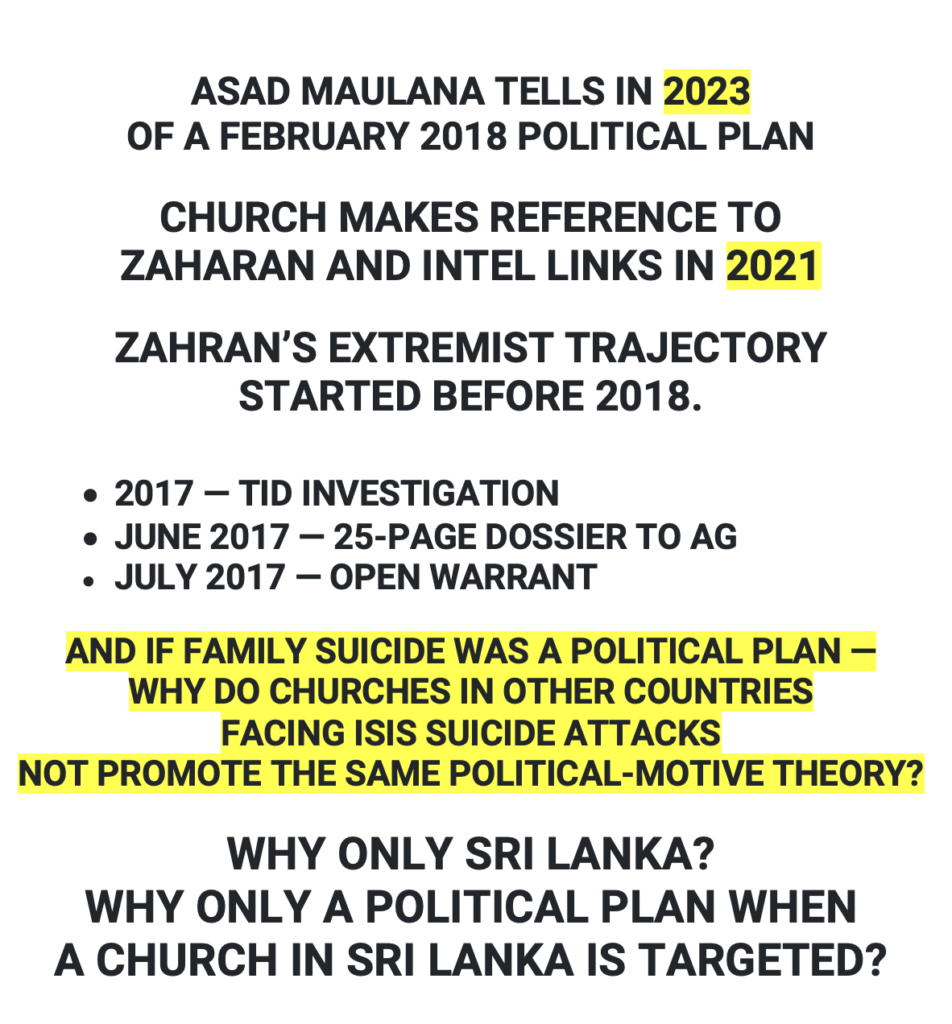
Asad Maulana has alleged that the political plan involving Zahran emerged after a February 2018 meeting with Suresh Sallay, at the request of Pillayan.
However, the chronology raises a fundamental question.
WHAT WAS ZAHRAN DOING BEFORE FEBRUARY 2018?
Zahran was already under investigation in 2017. In June 2017, the TID sent a 25-page dossier on his extremist activities to the Attorney-General’s Department seeking legal action.
So if the February 2018 meeting created the political motive, how does that explain:
- Zahran’s extremist activities already being investigated in 2017?
- The files already before the AG’s Department?
- His subsequent surveillance and open warrant obtained in July 2018?
IF THE FEBRUARY 2018 MEETING CREATED THE POLITICAL MOTIVE AS IS BEING PROMOTED BY THE CHURCH, HOW DOES IT EXPLAIN THE EXTREMIST NETWORK THAT ALREADY EXISTED BEFORE THAT MEETING?
And more importantly:
DID THE POLITICAL MOTIVE CREATE ZAHRAN’S EXTREMISM — OR WAS IT AN ALLEGED ELEMENT ADDED TO AN ALREADY EXISTING EXTREMIST PROJECT?
That is where the Church’s political-motive argument makes no sense.
It does not explain the religiously framed willingness to die.
The question is not only who benefited politically.
The question is what made entire families willing to die?
Let the Church not forget that ISIS suicide attacks take place across the world — not just in Sri Lanka.
If the Church’s argument is applied, then every ISIS suicide attack across the world would have to be an act to bring a non-Muslim leader to power.
Why is this argument being advanced only by Sri Lanka’s Catholic Church?
Why are the Churches in other countries where ISIS suicide attacks take place now making this same argument?
Equally important is for the Church to answer if a political motive is applied only when a Church is targeted?
Presuming a political motive & influencing voters was a prime target.
Did the attacks change Catholic vote base?
Gotabaya lost the Catholic bases in Wattala and even Negombo where the Katuwapitiya Church was attacked.
AND ISIS DID NOT OPERATE ONLY THROUGH MEN
The global ISIS experience also demonstrates why the family question matters.
Women and children were not merely spectators. They transmitted ISIS ideology to their children.
This does not mean every woman or child associated with ISIS was an ideological supporter.
Some were victims.
Some were coerced.
Some were abducted.
Some were born into the system.
Some voluntarily joined.
That distinction is vital.
But it demonstrates something important:
EXTREMIST IDEOLOGY CAN BECOME A FAMILY ENVIRONMENT.
THE SHOCKING QUESTION: WHY WOULD A PARENT ACCEPT THIS?
Think about the normal human instinct.
A parent wants to protect a child.
A husband wants his wife to live.
A wife wants her husband to come home.
A brother wants his brother to survive.
A family normally pulls people toward life.
So when a family moves in the opposite direction — towards death — something extraordinary has happened to the meaning they attach to life and death.
That is why the family connection is so important.
The question is not simply:
“Were they radicalised?”
It is:
“WHAT DID THEY COME TO BELIEVE ABOUT DEATH?”
The 2 Ibrahim brothers – his wife – their 2 children & an unborn child all sacrificed their lives.
Zaharan – his father – his mother – his brothers & some other family members all sacrificed their lives.
Even among the 24 accused – they were many family members.
THIS HAS HAPPENED BEYOND SRI LANKA
The phenomenon is not unique to Easter Sunday or Sri Lanka.
Across conflicts involving jihadist organisations, investigators have encountered families in which extremist ideology shaped several members of the household.
We can recall the then Justice Minister in 2015 claiming 32 members from 4 Muslim families travelled to Syria to join ISIS. Grandparents were also included.
ISIS deliberately sought to create ideological continuity across generations.
Its ideology sought not merely fighters but an enduring community that would reproduce its ideology worldview.
This is why Sri Lanka must look beyond the individual bomber.
The Church must realize the greater danger unfolding by neglecting the ideology to persist in following a political motive objective.
THE GLOBAL LESSON IS NOT THAT “MUSLIMS WANT TO DIE”
That would be both inaccurate and intellectually incorrect.
The overwhelming majority of Muslims do not become suicide attackers.
Islamic authorities explicitly reject suicide terrorism.
Muslim communities themselves have produced strong counter-narratives against jihadist interpretations.
Research examining Muslim responses to ISIS notes that Muslim interviewees explicitly rejected the idea that suicide bombing constitutes martyrdom and instead described it as religiously prohibited.
WHAT MAKES THE EXTREMIST INTERPRETATION DIFFERENT?
What happens when a movement tells someone:
You are not merely a Muslim.
You are part of a struggle.
You are part of a chosen community.
Your enemies are enemies of Islam.
Your death will have meaning.
Your sacrifice will make you a martyr.
Your family will honour you.
Your death will inspire others.
And your place in history will be secured.
That is a powerful recruitment narrative.
NOW COME BACK TO ZAHRAN
This is where the global picture meets Sri Lanka.
Zahran Hashim did not emerge in isolation.
The Parliamentary Select Committee documented his movement towards violent extremism and ISIS ideology and identified him as the main suspect behind the coordinated Easter attacks.
The Easter attackers themselves were part of a network in which ideological radicalisation, recruitment and ISIS allegiance became central.
WHAT DID ZAHRAN TEACH HIS FOLLOWERS ABOUT DEATH?
HOW DID THAT BELIEF ENTER THEIR FAMILIES?
LOOK AT THE FAMILIES INVOLVED IN EASTER
This is where the Easter story becomes particularly disturbing.
The PCoI documented the involvement of members of the Ibrahim family and recorded extremist material recovered from the family’s home.
Ilham Ibrahim became one of the Shangri-La suicide bombers.
Inshaf Ibrahim was one of the Cinnamon Grand suicide bombers.
His wife Fathima committed suicide in their home in Dematagoda along with her 2 children & unborn child.
This was not simply an individual walking into a hotel.
There were family relationships surrounding the extremist network.
And that should have prompted a deeper investigation into familial radicalisation.
What did the family environment expose him to?
What did he read?
What did he hear?
What did he believe?
Who reinforced those beliefs?
How was martyrdom explained to him?
What did he believe would happen after his death?
Both brothers transferred their assets to their other brother before their suicides.
And most importantly:
WHY DID DEATH CEASE TO BE THE THING A HUMAN BEING FEARS MOST?
THAT IS THE REAL PSYCHOLOGICAL REVOLUTION
The most dangerous thing an extremist movement can accomplish is not teaching someone how to make a bomb.
It is teaching someone to stop fearing death.
Once that happens, an ordinary security calculation changes.
A prison sentence no longer matters.
Fear of death no longer matters.
The smiles on those accused before & after sentencing on 22nd September showed that eerie reality.
The normal instinct for survival has been replaced by an ideological promise.
And if several members of a family accept that promise together, the network becomes extraordinarily difficult to penetrate.
WHY FAMILY INVOLVEMENT MATTERS
Imagine trying to radicalise one person.
You need access.
You need trust.
You need persuasion.
You need secrecy.
Now imagine that the recruit goes home to a family that reinforces the same worldview.
The ideology does not have to be defended.
It is normalised.
A brother reinforces the brother.
A husband reinforces the wife.
A wife reinforces the husband.
Parents influence children.
Friends become brothers.
Religious language gives the worldview legitimacy.
And martyrdom gives death meaning.
THAT IS HOW AN IDEOLOGY CAN BECOME A FAMILY CULTURE.
Not every family associated with terrorism functions this way.
Not every relative is a willing participant.
But where multiple relatives become active participants, the family dimension demands investigation.
WHY “MASTERmind” THEORY IS TOO SIMPLE
A mastermind theory asks:
Who commanded them?
But the family question looks inward.
It asks:
What did they believe?
Even if someone says another person ordered the attack, they would still need to explain why the bomber accepted the order.
Why did he agree?
Why did his wife agree?
Why did his brother agree?
Why did his parents agree?
Why did people with families voluntarily move towards an operation that meant certain death?
ONLY AN IDEOLOGY EXPLAINS WHY THE ORDER COULD BE ACCEPTED.
WHAT DOES “MARTYR” MEAN TO THE EXTREMIST?
Sri Lanka seriously needs to start debating this immediately.
To the ordinary person:
death is the end of life.
To the extremist:
death may be the beginning of eternal reward.
That is the ideological transformation.
When a movement succeeds in convincing a person that death in its cause is not defeat but victory, then death itself becomes a recruitment tool.
The terrorist organisation no longer has to promise its follower a future on earth.
It can promise something beyond this life.
That is why martyrdom can be such a powerful concept in extremist propaganda.
Research into ISIS’s martyr biographies shows precisely how the organisation used religious narratives to transform dead operatives into examples for others.
THE QUESTION SRI LANKA SHOULD HAVE ASKED IN 2019
After Easter Sunday, Sri Lanka understandably asked:
Why did the intelligence warnings fail?
They did not ask:
WHY WERE PEOPLE WILLING TO DIE?
After discovering family connections:
WHY WERE ENTIRE FAMILY NETWORKS CAPABLE OF MOVING TOWARDS THE SAME DEATH?
That question could have led investigators into:
- books
- sermons
- teachers
- preachers
- religious study circles
- online propaganda
- foreign connections
- ISIS material
- recruitment
- indoctrination
- martyrdom narratives
- family influence
- children
- money
- travel
- training
- communications
That is an enormous investigative trail.
THE CHURCH’S DEMAND FOR TRUTH MUST INCLUDE THIS
WHAT DID ZAHRAN BELIEVE?
WHAT DID HIS FOLLOWERS BELIEVE?
WHAT DID THEIR FAMILIES BELIEVE?
WHAT DID THEY THINK WOULD HAPPEN AFTER THEY DIED?
WHO TAUGHT THEM THAT?
WHO NORMALISED IT?
WHO CALLED IT MARTYRDOM?
Because without answering those questions, we may not understand why they were willing to become bombers in the first place.
Let us remember that ISIS declared its Caliphate in Asia in 2014.
Many wonder why Zahran himself committed suicide when he was the leader of the NTJ.
But what if the very thing that made him willing to die was the belief that death would make him a martyr?
What if he did not see his death as the end of his leadership — but as the ultimate act of his religious mission?
What if becoming a martyr was not a consequence of the mission, but the mission’s ultimate reward?
This is the core question we must confront if we are to understand why Zahran was willing to die.
THIS IS NOT AN ATTACK ON MUSLIMS
It is precisely because this issue is so serious that the distinction must be made.
Islamic authorities reject suicide.
Muslim communities have rejected ISIS’s interpretation.
Academic research itself distinguishes Islamic teachings from jihadist reinterpretation.
HOW DID JIHADIST IDEOLOGUES TAKE THE CONCEPT OF MARTYRDOM AND TURN IT INTO A TOOL FOR RECRUITING PEOPLE TO KILL AND DIE?
HOW DID THAT IDEOLOGY BECOME POWERFUL ENOUGH TO DRAW ENTIRE FAMILIES INTO THE SAME PROJECT?
The case of a convert Sara Jasmin wife of the Katuwapitiya bomber also becoming a suicide bomber shows a danger from a different angle.
That is a question Muslims, Christians, Buddhists, Hindus and everyone else should ask and get answers.
It is a question about how human beings can be persuaded to surrender the most basic instinct of all:
THE INSTINCT TO LIVE.
EASTER SUNDAY CANNOT BE UNDERSTOOD WITHOUT ASKING THIS
Eight suicide bombers did not simply wake up on 21 April 2019 and decide that morning to die.
There was a process.
There was ideology.
There was recruitment.
There was preparation.
There was a network.
There were relationships.
There were families.
And there was a belief powerful enough to overcome the instinct for survival.
THAT BELIEF MUST BE UNDERSTOOD.
Not caricatured.
Not hidden.
Not generalized to an entire religion.
Not exploited politically.
Understood.
Because if Sri Lanka does not understand what made these people willing to die, then how can Sri Lanka prevent the next person from being persuaded to do the same?
THE QUESTION IS NOT ONLY
WHO SENT THEM
THE QUESTION IS WHO MADE
THEM READY TO DIE
When brothers, spouses and other family members become part of the same extremist network, there is one question that becomes impossible to avoid:
HOW DID MARTYRDOM BECOME MORE POWERFUL THAN FAMILY, LIFE AND THE FEAR OF DEATH?
UNTIL WE UNDERSTAND THAT, WE HAVE NOT UNDERSTOOD EASTER.
And this is where the Catholic Church must look beyond the search for a political mastermind while we question why the Church is obsessed with a political mastermind motive.
Knowingly or unknowingly, by reducing the Easter question to a political motive, we are failing to confront the more dangerous question — how an extremist ideology can enter families, normalise death and make entire families willing to die?
To prevent a future attack we must understand this mechanism.
We should not wait for another attack — occurring long before an election — to prove the Church’s political-motive theory wrong.
Concentrating only on a political motive would mean we had neglected the far more dangerous question: how an extremist ideology can enter homes, families and create a willingness to die together.
We must understand and address the familial suicide ideology before it produces another Easter.
Shenali D Waduge