Can Section 127 Statements be Manipulated by Law Enforcement?
Section 127 of Sri Lanka’s Code of Criminal Procedure allows a Magistrate to record statements or confessions in criminal cases — not just from the accused, but also from anyone claiming to have information about a crime. The law aims to capture voluntary statements in a judicial setting. The Magistrate’s role is only to ensure that the statement is given freely, without threats or inducements. This means the Magistrate only sees the final statement — not the discussions, questioning, or pressure that may have shaped the statement. A statement may appear voluntary, yet its content could have been influenced long before it reached court. Importantly, the law does not require verification at the point of recording, so a statement can enter the legal process even if its truth has not been established.
What Section 127 Actually Requires
127(1): A Magistrate may record any statement or confession made during a criminal investigation.
- Once recorded, it is part of the case filein the Magistrate’s court.
127(3): The Magistrate ensures that the statement is:
- Made voluntarily
- Understood by the person giving it
- Recorded accurately
The law does not require the Magistrate to verify the truth of the statement or how the information was obtained.
The Magistrate’s duty is limited to recording and certifying voluntariness — not checking accuracy.
Defense access
- The defense usually does not attend when the statement is recorded.
- They may not even know immediately that a statement has been filed against their client, especially if it is from a new witness or a late introduction.
- In practice, defense lawyers often learn about it only when the prosecution uses the statement — for example:
- To justify an arrest
- In a bail hearing
- Or when the case is formally presented in court
A statement can influence custody or public perception before the defense even knows it exists.
The Difference:
- A confession by an accused, which is carefully tested for coercion, and
- A statement by another person, which usually escapes scrutiny.
Statements by others can:
- Point fingers
- Influence arrests
- Shape investigations
All before their truth is tested in court.
How Statements Can Be Influenced
A statement (by either an accused or other) may reflect not just what a person knows, but also:
- How they were questioned
- Fear of being implicated
- Expectation of protection or benefit
- Personal motives, bias, or pressure
Even if these influences exist, the final statement may appear confident and voluntary before the Magistrate.
Timing Matters
When new statements appear years after an incident, especially after multiple investigations or public proceedings, it raises legitimate questions:
- Why was the information not presented earlier?
- Why have these late statements suddenly influenced arrests or custody?
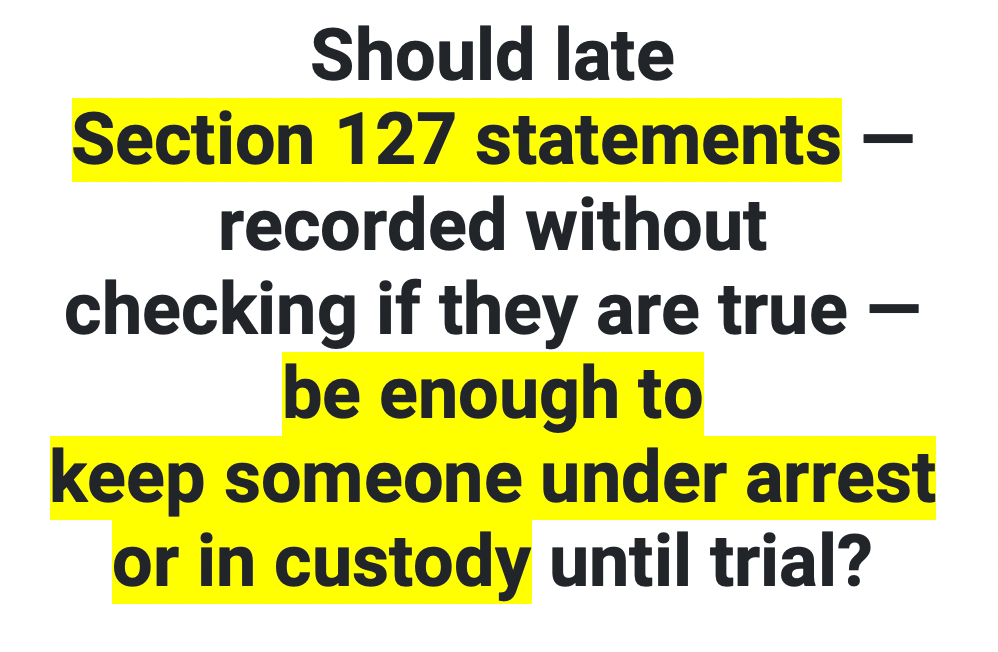
Such timing increases the risk of injustice, particularly when a statement recorded under Section 127 is used to justify arrest or continued detention before its truth is tested in court.
By allowing late statements under Section 127 to be recorded as ‘voluntary’ without verifying truth, law enforcements are able to make arrests or continue custody until the courts examine their validity.
The Gap in Practice
A statement can be legally recorded as “voluntary” without verification.
Its truth is usually examined much later in court.
By that time, the affected person may already be:
- Arrested
- Kept in custody
- Publicly linked to a crime
- Positioned as a suspect
Courts can reject unreliable statements, but often only after the statement has already influenced public perception and investigations.
This shows a structural gap: procedural safeguards exist on paper, but their effect may come too late.
Why Reform Is Needed
Section 127 statements are not just records.
They can shape investigations, influence custody, and affect a person’s future — even before the full truth comes out.
The risks are magnified under detention powers such as those authorized by the PTA.
Stronger oversight is needed from the Attorney General’s Department and the Ministry of Justice to:
- Monitor how Section 127 statements are recorded
- Ensure early verification of statements’ credibility
- Require law enforcement to corroborate information before acting
- Introduce reforms to prevent misuse or selective influence
Without these safeguards, Section 127 can become a loophole: a tool that enables arrest or continued custody based on statements whose truth has not been independently verified, leaving the law vulnerable to manipulation while its intent to support justice is compromised.
Shenali D. Waduge