From Violence against Women to Gender-Based Violence: How Non-Binding Policies quietly added LGBTQIA categories to GBV
- Original purpose
The below represents the legal-treaty core of GBV Violence Against Women framework applicable to women & girls & not inclusive of sexual-orientation or gender-identity.
These treaties were negotiated by States and adopted through formal diplomatic processes. Therefore, only the definitions found in such treaties have legal force. No UN agency, NGO or Ministry can expand these definitions without explicit parliamentary approval.
Thus historically & legally, international treaties meant to combat “gender-based violence against women and girls” and did not cover LGBTQIA or gender identity based categories.
- The Declaration on the Elimination of Violence Against Women (DEVAW) was adopted by the United Nations General Assembly on 20 December 1993. That declaration defines “violence against women” as “any act of gender-based violence … likely to result in physical, sexual or psychological harm … to women.” – GBV applied only to the biological female.
https://en.wikipedia.org/wiki/Declaration_on_the_Elimination_of_Violence_Against_Women
Notably, DEVAW contains no reference to gender identity, sexual orientation, transgender categories, or “gender-diverse” groups. Its definition is focused exclusively on violence against women as a sex-based category.
- The Istanbul Convention (formally, the Council of Europe Convention on Preventing and Combating Violence Against Women and Domestic Violence) was opened for signature on 11 May 2011 and came into force on 1 August 2014. Its text defines “gender-based violence against women” as violence “directed against a woman because she is a woman or that affects women disproportionately.”
- The Istanbul Convention also makes no mention of LGBTQIA, SOGI or SOGIESC categories. Its scope is strictly limited to women and girls, defined in biological terms, and domestic violence within families.
Treaties like DEVAW (1993) and the Istanbul Convention (2011) remain legally binding.
This means that, in international law, “gender-based violence” remains a sex-specific protection category for women and girls — not a gender-identity-based category.
Under these Treaties the definition of GBV/VAW remains focused on women and girls facing violence.
- Shift in definitions by some international agencies from 2000 onwards
Language changed from “violence against women” to “gender-based violence” including gender identity & sexual orientations. This is documented in UNHCR, UN Women guidance & Council of Europe materials.
This change did not occur through treaty amendment or new law. It occurred through agency-issued guidelines, donor policy frameworks, training manuals and internal terminology updates — all of which are administrative tools, not law.
Because these updated definitions were not negotiated or voted on by States, they were introduced quietly — through reporting templates, funding requirements, programme language, and NGO conditionalities.
This essentially diluted the attention given to the biological women by including and allowing men identifying as women to fall under the same category as women.
These definitions are presented as “gender-neutral” or humanitarian, making it appear that GBV applies equally to everyone, while the original focus on women is downplayed.
However, the public is rarely informed that these changes stem from non-binding agency guidance, not from a democratic or legislative process.
This was an affront to the 4billion women of the world.
These new broader definitions at agency-level (UNHCR, IASC, Council of Europe) are not legally binding. Their programs, policies, training do not replace treaty definitions UNLESS LOCAL LAWS allow it. This is why there is a feverish attempt to implement non-binding new definitions via the Education Ministry.
The push to embed these definitions into school curricula is significant because education reforms are one of the fastest ways to standardise a non-binding concept into perceived national “policy.”
- How local programmes can reflect that shift
- International funding and technical support often flow to local NGOs and government programmes that adopt the broader definitions while not keeping solely to Treaty agreements. These programmes may include: school workshops, teacher training, community outreach and “child-protection” materials.
- Where these materials or trainings are introduced without wide public consultation, the public can reasonably feel surprised or excluded from policy decisions affecting families and schools.
- Violence against LGBTQIA or anyone who “defies gender norms” is now GBV. This represents a complete conceptual shift: GBV is no longer limited to protecting women from violence, but re-framed as a tool to advance gender-identity policy agendas at community level.
- “Child protection” or “gender equality” is used as a cover narrative & is not about protecting the biological child but transgender children (a new breed that is being created via ITGSE Comprehensive Sexuality Education) which Sri Lanka’s Education Minister is trying desperately to roll out.
- This quietly shifts the narrative from protecting women and girls to promoting a broader social agenda without public debate or public awareness. The real objective is hidden behind carefully crafted words & terms that the public are unaware of.
- What is changing in practice
- In some cases, materials and training now explicitly recognise and respond to violence experienced by sexual- and gender-minority persons alongside women’s protection work.
- This can broaden the scope of GBV work, and — if not managed transparently — it can reduce public clarity about the original priority of protecting women and girls.
- Where resources are limited, expanding GBV categories may reduce available funding and attention for women’s shelters, counselling, legal services, and protection units.
WHY THE PUBLIC SHOULD PAY ATTENTION
Sri Lanka has never passed a law redefining GBV to include gender identity or sexual orientation. Therefore, any expansion introduced through agency programmes is outside the scope of national law unless Parliament explicitly approves such changes.
- Transparency:Parents and communities are not always given clear, plain-language explanations of what new GBV programmes cover.
- Scope creep:When definitions change, programmes, curricula and official trainings can expand into areas the public did not expect.
- Resource priority:There is a legitimate public interest in ensuring that services and funding intended to protect women and girls remain available and effective.
- Education impacts:Changes tied to education reforms or new materials in schools should be publicly explained and debated before rollout.
- Parents and communities are rarely consulted about these new definitions.
- The Education Minister is doing district tours to justify as having “briefed” and consulted parents & communities on paper. None of these briefings will tell parents that GBV is mostly now covering not the biological women & girls but the LGBTQIA and mostly TQIA communities.
- Programs funded by international agencies are subtly influencing 13 Sri Lankan Ministries including Sri Lanka Police as well as school curricula, community training, and youth programs, presenting the expanded GBV framework as standard. Due to these being “official” programs – public servants have to comply & listen.
- The original focus — protection of women and girls — is being replaced by a wider agenda that includes LGBTQIA categories, sometimes framed as “norm enforcement” rather than protection.
KEY QUESTIONS FOR CITIZENS TO ASK
- Are GBV programmes in our schools and communities still prioritising services and protection for ONLY women and girls? Or are they now including men who identify as women while influencing perfectly normal children to also identify as transgender (opposite sex)
- Which government departments and agencies approved the new materials, and where is the public record of those approvals?
- Were parents and communities consulted in clear, documented ways before the introduction of new curricula or trainings?
- How are international funds allocated locally — what portion supports women’s protection services vs. broader GBV programming?
- Will essential women’s services (shelters, legal aid, counselling) retain funding and priority?
- Is the 16-day promotion of GBV-launched by the Govt and spoken highly by Govt ministers about social-re-engineering and influencing the mind of 5 year olds to 18 years towards LGBTQIA via the new education reforms camouflaged and presented through campaigns & by individuals tapped to get the public to agree to the new reforms hiding its true agenda & intentions.
- Should public funds and local programs promote a broader agenda without open discussion?
- Why are non-binding foreign policy concepts being embedded into schools, ministries and police training when Sri Lanka has not legally adopted these definitions?
- Sources / Evidence (Verifiable)
- UNHCR: https://www.unhcr.org/what-we-do/protect-human-rights/protection/gender-based-violence
- UN Women (SOGIESC report, 2025):
- https://knowledge.unwomen.org/sites/default/files/2025-06/data-collection-and-evidence-on-violence-based-on-sogiesc-en.pdf
- Council of Europe: https://www.coe.int/en/web/gender-matters/what-is-gender-based-violence
- “someone may be born with female sexual characteristics but identify as male, or as male and female at the same time, or sometimes as neither male nor ”
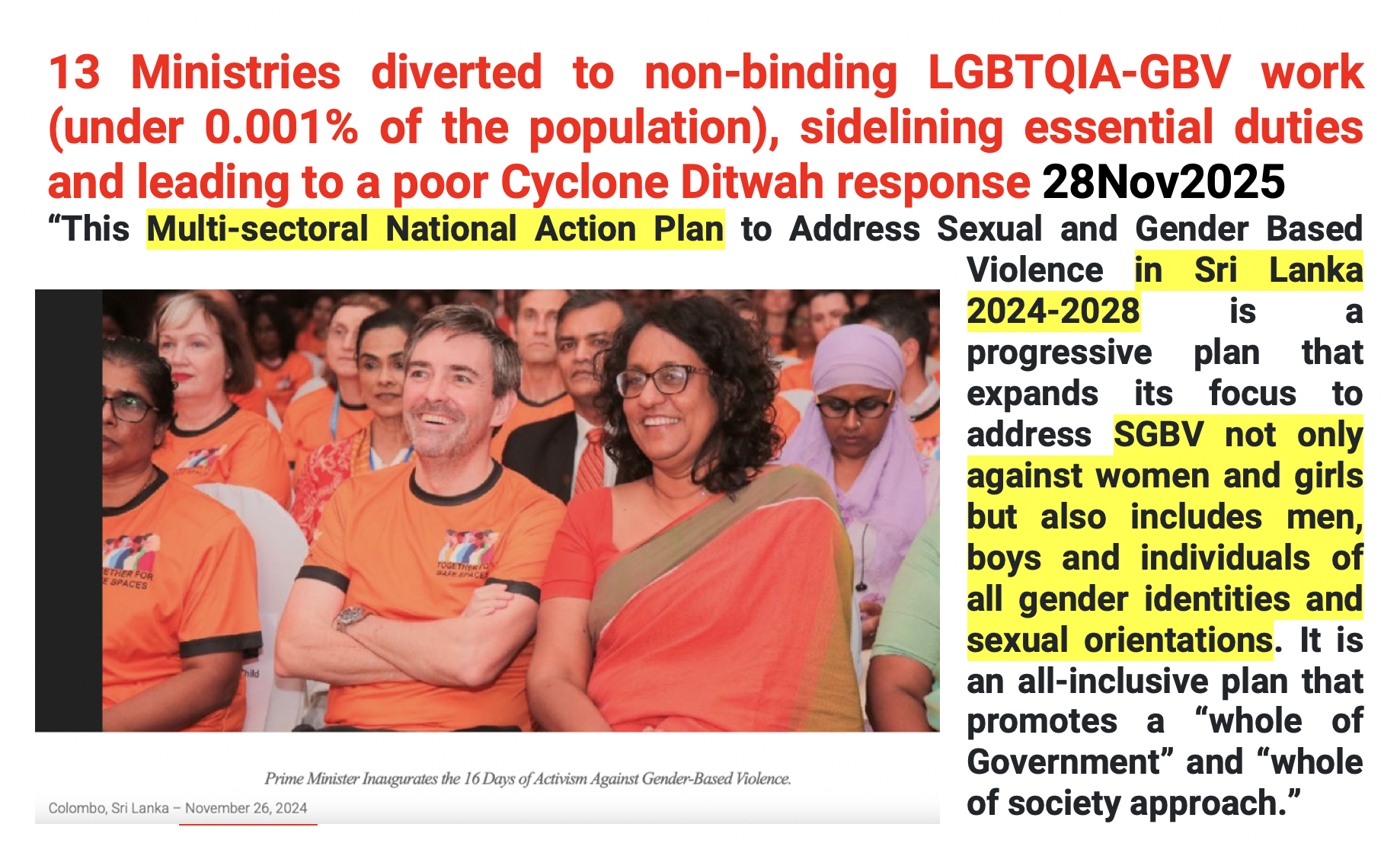
- 13 Ministries to undergo GBV-LGBTQIA-focused training – Multi-Sectoral National Action Plan to Address Sexual and Gender-based Violence (SGBV) in Sri Lanka – II – 2024-2028
https://www.childwomenmin.gov.lk/uploads/common/sgbv-nap-2024-2028.pdf?
‘This Multi-sectoral National Action Plan to Address Sexual and Gender Based Violence in Sri Lanka 2024-2028 is a progressive plan that expands its focus to address SGBV not only against women and girls but also includes men, boys and individuals of all gender identities and sexual orientations. It is an all-inclusive plan that promotes a “whole of Government” and “whole of society approach.” (ACKNOWLEDGEMENTS- PAGE 3) – this exposes the plan & the program.
https://www.undp.org/srilanka/press-releases/government-launches-multi-sectoral-national-action-plan-address-sgbv-sri-lanka-ii-2024-2028 (Multi-Sectoral National Action Plan)
http://www.adaderana.lk/news.php?nid=95598&
(the plan from 2023)
https://reliefweb.int/report/sri-lanka/policy-framework-and-national-plan-action-address-sexual-and-gender-based-violence (Policy framework & national plan on SGV)
By inserting LGBTQIA categories into GBV frameworks, policymakers are creating the foundation for these groups to later claim “fundamental human rights” protections through the back door. This bypasses national debate and directly conflicts with Sri Lanka’s Constitution, the country’s cultural and religious foundations, and the existing Penal Code, which has not been amended or repealed. The result is a manufactured legal pathway for rights-claims that have never been democratically approved.
The shift from Violence Against Women (VAW) to the expanded and non-binding concept of Gender-Based Violence (GBV) with intent to include LGBTQIA community has not only altered definitions quietly but has also redirected the priorities of State institutions.
In Sri Lanka, 13 ministries—including those responsible for national security, disaster management, social services, child protection, and grassroots administration—have been drawn into GBV/LGBTQIA-focused training agendas promoted by international agencies and their local partners.
This diversion has resulted in real consequences.
At a time when ministries should have been fully engaged in core statutory duties, including risk assessment, disaster preparedness, infrastructure audits, and public-safety responses, their institutional attention was absorbed by programs that do not arise from any binding treaty obligation.
The poor level of preparedness exposed by Cyclone Ditwah—despite both global and local warnings—highlights the cost of such misalignment.
The announcement that ADB was supporting the new educational reforms within hours following the cyclonic disaster echoed the announcement of the MCC immediately after the 2019 Easter Sunday Islamic terror attacks.
Critical ministries that should have anticipated vulnerabilities and coordinated mitigation measures were instead channelled into policy agendas that fall outside their primary mandate.
This underscores a fundamental problem:
Non-binding GBV expansions—especially those introducing LGBTQIA categories—have influenced national policy direction without legal basis, parliamentary approval, or public consultation.
In contrast, binding international law—including the Convention on the Elimination of All Forms of Discrimination Against Women (CEDAW)—remains rooted in its original purpose: protecting women and girls from the disproportionate violence and discrimination they face. However, even CEDAW has gradually digressed from its own treaty text through committee-level interpretations, General Recommendations, and concluding observations that go far beyond what States actually ratified. These committee interpretations are advisory, not binding—but they have been used to influence national policy in ways never agreed to in the original treaty negotiations.
As the nation reflects on recent failures in disaster response, it becomes clear that Sri Lanka must distinguish between:
- Legally binding obligations that protect citizens, and
- External policy insertions that dilute ministerial focus and national priorities.
For the public, the lesson is simple but critical:
For the public, the lesson is simple but critical:
national governance cannot afford to be diverted by unratified, non-binding external agendas. Ministries exist to protect citizens, ensure disaster readiness, strengthen public services, and respond to real community needs—not to prioritise frameworks never agreed to by Parliament or the Sri Lankan people.
Equally important, no educational reform should use GBV, SOGIESC language, or LGBTQIA terminology as a gateway to introduce Comprehensive Sexuality Education under the claim of “child welfare.”
Children’s education must be guided by parental trust, national values, and in keeping with Sri Lanka’s constitution/penal code, culture & religion, not external pressure or redefined concepts that have never been openly debated or democratically approved.
Shenali D Waduge