Why doesn’t Sri Lanka’s Media ask Former Attorney General Dappula — Where Is the ‘Grand Conspiracy’ Evidence
On 21 April 2019, eight suicide bombers unleashed coordinated attacks that killed nearly 300 people and shattered a nation that had experienced a decade of peace since the defeat of LTTE in May 2009. The scale of the tragedy was compounded by a disturbing reality: multiple intelligence warnings had been received weeks in advance. Sri Lanka’s own intelligence units had forwarded information on Zahran Hashim to the Attorney General’s Department as early as 2017, while an arrest warrant had also been issued that same year.
The testimonies before numerous inquiries and commissions exposed a pattern of institutional lapses and blame-shifting. However, the turning point came in May 2021, before leaving office when former Attorney General Dappula de Livera publicly declared the existence of a “grand conspiracy” behind the attacks. For 5 years years this grand conspiracy claim has gone unchecked.
Attorney General appointment
- 11 February 2016 to 29 April 2019 – Jayantha Jayasuriya (during attacks)
- 29 April 2019 to 25 May 2021 – Dappula de Livera
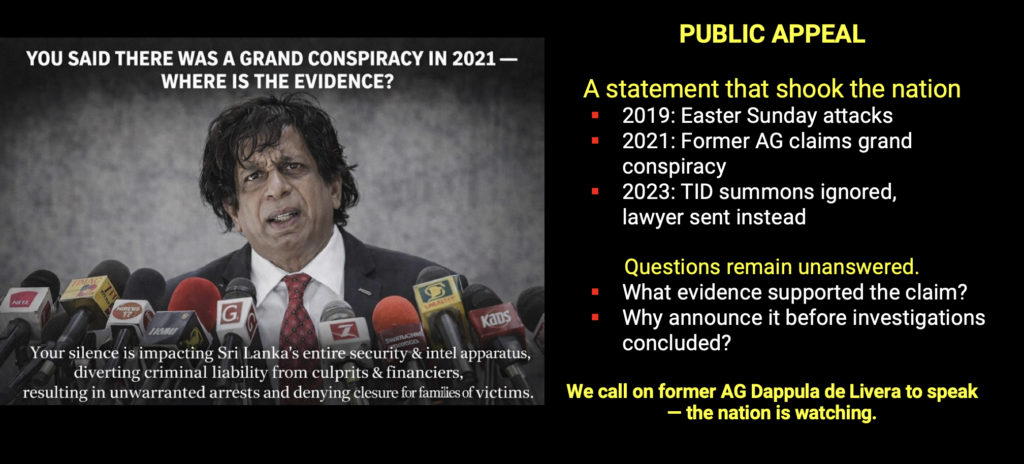
This was not a casual remark — it was a statement carrying the full weight of the country’s highest legal office.
This is the most critical point: legal processes are being used to keep evidence out of public view while arrests are made based on an untested theory.
His claim was made to a private media channel just before he left office. If it could be said publicly, why is the evidence not being made public? Instead, legal processes are being used in a manner that keeps the evidence out of public view. For a matter of this gravity, that is unacceptable especially when people are being arrested based on/manipulating this conspiracy theory.
When the country’s chief legal officer — a man entrusted with the highest standards of evidence, accountability, and prosecutorial integrity — makes such a claim, the nation is compelled to take it seriously.
When called upon to substantiate this claim, he did not publicly present evidence.
Instead, he sought court protection to avoid questioning, leaving the claim untested in public
https://www.youtube.com/watch?v=lS7JIlY5frM
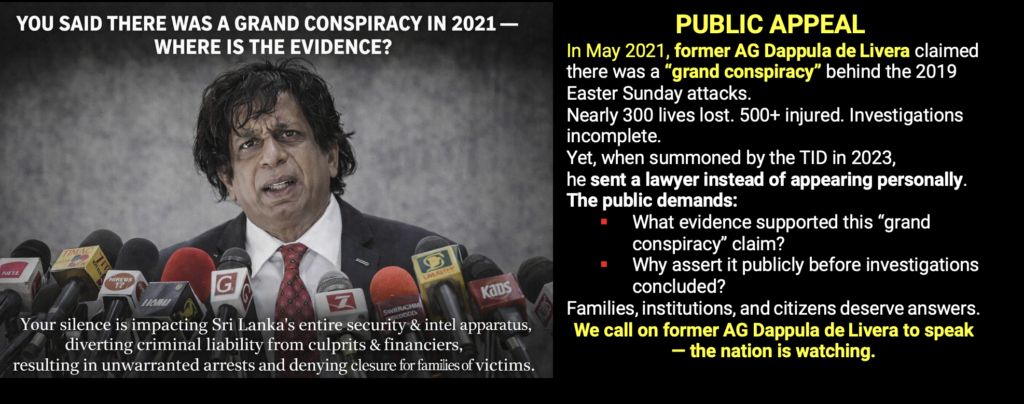
Yet, it is now nearly seven years since the attacks — and the question remains: where is the evidence of this “grand conspiracy”?
A “grand conspiracy” of this nature would necessarily imply:
- Network: A major network beyond the suicide bombers
- Structure & support system: Financiers, facilitators, and handlers – a large group
- Coordination beyond local extremist cells
- Communication systems: A sophisticated communication structure
Following the attacks, we have had a Presidential Commission of Inquiry, numerous committees as well as international investigations by the world’s best intelligence agencies.
None of these findings have conclusively established the existence of a “grand conspiracy.” What has emerged instead is that the objective of Zahran Hashim and his network aligned with the broader global extremist radical ideology of ISIS, including the ambition of extending a so-called caliphate.
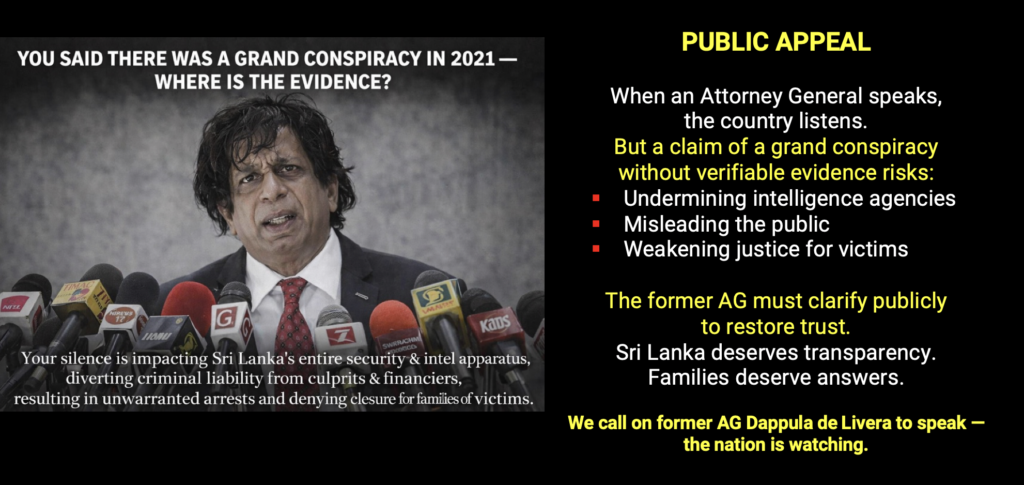
Sri Lanka’s media is fully aware of the former Attorney General’s statement.
In fact, it was widely publicized at the time, generating headlines and public speculation.
However, the same media has shown little sustained interest in interrogating the claim itself.
Why amplify a claim without verifying it?
There has been no consistent effort to:
- Demand evidence from its originator
- Examine the basis of the assertion
- Or pursue accountability with the same intensity used to amplify it
If, as suggested in testimony, thousands may have had prior knowledge of the attacks, the logical responsibility of the media would be to investigate the full scope of that possibility — not limit inquiry to selective narratives.
Yet, this line of inquiry remains largely unexplored.
The starting point should have been to question the former Attorney General on what basis such a public claim was made.
Anyone in a responsible role making such a public claim must substantiate with evidence.
When an unverified claim of this magnitude continues to circulate, it does not remain without consequence. It begins to shape public perception, influence investigative direction, and create an environment where suspicion can expand beyond evidence. In such a climate, actions risk being driven not purely by established facts, but by the need to sustain a narrative.
The Church that accepted the claim has had to continue it while people are continuously pressurizing the Church to produce evidence as well. This is bringing the Church itself into an embarrassing situation with people of the faith finding fault with the Church for not allowing the dead to rest in peace.
A statement of this magnitude, left unsubstantiated, has serious consequences:
-
Diversion of Investigations
Attention has shifted away from proven perpetrators and networks, toward speculative theories. This is an injustice to the victims while it endangers arrest of potential other suicide bombers.
-
Institutional Damage
Sri Lanka’s security and intelligence apparatus risks being undermined by public doubt and conflicting narratives – this has demoralized the intel apparatus, an aspect many destabilizing factors are jubilant about.
-
Legal Confusion
Unverified claims can influence arrests, detentions, and legal proceedings — raising concerns about due process especially when witnesses themselves are encouraged to give testimony aligned to this theory.
Unverified narratives risk creating a situation where process follows perception rather than evidence.
-
Denial of Closure
Most importantly, the families of the 269 victims are left in limbo — caught between narratives, without definitive answers.
The Responsibility of Office
When a sitting Attorney General makes a claim, it is not political commentary.
It carries:
Legal weight
Institutional authority
Public trust
If the claim was based on evidence, that evidence must be presented.
If it was not, then the public deserves an explanation and an apology.
Silence, in this context, is not neutrality — it is a failure of responsibility.
The Question That Must Be Asked
This is not about politics.
This is not about personalities.
This is about accountability.
The media, as the fourth estate, has a duty — not to echo narratives, but to interrogate them.
If the country’s highest legal officer can make such a claim, the media has no excuse for silence — every day they fail to ask, they become accomplices in leaving victims and families in limbo.
It’s been 5 years since the claim was made – this means media has failed in 5 years to demand answers.
The public deserves to know whether reporting is for truth or simply for headlines.
If media institutions cannot demand answers from the former Attorney General, then they must explain to the public why they have failed in their most fundamental role: holding power accountable.
The question is no longer just for Dappula de Livera — it is for the media itself:
why are you allowing five years of untested claims to dictate the public narrative?
Which media institution will take the lead in asking this question directly and placing the answer before the public?
And so, the question remains:
Why has Sri Lanka’s media not directly and persistently asked:
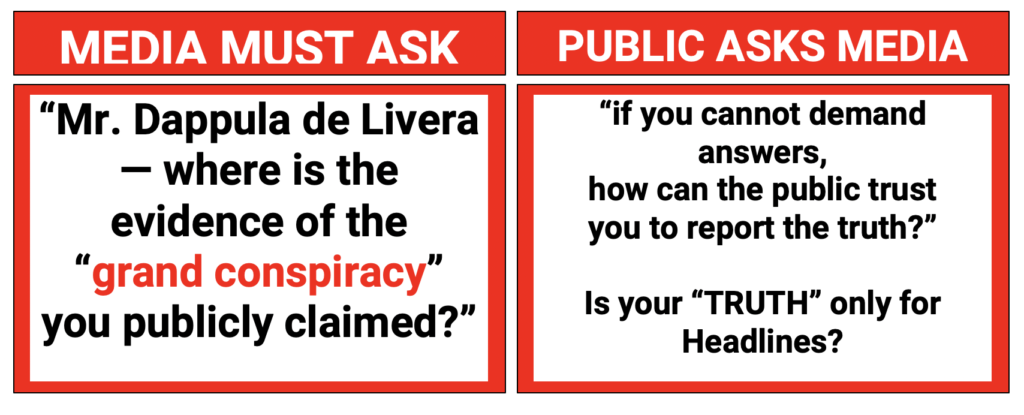
“Mr. Dappula de Livera — where is the evidence of the “grand conspiracy” you publicly claimed?”
And to the media, the public asks
“if you cannot demand answers, how can the public trust you to report the truth?”
Until this question is answered, the truth behind the Easter Sunday attacks remains incomplete.
And justice remains unfinished.
Five years is too long for a claim of this magnitude to remain unproven.
Shenali D Waduge