Why ITGSE-aligned CSE should not be adopted in Sri Lanka – A Legal, Cultural, and Educational Analysis”
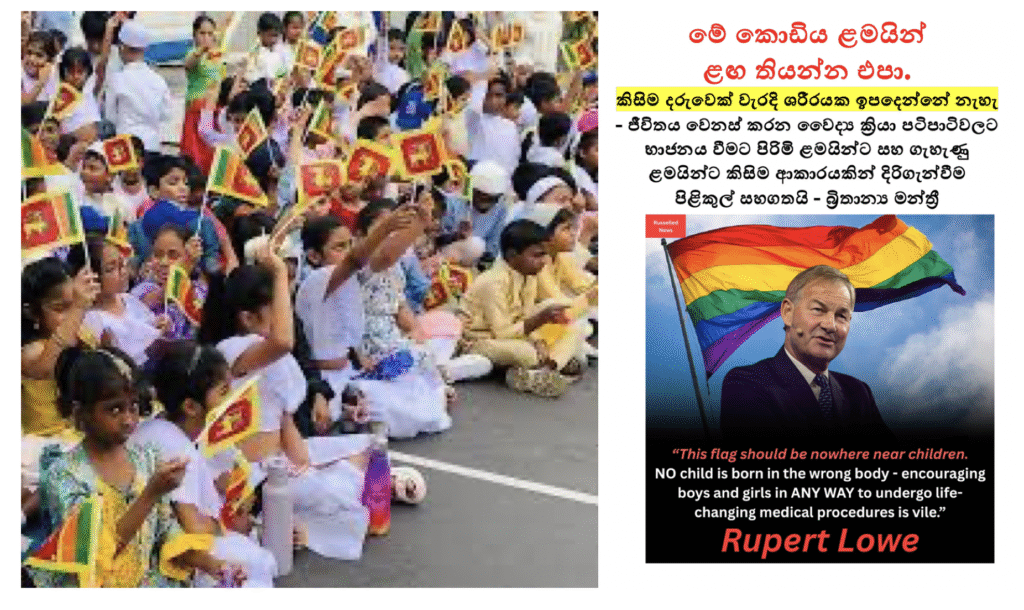
Sri Lanka already has a national, well-structured school curriculum created by the NIE (National Institute of Education). Our Health & Physical Education syllabus teaches students the essential knowledge they need: puberty, reproductive biology, hygiene, disease prevention, respect for others, responsible behaviour, and age-appropriate life skills. This curriculum is scientific, culturally rooted, legally compliant, and protective of children.
However, the current Education Minister proposes to replace or “align” Sri Lanka’s curriculum with Comprehensive Sexuality Education (CSE) based on the International Technical Guidance on Sexuality Education (ITGSE) — a framework created by external agencies such as UNESCO, UNFPA, UNICEF, WHO and UNAIDS.
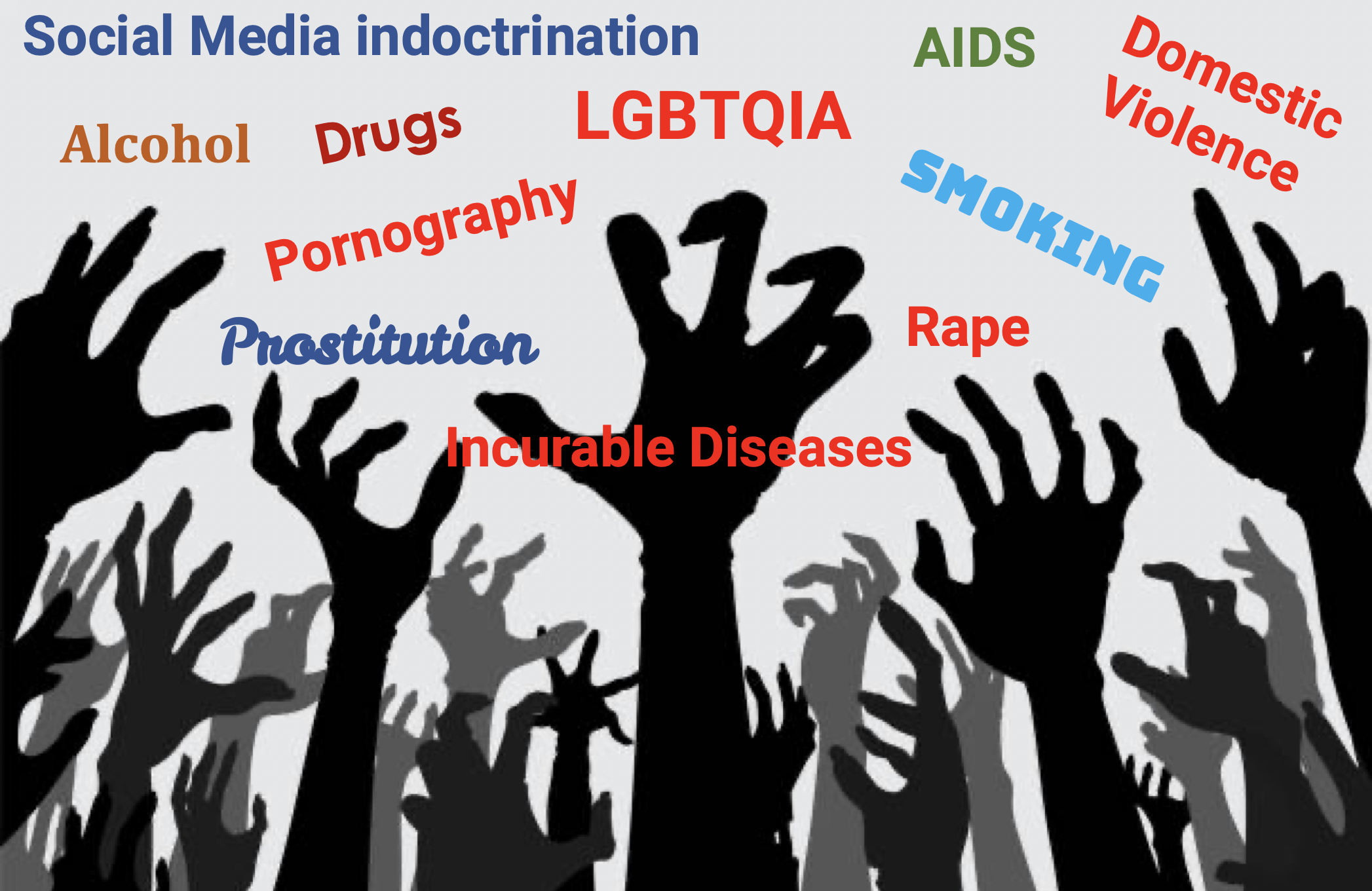
While the name sounds harmless, the content promoted by ITGSE introduces new ideological, sexual, and identity-based teachings to children from as young as 5 years old.
These teachings directly conflict with:
- Sri Lanka’s cultural and religious values
- Our legal framework, penal code, Constitution and child protection laws
- The NIE curriculum
- Parental rights
- National traditions regarding childhood, family, morality, and education
CSE is not a simple update to health education.
It is a complete shift in how sexuality, gender, identity, and childhood itself are taught — replacing Sri Lanka’s duty-based, family-centred approach with a rights-based, identity-political, Westernised model.
This analysis shows, with evidence, that Sri Lanka already teaches everything necessary for student health and protection, while ITGSE-aligned CSE introduces unnecessary, harmful, and culturally disruptive elements that no responsible government should impose on its young population.
SRI LANKA — NIE (National Institute of Education)— Health & Physical Education (Teachers’ Guide, Grade 9) — official Sri Lankan curriculum material.
Note: NO sexuality content is taught for Grades 1–8.
ITGSE wishes to introduces content of sexuality from age 5 onwards.
These subjects are not age-appropriate!
(Primary PDF I used: Teachers’ Guide – Grade 09 Health & Physical Education — NIE website).
https://www.nie.lk/pdffiles/tg/eGr09TG%20Health.pdf (NIE Teachers Guide – Grade 9)
- Where sexuality / responsible sexual behaviour appears in Sri Lanka’s Grade 9 guide
- Teachers’ Guide — Grade 9 — See the section“Competency 10 : Leads a happy life facing the obstacles in day to day life”
- “Explains the concept of human sexuality; Describes responsible sexual behaviors; Acts according to gender without injustice…”.
- The guide explicitly instructs teachers to“Explain the following facts associated with sexuality” including: the reproductive system, social roles after marriage, and the harms of “irresponsible sexual behaviours” (listed harms include unexpected pregnancies, STIs, disruption to education, mental harm, etc.).
- How the NIE frames sexual content
- The NIE framing isprotective and culturally contextual — it emphasises responsible sexual behaviour, marriage, protection from harm, and parental/community values
Sri Lanka’s official Grade 9 Health & Physical Education Teachers’ Guide Includes content on human sexuality, responsible sexual behaviour, reproductive biology, and safeguarding against irresponsible sexual behaviour — and it frames these in conservative/locally contextual terms (emphasis on marriage, harms of irresponsible behaviour, parental/community values).
What Sri Lanka’s NIE Curriculum Covers
Sri Lanka’s official syllabi focus on:
- Biology-based reproductive health
- Basic anatomy
- Puberty
- Bodily changes
- Menstruation
- Hygiene
- Prevention of disease
NOT included:
- Instructions on sexual acts
- Promotion of sexual experimentation
- Gender identity “options”
- Sexual orientation as a behavioural category
- Pleasure-based education
- Values-based moral and religious education
- Buddhist, Hindu, Christian, Islamic moral teachings
- Family values
- Self-discipline, modesty, respectful behaviour
- Social responsibility
This ensures sexuality topics are taught within a cultural, ethical, and religious framework, not as purely individualistic “self-expression.”
- Age protection & safeguarding
- No sexual content presented to young children
- Only basic puberty content introduced around Grade 6–8
- No exposure to adult sexual concepts under 14
- Focus on Sri Lankan cultural norms
- Marriage, family, responsibilities
- Avoidance of sexual misconduct
- Respect for parents and teachers
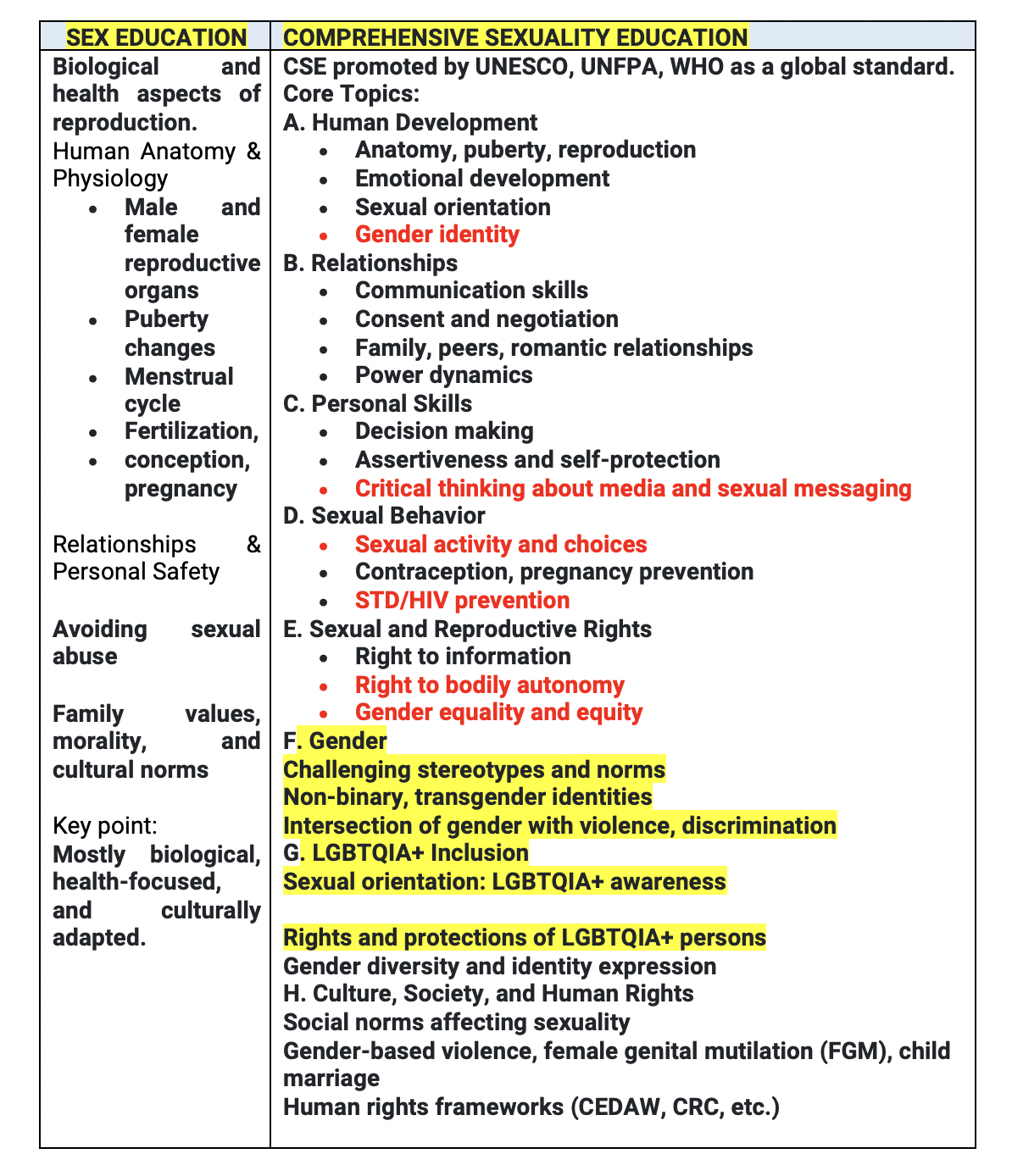
IGTSE – CSE
Comprehensive Sexuality Education (CSE) is the specific content framework and program approach that is guided by the International Technical Guidance on Sexuality Education (ITGSE).
The ITGSE acts as the international standard and master-framework for designing and implementing CSE programs.
Essentially, ITGSE is the set of guidelines, and CSE is the actual educational content and process that governments and organizations are encouraged to implement based on those guidelines.
Key Points:
- ITGSEprovides technical advice and a recommended set of topics and learning objectives. It divides the curriculum into eight key concepts with objectives.
- The guidance is developed and promoted by UN agencies including UNESCO, UNFPA, UNICEF, WHO, and UNAIDS.
- CSEis the curriculum-based process of teaching and learning about the cognitive, emotional, physical, and social aspects of sexuality, which aims to equip children and young people with knowledge, skills, attitudes, and values to make informed choices about their bodies and relationships.
Therefore, ITGSE is the guiding document for the implementation of CSE.
What ITGSE CSE Comprehensive Sexuality Education Introduces (and why they conflict)
Everything listed is directly verifiable from the ITGSE CSE Framework,
Conflict 1 —
ITGSE CSE normalises “sexual diversity” & “gender identity” concepts for children
Sri Lanka NIE:
Does not teach:
- Gender identity categories
- Sexual orientation categories
- LGBTQIA+ ideological frameworks
- “Gender expression” as a concept
ITGSE CSE:
Introduces:
- Sexual orientation as identity
- Gender identity & gender expression
- “Understanding diverse sexualities”
Conflict:
Sri Lanka’s Constitution, penal code, culture, religions, and NIE standards do not treat sexual orientation as an identity to be promoted in school.
Teaching these creates:
- Identity confusion in young children
- Conflicts with Buddhist, Hindu, Islam, and Christian/Catholicism teachings
- Leads to a breakdown of cultural norms regarding family and sex
- Opening the door for ideological foreign influence
Conflict 2 —
ITGSE CSE introduces sexual content to children as young as 5–8year olds
Sri Lanka NIE:
- No sexual content taught at primary level
- Only hygiene & good behaviour
ITGSE-CSE:
Recommended topics at ages 5–8 include:
- “Basic concepts of gender”
- “Different types of families” (including same-sex families)
- “Understanding one’s own body”
- “Protected vs unprotected touches” (which is fine)
- But also early introduction to “sexuality as part of being human”
Conflict:
Sri Lanka keeps sexual topics away from small children to protect innocence and reduce early sexualization.
Conflict 3 —
ITGSE CSE frames sexuality as “rights” and “autonomy”, but Sri Lanka teaches duties & responsibility
Sri Lanka NIE:
- Focus on discipline, respect, and behaviour
- Boundaries are linked to social responsibility
- No teaching of “sexual rights” for minors
ITGSE CSE:
- Introduces “sexual rights”, bodily autonomy, gender expression freedom
- Encourages children to challenge family norms
- Encourages young people to “make decisions about their sexuality”
Conflict:
Sri Lankan law does not recognise “sexual rights” for minors. Introducing them contradicts:
- Penal Code
- Child Protection Authority guidelines
- Cultural and religious norms
- Parental authority
Conflict 4 —
ITGSE CSE introduces risk-normalising topics about sexual behavior
While ITGSE CSE states it teaches risk reduction, its content includes discussion of:
- Sexual relationships
- Condom negotiation
- Pleasure
- Sexual decision-making
- Consent frameworks often designed for older teens but trickling down to lower age levels in practice
Sri Lanka NIE:
None of these appear in Sri Lanka’s curriculum at any level.
Conflict:
Introducing sexual behaviour discussion accelerates:
- Curiosity
- Experimentation
- Exposure to pornography
- Early sexual activity
- Vulnerability to exploitation
Sri Lanka’s approach is preventive.
CSE claims is harm-reduction but assumes sexual activity will occur, which misaligns with Sri Lankan moral foundations.
Conflict 5 —
ITGSE CSE supports socio-political concepts (power, gender roles, identity politics)
Sri Lanka NIE:
Focuses on:
- Social harmony
- Discipline
- Respect for boundaries
- National culture
ITGSE CSE:
Introduces:
- SOGIESC (Sexual Orientation, Gender Identity, Gender Expression, Sex Characteristics)
- Power relations
- Stereotype deconstruction
- Gender role transformation
Conflict:
These ideological frameworks do not align with Sri Lanka’s social fabric and can destabilize:
- Family structure
- Religious values
- Cultural expectations
- National cohesion
Why these ITGSE CSE concepts should NOT be included in Sri Lanka
Reason 1 — It violates cultural and religious harmony
All major religions in Sri Lanka (Buddhism, Hinduism, Islam, Christianity) teach:
- Sexual restraint
- Modesty
- Family-oriented ethics
- Responsibility before rights
CSE promotes:
- Sexual identity exploration
- Gender ideology
- Individual pleasure-based frameworks
- Challenging traditional norms
Reason 2 — It threatens child safeguarding
CSE assumes children should learn about sexual topics early. Sri Lanka presumes childhood innocence must be protected.
Introducing adult concepts early increases:
- Curiosity
- Risk-taking
- Sexual exploitation by adults
- Normalisation of pornographic concepts
Reason 3 — It conflicts with Sri Lankan law
Sri Lanka’s laws do not recognise:
- Gender identity categories
- LGBTQIA+ rights frameworks
- Sexual autonomy for minors
Yet ITGSE teaches minors they have these rights.
Reason 4 — It is externally funded and externally designed
CSE/ITGSE:
- Originates from global North
- Uses Western assumptions about sexuality
- Is promoted through donor incentives
- Does not reflect Sri Lankan realities
Reason 5 — Existing NIE syllabus already covers what is needed
NIE already includes:
- Biology
- Hygiene
- Puberty
- Prevention
- Morals
- Safety
ITGSE CSE adds deological and unnecessary content to the minds of a child.
- SEXUALITY & IDENTITY
| Category | NIE Sri Lanka | ITGSE / CSE | Conflict | Risk to SL Children |
| Sexual Orientation | Not taught in any grade. | Taught as an identity: “heterosexual, homosexual, bisexual.” | Introduces concepts
Sri Lankan culture/religion do not recognise. |
Identity confusion, importation of Western categories, ideological influence. |
| Gender Identity | Gender = male/female, biological. | Gender identity not only biological sex;
+ gender expression promoted. |
Contradicts
Sri Lankan cultural, legal, religious foundations. |
Encourages early self-labeling; increases confusion during puberty. |
| Sexual Diversity | Not included. | Promoted as a “normal part of human diversity.” | Conflicts with
Sri Lankan moral teachings. |
Displacement of local values by donor-driven ideology. |
| Family Types | Traditional family model (mother-father-children). | Includes same-sex families, LGBTQIA+ households. | Contradiction with Sri Lankan cultural norms. | Young children may struggle to reconcile with religious teachings. |
- AGE-APPROPRIATENESS
| Category | NIE Sri Lanka | ITGSE / CSE | Conflict | Risk to SL Children | |
| Content for Ages 5–8 | Hygiene, politeness, body safety (“good touch/bad touch”). | Introduces gender identity, family diversity, sexuality “as part of being human.” | Sri Lanka protects young children from sexual subjects. | Early sexualisation; unnecessary exposure to adult themes. | |
| Content for Ages 9–12 | Basic puberty, menstruation, personal hygiene. | Adds sexual orientation, gender expression, “feelings of attraction,” consent frameworks. | NIE limits content to biology, not emotions or sexuality. | Normalises romantic/sexual feelings in pre-teens. | |
| Content for Ages 13–15 | Anatomy, reproduction, STDs, responsible behaviour. | Adds sexual pleasure, condom negotiation, sexual rights, “decision-making about sexual behaviour.” | NIE does not encourage sexual experimentation. | Encourages curiosity, risk-taking, normalisation of sexual activity. | |
| Content for 15–18 | Biological reproduction, health risks, responsibility. | Discusses sexual autonomy, gender identity, challenging social norms. | Direct conflict with religious values and law. | Undermines parental authority and cultural expectations. | |
- VALUES, CULTURE & MORALITY
| Category | NIE Sri Lanka | ITGSE / CSE | Conflict | Risk |
| Values Base | Sri Lanka uses a moral, religious, duty-based culturally grounded framework. | CSE uses a rights-based, identity-based Western framework. | Opposing moral foundations. | Weakening of cultural identity and erosion of moral discipline. |
| Sexual Rights for Minors | NOT recognised or taught. | Minor-focused “sexual rights,” autonomy, decision-making. | Violates
Sri Lankan law & cultural norms. |
Could embolden minors to challenge parental boundaries. |
| Individualism vs Responsibility | Emphasis on discipline, duties, self-control. | Emphasis on rights, expression, autonomy. | Contradiction: duties-first vs. rights-first. | Breakdown of social discipline among youth. |
- SEXUAL BEHAVIOUR & PRACTICES
| Category | NIE Sri Lanka | ITGSE / CSE | Conflict | Risk |
| Discussion of Sexual Pleasure | NEVER included. | Explicitly includes sexual pleasure in adolescent learning outcomes. | Direct contradiction with cultural and religious norms. | Increased curiosity → pornography exposure → experimentation. |
| Condom Use / Negotiation | Not taught at school level. | Encourages children to learn condom negotiation skills. | Sri Lanka does not assume sexual activity among schoolchildren. | Encourages sexual behaviour by normalising adult content. |
| Different Types of Sexual Acts | NONE. | CSE modules include sexual behaviours for “informed decision-making.” | Direct misalignment with SL law and culture. | Exposure to adult sexual concepts could traumatise or confuse minors. |
| Consent Education | Taught within safety/abuse prevention ONLY. | Taught within romantic/sexual contexts. | SL treats consent as safety, not sexual readiness. | Encourages minors to think sexual consent is relevant to them. |
- SOCIAL & POLITICAL FRAMEWORKS
| Category | NIE Sri Lanka | ITGSE / CSE | Conflict | Risk |
| Gender Politics & Ideology | NO ideological content. | Introduces social constructs, power dynamics, gender activism. | Sri Lanka does not include political gender ideology in school. | Imposition of foreign socio-political constructs. |
| Challenging Norms | Encourages respect for hierarchy and culture. | Encourages challenging family, societal, religious norms. | Opposes Sri Lanka’s social foundation (family → school → religion). | Creates conflict between students & families. |
| Human Rights Framing | Rights taught through Civics in a general way. | Sexual rights, LGBTQIA+ rights, bodily autonomy. | SL law does NOT recognise these categories. | Potential legal conflict; confusion about lawful behaviour. |
- PEDAGOGICAL APPROACH
| Category | NIE Sri Lanka | ITGSE / CSE | Conflict | Risk |
| Teacher Role | Teachers follow content closely with strict boundaries. | CSE encourages open discussions about personal beliefs, sexuality. | SL teachers are NOT trained for such sensitive content. | Risk of inappropriate discussions or boundary violations. |
| Parental Rights | Parents are core stakeholders. | ITGSE assumes educator autonomy over sexuality topics. | Parents excluded from decision-making. | Erosion of parental oversight; distrust in education system. |
| Cultural Adaptation | NIE adapts to SL culture and religion. | ITGSE designed for global use, with Western assumptions. | One-size-fits-all approach inappropriate for SL. | Cultural displacement and identity dilution. |
- LEGAL COMPATIBILITY
| Category | NIE Sri Lanka | ITGSE / CSE | Conflict | Risk |
| Alignment with Penal Code | Fully aligned. | Promotes ideas contradictory to Sections 365/365A and child protection laws. | Direct legal conflict. | Confusion among teachers/students about what is legal/illegal. |
| Child Protection Laws | Strict: no sexual content for minors. | Sexuality content begins at age 5. | Violates child safeguarding practice. | Potential psychological harm. |
Why ITGSE/CSE Conflicts With Sri Lanka’s NIE
Sri Lanka’s curriculum is:
- Biology-based
- Morality-based
- Duty-Respect based
- Religion-compatible
- Culture-protective
- Legally compliant
- Developmentally safe
ITGSE/CSE is:
- Identity-based
- Sexuality-centered
- Rights-framed
- Western socio-political
- Early-sexualisation oriented
- Legally incompatible in Sri Lanka
Introducing sexuality topics that have ruined lives of children in the West so much so that the Western governments are reversing their laws, closing down gender-affirming clinics and banning hormone treatments & puberty blockers.
Therefore, integrating ITGSE/CSE would:
- Introduce Western identity politics
- Remove cultural and parental oversight
- Sexualize children prematurely
- Increase confusion among pre-teens
- Conflict with Sri Lankan religious values
- Contradict national law and child protection standards
- Undermine national education sovereignty
The Government MUST STOP attempting to introduce ITGSE CSE for Sri Lankan Schools
Comparing Sri Lanka’s legally approved NIE curriculum with the ITGSE-based CSE model promoted internationally, the conclusion is unmistakable:
Sri Lanka already provides age-appropriate, scientifically accurate health education — WITHOUT compromising culture, religion, or child protection.
The proposed ITGSE-aligned CSE, however:
Conflicts with Sri Lankan law
— especially child protection laws and Penal Code provisions that do not recognise “sexual rights” or “gender identity” frameworks for minors.
Undermines cultural and religious values
— by promoting identity politics, sexual orientation categories, gender ideology, and individualised “sexual autonomy” for children.
Introduces sexual content to children too early
— beginning at ages 5–8, leading to premature exposure, confusion, and potential psychological harm.
Erodes parental authority and community values
— shifting control away from families and local educators towards external ideological frameworks.
Has no educational necessity
— because the NIE already covers biology, puberty, behaviour, safety, ethics, and health in an age-appropriate, culturally safe manner.
Risks destabilising the moral foundations of future generations
— by moving from a duty-based moral system to a Westernised “rights-first” approach that is not compatible with Sri Lanka’s social fabric.
Final Message to the Public and Government
Sri Lankan children do not need a foreign-designed sexuality curriculum.
They need protection, guidance, discipline, moral grounding, and age-appropriate education — which the NIE already provides.
Therefore:
Parents, teachers, religious leaders, and citizens have every right — and responsibility — to demand that the Government DOES NOT adopt ITGSE-aligned CSE in any part of Sri Lanka’s school system.
This is not a rejection of health education. This is not even health education that is being proposed.
It is a defence of:
- Sri Lanka’s sovereignty
- Sri Lanka’s culture
- Sri Lanka’s religions
- Sri Lanka’s legal system
- Sri Lanka’s children’s childhood
- And the mental & physical well-being of the future of our nation’s children
Sri Lanka must continue its own, locally grounded Health & Physical Education curriculum — not surrender its educational values to external agendas or simply because funding bodies or loan conditions demand its inclusion.
Shenali D Waduge