Road to “Independent” Sri Lanka – The Republican Rule (1972-1977)
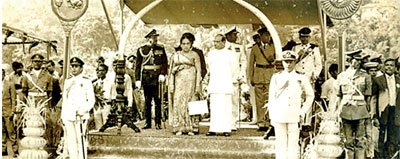
An attempt at civilisational reclamation was made in 1972 but it had its limits.
The period from 1972 to 1977 ended the “nominal independence” tag given to Sri Lanka. For the first time since 1815, Sri Lanka formally severed its constitutional link with the British Crown. This was not merely a legal shift; it was a symbolic assertion that the colonial chapter — at least in form — had ended. Yet symbolism alone could not undo centuries of psychological, institutional, and economic brain-social-economic conditioning.
1972 Was a Break — Not a Continuation
Unlike earlier leaders, Sirimavo Bandaranaike did not seek colonial or Western validation. Her leadership consciously attempted to reclaim sovereignty politically, economically, and culturally. She made firm decisions to prioritise national interest over external pressures — from asserting non-aligned foreign policy, intervening at the UN to safeguard Buddhism’s global stature, to resisting international corporate pressure that threatened local industries.
For the first time, the state openly acknowledged that the 1948 settlement was inadequate, colonial systems were incompatible with genuine sovereignty, and Sri Lanka required self-definition, not borrowed legitimacy.
Adoption of the 1972 Republican Constitution was therefore an admission that independence had been incomplete.
The state openly acknowledged that:
- The 1948 settlement was inadequate
- Colonial systems were incompatible with genuine sovereignty
- Sri Lanka required self-definition, not borrowed legitimacy
Adoption of the 1972 Republican Constitution was therefore an admission that independence had been incomplete.
What distinguished this phase was intent even if it had its drawbacks.
For the first time, the state openly acknowledged that:
- The 1948 settlement was inadequate
- Colonial systems were incompatible with genuine sovereignty
- Sri Lanka required self-definition, not borrowed legitimacy
The adoption of the 1972 Republican Constitution was therefore an admission that independence had been incomplete and delayed.
The 1972 Constitution: A Civilisational Signal
On 22 May 1972, Ceylon became the Republic of Sri Lanka.
Key civilisational shifts included:
- Formal removal of the British monarch as Head of State
- Assertion of legislative supremacy through a unicameral legislature
- Recognition of Buddhism as having the foremost place, reflecting the historical moral framework of the land
- The name “Sri Lanka” officially adopted, replacing “Ceylon”
This was not merely religious recognition. It was a partial acknowledgment that the Buddhist ethical order — deliberately dismantled under colonialism — had been central to social cohesion, restraint, and governance.
However, restoring symbolic primacy did not automatically restore ethical governance or civilisational confidence across institutions.
Concurrently, education reforms were introduced, including fair quotas that allowed children previously denied access to university education to enter, ensuring broader participation and social mobility. These initiatives reflected an effort to restore a sense of justice, ethical governance, and civilisational pride — though full operationalisation across institutions remained incomplete.
Nationalisation and Economic Sovereignty
Between 1970–1977, the state nationalised plantations, key industries, foreign-owned enterprises, and banking and insurance sectors, concentrating on manufacturing rather than mere import dependence.
This economic strategy aimed to reverse colonial-era extraction, encourage domestic production, and assert state control over national assets. International trade policies were carefully calibrated to balance relations with both Eastern and Western powers, reflecting Mrs. Bandaranaike’s astute positioning as a friend of both blocs while defending national interests.
These moves were intended to reverse colonial-era economic extraction and elite capture. Unlike later neoliberal reforms, nationalisation sought to assert state control over national assets rather than surrender them to external interests.
Yet nationalisation alone could not correct deeper distortions:
- Bureaucracies still operated on colonial logic
- Education remained disconnected from civilisational grounding
- Productivity suffered without institutional reform
- The moral dimension of governance was not restored
Economic sovereignty was pursued without fully addressing the ethical and psychological foundations required to sustain it or the animosities that would arise from those who stood to lose the privileges enjoyed under colonial & post-colonial rule.
Ethnic & Ideological Challenges
- Tamil New Tigers (LTTE) formed by Prabakaran on the same day (22 May) as the Republican Constitution it became LTTE in 1976.
- 1971 JVP Insurrection erupted, a symptom of youth alienation, foreign ideological influence, and disconnection from indigenous ethical frameworks
- Brutal suppression revealed a deeper crisis: generations trained to reject colonial rule and their own civilisational roots, leaving ideology to fill the void
The 1971 JVP Insurrection: A Symptom, Not an Accident
In April 1971, a violent Marxist-Leninist youth uprising erupted — not against colonial powers, but against the post-colonial state itself.
This was not a spontaneous rebellion.
It was the outcome of:
- Youth educated in alien ideologies
- Disconnection from indigenous ethical frameworks
- Unemployment created by colonial-era distortions which including the language factor
- A vacuum of meaning, belonging, and direction
The brutal suppression of the insurrection exposed a deeper crisis:
Sri Lanka had produced generations trained to reject both colonial rule and their own civilisational roots — leaving ideology to fill the void without a proper system to be replaced.
Why Mrs. Bandaranaike was Different
Sirimavo Bandaranaike stands apart from both her predecessors and successors because she attempted to govern outside the colonial comfort zone.
Unlike later leaders:
- She resisted wholesale Western economic prescriptions
- She prioritised national ownership over foreign capital
- She did not treat Buddhism as ceremonial symbolism alone
- She accepted political cost in resisting external pressure
Yet her project remained constrained.
She attempted structural reform without full civilisational restoration.
The ethical foundations dismantled under colonialism were acknowledged — but not rebuilt deeply enough to anchor reform and partnerships to forge the change was not inked as expected.
The Limits of the Republican Shift
Despite its historic importance, the 1972–1977 phase suffered from critical limitations:
- Colonial education systems remained intact
- Legal philosophy continued to reflect Western jurisprudence
- Ethnic fault lines inherited from colonial rule remained unresolved
- The civilisational role of Buddhism was recognised constitutionally but not operationalised in governance
The state attempted to reclaim sovereignty from the top, without fully re-rooting society from the ground up.
As a result, reforms were vulnerable — politically, economically, and psychologically.
International Statesmanship: Non-Alignment in Action, Not Rhetoric
Sirimavo Bandaranaike’s foreign policy was not symbolic non-alignment but strategic statesmanship exercised under extreme geopolitical pressure.
During the 1971 Indo-Pakistan war, when global powers aligned aggressively along Cold War lines, Sri Lanka under Mrs. Bandaranaike maintained principled neutrality while preventing its territory and airspace from being used to destabilise the region. Her decisions were guided not by fear of powerful nations, but by regional stability and sovereign discretion.
Similarly, during the Indo-China conflict and broader Cold War confrontations in Asia, Sri Lanka refused to become a proxy battleground for Western or Eastern blocs. Mrs. Bandaranaike resisted pressure from the United States and its corporate interests, particularly where foreign commercial entities sought preferential treatment or influence over national policy. Her government’s stance demonstrated that a small nation could exercise independent judgment without surrendering dignity or becoming subservient to power.
Internationally, she positioned Sri Lanka as a respected voice among newly independent nations, strengthening the Non-Aligned Movement and acting as a bridge between East and West. Her interventions at global forums were grounded in civilisational self-confidence — including advocacy for Buddhism’s recognition and protection at international platforms — asserting that Sri Lanka was not merely a post-colonial state, but a civilisation with ethical foundations predating modern geopolitics.
Why This Phase Still Matters
The 1972–1977 period matters because it proved one thing conclusively:
Sovereignty cannot be sustained by law, economics, or symbolism alone.
Without:
- Ethical grounding
- Civilisational confidence
- Education aligned with heritage
- Psychological decolonisation
…every reform remains fragile.
The failure was not that Sri Lanka attempted to reclaim sovereignty —
The failure was that it did so without fully restoring the moral architecture that once governed the land. The shift did not provide peace of mind.
A Bridge to the Next Phase
By 1977, the Republican experiment was politically exhausted.
Economic strain, global pressure, and internal contradictions created an opening for a dramatic reversal — one that would repackage colonial dependency under a new name: liberalization / open economy / free trade
What followed was not merely a policy shift, but a civilisational pivot.
From 1977 onward, Sri Lanka would abandon the struggle for self-definition and re-enter dependency — this time voluntarily.
That next phase would undo much of what little sovereignty had been asserted.
- https://www.youtube.com/watch?v=Paxf64SWq8Y — Sirimavo Bandaranaike: The world’s first woman prime minister
- https://www.youtube.com/watch?v=YRX2zvSENrk – Sirimavo Bandaranaike speech at united nations conference in 1971/ proposing Indian Ocean as a Zone of Peace
- https://www.youtube.com/watch?v=CY50eS3m9sw – Sirimavo Bandaranaike Documentary Part 1 of 4
- https://www.tiktok.com/@lost.ceylon.diaries/video/7515483377009462536 – Mrs B’s first historic visit to Soviet Union 1963
- https://www.youtube.com/watch?v=M0WofjJxVMM – Mrs B’s first historic visit to China 1972 & meeting Chairman Mao
- https://www.youtube.com/watch?v=EYyN8f3AGE4 – Non-Aligned Summit 1976 hosted by Mrs. B
Shenali D Waduge