Civilizational Erasure: The Systematic Dismantling of Sinhala Buddhist Identity, Heritage, and Constitutional Rights in North & East Sri Lanka
Sinhala Buddhists, constituting approximately 70% of Sri Lanka’s population, and forming the islands continuous civilizations core for over 2500 years are experiencing systematic marginalization across governance, administration, legal protection, cultural preservation, and education, particularly in the Northern and Eastern Provinces. Despite being the majority, their religious, cultural, and linguistic rights, as guaranteed by Article 9 of the Constitution of Sri Lanka—which provides for freedom of religion and recognizes the foremost place of Buddhism—are under threat due to structural biases favoring minority groups.
International Human Rights – Legal angle
These developments conflict directly with internationally accepted human rights standards, including:
- Universal Declaration of Human Rights (UDHR) – Articles 2, 18, 27
- International Covenant on Civil and Political Rights (ICCPR) – Articles 18, 26, 27
- UN Declaration on the Rights of Minorities (1992)
While Tamils constitute minorities nationally, Sinhala Buddhists function as vulnerable minorities within the Northern and Eastern Provinces, thereby qualifying for protection under international minority-rights frameworks.
Civilizational and Archaeological Continuity
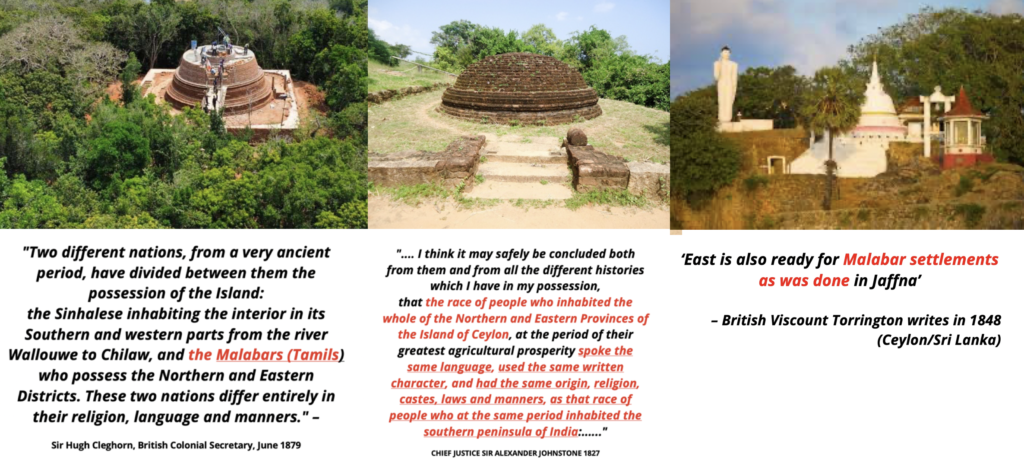
The Northern and Eastern Provinces contain extensive archaeological evidence of continuous Sinhala Buddhist habitation extending over two millennia, including:
- Kurundi Viharaya
- Sampur Stupa
- Vadunnagala (Vaddamana Pabbatha) Viharaya
- Kandarodai
- Thiriyaya Girihandu Seya
The destruction, obstruction, or denial of these sites constitutes cultural erasure, prohibited under:
- UNESCO World Heritage principles
- Hague Convention for Protection of Cultural Property (1954)
- Rome Statute – Article 8 (war crimes relating to destruction of heritage)
Late MP Cyril Mathew in fact wrote to UNESCO documenting all of the vandalized sites throughout in July 1983 for which he had not received any response.
Central Government Level Impacts
Constitutional & Legislative Marginalization
Official Language Issues:
- Article 18(2) of the Constitutiondeclares Tamil as “also” an official language, implying equality but in practice favoring Tamil in North/East provinces due to the 13th Amendment (1987).
- The 16th Amendment (1988), Article 22(1)mandates that Sinhala and Tamil shall be used in administration, legislation, and judicial proceedings throughout Sri Lanka, guaranteeing equal access to State services regardless of region. However, in practice, Tamil has become the dominant — and often exclusive — administrative language in the Northern and Eastern Provinces, creating systemic barriers for Sinhala-speaking citizens in:
- Local government offices
- Divisional Secretariats
- Police stations
- Magistrate courts
- Provincial administrative services
This is denying Sinhala-speaking citizens their constitutional right to receive public services and access justice in their own official language.
The practical exclusion of Sinhala from administration in these provinces constitutes institutional linguistic segregation, amounting to indirect discrimination, prohibited under Article 12(1) (Equality before the law) of the Constitution.
Sinhala is de facto de-prioritized in administrative regions with Tamil majorities.
Representation & Appointments:
- Senior bureaucratic and ministerial positions in North & East provinces frequently favor minorities or expatriate Tamils, reducing Sinhala Buddhist influence.
Educational Policy:
- Schools in Tamil-majority areas receive better funding and infrastructure per capita than Sinhala-majority areas post-1987.
- Scholarships, Sinhala-medium education, and teacher recruitment are often skewed toward Tamil-speaking students/teachers.
Political Policy Bias
- Central funding is frequently earmarked for minority cultural projects, while Sinhala Buddhist temples, heritage sites, and pilgrimages receive less attention.
- Policies claiming “equal treatment” are often unequal in practice, disproportionately impacting Sinhala Buddhist communities in areas historically affected by separatism.
Language & Education
- Administration increasingly favors Tamil, creating barriers for Sinhala speakers in accessing government services.
- Sinhala-medium schools in mixed districts remain underfunded, limiting educational opportunities and cultural preservation.
This practice further violates Article 26 of the International Covenant on Civil and Political Rights (ICCPR), which guarantees equal protection of the law without discrimination based on language, and Article 2 of the Universal Declaration of Human Rights (UDHR), prohibiting discrimination on linguistic grounds.
Provincial & Local Government Impacts (13th Amendment & Provincial Councils)
Representation & Governance
Provincial councils in Tamil-majority areas minimize Sinhala Buddhist participation, particularly in decision-making on land, religious sites, and schools.
Provincial budgets prioritize minority cultural or linguistic projects over Sinhala Buddhist heritage preservation.
Scenario Example:
A Sinhala Buddhist temple in Trincomalee requests renovation; approval is delayed for 3–5 years, while minority religious projects are expedited.
Likely affected population: ~100,000–150,000 adults directly affected.
Land & Property
- Historical resettlement programs for Sinhala Buddhists are delayed or blocked, whereas minority claims are fast-tracked.
- None of the Sinhala Buddhists chased out of North since 1980s have been properly resettled in their original habitats or had their livelihoods restored/ land and property granted.
- Sinhala Buddhist communities in Northern & Eastern provinces face restrictions, displacement, or denied land tenure as well as daily harassments.
- https://www.dailynews.lk/2022/05/23/features/279399/sinhalese-displaced-north-still-wait-return
The forced displacement of over 50,000 Sinhala Buddhist families during LTTE-controlled years, followed by systematic obstruction of resettlement, violates:
- UN Guiding Principles on Internal Displacement
- Article 12 of the Sri Lankan Constitution (Equality before law)
- ICCPR Article 12 (freedom of residence)
Preventing resettlement while advancing mono-ethnic territorial consolidation constitutes demographic engineering, a known precursor to separatist state-building.
Likely affected population: ~50,000 families (~200,000 individuals).
Administrative Language Bias
- Tamil is often the primary administrative languagein Northern & Eastern provinces.
- Sinhala speakers encounter practical barriersin accessing services, filing complaints, or participating in local governance.
- Activists who claim to be taking side of Tamils based on human rights conveniently omit the human rights of Sinhala Buddhists in these areas.
District & Local Government Impacts
Representation
- Sinhala Buddhists are underrepresentedin local councils and administrative bodies in Northern and Eastern districts.
- Local government elections are often dominated by Tamil or Muslim parties, limiting political influencefor Sinhala Buddhists.
Public Services
- Infrastructure, healthcare, and local development allocation often favors Tamil-majority areas, even when Sinhala Buddhist populations are significant.
- Sinhala Buddhist temples may face funding shortages or delays in expansion approvals, while minority religious institutions receive expedited processing.
Education & Culture
- Schools in mixed areas may neglect Sinhala-medium curriculum and Buddhist cultural education.
- Sinhala Buddhist festivals like Vesak may not receive local support, whereas minority festivals are prioritized.
Judicial & Law Enforcement Impacts
Court Delays & Language Barriers
- Magistrate courts in Northern & Eastern districts frequently conduct proceedings in Tamil, creating barriers for Sinhala Buddhist litigants.
- Fewer Sinhala-speaking lawyers limit access to effective legal representation.
- Ongoing court proceedings related to Buddhist temples and land disputes demonstrate prolonged legal uncertainty and delayed justice.
- Vaddamana / Vadunnagala Pabbatha Viharaya – Archaeological Vandalism + Supreme Court Case – The vandalism of Vadunnagala (Vaddamana Pabbatha) Viharaya — a site associated with the Buddha’s legendary visits — represents not merely property damage, butan attack on living civilizational heritage, warranting the highest legal protection under both national and international cultural heritage law.
- The persistent obstruction of archaeological protection efforts revealssystematic denial of Sinhala Buddhist historical legitimacy in the North and East, aimed at erasing the truth
- https://www.dailymirror.lk/front-page/Vandalising-of-Vadunnagala-Pabbatha-Viharaya-Activists-go-before-SC/238-258535?
- Sampur Stupa – Total Demolition of Ancient Buddhist Site (Trincomalee) – Entire Buddhist stupa flattened, happened days after archaeological discovery, shows deliberate cultural erasure, occurred in Eastern Province minority-dominated area
Magistrate courts in Northern and Eastern districts frequently conduct proceedings primarily or exclusively in Tamil, creating systemic barriers for Sinhala-speaking litigants.
- Sinhala Buddhist citizens often require private translators at personal cost, delaying access to justice and weakening legal defense — a burden not imposed on Tamil-speaking litigants.
This constitutes unequal treatment before the law, violating:
- Article 12(1)– Equality before the law
- Article 22(1)– Language rights in judicial proceedings
- ICCPR Article 14– Right to fair trial
Likely affected population: ~30,000–50,000 litigants annually.
Selective Enforcement
- Crimes or property disputes against Sinhala Buddhists are often less rigorously investigated, undermining trust in law enforcement.
- This incident highlights how law enforcement and political actors may react differently to Sinhala Buddhist initiatives, potentially undermining trust in rule‑of‑law and equal treatment before the law.
- Protests and police deployment outside Buddhist religious sites in Trincomalee demonstrate persistent hostility and tension surrounding Sinhala Buddhist religious presence.
- Sinhala Buddhist monks and devotees have been prevented from holding religious observances, including Vesak commemorations, in Northern districts.
- Organized protests against Buddhist temples in Mullaitivu reflect systematic resistance to Sinhala Buddhist religious presence. When these protests are immediately hosted on pro-LTTE websites it showcases who are sponsoring the protests.
Scenario Example:
- Temple vandalism in a Tamil-majority town remains unresolved for years; perpetrators face minimal consequences.
- Repeated protests targeting ancient Buddhist archaeological sites such as Kurundi Vihara illustrate organized opposition to Sinhala Buddhist historical heritage.
Protests Against Buddhist Temple Construction – Jaffna
Scenario Example:
- Tamil kovils in the North/East are prioritized for restoration funding, while surviving Sinhala Buddhist temples remain in disrepair, affecting cultural continuity, morale, and community cohesion. Central Government allocations often bow down to provincial political pressures.
Sinhala Buddhist communities face organized protests and administrative obstruction when attempting to construct or renovate temples in the Northern Province.
Peace of Mind & Cultural Safety
- Cumulative effects contribute to psychological distress, insecurity, and erosion of cultural identity.
- Sinhala Buddhist monks face obstruction and harassment while performing religious observances in Northern provinces, contributing to fear, insecurity and erosion of religious freedom
- Sinhala Buddhist families report intimidation, harassment, and threats, contributing to fear and forced demographic retreat.
Protests Outside Buddhist Temples – Obstruction of Religious Practice
Repeated protests, obstruction campaigns, and pressure movements against Buddhist shrines in North & East — especially in:
- Mullaitivu
- Trincomalee
- Vavuniya
- Mannar
Beyond physical and administrative discrimination, Sinhala Buddhist communities endure chronic psychological insecurity, stemming from:
- Repeated temple attacks
- Obstruction of worship
- Demographic isolation
- Social hostility
- Block access for worship
- Prevent construction and restoration
- Intimidate monks and devotees
- Mobilize political pressure to halt archaeological work
This sustained fear environment constitutes psychological displacement, forcing families to abandon ancestral areas without formal expulsion — a tactic historically used in ethnic cleansing campaigns worldwide.
This violates:
- ICCPR Article 18 (Freedom of Religion)
- UN Declaration on Religious Intolerance (1981)
Such actions create an atmosphere of religious siege, producing psychological trauma, insecurity, and forced cultural retreat.
Economic & Social Impacts
Employment & Public Services
- Public sector employment in minority-majority provinces favors minorities, limiting career progressionfor Sinhala Buddhists.
Likely affected population: ~50,000–100,000 working-age adults.
Cultural & Religious Events
- Funding for Buddhist festivals, heritage restoration, and pilgrimagesis limited, while minority cultural events receive full support.
- Sinhala Buddhist communities face obstruction and protests when attempting to build or renovate temples in the North and East while illegal religious structures are put up with no intervention of authorities.
Likely affected population: Entire Sinhala Buddhist communities in Northern & Eastern districts (~300,000–400,000 people).
Unfairness
| Area | Example of Discrimination / Marginalization | Effect on Sinhala Buddhists |
| Language | Tamil priority in North/East governance | Access to services blocked; official documents inconvenient |
| Administration | Provincial councils favor minority appointments | Limited political influence |
| Education | Sinhala-medium schools underfunded | Cultural and educational neglect |
| Religious / Cultural Sites | Approval delays / less funding | Buddhist temples and festivals marginalized |
| Land / Property | Land claims favor minorities | Displacement or denied development |
| Courts / Police | Case delays, selective enforcement | Legal protections weaker; perception of injustice |
| Budget Allocation | Uneven funding | Less development in Sinhala Buddhist areas |
Legal Basis & Linkage to Article 9
Article 9 of the Constitution:
- Freedom of religion for all citizens.
- Protection and respect for Buddhism as the majority religion.
Violations include:
- Restricting Sinhala Buddhist access to land, temples, and religious sites.
- Delaying or denying funding for cultural and religious projects.
- Excluding Sinhala Buddhists from meaningful political participation in regions where they are present.
Other constitutional/legal references:
- Article 18(2)– Official languages.
- 13th Amendment– Provincial Council powers and devolution.
- Official Language Act (1956)– Implementation inconsistencies.
- Article 154P– Provincial council administration and minority protection clauses sometimes applied in ways that disadvantage Sinhala Buddhists.
Likely Number of Sinhala Buddhists Affected
| Area | Likely Population Affected | Key Impact |
| Central government policy | 500,000–700,000 | Reduced funding for temples & schools, administrative neglect |
| Provincial councils | 100,000–150,000 | Political marginalization, delayed project approvals |
| Land/property disputes | 200,000 | Resettlement blocked, land claims delayed |
| Courts & law enforcement | 30,000–50,000 | Delayed justice, language barriers |
| Cultural/religious events | 300,000–400,000 | Cultural marginalization, festival funding inequity |
| Employment & public services | 50,000–100,000 | Disadvantage in hiring and promotions |
| Overall community security | 200,000–300,000 | Peace of mind, psychological impact |
Despite being the majority population, Sinhala Buddhists face systemic marginalization across governance, law, land, education, cultural preservation, and public services. The scale of affected populations, combined with violations of constitutional guarantees (Article 9), represents a pressing human rights concern.
Sinhala Buddhists need
- Religious and cultural protection
- Equitable access to justice and administration
- Demographic balance and political representation
- Community security, peace of mind, and cultural continuity
The systematic marginalization of Sinhala Buddhists in Sri Lanka’s Northern and Eastern Provinces represents one of South Asia’s most overlooked minority-rights crises.
Failure by international human rights institutions to acknowledge these violations — while selectively amplifying one-sided narratives — risks normalizing cultural erasure, demographic engineering, and religious intimidation as legitimate political tools.
The principles of justice, equality, and non-discrimination demand equal protection for Sinhala Buddhists, particularly where they function as vulnerable minorities.
Sri Lanka must undertake a national corrective program to:
- Restore constitutional primacy of Article 9
- Reinstate:
- Archaeological protections
- Military protection of sacred sites
- Reverse:
- Administrative linguistic exclusion
- Land discrimination
- Discrimination to Sinhala Buddhist children
- Launch:
- Task a team of patriots to document the Nations historical truth
- An international academic audit of falsified narratives
Silence in the face of such injustice does not constitute neutrality — it constitutes complicity.
What is occurring in Sri Lanka today is not reconciliation — it is systematic demographic, cultural, and religious displacement of the island’s civilizational majority, executed under the language of minority rights, but violating the very principles of equality, truth, and justice
Shenali D Waduge
Additional reading:
https://www.lankaweb.com/news/items/2019/08/03/buddhists-heritage-in-jaffna-vandalised-by-tamil-extremists/ – Buddhist heritage in Jaffna vandalized by Tamil extremists