How 2 JVP insurrections, LTTE & Jihadi terrorism contributed to Sri Lanka’s debt
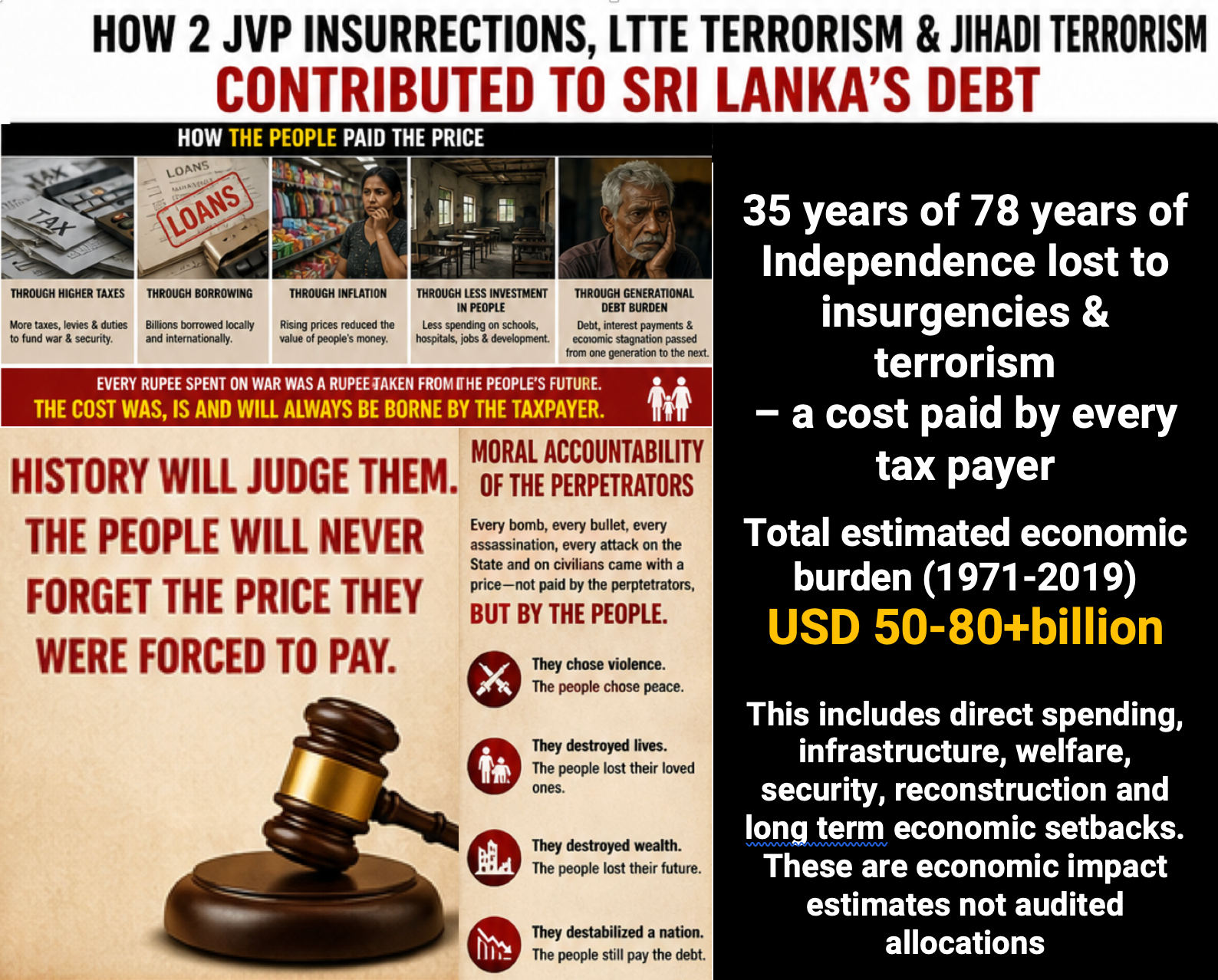
35 years out of 78 years of independence went into dealing with insurrections and terror against the State of Sri Lanka. This is almost half of Sri Lanka’s independence. While many strife to explain Sri Lanka’s debt crisis through economics, corruption, IMF policies or bad governance – a major contributor often left undiscussed is the financial burden as a result of armed insurgencies and the cumulative impact post-conflict. The JVP and the LTTE and since 2019 Islamic terrorism are 3 key reasons why Sri Lanka continues to struggle to come out of debt.
All 3 movements have attempted to overthrow or divide Sri Lanka. We cannot ignore the radicalism context as a single event if we have learnt lessons from the previous 2 incidents.
The cost of defending the territorial integrity of Sri Lanka, restoring stability, rebuilding infrastructure, compensating victims and maintaining an alert national security continues to contribute to Sri Lanka’s accumulating debt. Slackening security resulted in what arose in 2019 which means national security can never be undermined.
JVP & LTTE contribution to Sri Lanka’s debt
Sri Lanka forced into survival spending
While most developing nations borrow for:
- infrastructure
- industry
- agriculture
- education
- technology
- exports
Sri Lanka, however, was forced to spend on:
- counter-insurgency
- intelligence
- military expansion
- emergency law enforcement
- reconstruction after attacks
- welfare for displaced persons
- protection of economic assets
- maintaining territorial sovereignty
What Sri Lanka should have spent on – Sri Lanka ended up reprioritizing from development to survival.
Economic Damage of JVP Insurrections
1971 – 1st uprising – attempted armed overthrow of the state, resulted in:
- destruction of police stations
- attacks on state institutions
- disruption of transport and administration
- emergency military expenditures
- foreign military assistance costs
- economic paralysis during the uprising
Sri Lanka had to urgently:
- import weapons
- expand military capability
- increase intelligence operations
- finance detention and rehabilitation operations
This was an unplanned expenditure but one that had to be made.
1987 – 2nd uprising – Economically & socially devastating
Sri Lanka faced:
- assassinations
- strikes
- sabotage
- destruction of public property
- attacks on civilians
- shutdown of transport
- intimidation of workers
- targeting of politicians and administrators
Economic consequences:
- factories closed
- schools shut
- transport collapsed
- tourism declined
- investor confidence fell
- productivity dropped sharply
The government had to massively expand:
- armed forces
- policing
- intelligence networks
- emergency operations
This was one of the most devastating periods of post-independence as Sri Lanka was being attacked in the North by LTTE and simultaneously in the South by JVP.
This required large-scale state expenditure financed increasingly through borrowing.
Economic damage by LTTE terrorism
The brutal 30 year conflict was one of the costliest in South Asia.
The Sri Lankan state had to finance:
- Army expansion
- Navy expansion
- Air Force modernization
- intelligence systems
- border security
- maritime surveillance
- counter-terror operations
- cyber and communications systems
Sri Lanka’s budget had to be fundamentally changed to meet the threat.
Massive Increase in Defence Expenditure
Year after year, billions were allocated to:
- weapons procurement
- aircraft
- naval craft
- ammunition
- troop salaries
- pensions
- logistics
- battlefield medicine
- military camps
- reconstruction of damaged infrastructure
Defense spending became one of the largest components of government expenditure.
Funds that could have gone into:
- industrialization
- export diversification
- technology
- irrigation
- modern agriculture
- research
- higher education
instead went toward preserving the state itself.
Destruction of National Infrastructure
The LTTE targeted:
- buses
- trains
- airports
- ports
- banks
- oil installations
- power infrastructure
- religious sites
- economic centers
Examples include attacks on:
- the Central Bank
- Katunayake International Airport and planes
- buses and railways
- economic hubs in Colombo
Each major attack caused:
- reconstruction costs
- insurance losses
- foreign exchange losses
- reduced investment confidence
- reduced tourism revenue
The state had to borrow to rebuild.
Loss of Tourism Revenue
Both JVP & LTTE contributed to the downfall of Sri Lanka’s key foreign exchange earner – tourism.
Repeated bombings and instability:
- reduced tourist arrivals – some tourists were even killed
- increased travel warnings
- weakened investor confidence
- harmed aviation and hospitality sectors
Loss of foreign exchange forced the country to rely more heavily on:
- external borrowing
- balance-of-payment support
- foreign debt
Humanitarian and Welfare Costs
The war created:
- widows
- orphans
- internally displaced persons
- disabled soldiers
- damaged communities
The state had to finance:
- refugee camps
- rehabilitation
- resettlement
- pensions
- compensation
- reconstruction of villages
- demining operations
These are long-term recurring costs.
Economic Opportunity Cost
One of the biggest hidden costs was lost development opportunity.
Ironically, given the scale of resource outsourcing without factoring risk-analysis how much of “investor” take-aways have benefitted Sri Lanka needs to be separately analyzed. In many ways the conflict managed to protect some key national assets for 30 years!
Investments have to be considered not only on the initial dollar placed for the deal – while investors are enjoying free imports – tax holidays etc – weighed against this Sri Lanka needs to consider exactly what we gain and what the investors are gaining more and if it is actually worthwhile?
Countries that invested continuously in:
- manufacturing
- technology
- logistics
- exports
advanced rapidly during the same decades.
Sri Lanka spent much of that period fighting two internal armed movements.
This delayed:
- industrial transformation
- infrastructure modernization
- export competitiveness
- foreign direct investment
The debt problem therefore was not only money spent — but growth that never happened.
Economic Impact of Post-2019 Terrorism Threats (Including Easter Sunday Attacks)
The Easter Sunday terrorist attacks, introduced a renewed security and economic burden on Sri Lanka. It ended peace without terror achieved in May 2009.
This phase contributed to:
- increased national security expenditure and restructuring of intelligence systems
- temporary but significant decline in tourism and international confidence
- heightened aviation, port, and public security costs
- disruption to foreign exchange earnings in the immediate aftermath of the attacks
- long-term preventive counter-terrorism preparedness expenditure
The State was required to reallocate financial resources toward strengthening surveillance, intelligence coordination, and national security infrastructure to prevent recurrence of similar attacks.
This period reflects a post-conflict security shock cycle, where even in the absence of full-scale war, terrorism-related risks continue to impose recurring fiscal obligations on the State and, ultimately, on taxpayers.
FOREIGN BORROWING & WAR FINANCING
To sustain prolonged conflict, governments increasingly relied on:
- domestic borrowing
- foreign loans
- defense credit arrangements
- sovereign debt instruments
War expenditure became structurally embedded in the economy.
As debt servicing grew:
- interest payments increased
- fiscal deficits widened
- dependence on external financing deepened
A substantial portion of national expenditure over several decades was diverted toward defending the sovereignty, territorial integrity, and democratic continuity of the state against violent insurgencies and separatist terrorism. The economic cost of preserving the nation was immense.
Every bomb attack, assassination, military operation, destroyed railway, damaged airport, displaced family, and emergency security expansion carried an economic cost. Sri Lanka’s debt story is therefore also inseparable from the cost of defending the state against armed attempts to overthrow or divide it.
The real question is:
If Sri Lanka had enjoyed uninterrupted peace from the 1970s onward, how much larger could the economy have become, and how much lower could the debt burden have been?
DIRECT DEFENCE EXPENDITURE
Sri Lanka’s military spending rose sharply during the insurgency and war years. Military expenditure reached nearly 6% of GDP in peak war periods.
If Sri Lanka had remained peaceful, defence spending may have stayed closer to:
- 1%–1.5% of GDP
Instead, during conflict periods it often ranged:
- 3%–6% of GDP
That means Sri Lanka spent roughly an extra:
2% to 4% of GDP annually for decades2% to 4% of GDP annually for decades on conflict-related security.
Sri Lanka’s economy over those decades cumulatively produced hundreds of billions in GDP.
A conservative estimate suggests:
direct excess defence/security expenditure alone may have exceeded:
USD 40–60 billion equivalent (constant comparative value)
over several decades.
That does NOT include:
- interest on debt,
- destroyed infrastructure,
- lost investment,
- lost tourism,
- reduced exports,
- or slowed growth.
THE BIGGER COST: LOST GROWTH
The true damage was not only what Sri Lanka spent —
it was what Sri Lanka failed to become.
Countries that avoided prolonged conflict:
- Malaysia
- Thailand
- Vietnam (post-war recovery)
- Singapore
invested heavily into:
- industry,
- ports,
- exports,
- technology,
- logistics,
- tourism,
Sri Lanka instead diverted national resources into:
- survival,
- emergency security,
- reconstruction,
- and war financing.
Suppose Sri Lanka had grown only:
- 5% faster annually
without:
- insurgencies,
- terrorism,
- instability,
- investor fear,
- and war expenditure.
Sri Lanka’s economy could theoretically have been ~80% larger today with only 1.5% additional annual growth sustained over four decades.
WHAT WOULD THAT MEAN TODAY?
Sri Lanka’s nominal GDP in 2024 was about:
- USD 99 billion
If the economy were ~80% larger:
99 billion×1.899 billion×1.8
= approximately:
USD 175–180 billion economy
instead of ~USD 99 billion.
That changes everything:
- larger tax base,
- stronger rupee,
- lower debt-to-GDP ratio,
- higher exports,
- better reserves,
- less IMF dependence,
- higher wages,
- stronger infrastructure.
DEBT-TO-GDP WOULD LOOK VERY DIFFERENT
A country can manage debt if GDP grows strongly.
The issue is not only borrowing —
it is weak growth relative to debt.
If Sri Lanka’s GDP had been ~USD 175 billion instead of ~USD 99 billion:
- the debt ratio would look dramatically smaller,
- external shocks would be easier to absorb,
- reserves would likely be stronger,
- and investor confidence higher.
TOURISM LOSSES
The LTTE war repeatedly damaged tourism through:
- bombings,
- airport attacks,
- insecurity,
- international travel warnings.
USD 1–2 billion loss annually in tourism and related investment over decades
creates enormous cumulative foreign exchange loss.
That loss forced:
- more external borrowing,
- reserve depletion,
- and balance-of-payments pressure.
INFRASTRUCTURE DAMAGE
Repeated attacks destroyed or damaged:
- railways,
- buses,
- ports,
- aircraft,
- roads,
- banks,
- power systems,
- public buildings.
Each reconstruction cycle required:
- government borrowing,
- insurance payouts,
- emergency spending,
- import costs.
HUMAN CAPITAL LOSS
Thousands died:
- soldiers,
- professionals,
- workers,
- youth,
The country also lost:
- productivity,
- investor confidence,
- educational continuity,
- entrepreneurial momentum.
Brain drain accelerated during periods of instability.
SRI LANKA: THE LOST PEACE DIVIDEND
If Sri Lanka had not faced:
- the 1971 JVP insurrection,
- the 1987–89 JVP insurrection,
- and the 30-year LTTE war,
- ESTIMATED SECURITY & WAR EXPENDITURE SAVINGS
A conservative estimate of excess conflict-related spending:
| Category | Estimated Long-Term Cost |
| LTTE war expenditure | USD 35–45 billion |
| Reconstruction & infrastructure damage | USD 5–10 billion |
| JVP insurgency security/recovery costs | USD 2–5 billion |
| Emergency policing/intelligence expansion | USD 2–4 billion |
| Tourism & investment loss compensation impact | USD 5–10 billion |
| Approximate Total | USD 50–70 billion |
- WHAT IF THIS MONEY HAD BEEN SAVED OR INVESTED?
Instead of war spending, suppose Sri Lanka redirected:
- USD 60 billion
into productive development over decades.
If invested gradually into the economy, exports, infrastructure, and sovereign reserves, the multiplier effect becomes enormous.
- COMPOUND NATIONAL DEVELOPMENT EFFECT
Even a modest annual national return of 5%–6% on productive investment creates major long-term growth.
Using a simplified compounded national investment model:
FV=60(1.05)30FV=60(1.05)30
(1.05)30≈4.32(1.05)30≈4.32
Meaning:
60×4.3260×4.32
= approximately:
USD 259 billion equivalent economic impact
over time.
At 6%:
FV=60(1.06)30FV=60(1.06)30
(1.06)30≈5.74(1.06)30≈5.7460×5.7460×5.74
= approximately:
USD 344 billion equivalent impact
over three decades.
- WHAT THIS COULD HAVE MEANT FOR SRI LANKA
Had those resources gone into development instead of conflict management, Sri Lanka could potentially have achieved:
Infrastructure
- nationwide modern rail systems
- advanced public transport
- multiple industrial zones
- modern ports/logistics hubs
- stronger power infrastructure
Economy
- stronger foreign reserves
- larger export industries
- lower dependence on foreign debt
- stronger rupee stability
- higher per capita income
Social Development
- better universities
- advanced hospitals
- rural modernization
- technological innovation
- higher wages and employment
- THE HIDDEN COST: LOST CONFIDENCE
Beyond direct spending, conflict also:
- scared investors,
- reduced tourism,
- accelerated brain drain,
- increased insurance costs,
- discouraged manufacturing expansion,
- weakened long-term planning.
These indirect losses compounded over decades.
- THE PEACE DIVIDEND SRI LANKA NEVER FULLY RECEIVED
Many countries that escaped prolonged internal conflict experienced a “peace dividend”:
- rapid investment,
- export growth,
- industrial expansion,
- tourism booms,
- rising reserves.
Sri Lanka’s growth trajectory was repeatedly interrupted by:
- insurgency,
- terrorism,
- emergency spending,
- and reconstruction cycles.
A substantial portion of Sri Lanka’s debt and economic stagnation must be viewed through the lens of conflict economics. Tens of billions of dollars that could have been invested into national development were instead diverted toward defeating armed insurrections, preserving territorial integrity, rebuilding destroyed infrastructure, and maintaining national security.
Sri Lanka’s lost wealth was not only the money spent on war. It was the factories never built, the industries never created, the tourists who never arrived, the investments that never came, and the generations of development delayed by nearly four decades of internal conflict.
ESTIMATED TAXPAYER-BORNE COST OF INTERNAL CONFLICT (SRI LANKA)
JVP Insurrections (1971, 1987–89)
Estimated burden: USD 2 – 5 billion
LTTE Armed Conflict (1983–2009)
Estimated burden: USD 50 – 70 billion
Post-2019 Terrorism Security Impact (Easter Sunday aftermath)
Estimated burden: Multi-billion USD (security + economic disruption + prevention costs)
TOTAL ESTIMATED BURDEN
USD 50 – 80+ billion from 1971 to 2019 (direct + indirect estimates, excluding psychological and social trauma costs)
These figures represent economic impact estimates based on conflict-cost modelling, not legally adjudicated liabilities or audited fiscal allocations.
THE TRUE COST BORNE BY THE TAXPAYER
The estimated economic costs associated with the JVP insurrections, the LTTE conflict, and post-2019 terrorism-related security impacts collectively amount to tens of billions of dollars in direct and indirect burden.
However, it is essential to understand that these costs were not absorbed by abstract institutions — they were ultimately borne by the Sri Lankan taxpayer, through:
- increased taxation
- domestic and foreign borrowing
- inflationary pressure
- reduced public investment in development sectors
- long-term debt servicing obligations
THE PEOPLE WHO PAID THE PRICE
Sri Lanka’s internal conflicts were not cost-free historical events. They were long-term national expenditures financed entirely by the taxpayer, through decades of taxation, borrowing, inflation, and diverted development spending.
The JVP insurrections, the LTTE separatist war, and the post-2019 jihadi terrorism security burden collectively imposed an estimated economic cost exceeding USD 50–80+ billion, excluding the immeasurable human and psychological trauma experienced by the population.
This is not simply a number.
It represents:
- hospitals that were never built on time
- schools that were underfunded
- infrastructure that was delayed
- industries that never fully developed
- and generations that inherited debt instead of prosperity
Every phase of conflict required the State to prioritise survival over development — and every rupee spent on survival was ultimately drawn from the public purse.
THE CORE TRUTH
Whether through insurgency, separatist terrorism, or post-2019 security the financial burden of internal instability has always been transferred to one entity:
The ordinary taxpayer of Sri Lanka.
Not political actors. Not armed groups. Not ideology.
The taxpayer.
THE UNASKED QUESTION
If such enormous national wealth had not been consumed by decades of internal conflict:
- Would Sri Lanka’s economy today be nearly twice its current size?
- What would this mean for Sri Lanka’s Education, Health, Social Welfare?
- Would development have accelerated instead of being repeatedly reset?
These are not historical curiosities — they are central economic questions that define Sri Lanka’s present and future.
Understanding this history is not about revisiting the past.
It is about recognising a structural economic reality:
Internal conflict is not only a security issue — it is a long-term national debt generator carried by the people.
Until this is acknowledged in full, Sri Lanka’s debt narrative will remain incomplete, and its future policy choices will remain vulnerable to repeating the same cycle of cost, disruption, and delayed development.
JVP-LTTE-Jihadists have a moral responsibility & accountability to the tax payers.
Shenali D Waduge