Easter Sunday Allegations by Asad Maulana: He Cannot Reverse or Revise his 2023 Statements
The reported move by the Criminal Investigation Department Sri Lanka to obtain a statement from Asad Maulana living overseas since 2022, in connection with allegations involving Maj. Gen. Suresh Sallay, raises several questions.
Media reports indicate that the CID’s actions are linked to a complaint filed by Father Rohan based on claims made by Asad Maulana in the Channel 4 Sri Lanka’s Easter Bombings: Dispatches.
Several issues remain unaddressed:
- Why did Maulana not appear before domestic commissions or parliamentary committees to officially state his claims post-attacks
- Why did he not file any formal police complaint in Sri Lanka in February 2018 itself
- Even the Fort Magistrate had questioned why he did not come to Sri Lanka to record a statement
This then necessitates to ask:
On what legal and procedural basis is public funds being used for investigative officers to travel overseas without exhausting domestic mechanisms first?
Let us make clear that a witness who has made detailed public allegations in a fixed forum cannot freely alter those statements without undermining their own credibility.
-
Fixed Public Record Cannot Be Rewritten
Asad Maulana’s September 2023 testimony is not private or informal.
It was:
- Broadcast internationally via Channel 4
- Framed as “extraordinary testimony”
- Presented as evidence of alleged State complicity
Once placed in the public domain, such statements become:
- A fixed narrative record
- A basis for investigative reliance
- A benchmark against which any later statement will be tested
Therefore:
Asad Maulana cannot materially revise or contradict claims made in 2023. While all claims require to be independently corroborated.
Under the Evidence Ordinance (Sri Lanka), prior inconsistent statements may be used to impeach the credibility of a witness in judicial proceedings.
Furthermore – where a witness provides detailed, time-specific allegations in a public forum, any subsequent material deviation from those claims must be explained and supported by objective evidence.
Accordingly, while investigative authorities may record supplementary statements, such statements cannot be selectively revised in a manner that undermines earlier sworn or publicly recorded narratives without affecting its credibility.
Publicly broadcast allegations do not, by themselves, substitute for judicially tested evidence in a court of law.
The burden of proof rests on the party making the allegation.
Serious allegations of this magnitude require more than assertions or media hype.
If materially contradicted by objective evidence or judicial findings, such statements may become vulnerable to challenge during cross-examination for reliability & credibility.
-
Scope of Allegations Made in the Documentary
Maulana asserts:
- A meeting in February 2018
- Arranged on request of Sivanesathurai Chandrakanthan (Pillayan)
- Between:
- Then Brig. Suresh Sallay
- Zahran Hashim
- At a coconut estate
- Duration: approximately three hours
- He remained outside during the meeting
He further alleges:
- Sallay stated to him that “an unsafe situation was needed” for political transition
- He facilitated legal and financial assistance to extremist-linked detainees
- He received instructions from Sallay on Easter morning to pick up a suspected attacker
This raises the question – Is Asad a whistleblower or an accomplice given his role as facilitator and participant. If so he is liable under criminal law as an accomplice.
Untested one-sided allegations made in public or media platforms, if inaccurate or materially misleading may also expose Asad to legal consequences including defamation – given his allegation by name without judicial determination.
If Maulana possessed knowledge of a mass-casualty attack in advance, why did he not alert any authority, and how should such silence be interpreted?
All claims must be evaluated against the findings of prior investigations, international investigations, law enforcement inquiries & commissions which clearly determined operational negligence & lack of communications across the security apparatus.
-
Internal Contradictions and Evidentiary Gaps
Several inconsistencies arise when the claims are assessed against known facts:
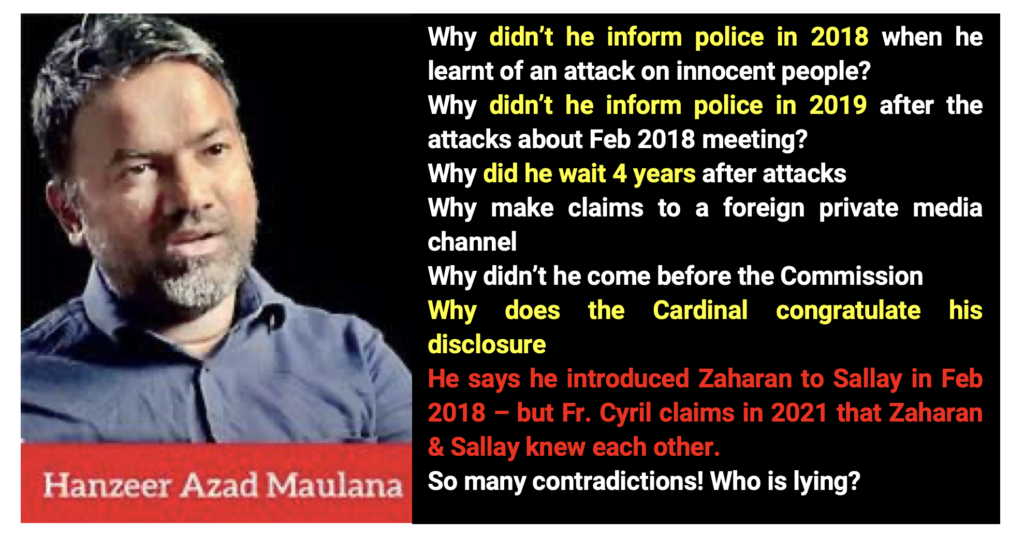
Prior Knowledge Claim – Contradicts with Fr. Cyril Gamini
If Zahran Hashim and Sallay were already known to each other (as suggested in the 2021 zoom by Fr. Cyril Gamini), there was no requirement for Maulana to function as an intermediary to introduce Sallay to Zaharan, yet the Cardinal immediately congratulated the C4 documentary with a 3 page letter.
Physical Presence Claim – Contradicts with Overseas Records
Sallay’s location at the time is contested.
He was overseas. This can be verified through:
- Travel records
- Immigration data
- Call data records, tower location mapping, and international routing logs can objectively confirm or refute the existence of alleged communications.
Building Existence Issue
If the alleged meeting occurred in February 2018:
- Evidence suggests there was no building constructed in February 2018. The building was constructing in Aug-Sept 2018. This raises the question how would a fugitive like Zaharan hold a 3 hour meeting in the open & how can Maulana be stationed outside the building if there was no such building in February 2018.
Participation Paradox
Maulana claims:
- He facilitated the meeting
- Yet remained outside for the duration
This raises a fundamental question:
- How does a non-participant claim detailed knowledge of a three-hour operational discussion if he was kept outside and why would they tell him of the plan if he was not invited to the discussion?
What CID must first establish is whether claims made by Maulana is based on
- Direct knowledge
- Inference / assumption
- Subsequent interpretation
-
Legal Exposure within his Own Statement
Maulana also claims:
- Facilitation of financial assistance
- Legal support for detainees linked to extremist elements
If true, these actions may:
- Place him under complicity rather than as a witness
- Create self-incriminating implications under criminal law principles
- If he knew in February 2018 of such a plan – why did he remain silent if he was concerned about the lives of innocent people?
This raises a critical legal contradiction:
- A person claiming involvement in facilitating activities linked to extremists cannot simultaneously occupy a neutral “whistleblower” position without judicial scrutiny.
Credibility Questions Arising from Conduct
- Why did Maulana fail to come forward immediately in February 2018 or after the attacks in 2019 if he possessed such critical knowledge?
- Why were these allegations made only in 2023, four years after the attacks and one year after leaving Sri Lanka?
- If his claims were genuine and urgent, what explains the delay in disclosure?
- Why did he choose a foreign private media platform instead of first making a formal complaint to law enforcement authorities?
- Why did he avoid appearing before multiple domestic commissions that were specifically appointed to investigate the attacks?
- If he claims Pillayan first suggested his involvement, why has he not formally incriminated Pillayan through official legal channels?
- Has any independent investigative body verified his alleged presence at the claimed meeting location?
- Has he provided any documentary, electronic, or witness corroboration to support his claims beyond his own statement?
- What personal, legal, or asylum-related incentives, if any, may have influenced the timing and content of these disclosures?
- Has any benefit, protection, or status been granted or sought in exchange for such testimony?
Delayed disclosure of critical information may affect reliability, particularly where contemporaneous reporting would have been reasonably expected.
-
Legal Reality of Overseas Statements
Even if the CID records a statement abroad:
- It remains investigative material, not judicial proof
- It cannot replace in-court testimony
- It is subject to strict admissibility rules
- It must be tested through cross-examination if relied upon in court
Therefore:
An overseas statement cannot independently establish guilt or conspiracy even if used as negative publicity against the accused.
-
Institutional and Financial Accountability Question
- What legal authorisation was granted for overseas engagement – how many officials travelled and what is the cost of this overseas travel (flight, hotels, transport & other incidentals)?
- Why were domestic judicial mechanisms not prioritised first – if so, where is the proof?
- On what basis is taxpayer-funded investigative travel justified – if a complaint filed without evidence results in investigators traveling abroad – how many such complaints will get filed taking this as a precedent?
- Why is investigative focus being directed primarily at one individual based on a single witness narrative, while other lines of inquiry supported by prior investigations remain secondary?
-
Questions
The case ultimately turns on verifiable questions:
- Did Maulana meet Sallay in February 2018 — yes or no?
- Was the meeting arranged on Pillayan’s request — yes or no?
- Was Sallay in Sri Lanka at the time — yes or no?
- Did any physical structure exist at the claimed location during that period — yes or no?
- Was Maulana party to the discussion between Zaharan & Sallay? Yes or no?
- If no, how did he know of the plan? If he was not involved why would they tell of their plan?
- Legal Authority & Jurisdiction
- Under what legal provision is the CID travelling overseas to record a statement from Asad Maulana?
- Was prior approval obtained from a Sri Lankan court before initiating overseas evidence collection?
- Has an arrest warrant or Interpol notice been issued against Asad Maulana, or is he currently treated as a witness?
- If he is a suspect in any pending case, why has extradition not been formally pursued through the legal channels in the nation he is now living in?
- Evidentiary Basis
- What specific new material prompted the CID to seek a fresh statement now, four years after the events?
- Is the CID treating Maulana’s Channel 4 testimony as evidence, intelligence, or allegation?
- Has any part of his 2023 televised statement been independently verified before this overseas engagement?
- What corroborative evidence exists to support or contradict his claims regarding alleged meetings or instructions?
- Consistency of Narrative
- How does the CID reconcile any new statement with Maulana’s previously broadcast testimony in the Sri Lanka’s Easter Bombings: Dispatches?
- Will inconsistencies between his earlier public statements and any new statement be formally recorded and assessed?
- If material contradictions arise, will the CID treat this as an issue of credibility or potential fabrication?
- Witness vs Suspect Status
- What is the official status of Asad Maulana in ongoing investigations — witness, suspect, or person of interest?
- If he is treated as a witness, how does the CID address allegations that he may have facilitated meetings involving extremist-linked individuals?
- At what point does a witness providing detailed operational claims become subject to investigation as a potential accomplice?
- Channel 4 Dependency Issue
- Why is a foreign documentary being used as a triggering basis for active CID investigative action?
- Has the CID independently verified the claims made in the Channel 4 programme before acting upon them?
- Did CID officials consider that Channel 4’s production relied heavily on a single principal witness?
- What is the CID stand on the Imam Committee findings specifically appointed to look into Channel 4.
- Can the CID reject this Govt commissioned report?
- Chain of Custody & Admissibility
- If a statement is recorded in France, under what legal framework will it be admissible in Sri Lankan courts under the Evidence Ordinance (Sri Lanka)?
- Will the statement be recorded under oath, and will it be subject to cross-examination rights?
- How will the CID ensure that the statement is not later challenged as hearsay or untested testimony?
- Prior Domestic Proceedings
- Why was Maulana not compelled earlier to give evidence before domestic commissions or parliamentary inquiries?
- Were previous attempts made to secure his testimony while he was still within Sri Lanka?
- If not, what changed now that justifies overseas engagement?
- Financial & Administrative Accountability
- What is the estimated cost of the CID overseas mission, and who approved it?
- Was Cabinet-level or judicial approval required before deploying officers abroad?
- How is taxpayer expenditure being justified for what appears to be a follow-up statement rather than new evidence?
- Consistency with Other Cases
- In cases involving other suspects or witnesses, is overseas evidence collection standard practice?
- If not, what makes this case exceptional compared to other major criminal investigations?
- Given that Maulana’s claims involve alleged high-level coordination, why is the CID prioritising statement collection abroad instead of presenting independently verified evidence before a court of law?
These are not political questions—they test the authenticity of the claims.
The Easter Sunday tragedy demands rigorous truth-seeking, not narrative reconstruction.
However:
- When a single witness statement becomes the foundation for international allegations of state complicity, the evidentiary burden must rise—not fall.
Maulana’s 2023 testimony now forms a fixed public record.
It cannot be casually revised without consequence.
And it cannot substitute for:
- corroborated evidence
- judicial testing
- or cross-examined proof
The central legal test is not whether an allegation is repeated, but whether it is independently corroborated, consistent, and capable of withstanding cross-examination in a court of law.
Ultimately:
Allegations of this magnitude must stand on evidence, not assertion—and evidence must survive contradiction, not depend on repetition.
Shenali D Waduge