
SEX EDUCATION VS SEXUALITY EDUCATION – WHAT IS THE DIFFERENCE?
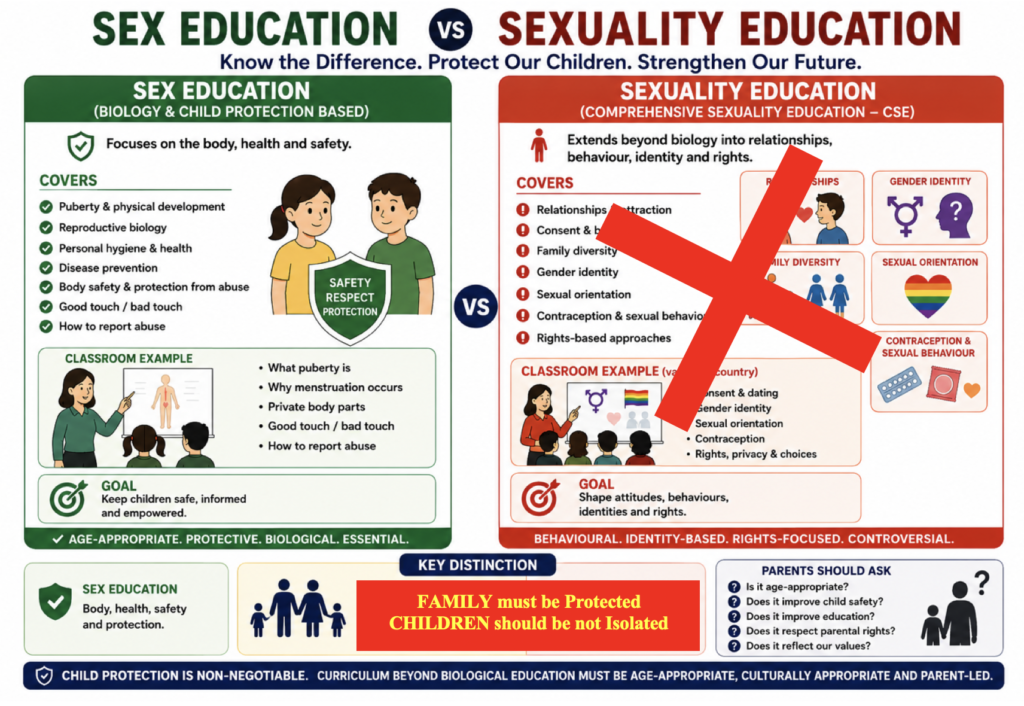
Across many countries today, there is growing concern among parents, educators, and cultural institutions about the changing direction of school-based education on child development. While education on biology and child protection is necessary and universally accepted, the expansion of curricula into broader areas of sexuality, sexual relationships, newly-created gender identity, and behaviour under what is often referred to as sexuality education or comprehensive sexuality education (CSE) is a concern that should not be taken lightly.
These expanded frameworks are no longer limited strictly to health, hygiene, and protection, but are increasingly shaped by external policy influences, donor-driven priorities, and international models, and in some cases influenced by private-sector and institutional interests that operate within wider global advocacy and funding.
This shift has contributed to a gradual weakening of parental and religious authority in moral and values-based upbringing, as well as create a growing disconnect between school-based messaging and traditional social norms.
More importantly, concerns are also raised that the institutionalization and normalization of sexuality-related content within formal education systems creates space for commercialisation of educational content that was previously not included in formal education for valid reasons.
It is without doubt that any education system must focus on child protection, abuse prevention, personal safety, and basic biological education.
However, there is critical concern that, under the pretext of strengthening child protection, behavioural and identity-based areas that go beyond the original intent of safeguarding the child’s physical wellbeing and providing developmentally appropriate knowledge are being inserted into curricula.
Child protection, cultural values, and parental rights cannot be compromised at the behest of funding bodies and those seeking commercial gain from the sexualization of children.
The promotion of sexuality education, when extended beyond biological and protective boundaries, risks creating confusion during early developmental stages and contributes to the premature exposure of children to complex adult behaviours that are not aligned with their psychological maturity or social environment.
As Will Durant said,
“A great civilization is not conquered from without until it has destroyed itself from within.”
Introducing sexuality-based education into Sri Lanka’s education system risks encouraging changes that may undermine the cultural and civilizational foundations that have sustained our society.
The relentless pressure by activists, advocacy groups, international agencies, funding bodies, and others promoting these frameworks is itself a clue. Their determination to advance such changes despite the reservations of parents, religious institutions, and cultural bodies exposes an agenda that extends well beyond child protection and basic biological education.
SEX EDUCATION (BIOLOGY & CHILD PROTECTION BASED)
Sri Lanka’s national curriculum already includes Health & Physical Education components that broadly cover sex education in an age-appropriate manner.
Core content typically includes:
- Puberty and physical development
- Reproductive biology
- Personal hygiene and health
- Basic disease prevention
- Introduction to personal safety and protection from abuse
Sex education is primarily biological and protective, aimed at helping children understand bodily changes and maintain personal safety.
CLASSROOM EXAMPLE (SEX EDUCATION)
A teacher explains:
- What puberty is
- Why menstruation occurs
- Why voice changes occur in adolescence
- Which body parts are private
- How to report inappropriate touching or abuse
This form of education is already present in many school systems, including Sri Lanka, at appropriate grade levels.
The existing system can be strengthened so that every child is clearly taught:
- What private body parts are
- That no one has the right to touch them inappropriately
- How to report abuse and to whom
This forms the essential foundation of child safety education.
SEXUALITY EDUCATION (COMPREHENSIVE SEXUALITY EDUCATION – CSE)
Sexuality education extends beyond biology into emotional, social, behavioural, and identity-related areas.
It is commonly associated with international guidelines such as:
- UNESCO International Technical Guidance on Sexuality Education (ITGSE)
- UNFPA-supported Comprehensive Sexuality Education (CSE) frameworks
Sexuality Education covers:
- Emotional relationships and attraction
(Teaching about romantic feelings, crushes, emotional attachment, and intimate relationships.) - Consent and interpersonal boundaries
(Teaching how people agree to physical contact, relationships, or sexual activity) - Family diversity concepts
(Teaching that families can take different forms, including same-sex parenting- 2 mothers & 2 fathers/a man pretending to be mother / a woman pretending to be father.) - Gender identity discussions (varies by country)
(Teaching that a person can identify the opposite to the gender he/she was born as – children are asked to keep these teachings secret from parents) - Sexual orientation topics (varies by curriculum)
(Teaching about different patterns of romantic or sexual attraction, including heterosexuality, homosexuality, bisexuality, and other orientations.) - Contraception and sexual behaviour (at secondary level in many systems)
(Teaching methods used to prevent pregnancy and discussions relating to sexual activity, decision-making, and associated risks.) - Rights-based approaches to relationships and sexuality
(Teaching that individuals have personal rights relating to relationships, bodily autonomy, privacy, sexual expression, and reproductive choices even challenging parents)
You can fathom the type of education this will enable and the outcomes it will produce!
The fundamental question is whether such curriculum content should take precedence over educational priorities that must equip children with the knowledge, skills, discipline, critical thinking, and practical competencies necessary to build productive lives, secure meaningful employment, contribute positively to society, and become responsible adults.
At a time when educational standards, literacy, numeracy, scientific knowledge, vocational skills, and economic competitiveness require urgent attention, serious consideration must be given to whether the expansion of sexuality-based curricula serves the best interests of children and the nation, or diverts valuable educational time and resources away from core learning objectives that directly contribute to their future wellbeing and livelihood.
SEXUALITY EDUCATION CLASSROOM EXAMPLES (VARIES BY COUNTRY)
Early primary (approx. 5–9 years in some systems):
- Body autonomy concepts (“my body belongs to me”)
- Basic discussions of family structures
- Introductory language on privacy and boundaries
Upper primary (approx. 9–12 years):
- Consent and personal boundaries
- Internet safety regarding sexual content exposure
- Early discussions on emotional changes and attraction (in some curricula)
Secondary level (approx. 13–16 years):
- Contraception and reproductive choices
- Sexual health risk education
- Relationship decision-making frameworks
- In some systems: discussions on sexual orientation and gender identity
KEY DISTINCTION
- Sex Education:Focused on biology, physical development, and protection
- Sexuality Education:Focused on relationships, behaviour, identity, and rights-based frameworks
GLOBAL PROMOTION OF CSE
Comprehensive Sexuality Education (CSE) frameworks are promoted internationally by organizations such as:
- UNESCO
- UNICEF
- UNFPA
- World Health Organization (WHO)
While these frameworks are described as guidance models, they are widely referenced in curriculum development across multiple countries.
HOW INCENTIVES EXPAND THE FRAMEWORK
Once sexuality-based frameworks become embedded within national education systems, the floodgates are open.
- Curriculum revisions require consultants.
- New teaching modules require authors.
- Teachers require training.
- Schools require workshops.
- Governments commission studies.
- NGOs seek grants.
- International agencies fund programmes.
- Researchers secure funding.
- Publishers produce educational materials.
- Advocacy organisations gain relevance and influence by expanding the scope of the issues they address.
The result is that the continued expansion of sexuality-related content can become self-sustaining. The more topics that are added, the greater the demand for funding, training, materials, expertise, monitoring, evaluation, and specialist services.
EXAMPLE: DIGITAL EDUCATION AND POLICY SHIFTS
A similar pattern was seen in the global push for digital education, where large-scale funding and advocacy promoted extensive use of devices in classrooms. Over time, concerns began to emerge about reduced attention spans, weaker handwriting skills, and declining foundational learning in early education. As a result, several countries are now reintroducing greater use of books, handwriting, and reduced screen exposure in early grades.
This illustrates how education policies can be heavily driven by funding and advocacy cycles, and later reassessed when outcomes are reviewed. But the damage is irreversible.
This creates a situation in which institutions, organisations, and individuals may acquire a professional, financial, or ideological interest in ensuring that such programmes continue to expand.
WHY PARENTS SHOULD PAY ATTENTION
A key concern among parents is that children process information in stages. Concepts related to identity, attraction, and adult relationships require emotional and cognitive maturity. When introduced too early, they may shift attention away from foundational learning, or create interpretive confusion that children are not developmentally equipped to resolve.
Parents are therefore justified in asking whether curriculum decisions are being driven primarily by the educational and developmental needs of children, or whether external interests are influencing policy.
When sexuality-related topics are introduced at increasingly younger ages, concerns naturally arise regarding:
- Age appropriateness.
- The role of parents in guiding moral development.
- The influence of external organisations on national education policy.
- Whether educational priorities are being diverted from core academic and life skills.
- Whether children are being exposed to concepts and discussions that exceed their developmental maturity.
The issue is not whether children should be protected. The issue is whether the expansion of sexuality-related content is always being justified on the basis of child protection when other institutional, ideological, or professional interests may also be involved.
INTERNATIONAL CONTEXT
Even in Western countries, there is no universal consensus on:
- Appropriate age for specific topics
- Depth of sexual health content in schools
- Parental consent and opt-out rights
- Inclusion of gender identity topics in early education
As a result, curricula are continuously debated, revised, and locally adapted.
WHAT SHOULD BE PRIORITISED IN CHILD SEX EDUCATION
For young children:
- Body safety awareness
(Not exposing one’s body to others and understanding that certain parts of the body are private.) - Understanding privacy boundaries
(Knowing that nobody has the right to invade a child’s personal space or privacy without a valid reason.) - Good touch / bad touch education
(Understanding the difference between appropriate care and inappropriate physical contact.) - Reporting mechanisms for abuse
(Knowing whom to tell, how to seek help, and that abuse should never be kept secret.) - Basic online safety
(Avoiding strangers online, protecting personal information, and reporting inappropriate content or requests.)
For adolescents:
- Puberty and reproductive biology
(Understanding the physical and biological changes that naturally occur during adolescence.) - Health and hygiene education
(Maintaining personal cleanliness, health, and wellbeing during adolescence.) - Risk awareness and responsible behaviour
(Understanding the consequences of harmful decisions and learning self-discipline and personal responsibility.) - Emotional development and respect
(Managing emotions appropriately, respecting others, and building healthy friendships and family relationships.)
For society and schools:
- Strong child protection laws and enforcement
(Ensuring that those who abuse, exploit, traffic, or harm children are swiftly investigated, prosecuted, and punished.) - Parental involvement in education policy
(Recognising parents as the primary guardians responsible for the upbringing and moral guidance of their children.) - Culturally appropriate curriculum design
(Ensuring that educational content reflects the values, traditions, beliefs, and social realities of Sri Lankan society.) - Focus on evidence-based outcomes
(Prioritising educational programmes that demonstrably improve child safety, wellbeing, academic achievement, and future livelihood opportunities.)
This format keeps the emphasis on protection, responsibility, and practical outcomes while making each point immediately understandable to a general audience.
Child protection education is a necessary and universal responsibility of any education system.
However, it is important to clearly distinguish between biological safety education and broader sexuality-based frameworks that include behavioural and identity components.
Education policy should be guided by:
- National cultural context
- Child development science
- Parental engagement
- Clear educational outcomes
- Long-term societal wellbeing
Child protection education should remain firmly grounded in biology, safety, and responsibility, ensuring children are protected and informed without introducing complex behavioural or identity frameworks at developmentally inappropriate stages.
THE REAL QUESTION
The debate is not whether children should be protected.
Everyone agrees they should.
The debate is whether child protection is being used as the vehicle through which broader social, behavioural, and identity-based frameworks are introduced into schools.
Parents must therefore ask:
- Does this improve child safety?
- Does this improve educational outcomes?
- Does this strengthen families?
- Does this respect parental authority?
- Does this reflect the cultural values of our society?
If the answer is no, then policymakers must reconsider whether the curriculum is serving the child—or serving another agenda.
Shenali D Waduge


