
50 years of Vaddukoddai separatist politics and 3 decades of LTTE terrorism, time to stop fooling the Tamil people
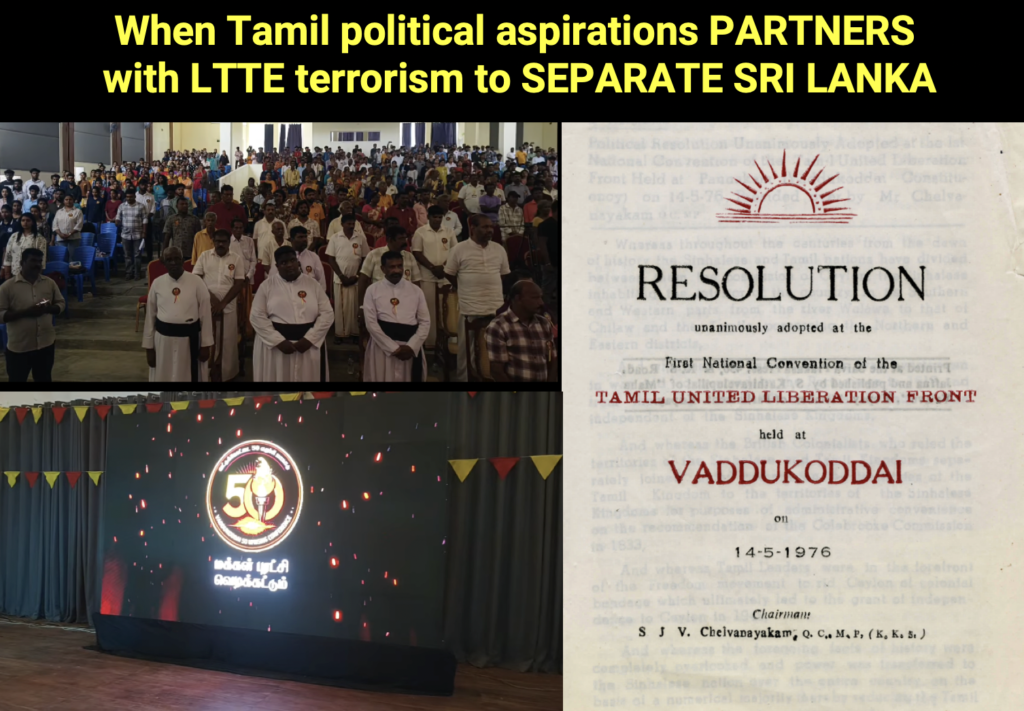
Fifty years after the Vaddukoddai Resolution and seventeen years after the defeat of the LTTE, it is time for an honest assessment. While separatist politicians, their supporters, promoters and beneficiaries continue to commemorate Vaddukoddai, it is ordinary Tamil families who paid the real price—through death, displacement, lost opportunities, economic hardship and generations of suffering. The Tamil people were promised security, prosperity, dignity and a separate state. Instead, they endured decades of war, destruction and the silencing of dissenting voices. Who benefited from fifty years of separatist politics? Who paid the price? Why are the same failed narratives still being promoted today? Fifty years after Vaddukoddai, the Tamil people deserve honest answers.
Political Outcomes
Was Tamil Eelam achieved in Sri Lanka or even in Tamil Nadu where the idea was first birthed?
Human Cost
How many Tamil youth died in the conflict? What would they have become if they had not been sent to the jungles holding guns
How many Tamil families lost loved ones? Where would they be if alive
How many Tamils live with injuries?
How many children grew up without parents because of the war?
Economic Impact
How many decades of development were lost in the North and East? Inspite of making millions of profits did LTTE spend on its people?
How many businesses were destroyed?
How many educated Tamils emigrated permanently?
Social Impact
Did separatist politics strengthen Tamil society or fragment it?
What happened to dissenting Tamil voices? How many Tamils did LTTE kill
What happened to Tamil politicians who disagreed with militancy? Entire moderate Tamil politicians were wiped away.
Future Generations
What lessons should Tamil youth learn from the past?
Should the next generation inherit unresolved grievances or opportunities for advancement?
Fifty years after Vaddukoddai and seventeen years after the defeat of the LTTE, are ordinary Tamils better served by continuing to pursue separatist narratives, or by focusing on economic development, education, investment, and equal citizenship within a united Sri Lanka?
It is a good time to look back on how they lived under LTTE iron rule and how they are now living without LTTE.
-
What were the outcomes of the strategy chosen in 1976?
The Tamils were promised:
| Promise | Outcome |
| Separate state | Not achieved |
| Security | Decades of war |
| Prosperity | Economic destruction |
| Political empowerment | Reduced leverage |
| Youth advancement | Thousands of deaths |
| International recognition | Continued uncertainty |
-
Were all Tamils supporters of separatism?
Why were the voices of the following forgotten:
Tamil political moderates.
Tamil intellectuals who opposed violence.
Tamil public servants.
Tamil religious leaders.
Tamil civilians caught between the LTTE and the state.
-
Tamil Victims of the LTTE
Many international audiences are told about abuses committed during the conflict, but fewer know about Tamils who were victims of LTTE actions.
What happened to Tamil politicians who opposed the LTTE?
What happened to Tamil academics who disagreed?
What happened to Tamil villagers who resisted recruitment?
What happened to children recruited into the movement?
“The first victims of extremism & terrorism were Tamils themselves.”
-
Lost Opportunities
“What might the North and East look like today if a different path had been chosen?”
Have Tamils themselves wondered where the following would have left the North & East if 3 decades of LTTE terror did not prevail?
Education.
Infrastructure.
Tourism.
Ports.
Fisheries.
Technology.
Foreign investment.
-
Damage done by Tamil Political Elites
What responsibility do political leaders bear for the consequences of the path they advocated?
-
Why is the Same Narrative Continuing
“If the strategy failed to achieve its stated goal, why is the same political narrative still being promoted 50 years later?”
What new outcome is expected?
What evidence suggests a different result?
What practical pathway exists today?
-
Positive Alternative
“From Eelam to Excellence”
Education.
Entrepreneurship.
Technology.
Global Tamil success.
Economic empowerment.
Regional development.
“The next generation deserves opportunities, not inherited conflicts.”
-
International forums must realize that accepting Tamil grievances should not equate to endorsing separatism while rejecting terrorism does not reject Tamil grievances.
Democracy.
Human rights.
Protection of civilians.
Rejection of terrorism.
Equitable citizenship.
-
Fifty years after Vaddukoddai, where are the Tamil people today compared with where they were promised they would be?”
Population movement.
Youth migration.
Economic indicators.
Political influence.
Social well-being.
Educational outcomes.
-
50 Years After Vaddukoddai: Time for an Honest Audit”
What was promised?
What happened?
Who paid the price?
Who benefited?
What lessons were learned?
What future should Tamil youth choose?
-
The Forgotten Victims of Tamil Separatism
While much attention is given to the grievances that led to the Vaddukoddai Resolution, far less attention is given to those who suffered because of the separatist project itself.
Who remembers:
- The Tamil children forcibly recruited into militancy?
- The Tamil parents who watched their children kidnapped?
- The Tamil civilians used as human shields?
- The Tamil families prevented from leaving conflict zones?
- The thousands of Tamil mothers who never saw their children return?
If Tamil political leaders claim to speak for the Tamil people, who speaks for these victims? The above crimes were committed by LTTE & no other.
-
Did Separatism Deliver Democracy?
The Vaddukoddai Resolution was presented as a democratic aspiration.
But what followed?
- Were alternative Tamil political views tolerated? How many Tamil politicians were killed by Tamils?
- Could Tamils openly oppose separatism?
- Could Tamils criticize the LTTE without fear?
- Could Tamils freely choose their political representatives?
- Could elections take place without intimidation?
If democracy was the objective, why did democracy disappear from areas under LTTE control?
-
The Elimination of Tamil Leadership
A tragic consequence of militancy was the destruction of Tamil moderate leadership.
How many Tamil leaders who sought democratic solutions were assassinated?
How many Tamil intellectuals, academics, journalists, religious leaders and public servants were silenced by LTTE?
What would Tamil politics look like today had those voices survived?
Did Tamil society lose its best minds to extremism?
-
Who Benefited From the Conflict?
Who gained politically from keeping the conflict alive?
Who gained financially?
Who built political careers from the conflict?
Who raised funds internationally in the name of Tamil suffering?
Who became influential while ordinary Tamil families buried their children?
While the ordinary Tamil family paid the price, who collected the dividends?
-
The Diaspora Question
Many who advocate separatism today do not live in the areas where the conflict occurred.
Therefore:
- Would they send their own children to fight for the cause they advocate?
- Would they relocate permanently to a future Tamil Eelam if one emerged?
- Why do many promote separatism abroad while enjoying the stability and opportunities of foreign democratic countries?
Should Tamil youth in Sri Lanka carry burdens that Tamil youth advocate from a safe distance overseas? Why should they outsource to Tamil youth in Sri Lanka?
-
The International Double Standard
Many foreign actors condemned terrorism elsewhere while remaining silent when Tamil civilians suffered at the hands of the LTTE.
Questions for international forums:
- Would they tolerate an armed separatist movement in their own countries?
- Would they permit child recruitment?
- Would they accept political assassinations?
- Would they allow ethnic cleansing?
- Would they negotiate with armed groups indefinitely while civilians suffered?
Why should Sri Lanka be judged by standards different from those applied elsewhere?
-
The expelled Sinhalese & Muslims
What lessons were learned from the expulsion of Northern Sinhalese and Muslims?
- How can reconciliation occur without acknowledging all victims?
- What responsibility do separatist advocates bear for addressing this history?
- Can a political project claim moral legitimacy while ignoring those displaced by it?
-
The Cost of Inherited Grievances
For fifty years, each generation has inherited the grievances of the previous generation.
But what has this inheritance produced?
- More opportunities?
- More investment?
- More jobs?
- More development?
- More influence?
Or has it produced continued political stagnation?
At what point does remembrance become a barrier to progress?
-
The Next Fifty Years
The most important question is not what happened in 1976.
The most important question is:
What future do Tamil youth want in 2076?
Will the next fifty years be spent pursuing the same unresolved political project?
Or will they be spent building:
- World-class education.
- Modern industries.
- Technology hubs.
- Global entrepreneurship.
- Regional prosperity.
- Genuine reconciliation.
The next generation deserves a future larger than the conflicts of the past.
-
The Final Audit
Fifty years after Vaddukoddai, the Tamil people deserve honest answers.
What was promised?
What was delivered?
Who paid the price?
Who benefited?
Who was silenced?
Who was forgotten?
What lessons were learned?
And most importantly:
Should the next generation repeat the journey—or choose a different path?
Who Owns the Tamil Mandate Today?
Who elected current politicians to pursue the objectives of 1976?
Is there a modern democratic mandate for separatism?
Have Tamil youth been consulted?
Have Tamil women been consulted?
Have Tamil professionals been consulted?
Have Northern and Eastern Tamils been asked whether they want another fifty years centered on the politics of grievance?
50 Years After Vaddukoddai: The Tamil People Deserve an Honest Audit.
History must be judged by outcomes, not promises.
Fifty years after Vaddukoddai, the Tamil people have a right to ask whether separatist politics delivered what it promised or whether ordinary Tamils paid the price for a failed project.
Fifty years after Vaddukoddai, the time has come for an honest audit and an end to Tamil politicians & cohorts fooling the Tamil people.
The next generation deserves opportunities, not inherited conflicts; progress, not division; and a future built on education, prosperity and peace.
Shenali D Waduge


