Why is the EU Delegation visiting only Chemmani — But not the LTTE Torture Camps? Where are the Skeletons from the LTTE camps?
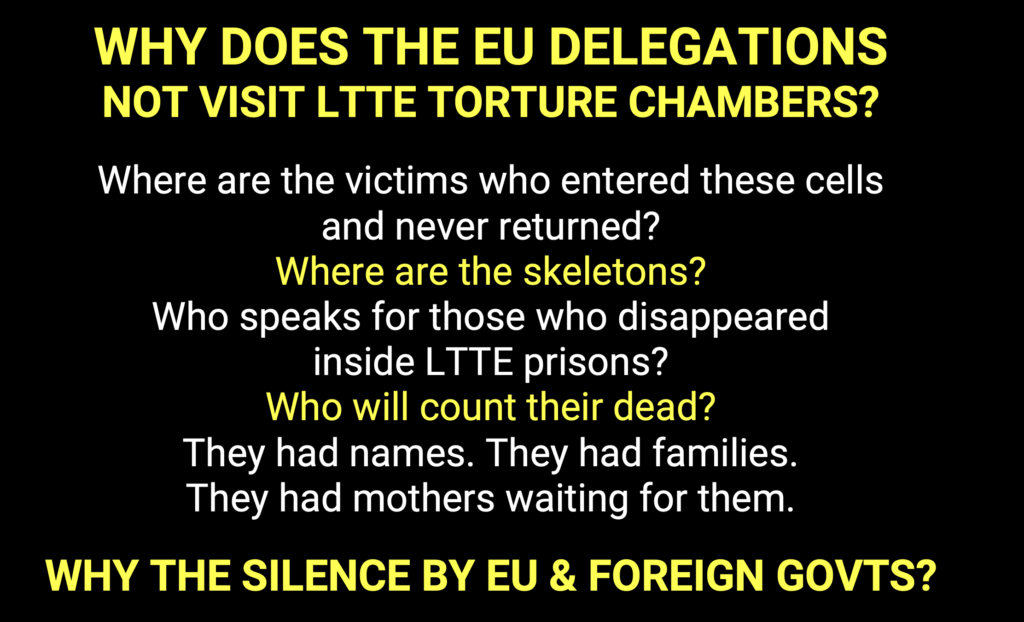
The European Union delegation has travelled to Chemmani in the name of truth, accountability and justice. That raises a question that every Sri Lankan—regardless of ethnicity or political persuasion—has a right to ask: Why only Chemmani? Why is the delegation not visiting the documented LTTE detention and torture centres at Thunukkai, Chavakachcheri, Jeevan Base, Kachchai and Kopay where LTTE had its cemetary? If the search for truth requires forensic investigation, then why has the international community not demanded the same scrutiny of locations where thousands of Tamils, Muslims and Sinhalese were allegedly detained, tortured and disappeared under LTTE control?
This is not the first time international attention has focused on locations connected to allegations against the State while questions remain unanswered about victims of LTTE crimes. Previous visits by international human rights officials have raised similar concerns among Sri Lankans who ask why victims of LTTE violence receive far less attention.
For years, international institutions have called for investigations into allegations arising from the conflict. Yet one uncomfortable reality remains: the crimes committed by the LTTE against Tamils, Muslims and Sinhalese have often received far less international attention than allegations against the State.
This is a call to stop ignoring the other victims. Tamils were not the ONLY victims.
The uncomfortable truth is that many Tamil victims have two stories: they suffered because of the conflict, but some also suffered because of the LTTE.
The Tamil community itself included victims of LTTE executions, disappearances, forced recruitment, extortion, censorship and punishment for dissent. Their suffering cannot be erased simply because the perpetrators were a non-state actor.
The LTTE did not only kill members of the Sri Lankan armed forces or Sinhalese civilians. It also killed Tamils who disagreed with it. Why are those Tamil victims denied equal recognition?
https://www.youtube.com/watch?v=4SdyCLseh3g
https://www.facebook.com/share/p/1E3xyJ1xCN/
But accountability cannot be a one-way process. A conflict does not produce only one category of victim and one category of perpetrator. The LTTE was not a political movement without responsibility; it was an internationally proscribed terrorist organisation that carried out assassinations, massacres, ethnic cleansing, forced recruitment, child soldier recruitment, bombings and internal repression against communities it claimed to represent.
Yet the international narrative after 2009 has often created the impression that Tamils were only victims of the State, while overlooking the thousands of Tamils who suffered under LTTE rule itself.
This concern over selective attention is not new.
For years, Sri Lankans have questioned why international mechanisms have focused overwhelmingly on alleged violations by the State while the extensive record of LTTE violence—including assassinations, ethnic cleansing, forced recruitment, child conscription, torture, disappearances and attacks against Tamil, Muslim and Sinhalese civilians—has received comparatively limited attention.
A genuine commitment to human rights cannot begin and end with one category of victim. It must include every victim, regardless of who the alleged perpetrator was.
The LTTE maintained documented detention centres, including Thunukkai, Chavakachcheri, Kachchai and Kopay. Contemporary reports by Amnesty International and the University Teachers for Human Rights (Jaffna) describe arbitrary detention, harsh prison conditions and allegations of torture at these sites. Many reportedly disappeared after being taken into LTTE custody.
If accountability is truly universal, why are these LTTE detention centres being ignored.
Chemmani is now receiving international attention based on heavy lobbying by LTTE diaspora.
This was clearly visible when the UNHRC Head arrived to visit Chemmani & LTTE flags surrounded the entire site exposing the organizers.
If graves, remains and missing persons are matters of international concern, then the same questions must be asked about every location where people are alleged to have disappeared—including former LTTE detention and torture centres.
The question is not whether Chemmani should be investigated.
The question is why other documented locations have not received the same urgency.
Chemmani is being presented as a place where forensic investigation may reveal the fate of victims. If forensic science is the pathway to truth, then the same standard must apply to every location where people are alleged to have been detained, tortured, disappeared or killed.
Where are the forensic investigations into the people who disappeared inside LTTE detention centres?
- Has the EU delegation visited these former LTTE detention centres?
Where are the records of those taken into LTTE custody and never returned?
- Has the EU sought to establish how many people were detained there?
Where are the remains of those alleged to have died inside these torture camps?
- Has the EU asked how many disappeared after entering them?
Where are the skeletons of those victims?
- Where are the remains of those who entered LTTE detention centres and never returned?
- Where are the names of those who disappeared inside LTTE prisons?
- Where are the forensic teams? Where are the international investigators? Where are the demands for excavation, identification and accountability?
- Why does forensic urgency appear only when the alleged perpetrator is the State?
- Has the EU even asked who died in these centres & where their skeletons are?
- Has the EU called for comprehensive forensic investigations at these sites?
- Has the EU examined whether those who never returned from LTTE custody have been properly accounted for?
If the international community demands answers from one side, it must also demand answers from the other.
Why does international curiosity end where LTTE responsibility begins?
- Why are some victims the subject of repeated international missions, while others remain largely invisible?
- Why do some alleged crime scenes attract diplomats, media crews and international campaigns, while documented LTTE detention centres rarely feature on official itineraries?
These are not questions about ethnicity.
They are questions about credibility.
Justice loses its moral authority when it appears selective.
Human rights lose legitimacy when compassion is shown to some victims but not others.
Accountability becomes political when investigators pursue one narrative while overlooking another.
The families of those who disappeared after being taken into LTTE custody deserve answers.
The victims of LTTE torture deserve recognition.
The relatives of those who never came home deserve the same commitment to truth that is demanded elsewhere.
A victim does not become less worthy of justice because the person who harmed them wore no uniform.
A disappearance does not become less serious because it occurred inside territory controlled by a terrorist organisation.
A grave does not become less important because the victims were killed by a group rather than a government.
If the EU delegation genuinely seeks justice for all victims of Sri Lanka’s conflict, then its work should not end at Chemmani. If it does – it exposes the EU delegation for hypocrisy.
Therefore the EU delegation is morally bound to visit all LTTE detention centres & ask the same questions.
It should visit Thunukkai.
Then Chavakachcheri.
Then Kachchai.
Then Kopay.
Only by applying the same standards to every allegation—regardless of the identity of the alleged perpetrator—can the international community credibly claim to stand for universal human rights. If not their foreign visits become a sham.
The credibility of international human rights advocacy depends on consistency.
The issue is not whether victims deserve justice.
Every victim deserves justice.
The issue is whether justice is being applied equally.
The LTTE was not merely a participant in the conflict. It was an armed terrorist organisation responsible for assassinations, massacres, ethnic cleansing, forced recruitment, child conscription, disappearances, torture and attacks against civilians—including Tamils, Muslims and Sinhalese.
Yet the international narrative surrounding Sri Lanka’s conflict has often focused overwhelmingly on alleged violations by the Sri Lankan Armed Forces, while the crimes committed by the LTTE have received far less scrutiny.
A genuine search for truth cannot transform one party into the sole perpetrator and erase the crimes of another.
A genuine commitment to human rights cannot recognise only those victims who support a particular narrative while overlooking those who suffered under LTTE control.
The families of those who disappeared into LTTE detention camps deserve answers.
The Tamil victims of LTTE violence deserve recognition.
The victims of LTTE torture deserve justice.
The question Sri Lankans continue to ask is simple:
Is the international community truly searching for the complete truth of Sri Lanka’s conflict — or is it selecting only those facts that support a predetermined narrative?
Shenali D Waduge