The Zaharan Trail: How years of Radicalisation, Warnings and Missed Intervention Challenge the “Mastermind” Theory promoted by Cardinal & Church Elements
Cardinal Malcolm Ranjith and certain elements within the Church, particularly after 2021, have advanced the position that Easter Sunday was not solely the result of Islamist extremism but involved an external political actor who allegedly manipulated Zaharan Hashim to achieve a political objective. Such a serious allegation requires evidence capable of establishing the alleged chain of command — who recruited Zaharan, when such recruitment occurred, how control was exercised, who financed the operation, who directed operational decisions and what evidence demonstrates that Zaharan and the attackers acted under external command. Zaharan was influenced and inspired by global extremist ISIS ideology wanting to make Sri Lanka an ISIS stronghold but this does not necessarily imply he was controlled by it as his evolution shows.
The allegations surrounding Maj. Gen. Suresh Sallay emerged following claims made by Asad Maulana, who inserted Easter Sunday into his narrative while naming Sallay. These claims require verification through evidence, not assumption. Asad Maulana left Sri Lanka and sought asylum overseas after facing legal issues, yet those promoting the mastermind theory have still not produced verifiable evidence demonstrating how, when or through whom Zaharan was allegedly controlled.
The central problem with this theory is the documented timeline of Zaharan Hashim himself. The evidence shows an ideological evolution that began years before Easter Sunday — including his exposure to extremist ideology, establishment of his own organisations, conflicts with Sufi Muslims, complaints against him by members of the Muslim community, public extremist statements, recruitment of followers, training activities and preparation for violence.
A terrorist network involving recruitment, indoctrination, funding, training, logistics and operational planning cannot be created overnight for a single political objective in 2019. Therefore, if Zaharan was merely a person “created” or “activated” in 2019 by an external mastermind, the fundamental question remains: How does such a theory explain the events surrounding Zaharan from 2005, 2009, 2014, 2016, 2017 and 2018 — years before Easter Sunday?
The First Problem with the “Mastermind” Theory: Zaharan existed long before Easter Sunday
- Born 1985
- Radicalisation process began years before Easter
- Exposure to Wahhabi ideology through religious networks
- Established organisations before 2015
- Developed ideological disagreements with Sufi Muslims
- Built his own network
A person who spent over a decade building an ideological identity, recruiting followers, attacking rival Muslim groups, establishing organisations and publicly promoting extremist ideas cannot logically be described as a person suddenly activated by an external political mastermind in 2019.
The Sufi Muslim complaints destroy the “Unknown Actor” narrative
2013–2014 complaints
- 11 complaints by Alhaj Abdul Jawaadh Alim Waliullah Trust
- Complaints against Zaharan
- Complaints regarding threats against Sufi clerics
- Police involvement
- Court proceedings
1 May 2014 Major General Lal Perera:
- received complaint
- summoned Zaharan
- warned him against violence
Before Easter Sunday, Zaharan was not unknown to Sri Lanka.
He was already identified by members of the Muslim community themselves as a dangerous extremist personality.
This directly destroys:
“Someone created Zaharan later.”
Because the complaints filed were against Zaharan were by Muslims themselves.
If Zaharan was a manufactured operative created for a future political objective:
Why was he already developing an ideological movement more than a decade earlier?
The earliest warnings came not from foreign actors.
They came from:
Sri Lankan citizens and Sri Lankan religious communities.
This demonstrates:
- local grievances,
- local ideological conflict,
- local escalation.
The NTJ timeline contradicts the Political Conspiracy Theory
2005/2006 – Zaharan created Darul Adhar ad Da’iyyah (not NTJ) in Kattankudy.
This organisation was associated with propagation of Wahhabi-oriented ideology.
Zaharan was expelled from Darul Adhar ad Da’iyyah.
He then developed his own following. This shows his ideological development.
2015/2016 – NTJ formed – National Thowheed Jama’ath
The organisation associated with Easter Sunday did not suddenly appear in 2019.
He even supported the yahapalana alliance in 2015 to come to power. This shows his political engagement & direct negotiations with leaders of political parties. It was he & no other who issued conditions to political parties. He was not issuing conditions on behalf of any “mastermind”.
This also shows that NTJ & Zaharan was powerful enough for Muslim political parties & their leaders to reach out to him for election support.
The 2016 Turning Point:
Public records reveal how Zaharan Hashims Radicalisation turned into Violence
- Facebook posts supporting IS ideology
- references to Abu Bakr al-Baghdadi
- justification of killing non-Muslims
- ISIS videos
- Caliphate discussions
September 2016 onwards:
NTJ sermons covered:
- Islamic State
- Caliphate
- Bay’ah
- jihad
December 2016:
Zaharan sermons covered:
- swords
- fighting enemies
- willingness to die
By the end of 2016, according to the Presidential Commission of Inquiry, Zaharan had progressed beyond ideological extremism into violent extremism.
If the objective was only an election conspiracy in 2019, why was Zaharan promoting ISIS ideology three years earlier? Can Cardinal Malcolm & the Church answer.
The Biggest Contradiction: Foreign ISIS links were known before 2019
Sri Lankan ISIS fighters:
- Mohomed Muhushin Ishak Ahamed – Syria 2013
- others joining ISIS 2014–2015
ISIS WAS A GLOBAL INFLUENCE — NOT A NEW CREATION OF ZAHRAN
Sri Lanka already knew:
- approximately 38 Sri Lankans had travelled to Syria
- then Justice Minister Wijayadasa Rajapakse revealed how Muslims from 4 families left for Syria to join ISIS.
- ISIS recruitment networks existed,
- foreign fighter movements were occurring.
- 2014 Asian Islamic Caliphate declared with Sri Lanka included in map.
ISIS influence explains the ideological environment.
It does not prove:
- an external mastermind planned Easter Sunday,
- Zaharan was created by outsiders.
- Influence is not operational command.
The ISIS threat was not introduced to Sri Lanka through Easter Sunday.
It was already a recognised security concern.
2016-2018 – ZAHRAN OPENLY MOVES TOWARDS ISIS IDEOLOGY
- promoted ISIS-aligned content,
- discussed Caliphate,
- referred positively to Baghdadi,
- circulated extremist material.
- Foreign fighter networks forming
- Sri Lanka received Pakistan intelligence warnings
PUBLIC RADICALISATION AND VIOLENCE
Zaharan publicly spoke about:
- jihad,
- Islamic State,
- swords,
- killing enemies.
- March 2017: Aliyar Junction violence involving swords.
The movement was already demonstrating:
- ideology,
- followers,
- organisation,
This is a progression. Not a sudden activation.
2017–2018 – FROM IDEOLOGY TO MILITANT STRUCTURE
- Training activities:
- firearms training,
- explosives training,
- militant indoctrination.
- Participants later became Easter Sunday attackers.
A mastermind theory requires showing:
“Who built this network?”
But the evidence shows:
- recruitment,
- training,
- indoctrination,
- preparation
were already occurring within Zaharan’s own network by Zaharan.
If an external mastermind created Zaharan in 2019:
Why was Zaharan openly expressing ISIS ideology from 2016?
The March 2017 Sword Incident: The Missed Arrest Question
- Aliyar Junction incident
- NTJ-linked violence
- swords
- complaints
Intelligence agencies collect information.
Police investigative agencies including CID & TID have legal powers of arrest.
- Who headed CID?
- Who headed TID?
- What investigation was conducted?
- Why was Zaharan not arrested?
“Why did institutions with legal powers fail to act?” even when arrest warrants were issued.
Training Camps destroy the “External Puppet” Theory
2018:
- Lewella
- Nuwara Eliya
- Hambantota
- Activities:
- weapons training
- firearms
- explosives
- ISIS indoctrination
A sophisticated training network does not appear overnight.
It requires recruitment, funding, logistics, locations and time.
Therefore:
The question is not: “Who suddenly manipulated Zaharan?”
The question is: “How did an internally developed terrorist infrastructure continue operating despite multiple warning signs?”
2018
Mawanella:
Evidence of:
- extremist attacks,
- safe houses,
- network movement.
Wanathawilluwa: Proof of terror infrastructure
Recovered:
- explosives,
- chemicals,
- detonators
- ISIS material.
CID Director Shani Abeysekera’s own statement: The material could have facilitated multiple attacks.
Wanathawilluwa was not the beginning of the conspiracy.
It was evidence that the conspiracy already existed.
A terrorist network was already operational.
The question becomes:
Not:
“Who created Zaharan?”
But:
“Why was an already developing network not dismantled?”
The Evidence Trail before Easter Sunday: Vavunativu, Mawanella and Wanathawilluwa destroy the “Sudden Discovery” Narrative
The argument that Zaharan’s network was unknown until the Easter Sunday attacks cannot withstand the documented sequence of events between 2018 and April 2019.
The evidence shows that by early 2019, multiple agencies had accumulated information linking Zaharan’s group to extremist violence, weapons, explosives, training and preparation for future attacks.
Vavunativu Police Killings: The First Major link to Zaharan’s Network
- On 30 November 2018, two police officers stationed at Vavunativu were killed.
- Initially, suspicion was directed towards remnants of the LTTE due to the location and historical context.
- However, subsequent intelligence assessments changed this understanding.
- The Directorate of Military Intelligence (DMI) informed CID by letter dated 12 April 2019 that intelligence indicated the involvement of Zaharan’s group.
This is significant because:
- the incident was no longer only an LTTE-related investigation;
- Zaharan’s network had entered the official security picture;
- the possibility of an emerging Islamist extremist network committing organised violence was identified.
The key question therefore becomes:
After receiving intelligence linking Zaharan’s network to the killing of police officers, what further investigative action was taken even after IGP also visited the crime scene?
Mawanella Buddha Statue attacks: From Ideology to Operational Activity
The December 2018 Mawanella Buddha statue attacks provided another major warning indicator.
Following the arrests:
Investigations revealed links to Zaharan’s group and exposed:
- recruitment networks,
- safe houses,
- movement of suspects,
- extremist indoctrination,
- preparation for future attacks.
The arrested suspects provided information indicating:
- they had undergone training,
- weapons handling was involved,
- safe locations were being arranged,
- Zaharan’s network was preparing members for violent activity including suicide.
This was no longer merely ideological expression.
This was operational preparation.
Wanathawilluwa: The Point where denial became Impossible
In January 2019, CID discovered the Wanathawilluwa explosives cache.
Recovered items included:
- explosives,
- chemicals,
- detonators,
- ISIS-related material,
- bomb-making equipment.
This discovery represented a critical turning point.
Wanathawilluwa was not the beginning of the threat.
It was evidence of a terrorist infrastructure that had already developed.
At this stage authorities had:
- a known extremist leader
- identified associates – including potential suicide cadres
- extremist propaganda
- weapons training indicators
- explosives capability
- links to ISIS ideology
The question was no longer:
“Was Zaharan dangerous?”
The question was:
“Why was a national-level prevention mechanism not activated?”
The CID/TID defence of being “Misled” Requires Examination
The suggestion that investigative agencies were unable to act because intelligence agencies failed to provide information is difficult to reconcile with the timeline.
By January 2019, CID itself had discovered the Wanathawilluwa explosives cache.
This was not merely an intelligence warning.
This was physical evidence.
Furthermore:
- the Vavunativu intelligence connection,
- the Mawanella investigations,
- the Wanathawilluwa discovery,
created a cumulative evidentiary picture.
The agencies responsible for investigation and arrest had:
- suspects,
- evidence,
- locations,
- networks,
- extremist indicators.
Therefore, the central issue is not whether information existed.
The issue is:
Why did accumulated intelligence and investigative evidence not translate into preventive action?
They could have either arrested the gang or prevented the targets from being attacked.
April 2019: Foreign Intelligence only confirmed what was already known
The April 2019 Indian intelligence warnings were therefore not the first indication of danger.
They were an additional confirmation of an already developing threat.
Before Indian intel warnings:
Sri Lankan authorities had:
- prior complaints against Zaharan,
- hundreds of reports compiled by SIS on Zaharan
- intelligence on extremist activities,
- knowledge of ISIS links,
- evidence from Wanathawilluwa,
- information from Mawanella investigations,
- intelligence linking Zaharan’s group to violence.
The April Indian warnings added:
- names,
- targets,
- methods,
The failure was therefore not discovery.
The failure was inability to prevent.
The central question:
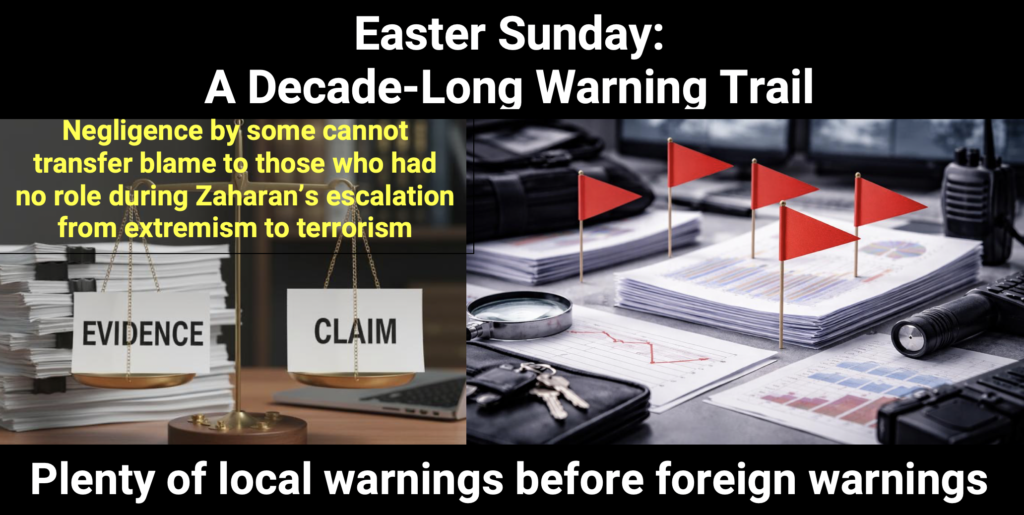
Was Easter Sunday caused by a hidden mastermind, or in reality by the failure of multiple institutions to act on accumulated intelligence received well in advance as well as knowledge of a history of evidence of Zaharan’s extremist actions?
The Cardinal / Church “Mastermind” Theory Faces a Timeline Problem
The theory that Easter Sunday was orchestrated by an external political mastermind requires the public to ignore an inconvenient timeline:
- years of radicalization of Zaharan
- complaints by even Muslims against Zaharan
- public extremist sermons,
- foreign fighter networks,
- weapons training and
- repeated warnings (within Sri Lanka far before foreign warnings)
A conspiracy theory cannot negate a decade-long trail of documented behavior that evolved from extremism to terrorism.
Terrorists evolve over years. No one can create a terrorist overnight.
“Who benefited?”
Architects of the conspiracy theory must answer:
- Who controlled Zaharan from 2005?
- Who controlled NTJ from 2016?
- Who controlled ideological development?
- Who controlled training camps?
- Who supplied explosives?
- Who recruited suicide bombers?
- Who provided financial support?
The external “mastermind” promoters must also answer – If Zaharan was created for political purposes:
Why did he:
- attack Sufi Muslims?
- Declare to kill non-Muslims?
- reject democracy?
- attack Parliament?
- oppose political systems?
His ideology was against the very political system he was allegedly created to influence. How can Cardinal & the Church explain this?
The Easter Sunday attacks were not the result of an unknown actor appearing suddenly in 2019. They were the culmination of a visible escalation: ideological radicalisation, public extremist preaching, violence against opponents, weapons training, explosives preparation and operational planning. The unanswered question is why institutions empowered with investigative and preventive authority did not neutralise the threat despite possessing multiple warning indicators.
The Easter Sunday tragedy was not the product of a man who suddenly appeared in 2019 or one who was being externally manipulated. Across his evolution there was no visible trace of any person steering him.
Easter Sunday was the final stage of a radicalization process that developed over years, visible to his own community, security agencies and authorities.
The tragedy demands accountability — not through replacing evidence with theories, but through examining why warnings, complaints and intelligence failed to become prevention.
Unlike LTTE terror attacks, Easter Sunday could have been prevented. If the agencies empowered to arrest failed to arrest him, they could have prevented people entering churches & jointly carried search operations with hotels on those who had booked into hotel the day before the attacks.
Why the officers who had powers to prevent did not do so has yet to be answered & the Cardinal & Church do not appear to be too keen to demand answers from them either.
Those promoting the mastermind theory have thus far failed to provide evidence of direct communication between Zaharan & the alleged mastermind, instructions issued by the alleged controller, financial transfers by the mastermind, operational orders of the controller, recruitment criteria given by controller, evidence that Zaharan acted as per orders or contrary to orders!
However, against the above unanswered claims are evidence of Zaharan being a known extremist, having his own extremist network & followers, plethora of police complaints, intelligence reports, statistics of violence, training camps teaching handling of weapons, explosives and allocating students as suicide cadres and violent actors.
Justice for the victims deserves truth. Truth comes with accountability. Accountability requires identifying those who failed in their duty – failed to take decisions that could have averted a tragedy. Accountability cannot be achieved by replacing evidence with mastermind theories & transferring blame on those who have no proven link to the attacks.
Shenali D Waduge