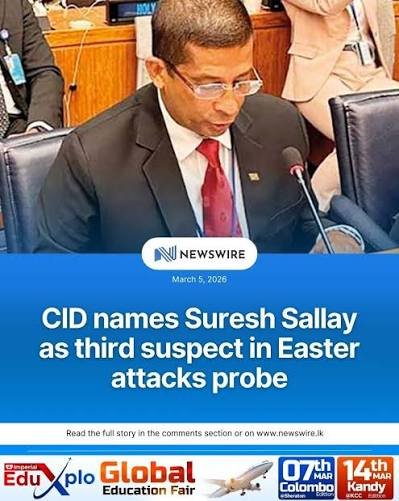
23,000 Charges, 25 Accused — What changed to make Suresh Sallay the Third Accused in 2026?
Seven years after the Easter Sunday attacks, the public is still searching for answers.
In February 2026, retired Major General Suresh Sallay was arrested under the PTA and placed in CID custody under a Presidential Detention Order.
When the media asked the police spokesman the grounds for his arrest, the response was that further investigation was required. When the Magistrate asked CID what charges had been filed, the position was that no charges had yet been filed.
Six months later, with another extension reportedly due, the fundamental question is simple: What has the investigation established since February 2026 that now justifies continuing his detention? Extraordinary detention requires an identifiable legal and evidentiary basis. PTA cannot be used for political vendettas.
The 23,000-Charge Question
The Easter Sunday attacks had many investigations.
There were CID investigations, intelligence investigations, a Presidential Commission of Inquiry, a Parliamentary Select Committee, Supreme Court proceedings and international intel investigative material.
The Attorney General’s Department subsequently proceeded against approximately 25 accused on more than 23,000 charges, following years of investigation and a vast body of evidence.
Yet Sallay was not among those accused.
Now, in 2026, he has emerged as the third accused.
What changed?
If the evidence now relied upon against Sallay already existed when the State formulated its Easter Sunday prosecution, why was he not included?
If it did not exist, when did it emerge, who produced it and how was it verified?
The Public deserves answers.
The Allegations Were Already Public in 2021
The allegations against Sallay did not begin in 2026.
In October 2021, Father Cyril Gamini publicly made allegations linking Sallay to Zaharan and presented him as the head of Military Intelligence during the relevant period.
Sallay’s lawyers responded through a Letter of Demand dated 29 November 2021, denying the allegations and setting out his actual service history, including his overseas postings.
The allegations were therefore already public and had been formally challenged more than four years before Sallay’s arrest.
If substantially the same allegations are now being relied upon, the question is:
What independent evidence emerged between 2021 and 2026?
The “DMI” Claim — How Did It Re-Enter?
The issue becomes more serious because Cardinal Malcolm Ranjith’s 2026 intervening petition, filed in the proceedings concerning Sallay’s arrest, also described Sallay as Director of Military Intelligence during the period of the Easter Sunday attacks.
But Sallay was not DMI in April 2019.
He had been posted overseas from 2016 and returned to Sri Lanka only in December 2019, when he became Director of SIS.
The Justice S.I. Imam-led Committee subsequently examined the allegations concerning Sallay and recorded that there was “no evidence at all” linking him to Zahran or members of NTJ. It also described his alibi as “an irreversible fact.”
This creates a direct evidentiary question:
- If Sallay was not DMI during Easter Sunday, how did that factual proposition enter both the public narrative and a court petition?
More importantly:
- Is the present CID case based, directly or indirectly, on the same 2021 narrative?
If it is, what evidence does CID possess to establish that proposition despite Sallay’s documented service history and the findings of the Imam Committee – he was DMI head during the Easter Attacks as claimed by Fr. Cyril & Cardinal?
If it is not, then CID should identify the independent evidence upon which the 2026 case rests.
A repeated allegation does not become new evidence merely because it is repeated.
The Channel 4 / Asad Maulana Evidence
If the present investigation arose from the Channel 4 documentary and allegations attributed to Asad Maulana, the CID must explain how those allegations were assessed.
The Justice S.I. Imam-led Committee subsequently examined these allegations. In relation to Sallay, the Committee recorded that there was “no evidence at all” linking him to Zahran or members of NTJ, described his alibi as “an irreversible fact” and found the alleged Karadiyapuval meeting to be “demonstrably a hoax.”
This does not legally prevent CID from investigating further. A committee finding is not a substitute for a criminal trial, and genuinely new evidence may justify reopening or pursuing an investigation.
But CID cannot simply rely on the same allegations without explaining what evidence now exists that was not before the Imam Committee.
If CID has now reached a different conclusion, the question is straightforward:
- What new evidence justifies departing from the findings of the Justice Imam Committee?
If such evidence exists:
- When was it obtained?
- Who provided it?
- How was it independently verified?
- Why was it not before the Imam Committee?
- Does it directly contradict the Committee’s findings?
More importantly:
- Did CID independently investigate and establish the reliability of the Channel 4 allegations before relying upon them against Sallay?
- If so, what evidence emerged from that investigation?
And if there is no new evidence:
- On what evidentiary basis are allegations examined by a Justice-led Committee and found unsupported now being relied upon to justify Sallay’s arrest and continued detention under the PTA?
The Missing CID–Attorney General’s Department Timeline
The CID investigates.
The Attorney General’s Department provides legal advice and conducts prosecutions.
The public is therefore entitled to know the sequence that led to Sallay’s arrest.
- When did CID first begin treating Sallay as a suspect?
- Was this before or after the existing Easter Sunday prosecution?
- When did CID first place the alleged evidence against Sallay before the Attorney General’s Department?
- Was legal advice sought before or after his arrest?
- Did CID’s investigation independently lead to Sallay, or did the present investigation arise following material or representations placed before the Attorney General’s Department?
And:
Why was the PTA necessary rather than the ordinary criminal process?
If there was sufficient evidence to identify Sallay as the third accused, why could he not have been dealt with through the ordinary criminal justice process?
Six Months Later — What Justifies Another Three?
The justification for an initial detention is not automatically the justification for extending it.
After six months, the authorities should be able to identify:
- what evidence has been obtained;
- what investigation remains incomplete; and
- why that investigation requires Sallay to remain physically detained.
- “Investigations are continuing” does not, by itself, explain why continued PTA detention is necessary.
If there is sufficient evidence to prosecute, prosecute.
If further investigation is genuinely required, explain what remains to be established and why continued detention is essential.
Three Institutions Now Owe the Public Answers
CID
What new evidence transformed Suresh Sallay from a person outside the approximately 25 accused in the existing Easter Sunday prosecution into the third accused in 2026?
Attorney General’s Department
When did you become involved, what evidence was placed before you, and why was extraordinary PTA detention considered necessary?
And specifically:
How does the evidence now relied upon fit into the existing prosecution involving more than 23,000 charges?
The President and Government
A Presidential Detention Order represents the exercise of extraordinary executive power.
Therefore:
What material was placed before the President to justify the original detention, and what new basis now exists to justify another three months after six months have already passed?
This Is Not a Demand for Immunity
Nobody is asking that Suresh Sallay be above the law.
If he committed an offence, he should face the law.
But the same law requires the State to justify the extraordinary deprivation of liberty.
The Easter Sunday attacks have already produced:
- years of investigation.
Multiple official inquiries.
Thousands of witnesses.
Approximately 25 accused.
More than 23,000 charges.
Against that background, the emergence of Sallay as the third accused in 2026 demands an explanation.
The central issue is no longer simply:
“Why was Suresh Sallay arrested?”
It is:
What changed between the State’s earlier investigation and February 2026?
And after six months of detention:
What new evidence exists, what remains to be investigated, and why does it require another three months of PTA detention?
If there is compelling evidence, bring it before the court.
If there is sufficient evidence to prosecute, prosecute.
But if the State is relying on genuinely new evidence, identify its existence and chronology.
After seven years of investigation, a massive prosecution, more than 23,000 charges and approximately 25 accused, the public is entitled to ask one blunt question:
WHAT EXACTLY WAS DISCOVERED THAT SUDDENLY MADE SURESH SALLAY THE THIRD ACCUSED IN 2026?
Shenali D Waduge