SURESH SALLAY – THE GOVERNMENT’S RESPONSE TO UN RAISES MORE QUESTIONS THAN ANSWERS
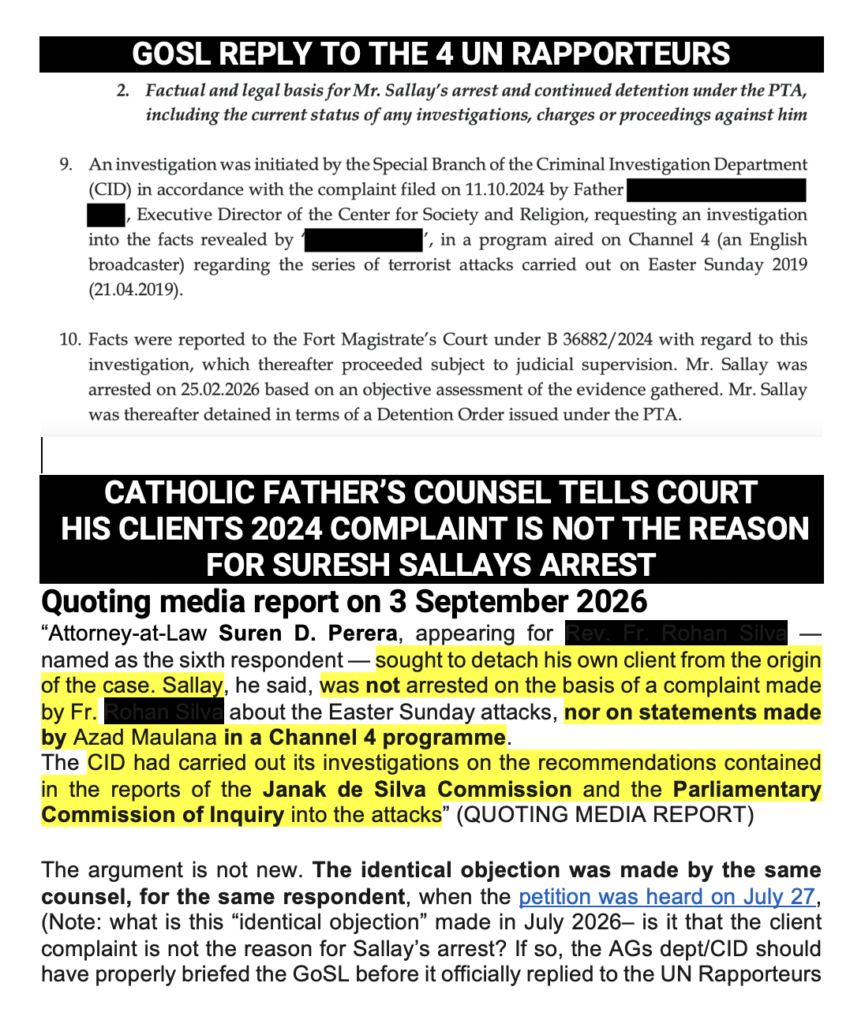
What the Sri Lankan Government has told the United Nations — and what the AG’s Department and CID have placed before Sri Lankan courts — contains statements that require reconciliation.
The Government of Sri Lanka has now responded to the Joint Urgent Appeal made by four UN Special Procedures concerning the arrest and detention of retired Major General Suresh Sallay.
The Government’s response repeatedly assures the UN of its commitment to human rights, due process, judicial independence and the prohibition of torture.
https://spcommreports.ohchr.org/TMResultsBase/DownLoadPublicCommunicationFile?gId=31125&
Assurances are not answers.
The Government’s response to the July 2026 UN letter raises a number of questions when compared with what has subsequently been placed before the Fort Magistrate’s Court and the Court of Appeal.
The issue is whether the State has provided one coherent account of the basis on which Suresh Sallay was arrested, what evidence existed when he was arrested, what changed thereafter, and what has actually been established since.
-
THE GOVERNMENT’S OWN ACCOUNTS RAISE A FUNDAMENTAL QUESTION:
WHAT WAS THE BASIS FOR THE ARREST?
The Government states in its response to the UN Special Procedures:
“An investigation was initiated by the Special Branch of the Criminal Investigation Department (CID) in accordance with the complaint filed on 11.10.2024…”
This was the complaint filed by a Catholic Father.
It further states that Sallay was arrested on 25 February 2026 following an “objective assessment of the evidence gathered.”
What was the objective assessment of evidence the CID investigation produce between October 2024 and February 2026 that formed the basis for Sallay’s arrest?
The existence of a complaint is not the same as evidence proving the allegations.
WHAT WAS THE BASIS GIVEN BEFORE THE COURT OF APPEAL?
However, on 3 September 2026, counsel appearing for the Catholic Father told the Court that Sallay:
- was not arrested on the basis of the Catholic Fathers October 2024 complaint;
- was not arrested on the basis of Azad Maulana’s Channel 4 statements; and
- was arrested following a CID investigation based on the
- Janak de Silva Commission report and
- recommendations of the Parliamentary Select Committee/Commission of Inquiry.
https://lankanewz.com/article/2026-09-03-sallay-court-appeal-september-18/
WHAT DOES “THE SAME OBJECTION WAS MADE IN JULY” MEAN?
The 3 September 2026 media report states that counsel for the sixth respondent, a Catholic Father, told the Court that Sallay was not arrested on the basis of Catholic Fathers complaint or Azad Maulana’s Channel 4 statements, but following recommendations of the Janak de Silva Commission and Parliamentary Commission of Inquiry.
The report then states:
“The argument is not new. The identical objection was made by the same counsel, for the same respondent, when the petition was heard on July 27.”
What exactly was this “identical objection” made in July?
If by ‘identical objection’ in July 2026, the report means the Fathers complaint was not the basis for Sallay’s arrest, then the Government must explain how its reply to the UN Rapporteurs states that the CID investigation was initiated pursuant to the Faathers complaint of 11 October 2024.
There appears to be a discrepancy between the Government’s written response to the UN and the submission made by counsel for the Catholic Father before the Court of Appeal.
- The GoSL written response to the UN Rapporteurs says the investigation was initiated in accordance with the October 2024 complaint and that the arrest followed an “objective assessment of the evidence gathered.
- The Counsel for the Catholic Father told Court in September 2026 that the CID investigation was based on the Janak de Silva Report and recommendations of the Parliamentary Select Committee/Commission of Inquiry and not his clients complaint.
THE ARREST TIMELINE RAISES ANOTHER ISSUE:
- 25 February 2026: Sallay was arrested by the CID. Police Media did not publicly state the specific reason for the arrest when questioned by media.
- 4 March 2026: When produced before the Magistrate, he had reportedly not yet been named as a suspect, CID did not provide court the charges.
Then the next day
- 5 March 2026: CID named him as the third suspect, referring to evidence that had emerged.
The Government therefore needs to explain two things:
What evidence existed on 25 February that justified the arrest?
What additional evidence emerged by 5 March that resulted in Sallay being named as the third suspect?
WHAT DID THE JANAK DE SILVA REPORT ACTUALLY SAY ABOUT SALLAY?
The Counsel for the Catholic Father tells the Court that the arrest was based on the Janak de Silva Report & Recommendations of the Parliamentary Select Committee and not the complaint filed by his client.
- If the Janak de Silva report was a basis for the investigation and not Channel 4 & the Catholic Fathers complaint, the Government should identify the specific finding, page and evidence in that report connecting Sallay personally to an alleged offence.
- If the recommendations of the Parliamentary Select Committee was the basis for the arrest, the Government should quote the specific recommendation against Sallay.
- If neither the Janak de Silva Commission nor the Parliamentary Select Committee has identified him, the UN and the public deserve to know exactly what evidence connected him to an alleged offence and formed the basis for his arrest.
- There is also a documentary discrepancy: the Government’s UN response refers to B 36882/2024 in one passage and B 35882/2024 in another, while the domestic record refers to B/35882/24.
The Government should clarify whether this is simply a clerical error.
In summary – the UN Rapporteurs deserve to be appraised of
What triggered the investigation
- If it was the October 2024 Catholic Fathers complaint or the Janak de Silva/PSC reports
- What evidence existed to warrant arrest on 25 February 2026 under PTA/Presidential Detention
- What the investigation and subsequent detention have established regarding the Easter Sunday attacks
- What connects Sallay to the Easter attacks
-
WHAT DID THE CID ACTUALLY HAVE BEFORE THE ARREST?
The Government tells the UN that Sallay was arrested following an “objective assessment of the evidence gathered.”
That phrase is important.
It raises a simple question:
What evidence?
No one is asking investigators to reveal every operational detail of an ongoing investigation.
The question is narrower:
What evidence transformed the investigation into grounds for arrest under the PTA?
Is Sallay being investigated for alleged aiding, abetting or conspiracy in relation to the Easter Sunday attacks,
or
for negligence/failure to act in the discharge of official duties?
What specific act is he alleged to have committed?
The two existing indictments make it important to identify what separate evidence now forms the basis of the case against Sallay.
The existing indictments set out the alleged acts, actors and evidence relating to the Easter Sunday attacks. Sallay was not among those charged in the principal case, and the prosecution of those accused proceeded without Sallay being named as one of the defendants.
The Government, CID and Attorney General’s Department therefore need to explain what separate evidence now forms the basis of the case against Sallay.
Sallay was not holding a military or intelligence position in Sri Lanka from 2016 to the end of 2019. However, the Cardinal’s intervening petition before Court has described him as the DMI head during this period.
Sallay was on a diplomatic posting to Malaysia and subsequently attending the National Defence College in India during 2019.
By contrast, the former IGP and former Defence Secretary faced proceedings concerning failure to act on warnings and the deaths resulting from the attacks.
The aiding & abetting case was filed against 24 Muslims and concluded recently with 9 acquittals for lack of evidence & 15 convictions. Not only Sallays name was not on this list none of the accused has even mentioned his name.
Taken together, these two lines of accountability make one question unavoidable: what, specifically, is Suresh Sallay alleged to have done, and under which legal basis is he being detained?
The Government, CID and Attorney General’s Department need to explain the evidentiary and legal basis without simply extending Presidential detention.
-
THE AZAD MAULANA QUESTION CANNOT SIMPLY DISAPPEAR
The 2024 complaint by a Catholic Father arose from allegations associated with the Channel 4 programme and Azad Maulana.
A substantial portion of Maulana’s broadcast has subsequently been challenged in an affidavit. The affidavit alleges that Maulana initially sought asylum on the basis of differences with Pillayan, that those applications were unsuccessful, and that he was subsequently advised to make allegations concerning military/intelligence/State involvement in the Easter Sunday attacks, with the prospect of citizenship for claiming such.
The affidavit further alleges that Maulana initially refused to make such allegations before subsequently changing his account.
The Imam Committee, tasked specifically with examining the Channel 4 allegations, handed its final report to the President in June 2024. The Committee concluded that Sallay’s alibi was an irreversible fact and rejected the alleged meeting account.
If the alleged February 2018 meeting did not take place, as the Imam Committee concluded, what independent evidence, if any, did CID subsequently obtain that led it to pursue the allegation?
There is also an objective factual question concerning the alleged meeting location:
What structure actually existed at the site in February 2018?
If the physical circumstances of the alleged meeting are inconsistent with the account given, that is a factual matter CID should have objectively verified.
What did CID independently verify that contradicted or altered the Imam Committee’s findings?
And if, as stated before the Court of Appeal, the arrest was not based on Maulana’s allegations, the question becomes even more important:
What evidence, other than those allegations, led to the arrest?
If the June 2024 Imam Committee Report had already examined and rejected the relevant Channel 4 allegations, what was the evidentiary basis for the complaint filed by a Catholic Father in October 2024 concerning allegations contained in the September 2023 Channel 4 documentary that the GoSL has given the UN Rapporeurs as reason for the arrest of Suresh Sallay
-
LOOK AT WHAT HAPPENED AFTER THE ARREST
- Sallay was arrested on 25 February 2026.
- A PTA Detention Order followed on 28 February.
- Yet the early proceedings before the Fort Magistrate raise a serious question about the status of the investigation.
- On 4 March 2026, the Magistrate was informed that CID had not yet reported facts to Court regarding Sallay’s detention.
- The following day, 5 March, CID informed Court that Sallay had been named as the third suspect, stating that evidence had emerged during the investigation.
The chronology is therefore:
- 25 February — Sallay arrested.
- 28 February — PTA Detention Order issued.
- 4 March — CID had not yet reported facts to Court regarding the detention.
- 5 March — Sallay named as the third suspect; CID said evidence had emerged.
- What evidence existed on 25 February that justified arresting and detaining Sallay under the PTA?
- What evidence emerged by 5 March that resulted in him being named as the third suspect?
These questions become more important because the Government’s UN response says that the arrest followed an “objective assessment of the evidence gathered.”
What evidence had been objectively assessed by 25 February 2026?
And what evidence emerged only afterwards? The UN Rapporteurs have a right to know.
-
THE GOVERNMENT SAYS FACTS WERE REPORTED TO COURT — BUT WHAT FACTS?
The Government’s UN response states that facts were reported to the Fort Magistrate’s Court and that Sallay was subsequently produced regularly in accordance with the law.
But the early Court proceedings require clarification.
On 4 March, the Magistrate stated that CID had not yet reported facts to Court concerning Sallay’s detention.
The CID officer appearing in Court confirmed that no such facts had been reported at that stage.
There is an important distinction between:
- a report existing somewhere within an investigative process
and
- the Magistrate being formally informed of the detention and the facts relied upon in a manner permitting judicial supervision.
The Government should therefore identify:
- when the Court was first formally informed of the arrest;
- what facts were reported;
- when Sallay was first named as a suspect;
- what offence was alleged; and
- what evidence was relied upon at each stage.
That is a factual question about the State’s own actions and does not require disclosure of legitimate investigative material.
-
THE STATE’S OWN LANGUAGE BECAME A PROBLEM IN COURT
On 22 September 2026, Additional Solicitor General Dileepa Peiris referred to Sallay before the Fort Magistrate as “the perpetrator of the Easter attacks.”
The Magistrate immediately intervened:
“He is not a perpetrator yet. He is only a suspect.”
The prosecutor subsequently apologised.
The significance is not that one word determines the outcome of a criminal investigation.
It is that the distinction between allegation, suspicion, charge and established guilt must remain clear.
The Government’s own UN response states that ultimate criminal liability is for the competent courts to determine and that the Government will not prejudge the outcome of the proceedings.
That is the correct legal position.
It must also remain the position in court.
Was the reference by the Additional Solicitor General simply a mistake, and what steps were taken to ensure that the correct legal terminology was thereafter maintained?
-
THE “SUB JUDICE” ARGUMENT CANNOT TURN EXECUTIVE DETENTION INTO COURT-ORDERED DETENTION
The Government repeatedly refers to the fact that matters concerning Sallay are before the Fort Magistrate’s Court and the Court of Appeal and therefore treats aspects of the matter as sub judice.
But the legal position needs to be made clear.
Sallay was not arrested pursuant to a court-issued arrest or remand order.
He was arrested by the CID on 25 February 2026 and subsequently detained under a Section 9 Detention Order issued under the PTA by the President in his capacity as Minister of Defence.
Under Sections 9A and 9B of the PTA, the officer in charge of the place of detention must make a certified copy of the Detention Order available to the relevant Magistrate within 48 hours, and the Magistrate must visit the place of detention at least once every month to personally see the detainee, examine his wellbeing, welfare and conditions of detention, and record observations and complaints.
On 4 March 2026, when the Magistrate specifically asked whether CID had reported facts concerning Sallay’s detention, the CID officer informed Court that no such facts had yet been reported.
When was the Magistrate provided with the certified Detention Order as required under the PTA?
When did the Magistrate first personally visit Sallay at the place of detention?
How many statutory visits have taken place?
What observations did the Magistrate record about Sallay’s wellbeing, welfare and conditions of detention, and what complaints did Sallay make?
Were his conditions of detention and any complaints recorded during those visits?
And if those statutory safeguards were not carried out, why not?
The Court of Appeal proceedings are a separate matter.
Sallay himself filed a writ petition challenging the legality of his arrest and detention and seeking relief against the PTA Detention Order. The Court of Appeal is therefore exercising its constitutional/writ jurisdiction over a challenge brought by the detainee; it did not issue the original detention order.
Accordingly, the fact that proceedings are pending before the Court of Appeal cannot by itself answer questions about how the executive detention was imposed or whether the statutory safeguards governing that detention were actually followed.
Nor can sub judice become a blanket answer to questions about the State’s own actions, records and compliance with the PTA.
-
THE GOVERNMENT’S RESPONSE ON LEGAL ACCESS IS ALSO INCOMPLETE
The Government states that Sallay was allowed regular access to legal counsel and that communications with counsel are confidential in law.
But the issue raised was not simply whether Sallay was technically permitted to meet a lawyer.
The issue was whether those consultations were actually confidential in practice.
The Court of Appeal material contains allegations that CID officers remained opposite Sallay and his lawyer, observed the discussion, took notes and placed a device on the table in circumstances alleged to indicate that the discussion was being recorded.
The Government’s statement that legal communications are confidential in law does not answer what happened in practice.
Was the consultation actually confidential?
That question should be answered by the relevant records and investigation, not simply by reference to the legal principle of confidentiality.
The stream of letters from Mrs. Suresh Sallay to the IGP, the Sri Lanka Human Rights Commission, the Pope and the President also requires substantive responses to the specific allegations and concerns raised in them.
-
THE SAME PROBLEM EXISTS WITH THE ALLEGATIONS OF ILL-TREATMENT
The Government says that no allegation of torture or ill-treatment has been substantiated or established to date and that credible allegations will be dealt with through the appropriate mechanisms.
But saying that an allegation has not been substantiated is not the same as explaining what the State has done to establish whether it occurred.
The relevant questions are:
- What investigation has been undertaken?
- Who conducted it?
- Were the officers involved interviewed?
- Were CCTV and detention records secured?
- Was the alleged strip-search investigated, including the applicable SOP and the officers responsible?
These questions are particularly relevant because the Human Rights Commission of Sri Lanka inquiry reportedly recorded that CID acknowledged that Sallay had been strip-searched on 8 March 2026 in the presence of other detainees.
The Commission sought information including the relevant search procedures, CCTV footage, the names of officers involved and related documentation.
The Government therefore needs to explain:
What has the State done to establish whether the alleged treatment occurred and whether the applicable procedures were followed?
-
CONDITIONS OF DETENTION AND MEDICAL CARE — THE GOVERNMENT MUST ADDRESS WHAT ACTUALLY HAPPENED
The Government says the CID facility is a legally authorised and designated detention facility and that it is subject to oversight by the Magistrate and the Human Rights Commission.
But the legal status of a detention facility does not, by itself, establish that the actual conditions experienced by an individual detainee complied with constitutional and human-rights safeguards.
His family and legal representatives have alleged that he was provided no bedding and was required to sleep on the floor, in conditions where rats were present and where the sleeping area was adjoining a toilet. They have also complained that food was provided on a piece of paper
The Government should therefore answer directly:
- Was bedding provided?
- What were the actual sleeping arrangements?
- Was the sleeping area adjoining a toilet?
- Were there complaints or reports concerning rats or other sanitary conditions?
- How was food served to the detainee?
- Were these conditions inspected or recorded by the Magistrate, Human Rights Commission or any other authorised body?
The Government’s medical response also needs to address a related but separate question.
The Government provides details of medical consultations and treatment provided to Sallay and states that medical recommendations were implemented.
But were the competent medical authorities asked to assess whether the conditions of detention, inadequate sleep, poor sanitation or refusal of food contributed to or aggravated any deterioration in his health?
These questions are capable of being answered through the relevant detention, inspection and medical records.
They are particularly important given that, by September, the Court had been informed that Sallay had been hospitalised for more than 100 days and that a medical board had recommended continued treatment. A nine-member medical panel had also reported a cardiac condition requiring a device.
37 years of service to the nation
The issue is not whether a detainee should receive special treatment because of his previous service.
The issue is whether any person held in State custody is entitled to humane conditions of detention, regardless of rank, status or allegation.
The Government should therefore provide the documented record of the conditions in which Sallay was held, the medical recommendations made during his detention, and the action taken in response to them.
-
THE GOVERNMENT’S ACCOUNTS MUST BE RECONCILED
The Government’s written response to the UN, the submissions recorded before the Court of Appeal, and the early Fort Magistrate proceedings raise questions that cannot simply be treated as separate matters.
- GoSL tells the UN – an investigation was initiated in accordance with the 11 October 2024 complaint and that Sallay was arrested following an objective assessment of the evidence gathered.
- But counsel for the Catholic Father told the Court of Appeal on 3 September 2026 that Sallay was not arrested on the basis of the Fathers complaint or Azad Maulana’s Channel 4 statements, and referred instead to a CID investigation based on the Janak de Silva Commission and Parliamentary Commission of Inquiry recommendations.
- The early Magistrate proceedings then show that on 4 March, CID had not yet reported facts to Court, followed on 5 March by CID informing Court that evidence had emerged and Sallay had been named as the third suspect.
- Later proceedings show that the prosecution subsequently presented more specific allegations concerning Sallay’s alleged role and alleged conduct, including allegations relating to the Easter attacks and subsequent investigative matters.
These stages need to be connected.
What evidence existed at arrest?
What emerged afterwards?
What evidence is now relied upon by the prosecution?
And how does that evidentiary progression reconcile with the account given to the UN?
-
FOUR QUESTIONS THE GOVERNMENT SHOULD ANSWER
The entire issue can therefore be reduced to four questions.
- WHAT STARTED THE INVESTIGATION?
Did the 11 October 2024 complaint initiate the investigation, as the Government’s UN response states?
If so, why was the Court of Appeal told that Sallay was not arrested on the basis of that complaint?
- WHAT EVIDENCE EXISTED ON 25 FEBRUARY 2026?
The Government says there was an objective assessment of evidence.
What evidence had been gathered and objectively assessed by the date of arrest?
- WHAT HAPPENED BETWEEN 25 FEBRUARY 2026 AND 5 MARCH 2026?
If Sallay had already been arrested and detained under the PTA, why had CID not yet reported facts to Court on 4 March, and what evidence emerged by 5 March that resulted in him being named as the third suspect?
- WHAT IS THE GOVERNMENT’S CONSISTENT ACCOUNT?
Is the account provided to the UN Special Procedures the same account being presented by CID and the Attorney General’s Department before the Sri Lankan courts?
If so, the Government should demonstrate how the accounts reconcile.
If not, the Government should explain why.
-
THIS IS NOT ABOUT PUTTING SURESH SALLAY ABOVE THE LAW
Victims and families of Easter Sunday deserve truth, accountability and justice.
Those objectives are not served by weakening the evidentiary standards of an investigation.
The more serious the crime, the more rigorous the investigation must be.
The more serious the allegation, the more important it becomes to distinguish:
allegation from evidence;
evidence from suspicion;
suspicion from charge;
charge from conviction.
The Magistrate’s correction on 22 September captured that principle in a single sentence:
“He is not a perpetrator yet. He is only a suspect.”
That distinction must remain intact throughout the investigation and prosecution.
The Government’s response to the UN Special Procedures gives rise to many concerns about the arrest & detention.
The Government says the investigation began with the 11 October 2024 complaint and that Sallay’s arrest followed an objective assessment of evidence.
Yet counsel for the Catholic Father told the Court of Appeal that Sallay was not arrested on the basis of that complaint or the Azad Maulana/Channel 4 statements.
The early Fort Magistrate proceedings raise a further question: what evidence justified the arrest on 25 February when, on 4 March, CID had not yet reported facts to Court and on 5 March said that evidence had emerged during the investigation?
Later proceedings show that the prosecution developed and presented additional allegations about Sallays role after the attacks. Sallay became SIS head only after December 2019.
The Government therefore needs to reconcile its international account with the record before the Sri Lankan courts.
This does not require disclosure of legitimate investigative secrets or prejudgment of guilt.
It requires one consistent, evidence-based account.
WHAT DID THE GOVERNMENT KNOW, WHAT EVIDENCE DID IT HAVE, WHAT DID IT TELL THE COURTS, AND WHAT DID IT TELL THE UNITED NATIONS?
That is the question the Government now needs to answer.
Shenali D Waduge