
CHEMMANI: PROMOTING A GENOCIDE NARRATIVE YET THE SCIENTIFIC REPORT SAYS OTHERWISE
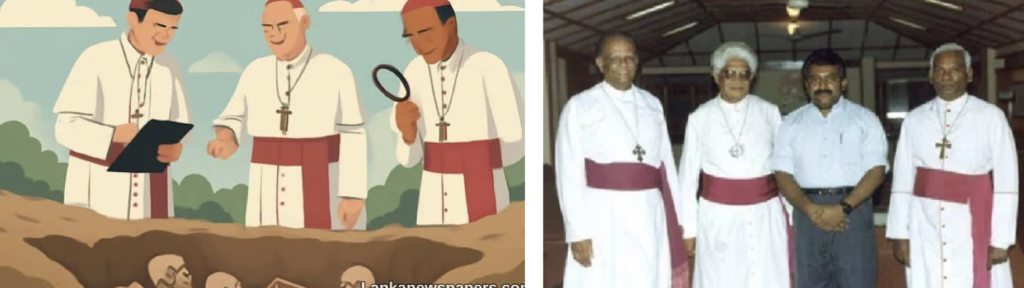
Chammani was turned into a political narrative and campaign for several reasons.
When the figure of 40,000 civilian deaths in the final stages of Sri Lanka’s war became an international rallying cry, the figure was not established through a completed forensic accounting of identified victims. The UN Panel of Experts said that a figure of up to 40,000 could not be ruled out. That is not the same as establishing that 40,000 people were killed. For over 17 years, we have challenged those who repeat the figure of 40,000 to produce verifiable evidence establishing that number, including the identities of the alleged victims. The campaign has now shifted from the final stages of the war in Mullivaikkal to Chemmani in Jaffna District, approximately 120 km away, where the burials under investigation relate to a different period, well before May 2009.
Chemmani has become the focus of another international campaign to substitute the inability to present evidence on 40,000 “dead”.
Tamil politicians, separatist campaign organisations, diaspora groups and religious bodies have mobilised around the excavation. Catholic priests, religious sisters and other clergy have even marched for Chemmani victims. Protesters have called for international investigations, UN involvement, international supervision and the gathering of evidence for alleged genocide, war crimes and crimes against humanity.
Pro-LTTE Tamil diaspora advocacy groups want to present Chemmani as evidence of systematic crimes against Tamils.
INGOs & NGOs use their reports to stress alleged state & military abuses, state impunity,
UN Human Rights mechanisms frame Chemmani as part of Sri Lanka’s unresolved disappearance & accountability aligned to its goal of setting up a quasi judicial system overriding Sri Lanka’s judiciary.
The most alarming has been the advocacy by the Cathollic Church whose campaign has even seen walks and demands for international investigations though the public question why its victims have been selective.
There have been no walks for victims of LTTE by the Catholic Church.
At the June 2025 “Eternal Lamp” protest, organisers inscribed six demands on a permanent plaque. These included calls for UN access to gather evidence of genocide, war crimes and crimes against humanity, international supervision of mass-grave investigations, and escalation of Sri Lanka’s accountability issues to the UN General Assembly and Security Council.
In July 2026, Catholic clergy led a procession from Ariyalai to Chemmani and appealed to the UN High Commissioner for Human Rights for an independent international investigation.
These are not merely private expressions of grief. They are well-funded organised campaigns seeking to shape the national and international interpretation of Chemmani and the mechanisms through which Sri Lanka will be judged.
But a campaign cannot determine what a grave proves. Only evidence can do that.
WHAT PROFESSOR RAJ SOMADEVA’S REPORT ACTUALLY SAYS
Professor Raj Somadeva and Anusha Wanninayake submitted an interim archaeological report on Chemmani to the Jaffna Magistrate’s Court in October 2026.
- Number and profile of the remains
- 574 minimum number of individual human skeletons recorded in the excavated assemblage.
- 51 accumulations of disarticulated human bones recorded separately.
- Preliminary age estimates:
- Children: 41%
- Infants: 22%
- Adults: 30%
- Sub-adults: 5%
- What the report says about the burial site
- The site has been affected by garbage dumping, waste-disposal pits and the burial of animal carcasses.
- These activities have caused substantial displacement of human skeletal remains, both vertically and horizontally.
- Human and animal bones were found in disturbed soil layers.
- The report suggests that the site was used not exclusively as a human burial ground, but also as a dumping ground for disposable material, including human remains.
- The excavated skeletons vary in depth, from approximately 0.24 metres to 1.52 metres below the present ground surface.
- The arrangement of the skeletons is irregular, with overlapping remains.
- The authors consider the possibility that the site contains successive episodes of burial rather than one single, simultaneous event.
- What the report says about burial practices
- available artefacts and contextual evidence show greater similarities to formal burial practices
- the report does not conclude that all the remains were deposited at the same time.
- Some iron nails and metal fragments may be remnants of coffins.
- Some skeletons were associated with jewellery, beads, amulets, coins and other objects. One coin dated back to 1870.
- Skeleton 25 was associated with a plastic bag, cloth pieces, footwear and an anklet; nearby nails may indicate a coffin.
- Two plastic garlands were found with one skeleton and may represent mourning, commemoration or final rites.
- What the report says about clothing
- No skeleton had directly preserved textile clothing attached to it.
- Buttons, eyelets and studs were found in association with some remains.
- They suggest that the burial environment and deterioration of organic material may explain the absence of surviving textiles.
- What the report says about body positions
- Approximately 72% of recorded skull orientations were north-west,
- the skeletons do not exhibit a uniform overall pattern of cranial orientation.
- Many individuals had their hands over the abdomen or alongside the body.
- Two skeletons, numbered 227 and 429, were found in seated positions.
- What the report says about dates
- A coin associated with Skeleton 367 bears the date 1870.
- Coins found in a separate ash layer included dates extending to 1994, but these do not independently date the human burials.
- What the report says about an epidemic or natural disaster
- epidemic or natural catastrophe as a possible explanation for a concentration of burials.
- bodies might have been disposed of rapidly, with relatively few objects placed with them.
- The report’s concluding 3 points
- The archaeological evidence, in isolation, is insufficient to establish definitively the nature and character of the burials.
- The artefacts and contextual evidence suggest greater similarities to formal burial practices than to clandestine burial sites used for comparison.
- An epidemic or natural catastrophe is presented conditionally as a possible explanation, not as a proven cause of death.
What Somadeva’s report establishes:
- that all 574 individuals were not victims of a massacre; that they were victims of genocide;
- that they probably died in an epidemic;
- that the burials were entirely lawful and customary.
WHY ARE POLITICAL AND RELIGIOUS CAMPAIGNS DEMANDING A PARTICULAR INTERNATIONAL OUTCOME BEFORE THE EVIDENCE IS COMPLETE?
The participation of Tamil political representatives, separatist organisations, diaspora groups and church bodies must be examined in light of the claims they have advanced and the outcomes they demand.
The issue is whether organised campaigns are using the discovery of human remains to reinforce a predetermined account of Sri Lanka’s conflict, while presenting allegations as though they were already established findings.
These demands demonstrate the scale and direction of the campaign.
The scientific report must be assessed independently of the political expectations surrounding it.
A forensic investigation cannot be required to deliver a predetermined political verdict.
THE OTHER TAMIL VICTIMS:
WHY IS THE LTTE’S RECORD SO OFTEN LEFT OUT?
A complete account of the suffering of Tamils during Sri Lanka’s conflict cannot begin and end with allegations against state forces alone.
Tamil civilians also suffered under the LTTE: through abductions, forced recruitment, detention, torture, killings and the suppression of those who opposed its rule. Families who lost relatives to the LTTE have their own unresolved demands for truth and justice.
Why are the parties campaigning for Chemmani not doing the same for Thunukkai victims and other torture chambers run by the LTTE – the Tamils silencd forever?
Where are the nuns lighting lamps for Thunukkai Tamil victims?
Where are the protest walks for Thunukkai Tamil victims?
Where are the international campaigns for Thunukkai Tamil victims?
Where are the speeches/statements from international media / international organizations & even UN agencies for Thunukkai Tamil victims?
Arun Siddharth has repeatedly raised allegations concerning LTTE detention, torture and killing, including accounts associated with Thunukkai. These allegations and the testimony of affected families deserve proper investigation and preservation as part of the historical record. Why are they no international lobbying or campaigns for this?
Why only Chemmani?
Thunukkai must not disappear from the discussion simply because it complicates a one-sided account of victimhood.
Where are the sustained international campaigns demanding the same attention for Tamil families whose relatives allegedly disappeared into LTTE custody?
Where are the families of Leaders of other Tamil militant groups gunned down by LTTE? Where are their bodies buried? Why are there no marches for them?
Where is the equivalent mobilisation for investigating alleged LTTE torture facilities and burial sites? Why should the suffering of one group of Tamil victims receive international attention while the suffering of others is marginalised because their alleged perpetrators do not fit the preferred political narrative?
These questions expose the danger of selective justice.
Tamil victims are not the property of any political party, separatist movement or organisation. Their suffering must not be used selectively to advance one political cause while other Tamil victims are forgotten.
More importantly, Tamils were not the ONLY VICTIMS.
THE 40,000 CLAIM AND THE CHEMMANI CAMPAIGN: ALLEGATIONS MUST NOT BE CONVERTED INTO FINDINGS
The figure of 40,000 associated with the final stages of the war illustrates why the distinction between allegation, estimate and established fact matters.
The UN Panel of Experts did not verify 40,000 identified civilian deaths. It stated that a figure of up to 40,000 could not be ruled out.
That finding must not be misrepresented as proof that exactly 40,000 civilians were killed.
The existence of human remains in Chemmani is a fact.
The circumstances of every burial, the dates of death, the causes of death and the identity of those responsible remain matters for investigation.
If campaigners present Chemmani as confirmation of a genocide narrative, they must identify the evidence supporting that conclusion. If they attribute the deaths to a particular perpetrator, they must demonstrate the basis for that attribution.
Political repetition, international publicity and religious processions cannot substitute for forensic findings.
For years, campaigners have repeated the figure of 40,000, yet vigils and repeated assertions cannot substitute for evidence establishing the number of victims, their identities or the lack of even skeletons.
Chemmani will likely become another sustained political campaign in which a predetermined narrative is repeatedly marketed internationally without being established by the forensic evidence.
THE QUESTION IS NOT WHO CAN ORGANISE THE BIGGEST PROCESSION OR WHICH MP CAN MAKE THE LOUDEST SPEECH IN PARLIAMENT
Chemmani is not a competition between political campaigns.
It is not a stage on which any organisation can declare a historical verdict and demand that the world accept it as we see happening.
The Catholic Church, Tamil politicians, separatist campaigners, diaspora organisations and every other interested party are entitled to make demands. But no organisation has the authority to dictate what forensic evidence must conclude.
If the evidence reveals different periods or circumstances of burial, those findings must not be suppressed to protect a political narrative by lobbying & protests.
And if Tamil families suffered torture, disappearance and murder under the LTTE, their suffering must not be erased because it is inconvenient to the same narrative & the same campaigners. They ask for justice but they only want selective justice.
Justice cannot be selective.
History cannot be written by processions and protests.
And genocide cannot be established by political insistence.
Professor Raj Somadeva’s report has not delivered a final verdict on Chemmani. It has made clear that the archaeological evidence so far does not establish the circumstances of genocide or mass murder.
Chemmani must not become another case where allegations are repeated until they are accepted as established history.
Those challenging Prof Somadeva’s findings must identify precisely which scientific conclusions are wrong and produce the evidence to prove it.
Justice cannot depend on which perpetrator fits a preferred political narrative. The same applies to the repeated figure of 40,000 civilian deaths: a number that the UN Panel of Experts said could not be ruled out is not a verified count of identified victims.
Let the evidence speak.
Let every victim count. And let no political movement, religious institution or international campaign decide the conclusion before the facts are established.
Shenali D Waduge


