INDIA, THE 2015 REGIME CHANGE, THE ANURADHAPURA SOBITHA THERO VILLAGE PROJECT & NOW FENCING RUWANWELISEYA
Why was an Indian-funded village named after a monk associated with Sri Lanka’s regime change?
In July 2017, two and a half years after Sri Lanka’s January 2015 presidential election brought Maithripala Sirisena and Ranil Wickremasinghe to power and ended Mahinda Rajapaksa’s presidency, India and Sri Lanka entered into an agreement for an Indian-funded housing project in Elapathgama, Anuradhapura.
The project was named the Most Ven. Maduluwawe Sobitha Thero Village.
India initially committed Rs. 300 million for 153 houses and associated community infrastructure.
It took 8 years for this project to build 115 houses (not 153 as promised).
India’s grant eventually increased to Rs. 450 million, while the completed project comprised 90 India-funded houses.
The final accounts should establish how the increased Indian grant was spent, including the costs of shared infrastructure and other facilities.
25 houses had to be funded by Sri Lanka.
The houses were officially handed over on 12 July 2025.
Why did a project announced in 2017 take approximately eight years to reach its official handover?
Why did the Indian contribution increase while the number of houses delivered fell below the original target?
Most importantly, what does this project reveal about the broader relationship between Indian development assistance and Sri Lanka’s political, cultural and strategic interests?
- January 2015: A political turning point
The presidential election of 8 January 2015 brought an end to Mahinda Rajapaksa’s presidency. Maithripala Sirisena, the common opposition candidate, won with the backing of a broad political coalition.
Ven. Maduluwawe Sobitha Thero was a prominent figure in the civil-society movement that supported political change. His role was sufficiently significant that contemporary reporting on the later Indian-funded housing project described him as instrumental in Rajapaksa’s defeat. Unfortunately he did not live to see any of the developments as the thero passed away on 8 November 2015.
The election also took place against a background of growing strategic competition in the Indian Ocean. India had expressed concern about China’s expanding presence in Sri Lanka, including Chinese naval activity in Colombo.
In January 2015, Reuters reported allegations from political and intelligence sources that an Indian intelligence official in Colombo had assisted opposition coordination before the election. India disputed the suggestion that the official had been expelled for interference and described his transfer as routine. These reports establish that allegations of Indian involvement were made at the time.
- July 2017: An Indian-funded village named after Sobitha Thero
In July 2017, India and Sri Lanka agreed on the Elapathgama housing project in Anuradhapura, named after the monk associated with the political movement that helped bring about the 2015 change of government.
The original Indian grant was Rs. 300 million. The proposed development included 153 houses, a multipurpose community building, an alms hall, water infrastructure and improvements to monks’ quarters and a library.
The official explanation was development assistance for a village in need.
Who first proposed the project? Who selected Elapathgama? Who decided on the name? What correspondence took place between the Sobitha Thero Foundation, Sri Lankan officials and Indian representatives before the agreement was signed?
The public should not have to rely on assumptions when the relevant records should exist.
- Eight years, increased funding and a reduced housing target
The project’s implementation history raises further questions.
The foundation stone was laid in May 2018, and construction began in July 2018.
In November 2019, the original contractor’s contract was terminated over poor progress and financial-management issues.
Eventually Sri Lanka’s Central Engineering Consultancy Bureau began construction through its subsidiary Central Engineering Services.
This immediately raises the question – were Indian nationals employed in Sri Lanka throughout this period? A Sunday Times report in April 2017 described companies seeking approval to bring foreign workers to Sri Lanka. Did this arrangement include Indian workers for this village project?
- Who was the original contractor? Was it an Indian or Sri Lankan?
- Were Indian nationals brought to Elapathgama?
- Under what immigration arrangements? Obtain the relevant work-visa approvals, employer sponsorship records and any approvals for foreign technical or construction personnel.
- Who paid them? Establish whether wages and accommodation were paid by the contractor, a subcontractor, or was this paid from the funding allocated by India?
- What happened after the original contract was terminated in November 2019? Establish whether any foreign workers remained on site, transferred to another project or left Sri Lanka.
- Did any foreign workers remain after the 2025 handover? This should be checked against immigration and project-completion records
Sri Lankan government reporting recorded a Rs. 195 million contribution alongside India’s original Rs. 300 million grant.
In March 2024, India announced an additional Rs. 150 million to address increased costs and complete the project.
The final handover took place in July 2025.
The figures require explanation:
- Original Indian grant: 300 million.
- Additional Indian grant: 150 million.
- Total Indian grant: 450 million.
- Original housing target: 153 houses.
- Completed housing scheme: 115 houses.
- Duration from MoU to handover: approximately eight years.
The reduction from 153 planned houses to 115 completed houses, together with the contractor problems and lengthy delays, justifies a public accounting of the project’s revised scope, expenditure and implementation.
The public should be able to examine the original and revised budgets, contractor records, progress reports, reasons for the reduced housing target and final completion accounts.
- The wider India–Sri Lanka agreements of 2017
The housing project did not occur in isolation.
In April 2017, India and Sri Lanka signed a broad Memorandum of Understanding concerning cooperation in economic projects. The framework covered areas including energy, ports, petroleum infrastructure, industrial development, transport and agriculture.
The Elapathgama housing agreement was a separate instrument. Later that year, India and Sri Lanka also signed agreements concerning the development of model villages.
These agreements demonstrate that Indian engagement with Sri Lanka extended beyond major infrastructure projects to housing, education, culture and locally visible development initiatives.
- What must be disclosed?
A proper examination of the Elapathgama project requires the following documents:
- The complete July 2017 Memorandum of Understanding, including its annexes.
- The original request submitted by the Ven. Maduluwawe Sobhitha Thero Commemoration Foundation.
- Records explaining why Elapathgama was selected and how the village was named.
- The original contractor agreement and the November 2019 termination decision.
- Revised project plans, budgets and explanations for the reduction from 153 planned houses to 115 completed houses.
- Records showing the respective contributions and responsibilities of India, the Sri Lankan Government and other participating bodies.
- The final completion and expenditure accounts.
FROM A SOBITHA THERO VILLAGE IN 2017 TO A RS. 7.7 BILLION SACRED CITY PROJECT IN 2026
The question becomes more significant when we examine what India is doing in Anuradhapura today.
In 2017, India entered into an agreement to fund the Sobitha Thero Village project in Elapathgama, Anuradhapura. Eight years later, in April 2025, Indian Prime Minister Narendra Modi visited Jaya Sri Maha Bodhi and announced Indian assistance for the development of the Anuradhapura Sacred City Complex.
The proposed Sacred City project is estimated to cost Rs. 7.7 billion.
These are two different projects, separated by eight years. But both place Indian funding at the centre of development initiatives in Anuradhapura.
The pattern does not end there.
During Modi’s April 2025 visit, India also inaugurated the upgraded Maho–Omanthai railway track and launched the Maho–Anuradhapura railway signalling project. India’s official statements identify the Sacred City project as part of a wider set of initiatives presented in terms of the civilisational, cultural and religious ties between India and Sri Lanka.
This makes it necessary to examine Indian engagement in Anuradhapura as a whole, rather than treating each project as an isolated act of assistance.
Why Anuradhapura?
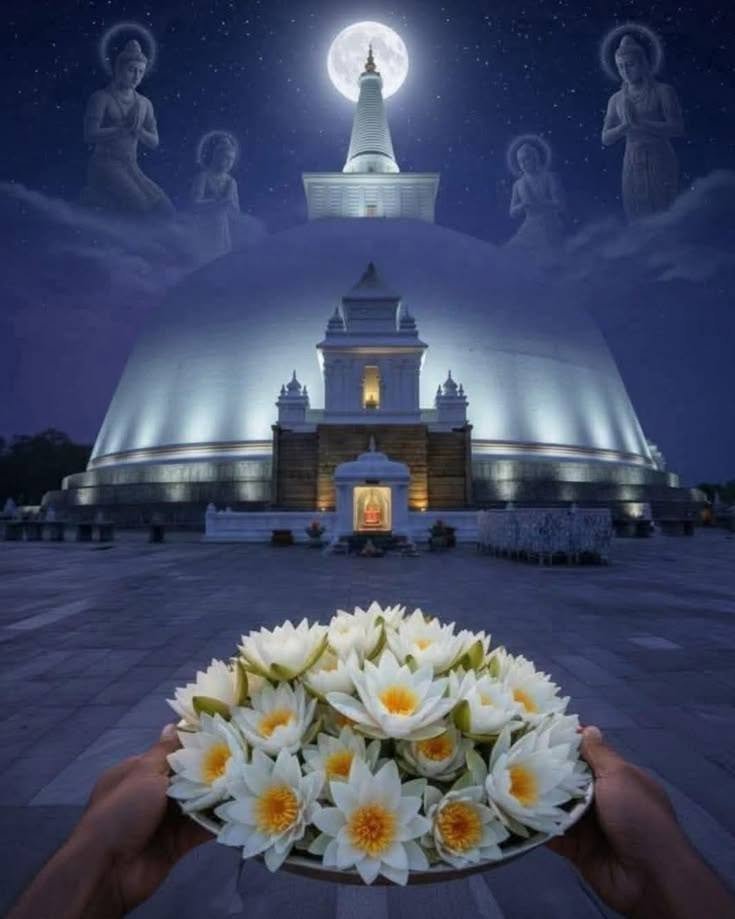
Anuradhapura is no ordinary district. It was the first ancient capital of Sri Lanka and remains one of the most important centres of Sinhala Buddhist civilisation. Jaya Sri Maha Bodhi, Ruwanweliseya and the surrounding monastic complexes are not ordinary tourist attractions. They are part of a living sacred landscape.
Anuradhapura is not merely a collection of ancient monuments to be fenced, landscaped or reorganised. It is a living sacred landscape where Buddhist worship, monastic traditions, pilgrimage routes, ancient reservoirs and the historic environment form an interconnected heritage. Any development plan that treats these elements separately risks damaging the very civilisation it claims to preserve.
Anuradhapura’s heritage is not confined to its stupas and excavated ruins. Its ancient reservoirs, waterways, agricultural landscape, monasteries and historic sightlines form part of the civilisational landscape that sustained the city. Development decisions affecting roads, parking areas, water bodies and surrounding land must therefore be assessed for their cumulative impact on this interconnected heritage, not merely for their effect on individual monuments.
When a foreign government offers billions of rupees to develop such a landscape, the public is entitled to know exactly what is being planned.
What land will be affected? What structures will be built? Will the project alter traditional pilgrim access? What is the purpose of the proposed parking facilities and changes to roads and boundaries? Who will manage the completed facilities? Will any land or buildings be leased or allocated for commercial purposes?
What impact could the proposed development have on archaeological remains, protected monuments, sacred sites and the historic landscape?
Will Sri Lanka retain complete control over every aspect of the project?
The concerns extend beyond the proposed physical works. An examination of Gazette Extraordinary No. 2477/44 of 27 February 2026 is necessary to establish what the planning scheme permits within the designated sensitive zone, including commercial guest houses, retail premises, vehicle repair garages and exceptions to building-height restrictions.
The public must also scrutinise Clause 5.1, which the published analysis identifies as providing for a protective fence around Ruwanweliseya and six entrance checkpoints. These provisions raise a fundamental question: do the proposed controls genuinely protect the sacred character of Anuradhapura, or could some of them facilitate changes incompatible with that purpose?
Who determines the future of Anuradhapura, and on what basis? The public must be able to examine the complete development plan, detailed maps, itemised expenditure, heritage-impact assessments and applicable approvals. The Maha Sangha, archaeological and heritage specialists, and affected local communities must have a meaningful opportunity to scrutinise the proposals before irreversible changes are made. Foreign funding cannot replace Sri Lanka’s responsibility to safeguard its own sacred heritage.
These questions are particularly important because the full Rs. 7.7 billion proposal, its detailed maps, itemised budget and grant agreement have not been established in the public record examined for this article.
Development assistance or strategic influence?
India openly describes its relationship with Sri Lanka in terms of civilisational and religious ties.
Yet this narrative cannot erase the history of invasions from the Indian subcontinent and the destruction associated with some invasions of Sri Lanka’s Buddhist heritage as well as the manner India enabled Tamil militancy/separatism.
While the Dussehra celebrations in India commonly include the burning of Ravana’s effigy to symbolise Rama’s victory over Lanka. This alongside the promotion of a mythical Ramayana Trails have generated concern that Sri Lanka’s historical past is subtly being replaced with India’s myths under a newly promoted shared civilizational heritage campaign.
India has its strategic interest but has Sri Lanka’s leaders examined the implications of foreign-funded development in a location of exceptional historic, religious & sentimental value to not only Sinhala Buddhists but the citizens of Sri Lanka.
Sri Lanka must not surrender scrutiny in the name of friendship
India may describe these projects as expressions of friendship and shared heritage. Sri Lanka must judge them by their actual terms and consequences.
Sri Lanka cannot forget the historical past tied to the friendship.
A grant is not a substitute for public disclosure. A development plan is not automatically appropriate simply because a foreign government offers to finance it. Nor should a sacred landscape be redesigned simply because a grant is being given without full scrutiny of its effects on worship, archaeology, heritage protection, local communities and national control.
Before the Rs. 7.7 billion project proceeds, the Government should publish the complete proposal, all relevant maps, the itemised budget, the grant agreement, the heritage-impact assessments and the arrangements governing future management.
- The questions Sri Lanka must ask
Most Sri Lankans are worried whether the Sri Lankan Govt has examined every area of concern.
The public deserves to know how decisions affecting its communities, its finances and its national interests are made.
BEFORE SRI LANKA COMMITS ANOTHER SACRED SITE
A 2017 Indian-assisted housing project in Anuradhapura took eight years to complete, saw its planned house count reduced and required a 50% increase in India’s grant commitment.
Kankesanthurai Harbour provides another warning. An agreement with India’s Exim Bank was signed for a US$45.27 million loan, but Sri Lanka estimated that US$61.5 million was needed. The Auditor General documented expenditure and financing costs despite the absence of physical construction by the end of 2024. By August 2026, the project was still under negotiation. Before Sri Lanka commits to another major India-funded development, the public deserves clear answers on financing, delays, additional costs and enforceable completion obligations.
The hybrid electricity project for Delft (Neduntheevu), Nainativu (Nagadeepa) and Analaitivu was originally awarded to a Chinese company in 2021 under a tender worth approximately US$12 million. Following Indian objections, Sri Lanka cancelled that contract and moved to an Indian-funded replacement.
India signed the project MoU in March 2022, and the implementation contract followed in March 2024. Although completion was announced as expected by March/April 2025, the Indian High Commissioner was still visiting the project site in June 2026. The natives remain without electricity.
Why was the Chinese contract cancelled and replaced by an Indian-funded project? What has been spent, what percentage of the work has been completed, when will the systems be commissioned?
Overseas, India’s Kaladan corridor in Myanmar saw its approved cost rise from ₹535.91 crore to ₹2,904.04 crore, while a key road remained incomplete in 2024.
India’s own audit authorities also documented planning and financial-management failures in the Indo–Nepal border road programme.
India and Iran began discussing Chabahar Port in 2003. India began operating the Shahid Beheshti terminal only in 2018 — 15 years later — and signed a ten-year operating agreement in May 2024, 21 years after the initial discussions. India fulfilled its US$120 million equipment commitment in August 2025. Yet, in 2026, 23 years after discussions began, the project’s future again faced uncertainty, with the US sanctions waiver expiring in April 2026 and no new allocation for the port in India’s 2026–27 budget.
More than two decades of discussions, years of implementation and continuing uncertainty: how much time does a country need to turn its overseas infrastructure commitments into a project with a secure future?
These cases establish a compelling principle: strategic announcements are not the same as completed infrastructure, and foreign assistance must be judged by delivery, cost, accountability and results.
India’s overseas infrastructure record also demonstrates why cost, delivery and accountability must be examined separately.
In Myanmar, the approved cost of the Kaladan Multi-Modal Transit Transport Project rose from ₹535.91 crore in 2008 to ₹2,904.04 crore in 2015, while a key road remained incomplete in 2024 amid continuing conflict.
In Nepal, India’s own Comptroller and Auditor General identified planning, financial-management, contract-execution and coordination failures in the Indo–Nepal border road programme, which missed its original March 2016 completion deadline and was extended to December 2022. These examples demonstrate why Sri Lanka must insist on transparent budgets, realistic timetables, independent monitoring and accountability for delays.
When India objects to a competing country’s involvement in a strategically sensitive Sri Lankan project, the public has a right to ask what enforceable guarantees follow if the replacement project is delayed.
That question is now especially important in Anuradhapura.
Before the proposed Rs. 7.7 billion Sacred City development proceeds, Sri Lanka ‘s Govt must publish the full plan, itemised budget, grant conditions, implementation timetable, land-use provisions and heritage safeguards as well as listen to all stakeholder concerns.
Anuradhapura’s sacred heritage is not a geopolitical bargaining chip. Sri Lanka must know where to draw the line, exactly what is being funded, who will control implementation, what is non-negotiable what will be delivered, when it will be delivered, and who will be accountable if commitments are not met.
When a Minister announces that a fence is going to be put around the sacred Ruwanweliseya while another Minister claims the monuments in Greece were replaced for hotels – the public have every right to wonder what the insidious designs are for Sacred Anuradhapura.
A government is elected for a term; it does not own the nation’s civilisational heritage. Presidential powers or Cabinet approval alone should not substitute for transparent disclosure, compliance with applicable law, proper heritage safeguards and meaningful consultation with affected stakeholders.
Principal sources
Indian High Commission, original project document:
Sri Lankan Cabinet Office, October 2017:
Shenali D Waduge