Colonial Divide & Rule in Sri Lanka – How Portuguese divided Sinhalese against Malabars (Tamils) & Muslims
Before European intervention, Sri Lanka’s people lived under a civilizational order that was not structured around rigid racial majorities and minorities. Indigenous social organization was shaped by:
- Buddhist cultural traditions
- Buddhist-based royal rule
- Agrarian economy and irrigation civilization
- Regional polities (Rata, Korale, Pattuwa)
- Religious identities — not racial categories
There was no formal racial majority–minority framework, no census-based demographic hierarchy, no communal political representation, and no institutionalized ethnic division or even conflicts.
The Portuguese introduced the first systematic racial segmentation, later formalized by the Dutch and politically weaponized by the British.
Sinhalese Presence in the North Before European Arrival
Long before Portuguese arrival in 1505, Sinhalese communities inhabited northern Sri Lanka. Archaeological and epigraphic evidence at Nagadipa (Nainativu), Kantharodai, Vallipuram, Kandarodai, and Keerimalai confirms Buddhist monasteries, stupas, inscriptions, irrigation works, and agrarian settlements dating centuries before the 10th century CE.
These northern Buddhist sites are integral to Sri Lanka’s ancient religious and cultural geography and predate South Indian political incursions.
Tamil-speaking groups entered the island much later, primarily through Chola and Pandya political and military interventions, introducing administrators, mercenaries, and settlers — but never displacing Sinhalese civilization wholesale.
This historical reality directly contradicts modern claims of an exclusive northern Tamil homeland.
- Portuguese Period (1505–1658): First Racial Labeling & Demographic Engineering
The Portuguese established maritime dominance, controlling coastal forts and harbours but never conquering the interior Sinhalese kingdoms.
Main Portuguese Holdings
- Galle
• Colombo
• Negombo
• Mannar
• Trincomalee (briefly)
• Jaffna Fort
• Batticaloa
They never controlled Kandy, Sitawaka, Rajarata, or the interior agrarian civilization.
Indo–Sri Lankan Colonial Logistics & Malabar Migration
Portuguese colonial Sri Lanka functioned as an extension of Portuguese India, administered through Goa (captured 1510).
While the Portuguese arrived in Galle in 1505 and later expanded toward the northern peninsula.
- Galle (1505) – First Landing
Dom Lourenço de Almeida lands after being blown off course from India.
- Kingdom: Kotte
- King: Parakramabahu VIII (1484–1518)
Indian Context:
- Portuguese already held Cannanore (1502) and Cochin (1503).
- They were actively recruiting South Indian sailors, mercenaries & traders.
This establishes early Indo–Sri Lankan Portuguese logistical integration.
- Colombo (1517) – Fortified Trade Hub
- Kingdom: Kotte
- King: Bhuvanaikabahu VII (1518–1551)
Indian Context:
- Goa (1510) was capital of Portuguese India.
- Colombo became the Sri Lankan administrative extension of Goa.
Result:
- Movement of Indian Christian converts
- Importation of Malabar labor
- Arrival of South Indian military detachments
- Negombo (1518–1520)
- Kingdom: Kotte
- King: Bhuvanaikabahu VII
Indian Context:
Negombo became: Logistics port connecting Colombo – Cochin – Goa.
Result:
Regular maritime movement enabled population flow from India to Sri Lanka.
- Mannar (1544) – Pearl Fisheries Hub
- Kingdom: Kotte
- King: Senasammatha Wickramabahu VII
Indian Context: Portuguese had long controlled South Indian pearl fisheries.
Result:
- Imported Malabar pearl divers
- Settled Tamil-speaking laborers
- Established Christianized South Indian communities
This became the primary gateway for Malabar demographic penetration into Sri Lanka’s North.
- Trincomalee (1622–1639)
- Interior Kingdom: Kandy
- King: Senarat (1604–1635)
Indian Context: Trincomalee served as:
- Military port connecting Jaffna to Coromandel coast
Used for:
- Movement of Malabar mercenaries
- Transport of South Indian Christian settlers
- Jaffna Fort (1619) – Northern Stronghold
- Kingdom: Kandy dominant inland
- King: Senarat (1604–1635)
This created a continuous logistical corridor between South India and Sri Lanka.
Through this corridor, Portuguese systematically:
- transportedMalabar mercenaries
• importedSouth Indian Christian converts
• relocated Tamil-speaking laborers
• deployed Indian military detachments
Mannar (1544) became the principal gateway for South Indian demographic inflow into northern Sri Lanka, driven by:
- pearl fisheries
• maritime trade
• fort construction
• plantation labor
This explains the artificial demographic transformation of the North under Portuguese rule.
Jaffna & Sinhalese Sovereignty – Correcting the Historical Record
There was no independent Tamil kingdom of Jaffna.
The so-called Aryacakravarti rulers functioned as:
- subordinate tributary chiefs
• politically dependent on Kingdom of Kotte
• later subordinate to Kingdom of Kandy
When the Portuguese attacked Jaffna in 1619:
King Senarat of Kandy (1604–1635) dispatched Mudaliyar Attapattu with Kandyan forces to defend the North.
This proves:
- Sinhalese political authority extended into the North
• Sinhalese population existed in the region
• Jaffna lacked autonomous military capacity or ability to defend the North from Portuguese.
Portuguese chroniclers confirm this intervention, demonstrating continued Sinhalese sovereignty over the northern territories.
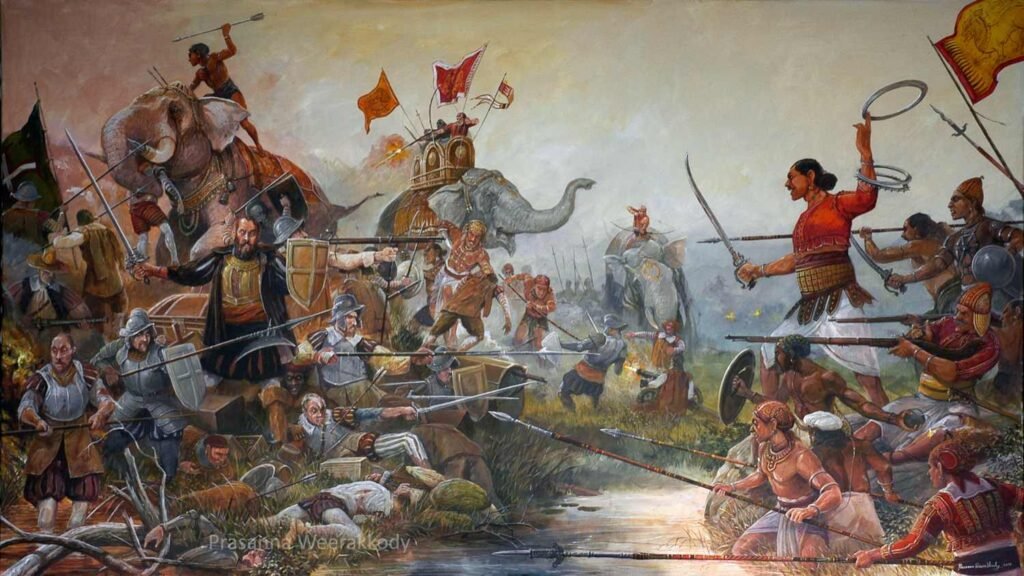
Major Battles & Campaigns: Sinhalese vs Portuguese (16th–17th Century)
1) Battle of Mulleriyawa (1559)
Sinhalese Leader: King Mayadunne (Kingdom of Sitawaka)
Portuguese Commander: Captain-General Dom Afonso Pereira de Lacerda
Location: Mulleriyawa Marshes, near present-day Colombo
Outcome: Decisive Sinhalese Victory
Why it matters:
- One of the worst defeats ever suffered by the Portuguese in Asia.
- Over 70% of the Portuguese force annihilated.
- Proved the effectiveness of Sinhalese guerrilla warfare, marsh combat, and terrain mastery.
- Cemented Sitawaka as the dominant military power in lowland Sri Lanka.
2) Siege of Colombo (1554–1555)
Sinhalese Leader: King Mayadunne
Portuguese Defenders: Portuguese garrison at Colombo Fort
Outcome: Strategic Sinhalese success
Significance:
- Forced Portuguese into defensive coastal entrenchment.
- Demonstrated logistical strain on colonial forces.
- Marked the beginning of decades of sustained resistance.
3) Battle of Danture (1594)
Sinhalese Leader: King Vimaladharmasuriya I (Kingdom of Kandy)
Portuguese Commander: Captain-General Pedro Lopes de Sousa
Location: Near Balana Pass, Central Highlands
Outcome: Complete Sinhalese Victory
Why it matters:
- Entire Portuguese expeditionary army destroyed.
- Ended Portuguese ambitions to control the Kandyan Kingdom.
- Preserved independent Sinhalese sovereignty in the highlands for another 160+ years.
4) Battle of Randeniwela (1630)
Sinhalese Leader: King Senarat of Kandy
Portuguese Commander: Constantino de Sá e Noronha
Outcome: Sinhalese Victory
Significance:
- Portuguese commander killed in battle.
- Further weakened Portuguese inland expansion.
5) Battle of Gannoruwa (1638)
Sinhalese Leader: King Rajasinha II
Portuguese Commander: Diogo de Melo de Castro
Outcome: Decisive Kandyan Victory
Why it matters:
- One of the largest Portuguese defeats in Sri Lanka.
- Cleared the path for Dutch–Kandyan alliance.
- Triggered the collapse of Portuguese rule on the island.
Strategic Warfare Methods Used by the Sinhalese
- Guerrilla warfare
- Ambush tactics
- Marsh & jungle combat
- Scorched earth strategy
- Supply-line disruption
- Monsoon-based timing of attacks
These methods neutralized Portuguese firepower, cavalry, and naval superiority.
Historical Importance
These conflicts show that:
- The Portuguese never conquered the Kandyan Kingdom.
- Indigenous Sinhalese forces always came forwarded to defend the Nation sacrificing life and limb and defeated European armies repeatedly.
- Sri Lanka offers one of the earliest examples of successful anti-colonial resistance in Asia.
Portuguese Racial Classification
Portuguese records drew explicit racial distinctions:
Queiroz (1687):
- “The Malabars are not natives of the island, but come from the coast of Coromandel.”
- “The Chingalas are the ancient inhabitants of the land.”
Ribeiro (1685):
- “The Chingalas are the true natives of the land.”
Portuguese classifications:
• Malabares — South Indian migrants
• Chingalas / Singalas — Indigenous inhabitants
They never used the term ‘Ceylon Tamil’.
This marks Sri Lanka’s first formal racial labeling.
Portuguese Divide & Rule Strategy
Portuguese colonial governance systematically fragmented indigenous society using three axes:
- Religious engineering
- Ethnic segmentation
- Economic favoritism
Their core objective:
Prevent unified resistance and entrench colonial dominance.
Portuguese Treatment of Sinhalese
Initially:
• trade alliances
• cinnamon monopoly
• coastal conversions
Later:
• military domination
• destruction of Buddhist temples
• suppression of monastic education
• forced conversions
• taxation and forced labor
• manipulation of royal succession
Queiroz:
“Churches were erected where temples once stood.” (Queiroz even names them in his book)
They:
• installed puppet rulers
• engineered dynastic conflicts
• militarized coastal zones
This deliberately weakened Sinhalese political cohesion.
Portuguese Treatment of Malabars (South Indian Tamils)
Portuguese uniformly described Malabars as foreign migrants.
Queiroz:
“The Malabars are foreigners who came from the Coromandel coast.”
Ribeiro:
“They crossed from the Coromandel coast and settled in Jaffna.”
Portuguese Policy Toward Malabars
Military Utility
• mercenaries
• fort labor
• auxiliaries
Strategic Buffer Role
• placed between Portuguese and Sinhalese kingdoms
• frontier insulation
Christianization & Patronage
• land
• employment
• protection
Population Engineering
• encouraged migration
• permanent settlement
• colonial client communities
This transformed migrant populations into politically and economically empowered colonial dependents.
Portuguese Treatment of Muslims — Systematic Elimination
Muslims were:
- religious enemies
• commercial rivals
• geopolitical threats
Religious Hostility
Papal Bulls Romanus Pontifex (1455) and Inter Caetera (1493) authorized:
- conquest
• conversion
• suppression of Islam
Queiroz:
“The Moors were the greatest enemies of the Christian faith and the Portuguese Crown.”
Commercial Hostility – Muslims dominated:
• maritime trade
• cinnamon commerce
• pearl fisheries
• shipping routes
Portuguese:
• attacked Muslim fleets
• burned vessels
• seized cargo
• expelled Muslim traders
• destroyed mosques
Result: Mass displacement of Muslims from:
• Colombo
• Mannar
• Galle
• Puttalam
Sinhalese Protection of Muslims
Sinhalese kings rescued Muslim refugees.
King Senarat of Kandy (1604–1635):
• resettled Muslims in Batticaloa & Eastern Province
• granted land
• restored trade privileges
Without Kandyan protection, Muslims would have been completely expelled from Sri Lanka.
Portuguese Triangular Divide & Rule Strategy
Portuguese deliberately pitted:
| Group | Against |
| Malabars | Sinhalese & Muslims |
| Converted locals | Buddhist Sinhalese |
| Christian Malabars | Muslim traders |
| Muslim intermediaries | Sinhalese authorities |
Queiroz:
“They set the Malabars against the Chingalas, and both against the Moors.”
Ribeiro:
“They inflamed ancient rivalries and created new ones, so that none could unite.”
K.M. de Silva:
“Portuguese policy deliberately fragmented indigenous society to prevent coordinated resistance.”
Colonial Genesis of Majority–Minority Thinking
The Portuguese:
- racialized identity
• militarized difference
• manipulated religion
• restructured demography
They introduced the conceptual foundations of majority–minority segmentation.
The Dutch would later:
→ legalize separation (Thesavalamai Law, 1707)
The British would:
→ politicize ethnicity (Ceylon Tamil, 1911 Census)
The Portuguese systematically pitted Sinhalese, Malabars, and Muslims against each other by weaponizing religion, ethnicity, and trade rivalry, inaugurating Sri Lanka’s first experience of colonial-engineered communal fragmentation.
This divide-and-rule strategy laid the psychological, demographic, legal, and political foundations upon which:
- Dutch racial law
• British ethnic engineering
• post-independence communal politics
• separatist ideology
were later constructed.
This proves that: Sri Lanka’s ethnic divisions are not ancient, not organic, and not civilizational, but are colonial political constructions, later exploited for separatist mobilization and international propaganda and continued for geopolitical & international trade agendas and advantages.
Shenali D Waduge