Easter Sunday Massacre: Tracing the Rise of Islamist Extremism in Sri Lanka

The Easter Sunday bombings were not isolated or random they were tied to a global jihadist ideology and the Islamic State (ISIS) caliphate narrative. Zahran Hashim and the NTJ network openly declared allegiance to ISIS and spoke about establishing Islamic rule in Sri Lanka. Thus, Sri Lanka’s 21 April 2019 massacre must be viewed in this context: eight coordinated suicide bombings targeting churches and hotels killed nearly 270 people and injured hundreds more. Extremism that had been spreading subtly evolved into mass murder and may well head for many more unless addressed.
Post-LTTE Security Vacuum and the Caliphate Ideology
A dimension often overlooked is the ideological objective behind the Easter Sunday attacks.
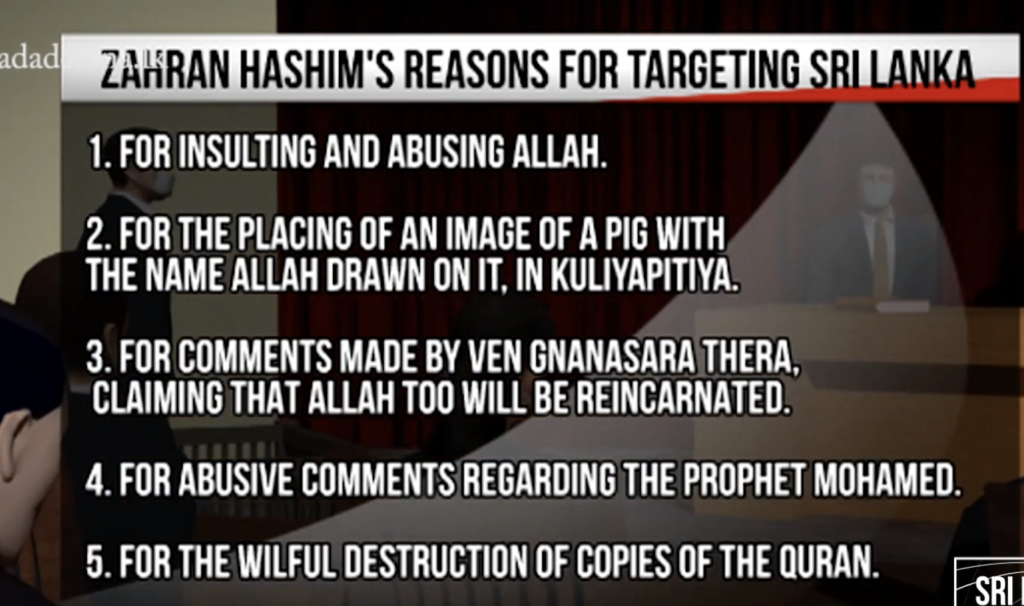
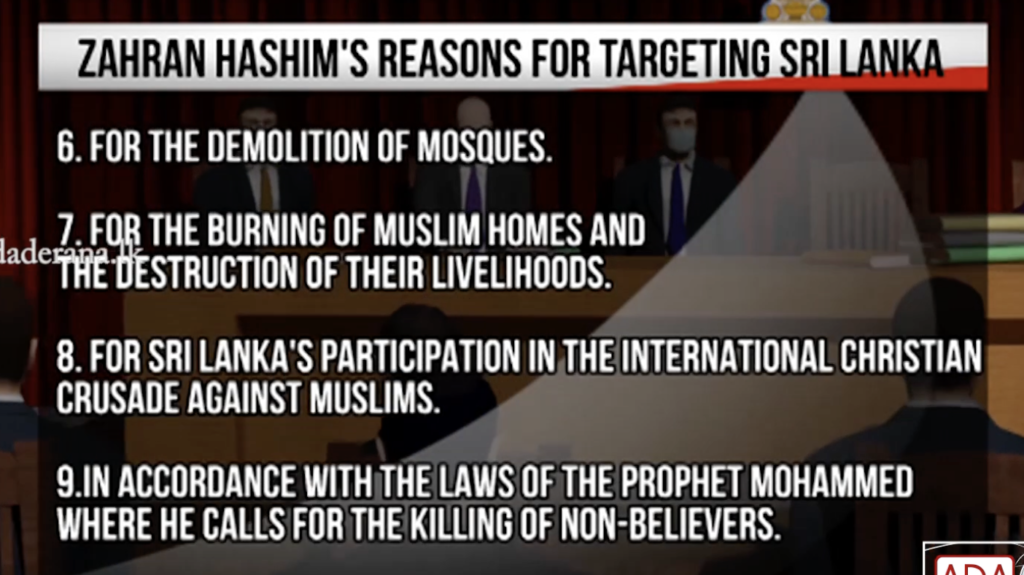
Zahran Hashim and members of the National Thowheed Jamath (NTJ) had pledged allegiance to the so-called Islamic State and promoted the vision of a global Islamic Caliphate — a political-religious system governed by strict Sharia rule in which political authority rests exclusively within the Islamic order.
This ideological reality conflicts with a floated claim that the suicides were aimed to bring a Sinhala Buddhist leader to power. This proposition collapses as no jihadist suicide seeks martyrdom for people outside their religious framework to seat of power. The doctrine promoted by groups such as ISIS explicitly rejects governance by non-Muslims and frames its struggle as one aimed at replacing secular political systems with Islamic rule.
Floating the theory that the suicides were orchestrated to bring a Sinhala Buddhist leader to power is a tactic to divert attention from the real threat of spreading extremis in Sri Lanka.
The Easter Sunday bombings align with the global jihadist strategy of attacking Christian worshippers and international targets — a pattern repeatedly observed in ISIS-inspired operations across multiple countries.
ISIS released a video showing the Sri Lankan attackers pledging allegiance to Abu Bakr al-Baghdadi, confirming the ideological link between the local cell and the global jihadist movement.
The concept of a caliphate is not merely theological rhetoric; it is a political objective pursued by extremist movements seeking to replace secular states with religious rule.
Another dimension that warrants attention is the growing presence of Arabic-language and religious instruction within certain private education spaces in Sri Lanka.
In recent years, Arabic teaching has expanded beyond traditional religious institutions into some private schools and Montessori settings, often through teachers or curricula linked to unmonitored foreign networks.
Language learning itself is not the issue. The concern arises when language instruction becomes a channel for ideological influence, particularly where oversight of curricula, teachers, and funding sources is weak.
Earlier parliamentary warnings had already raised concerns about foreign teachers entering Sri Lanka and promoting extremist interpretations within educational environments. Ensuring transparency in educational content and stronger monitoring of foreign-linked teaching networks is therefore an important part of preventing future radicalization.
https://www.dailymirror.lk/print/breaking-news/Easter-attacks-Security-agencies-received-97-early-warnings-Def-sec/108-193920
https://www.newsfirst.lk/2025/07/20/senior-dig-nilantha-jayawardena-dismissed-from-police-service?fbclid=IwY2xjawQVBK9leHRuA2FlbQIxMABicmlkETFxejRWNVpoZ2RwdVZPWXR1c3J0YwZhcHBfaWQQMjIyMDM5MTc4ODIwMDg5MgABHgGmdqdwiaQYeJnSiD824_cBzul74hlElmJGgvzYRH8HsD_iX4tiUgubj2pf_aem_8MZLngaNMM92lmA6yexWGw
https://www.reuters.com/article/world/sri-lanka-muslim-officials-quit-in-solidarity-with-minister-accused-of-islamist-idUSKCN1T41UY
In 2017, Minister Wijayadasa Rajapakse told Parliament that 32 Sri Lankans from four affluent Muslim families had joined ISIS in Syria, and that extremist teachers were operating in Beruwela, Kalmunai, Kal Eliya, and Kurunegala. This challenged the commonly cited link between poverty and radicalization.
Rajapakse even named MPs allegedly linked to extremists, including R. Rahman, M. Hizbullah, and A Salley.
These warnings, he said, were dismissed or ignored.
A troubling pattern emerges. Were any of the 8 suicide bombers linked to these 4 affluent families?
Radicalization was not isolated to a few individuals. It reflected a small but organized ideological current that had been developing for years, recruiting followers, spreading propaganda, and building networks.
After the defeat of the LTTE in 2009, intelligence monitoring units were disbanded or downsized post-2015 regime change, creating space for extremist networks to grow.
Radical preaching, foreign connections, and youth recruitment intensified.
Months before the Easter Sunday attacks, local resident Mohamed Taslim reportedly uncovered explosives and alerted authorities. His warnings did not trigger meaningful preventive action. He was attacked and now unable to properly function. Community‑level concerns about radicalization were real and documented long before April 2019.
Zahran Hashim: The Known Threat
The leader of the attacks, Zahran Hashim, was widely recognized as a radical.
Radical sermons circulated in communities.
NTJ vandalism incidents and extremist activity were reported since 2017.
The State Intelligence Service (SIS) had recommended “rendering Zahran inactive” years before the attacks.
Nilantha Jayawardena, former SIS Chief, testified that the April 4, 2019, foreign intelligence warning likely reached 10,000–15,000 officials, including VIP security and diplomats, yet no preventive action was taken. He also revealed that Zahran was assisted by a brother of MP Rishad Bathurdeen to flee to India.
Source: Jayawardena testimony, YouTube
Institutional Paralysis
Former Defence Secretary Hemasiri Fernando described the failure as institutional paralysis:
- Intelligence was received but not acted upon.
- Agency coordination broke down.
- National Security Council mechanisms were compromised.
- Political pressures, including ministerial resignations in solidarity with allegedly linked colleagues, hindered decisive action.
Source: Reuters, 2019
Post-attack operations — arrests, seizures of explosives, and neutralization of devices — show the security apparatus had the capacity. The gap was preventive leadership and cohesion, not capability.
Extremism Before and After Easter Sunday
The eight suicide attackers were products of long-term radicalization within organized networks.
- Indoctrination continued via foreign-connected recruiters.
- Networks were linked to wealthy families.
- Political warnings flagged potential ties to MPs, but action was delayed or absent.
The PCoI confirmed that actionable intelligence had been repeatedly ignored. The tragedy was preventable, but mandated authorities failed to act, leaving the country vulnerable.
Continuing Threat
Extremist networks remain active. Recent arrests and investigations indicate that pathways leading to Easter Sunday — overseas connections, ideological indoctrination, and political blind spots — have not been fully addressed.
Sri Lanka now faces a stark choice: allow systemic weaknesses to persist or implement long-term strategies to monitor networks, track foreign links, and counter radicalization in communities.
The Easter Sunday attacks illustrate a sobering truth: intelligence without action is meaningless, and mandates without accountability are dangerous.
Testimonies from Hemasiri Fernando and Nilantha Jayawardena, combined with parliamentary warnings from Wijayadasa Rajapakse, confirm:
- The threat was known.
- Networks were identified.
Preventive measures were ignored or politically constrained.
The challenge is not only to respond to past failures but to prevent future radicalization — by addressing structural weaknesses, ensuring oversight free from conflict of interest, and confronting extremist ideologies directly.
The lesson is clear: intelligence must be paired with decisive leadership, accountability, and systemic vigilance to prevent another tragedy.
The Lesson Sri Lanka must not ignore
Sri Lanka’s modern history offers lesson about the dangers of ignoring early signs of extremism.
During the 1970s and early 1980s, emerging Tamil militant movements carried out robberies, assassinations, and attacks on state institutions. At the time, many political actors dismissed these incidents as isolated or exaggerated threats. Instead of confronting radicalization early, the political environment often downplayed or rationalized it.
What followed was three decades of devastating conflict that cost tens of thousands of lives and destabilized the nation.
The rise of Islamist extremism prior to the Easter Sunday attacks shows troubling parallels.
Warnings were raised by Buddhist theroes, intelligence officers, by community members, and even within Parliament. Radical preaching, foreign ideological influence, recruitment networks, and travel to join ISIS were all documented years before the attacks.
Yet another troubling pattern has emerged whenever concerns about Islamist extremism are raised. Instead of addressing the substance of the warnings, the immediate response is often to frame the discussion as “anti-Islam” and mobilize the wider Muslim community against those raising the alarm. This tactic shuts down legitimate security concerns and discourages open discussion. In the process, it also undermines the many Muslims who themselves oppose extremism and who are equally threatened by radical ideologies operating in their midst. Treating every warning as an attack on an entire religion does not solve the problem — it merely shields extremists from scrutiny and prevents society from confronting the real threat.
Yet these signals were frequently dismissed, minimized, or entangled in political disputes. The messengers were branded racist, their warnings ridiculed as hate speech and a well-funded campaign to character assassinate them took place.
Today, attempts to redirect the national conversation toward conspiracy theories risk repeating the same historical mistake. When attention shifts away from extremist ideology, recruitment networks, and their sponsors, the real drivers of violence remain unaddressed.
The central issue is not political advantage or narrative control.
It is the need to confront extremism in all its forms — early, firmly, and without hesitation.
Sri Lanka has already paid the price once for failing to address militancy in its formative stages.
The lesson from both the LTTE era and the Easter Sunday tragedy is clear: ignoring early warning signs of radicalization allows extremist movements to grow stronger.
Preventing future violence requires vigilance, transparency, and the courage to address uncomfortable realities rather than deflect them.
The public must ask a simple question:
Are we prepared to once again silence those who raise warnings by branding them racist or hateful — and sweep radicalism under the carpet until another group of innocent people pays the price?
Shenali D Waduge