
No Charges against Pillayan for Easter Sunday: A direct blow to Asad Maulana’s Channel 4 Story and serious questions over Maj. Gen. Suresh Sallay’s continued detention
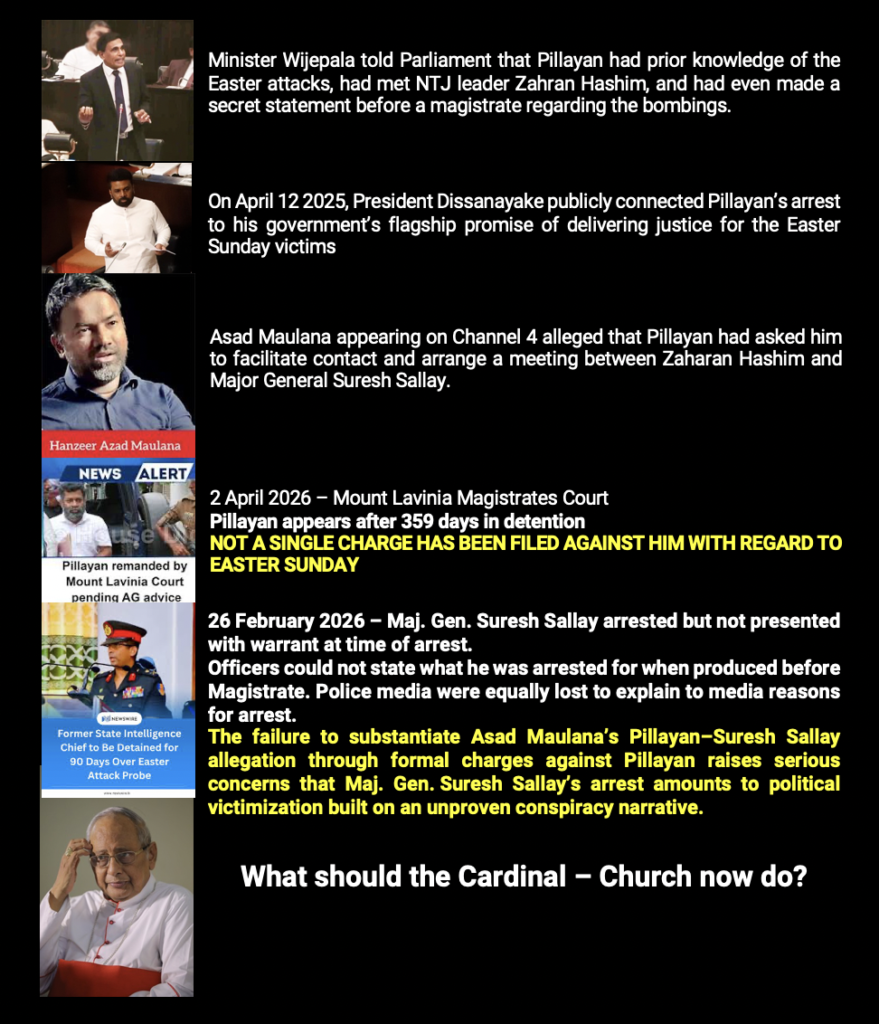
After nearly one year in detention (arrested by CID on 8 April 2025), NO Easter Sunday–related charges were filed agaist Pillayan when he was finally produced before the Mount Lavinia Magistrate’s Court on 2 April 2026.
This is not a minor procedural detail. It creates a serious contradiction between the Government’s political narrative, CID investigations and its actual prosecutorial conduct before court.
The most serious concern is that the strongest allegations were made under parliamentary privilege, where no evidentiary threshold applies and no judicial challenge is possible. The State appears to have told the public one story in a constitutionally protected political forum while presenting an entirely different case before court.
When Pillayan was arrested in April 2025, senior Government figures taking mileage from Parliamentary privileges denigrated Pillayan as being directly linked to Easter Sunday. Even the President declared the arrest as part of delivering justice to the victims. For those wanting to promote the conspiracy narrative his arrest was the perfect alibi.
For almost a whole year those who wanted to hide the ISIS element spreading across Sri Lanka, the LTTE Diaspora wanting to use any issue to seek revenge against personalities they blamed for the elimination of LTTE and even some actors who had already embraced a conspiracy theory of the attacks were quick to treat the arrest as confirmation of their preferred narrative.
However, after 359 days of detention, the prosecutorial record itself exposed the gap between political rhetoric and courtroom reality.- the State/CID failed to place even a preliminary Easter-related charge before court.
That fact alone raises an unavoidable legal question:
If the State had sufficient admissible evidence linking Pillayan to the Easter Sunday attacks that sufficed to keep him under PTA detention orders signed by the President, why was no charge filed?
What is more troubling is, these were not broad suspicions.
Parliament was specifically told that Pillayan had prior knowledge of the attacks, had met Zaharan, and had even made a secret statement before a magistrate.
These were precisely identical to the allegations made by Asad Maulana to Channel 4.
When allegations are framed with this level of detail and specificity, the total absence of even a preliminary Easter charge after 359 days does not merely weaken the narrative — it raises serious questions as to whether the public was politically primed with claims that could never survive judicial scrutiny.
In short have the public being taken for fools.
What this reveals is, that the public allegations made against Pillayan are not supported by evidence capable of surviving prosecutorial or judicial scrutiny.
What This Means for Asad Maulana’s Channel 4 Allegation
This directly weakens the allegation made by Asad Maulana to Channel 4 in 2023— namely, that Pillayan had asked him to arrange a meeting between Zaharan and Major General Suresh Sallay.
It exposes the failure of Channel 4’s central allegation which remains evidentially untested and uncorroborated by prosecutorial action.
A media allegation, however dramatic, remains only an untested allegation unless independently corroborated by admissible evidence and reflected in prosecutorial action.
The failure to convert the 2023 allegation into a formal Easter-related charge against Pillayan after one year of detention significantly weakens its evidentiary weight.
The State’s inability to translate the Channel 4-linked allegation into a formal court charge materially undermines the weight of that claim.
If all that Asad Maulana claims to be true – he has to support claims with evidence sufficient enough to file charges.
This automatically raises Questions about Suresh Sallay’s continued detention
This issue becomes even more serious when viewed alongside the arrest and continued detention of Major General Suresh Sallay.
Sallay was arrested in February 2026 in connection with the Easter Sunday investigations. Upon his arrest while charges were not filed when produced before the magistrate, CID claimed him to be the 3rd suspect, and police publicly stated that the arrest was based on evidence gathered during the probe and that he too was linked to Easter Sunday.
Both arrests publicly intersect with the same Asad Maulana narrative, even if investigators may claim additional material.
However, if the allegations against Pillayan have not matured into charges, then the Pillayan-Suresh Sallay link that Asad Maulana claimed has no weight either.
The people are entitled to ask
“what is the independent evidentiary basis for continuing to detain Suresh Sallay?”
This is a constitutional due process question, not a political slogan.
The legal principle is simple:
Detention orders signed by the President must be justified by independent, admissible evidence—not by recycled media narratives that have failed to produce charges against other alleged participants.
A Message to the Church and Cardinal
The Church and the Cardinal have every moral right to seek justice for the Easter victims.
But justice must remain evidence-led, court-tested, and legally sustainable.
It is equally important to note that one of the Cardinal’s central public demands after the Channel 4 allegations was that the sleuths and officers earlier removed from the Easter investigations be restored to the probe, while those accused in the documentary be kept away from it.
The Government appears to have substantially honoured that demand by allowing the investigation to proceed under restored confidence, backed by CID action, PTA detention, and presidential authorization.
Yet after 359 days of detention, even under this renewed investigative framework, not a single Easter-related charge was framed against Pillayan.
That reality now presents a difficult but necessary truth for the Cardinal and all those who embraced this line of inquiry: if even the investigators whose return was specifically sought could not produce tangible evidence sufficient to charge Pillayan, then the preferred conspiracy narrative itself requires urgent re-examination.
The issue can no longer be whether the “right officers” were assigned, because the very officers whose return was publicly demanded were restored, empowered, and still failed after 359 days to produce an Easter charge.
Therefore, what encompassed on 2 April 2026 at the Mount Lavinia Magistrates Court must compel all parties — including the Church, civil activists, and media actors — to reassess whether they have been relying on:
- verified evidence,
- admissible witness testimony,
- prosecutorial findings,
- or do they want to continue calls for justice based merely on politically amplified conspiracy narratives.
Justice for the Easter victims cannot rest on allegations that fail to translate into charges, witnesses, and evidence before court.
Justice cannot come at the injustice to others.
The failure to file any Easter Sunday charge against Pillayan after nearly one year of detention ordered by the President is a profound contradiction between executive rhetoric and judicial reality. It substantially weakens the credibility of the Asad Maulana–Channel 4 narrative and raises legitimate constitutional questions about parallel detentions built on overlapping allegations.
After restoring the investigators the Cardinal trusted, securing presidential PTA authority, and detaining Pillayan for 359 days and going further to even arrest Maj. Gen. Suresh Sallay, the evidentiary gap can no longer be blamed on process, personnel, or political obstruction. It points instead to the weakness of the conspiracy-theory narrative itself and the reality of political victimization.
If justice is to be real, it must be based on evidence tested in court—not on politically convenient theories, media sensationalism, or externally driven distortions.
Shenali D Waduge
https://www.jaffnamonitor.com/for-359-days-easter-claims-in-court-none-the-pillayan-case/


