RAJNATH SINGH IS IN SRI LANKA – BEFORE INDIA SPEAKS OF SECURITY, LET SRI LANKA SPEAK OF SOVEREIGNTY
Rajnath Singh’s visit comes 38 years after the previous official visit by an Indian Defence Minister. The visit is described in terms of defence cooperation, maritime security, connectivity and economic partnership. But this visit cannot be discussed without examining India’s historical and growing influence over Sri Lanka — military, political, constitutional, economic, cultural and strategic. Before India speaks of Sri Lanka’s security, Sri Lanka must first ask whether India’s actions have respected Sri Lanka’s sovereignty.
- 1987 — INDIA CROSSED SRI LANKAN AIRSPACE
On 4 June 1987, India launched Operation Poomalai, dropping supplies over Jaffna while Sri Lankan forces were conducting operations against the LTTE.
Indian aircraft entered Sri Lankan airspace without Sri Lanka’s consent.
It was a direct assertion of Indian power over Sri Lankan territory.
India whisked Prabakaran & family to Delhi & kept him there until the Indo-Lanka Accord was signed.
If Sri Lanka had entered Indian airspace during an Indian military operation, would India have called that respect for sovereignty?
- 1987–1990 — INDIA SENT ITS ARMY INTO SRI LANKA
The Indo-Lanka Accord was followed by the deployment of the Indian Peace Keeping Force.
The IPKF eventually fought the LTTE.
India’s own External Affairs Minister later described the episode as an “IPKF misadventure in Sri Lanka.” Indian armed forces are accused of committing mass murder & rape.
- INDIA ITSELF SAYS IT WILL INTERVENE WHEN ITS INTERESTS ARE AT STAKE
India officially speaks of non-interference.
But India’s own foreign-policy literature says that when another country’s actions have the potential to affect India’s national interests, India does not hesitate to intervene.
India’s security interests cannot automatically become Sri Lanka’s obligations.
Where does India’s security interest end and Sri Lanka’s sovereignty begin?
And who decides?
- INDIA SEEKS TO INFLUENCE SRI LANKA’S CONSTITUTION
India openly states that it engages Sri Lanka at the highest levels on implementation of the 13th Amendment and beyond, including meaningful devolution.
Should a foreign government have a say in determining the constitutional structure of a sovereign country?
- INDIA WANTS TO CHECK SRI LANKA’S RELATIONSHIP WITH CHINA
India’s own policy documents acknowledge its concern over Sri Lanka’s growing relationship with China and its desire to check Sri Lanka’s drift towards China.
But Sri Lanka is not an Indian state.
Sri Lanka must be free to choose India, China, Japan, America, Russia — or anyone else.
Friendship cannot mean permission.
- INDIA AND CHINA — SRI LANKA BECOMES THE BATTLEGROUND
Reuters described India as “muscling into port and other projects” as China expanded its
presence in Sri Lanka.
While India expands its dealings with China – India deems Sri Lanka must seek its permission to deal with China.
Sri Lanka’s ports, energy and infrastructure must serve Sri Lanka’s national interest.
They cannot become prizes in a contest between New Delhi and Beijing.
Sri Lanka must not become the battlefield on which other powers compete for strategic control.
- INDIA’S PUSH FOR STRATEGIC PORT ASSETS
India sought participation in Colombo’s strategic port infrastructure, including the East Container Terminal.
The formal Sri Lanka–India MOU of 2017 did not specifically name ECT; the Sri Lanka–India–Japan ECT arrangement came later.
The issue, however, is larger than one terminal.
Ports are not ordinary real estate.
They determine trade, shipping and strategic access.
How much strategic infrastructure should any one external power be able to influence and how will it impact Sri Lanka if India becomes hostile?
- COLOMBO DOCKYARD — FROM JAPANESE TO INDIAN CONTROL
India’s state-owned Mazagon Dock acquired the Japanese stake and secured 51% control of Colombo Dockyard.
When a foreign defence company gains control of a strategically located Sri Lankan shipyard, the question is no longer simply investment — it is who gains strategic maritime influence over Sri Lanka.
- TRINCOMALEE — STRATEGIC ENERGY
India’s involvement in Trincomalee’s strategic oil infrastructure has been controversial for decades.
Whoever controls critical energy infrastructure gains leverage over a country’s economy, transport and national security. Sri Lanka cannot afford strategic dependence for its energy security.
- THE NORTH — A CHANGING STRATEGIC FOOTPRINT
As Sri Lanka’s own strategic presence in the North changes, India’s involvement in connectivity, ports, airports and investment is increasing.
The question is what this means for the long-term balance of strategic influence in the North.
If Sri Lanka withdraws its own strategic presence while another power expands its footprint, the long-term question is: who will have greater strategic influence over Sri Lanka’s North?
- KANKESANTHURAI — INDIA’S GATEWAY TO THE NORTH
India is funding the rehabilitation of Kankesanthurai Port and strengthening maritime links with India.
A port is more than infrastructure. A permanent foreign strategic presence at Sri Lanka’s northern gateway can alter the balance of influence in one of the country’s most sensitive regions.
- PALALY — CONNECTIVITY OR STRATEGIC ACCESS?
Palaly is being developed for greater connectivity with India.
When an airport in Sri Lanka’s strategic North becomes increasingly connected to India, connectivity can also create access — and access can become influence.
- DIGITAL IDENTITY — WHO CONTROLS THE DATA?
Sri Lanka’s digital identity system is being developed with Indian assistance.
A nation’s identity database is part of its sovereign infrastructure. Sri Lanka must ensure that no foreign power can obtain access, influence or control over the personal and biometric information of its citizens.
- SRI LANKA’S MINERALS — THE NEXT STRATEGIC FRONTIER
India is seeking cooperation in Sri Lanka’s critical minerals, graphite and beach-sand resources, including exploration and investment.
Strategic minerals are national assets. If their exploration, extraction or export becomes externally controlled, Sri Lanka risks surrendering wealth that could determine its future
economic independence.
- ADANI — WHEN BUSINESS AND GEOPOLITICS MEET
Adani-linked investment now extends across ports and energy in Sri Lanka.
The danger is not Indian investment itself — it is excessive concentration of strategic assets in companies linked to one external power, creating economic leverage that can eventually become political leverage.
- TRANSSHIPMENT — SRI LANKA’S HIDDEN VULNERABILITY
Colombo’s transshipment economy depends heavily on Indian-linked cargo.
Sri Lanka may own its ports, but if another country can significantly affect the cargo flowing through them, it can exert economic pressure without owning the port itself.
- YUAN WANG 5 — WHEN INDIA’S SECURITY CONCERNS ENTER SRI LANKA’S PORTS
When the Chinese Yuan Wang 5 headed for Hambantota, India said it was protecting its security and economic interests.
India has security concerns. Sri Lanka has sovereignty. India’s security interests cannot become a veto over Sri Lanka’s independent decisions about its own ports and foreign relations.
- THE LAND BRIDGE QUESTION
A physical connection with India would transform movement of people, goods, capital and potentially security risks between the two countries.
Once physical separation disappears, Sri Lanka’s ability to independently control borders, migration, customs and security could become far more difficult.
- KATCHATHEEVU — WILL SETTLED AGREEMENTS REMAIN SETTLED?
The 1974 and 1976 maritime agreements settled the India–Sri Lanka boundary, yet Katchatheevu has been revived politically in India. Why is India not respecting what it originally signed?
If territorial settlements can be reopened for domestic politics, Sri Lanka cannot assume that agreements defining its sovereignty will remain permanently respected.
- FISHING — SRI LANKA’S WATERS ARE SRI LANKAN
Indian fishermen entering Sri Lankan waters are subject to Sri Lankan law.
If Sri Lanka cannot enforce its own laws in its own territorial waters without external political pressure, sovereignty exists on paper but not in practice.
- THE 1980s — THE COVERT QUESTION
India’s historical involvement with Tamil militant groups must be examined through documented evidence and clearly identified allegations.
The danger is not merely historical: foreign intervention in internal conflicts can create forces that eventually threaten the very country that intervened.
INDIA’S FOOTPRINT IS NO LONGER ONLY ON THE COAST
India’s influence in Sri Lanka is not confined to ports and maritime security.
It is increasingly present inside the country — through housing, education, healthcare, cultural institutions, community programmes, loans/grants/currency swaps, banking,
investment and economic assistance.
The Indian Housing Project alone has reached 60,000 houses, with major programmes specifically targeting plantation regions. India’s current Phase IV includes another 10,000 houses, including projects in the Central Province.
India is also supporting 60 smart classrooms in plantation schools in Nuwara Eliya, Kandy and Badulla, while providing assistance to educational institutions and communities in the Central Province. India has openly described the Indian-Origin Tamil community as a “living bridge” between India and Sri Lanka, and has expanded programmes covering housing, healthcare, education and community development.
At what point does development assistance become a permanent external footprint inside another country’s social, cultural and economic space?
India is also using its loans/grants to try to forward a shared history using invader Cholas. This is the newest narrative being promoted.
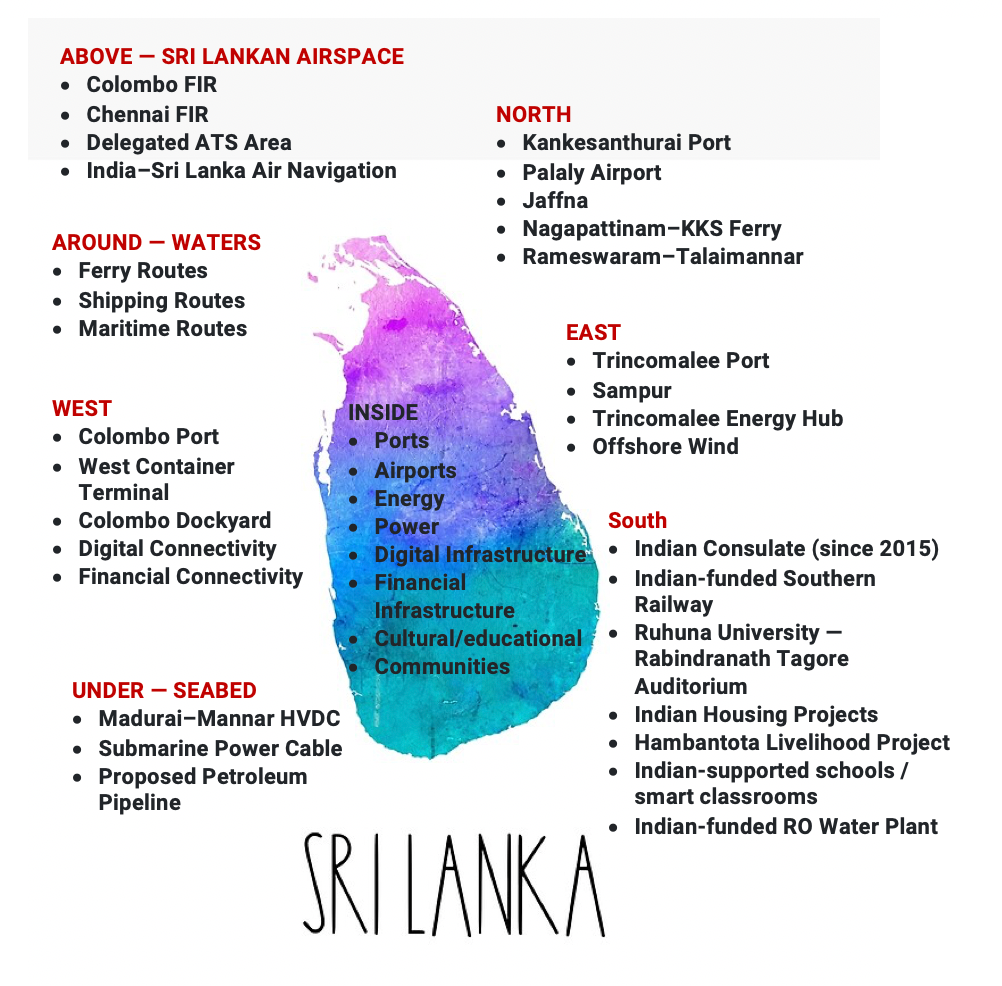
INDIA’S FOOTPRINT — AROUND, INSIDE, ABOVE AND BELOW SRI LANKA (INDIA’S FOUR-DIRECTIONAL FOOTPRINT)
AROUND SRI LANKA
Maritime security, shipping, ports, transshipment, Katchatheevu, fishing and India’s strategic presence across the Indian Ocean.
INSIDE SRI LANKA
Housing, education, healthcare, cultural institutions, community development, investment, energy, infrastructure and connectivity.
ABOVE SRI LANKA
Air connectivity, aviation links, telecommunications, digital systems, satellite/space cooperation and the growing technological relationship.
BELOW SRI LANKA
The mineral and resource base — graphite, ilmenite, rutile, zircon, phosphate, beach sand and other critical minerals.
India itself has identified Sri Lankan graphite, ilmenite, rutile, zircon and phosphate as minerals important to India’s critical-mineral requirements and has been pursuing cooperation in exploration and mining.
India’s footprint is no longer simply at Sri Lanka’s ports.
It is around Sri Lanka.
It is inside Sri Lanka.
It is above Sri Lanka.
It is beneath Sri Lanka.
And increasingly, it is within the systems on which Sri Lanka’s economy, security and society depend.
The question is what happens when all these projects, dependencies and relationships are viewed together.
But sovereignty is not lost only through one agreement. It can also be weakened when too many critical sectors become dependent upon one external power.
The question Sri Lanka must therefore ask is
“Can Sri Lanka still say NO to India — without suffering unacceptable economic, political or strategic consequences?”
INDIA’S COMMUNITY FOOTPRINT IS ALSO EXPANDING
The Indian-Origin Tamil plantation programmes, the wider Indian-origin community including Malayalis, and the education/housing/cultural/economic initiatives.
India’s own High Commission currently describes the Indian-origin population in Sri Lanka as including Sindhis, Bohras, Gujaratis, Memons, Parsis, Malayalis and Telugu-speaking people, while separately identifying the much larger Indian-Origin Tamil plantation community.
India’s influence is not one-dimensional. It operates through COMMUNITY, CULTURE, EDUCATION, ECONOMICS, INFRASTRUCTURE, ENERGY, DIGITAL SYSTEMS, MINERALS,
MARITIME SECURITY AND DIPLOMACY.
The issue is not Indian friendship.
The issue is whether friendship is gradually becoming dependence.
And that fits extremely well with your final “FRIENDSHIP —
YES. COOPERATION — YES. DEPENDENCE — NO.” ending.
Connectivity cannot mean strategic dependence.
And regional partnership cannot mean that Sri Lanka must choose its foreign relations according to another country’s interests.
THE PRINCIPLE IS SIMPLE:
INDIA CAN ADVISE.
INDIA CAN INVEST.
INDIA CAN COMPETE.
INDIA CAN COOPERATE.
BUT SRI LANKA MUST DECIDE.
THE QUESTION RAJNATH SINGH SHOULD HEAR
India’s Defence Minister has come to Sri Lanka to discuss security.
So perhaps Sri Lanka should ask one question first:
WHO DEFINES SRI LANKA’S SECURITY?
India?
China?
America?
Or Sri Lanka?
Because Sri Lanka can be:
A FRIEND OF INDIA.
A PARTNER OF INDIA.
A TRADING PARTNER OF INDIA.
A DEFENCE PARTNER OF INDIA.
But Sri Lanka must never become:
DEPENDENT ON INDIA.
FRIENDSHIP WITH INDIA — YES.
COOPERATION WITH INDIA — YES.
DEPENDENCE ON INDIA — NO.
SRI LANKA’S SOVEREIGNTY MUST REMAIN SRI LANKA’S.
Shenali D Waduge