Registering the ‘Muslim Left Front’: The Danger of a New Ethnic Party threatening Sri Lanka’s Unity”
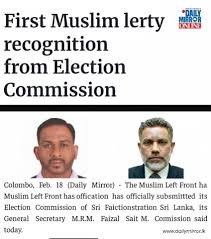
Sri Lanka’s media has reported on the application by the Muslim Left Front for registration with the Election Commission. A careful review of historical, regional, and global patterns shows that political parties — when built on religious identity fused with ideological activism — can become vehicles for external influence, social polarization, and long-term destabilization. This is not a path Sri Lanka should legally permit if it is serious about safeguarding national unity, electoral integrity, and long-term national security.
https://island.lk/recognition-sought-for-first-muslim-left-party/
This analysis does not target Islam or Muslim communities. It examines political engineering models, not religious belief. Across history ethno-nationalist political movements have similarly been weaponized when identity-based mobilization is fused with ideological activism. The issue is political structuring, not faith.
This analysis must not be mischaracterized as Islamophobia or conspiracy theory; such labels are routinely used to silence legitimate debate on national security, governance, and sovereignty.
Democracies collapse not when debate occurs, but when legitimate concerns are silenced through ideological intimidation.
Identity Politics and Global Lessons
Across South Asia, the Middle East, and Africa, the fusion of religious identity with political ideology has repeatedly been exploited to serve foreign or extremist agendas.
Historically, this transformation does not occur suddenly. It follows a predictable progression:
community identity → political mobilization → ideological consolidation → foreign patronage → parallel power structures → eventual radicalization or external manipulation.
Many organizations that are today designated as extremist or terrorist began as legitimate social, religious, or political movements claiming to protect community rights. Their later proscription was not arbitrary — it was the outcome of documented ideological radicalization, political capture, external funding, and operational extremism
A textbook example of this political evolution is the trajectory of Egypt’s Muslim Brotherhood which began as a social and religious reform movement but evolved into a political powerhouse, later spawning militant offshoots and ideological affiliates, including Hamas.
Similarly, in Africa, movements like Boko Haram in Nigeria and AQIM in the Sahel used local grievances and religious identity as a launchpad for extremist activity.
In Southeast Asia, regions such as Aceh in Indonesia and Mindanao in the Philippines show how ethno-religious identity-based political movements can later provide cover for violent actors.
These cases demonstrate a recurring pattern: communities seeking political representation on the basis of religion or ethnicity, especially when organized under ideological frameworks, often become tools for foreign leverage or internal destabilization, even when initially presented as peaceful or rights-based movements.
The likely outcome in Sri Lanka is what this warning is about.
South Asia: The Historical Context
South Asia is particularly vulnerable to this phenomenon.
Pakistan, India, Bangladesh, and Sri Lanka have all witnessed the rise of Islamic political parties and community-based organizations. While some genuinely represent minority interests, many have been exploited by external networks to advance political, strategic, or economic influence.
Groups such as Lashkar-e-Taiba, Jaish-e-Mohammed, and splinter Taliban-affiliated networks in the region illustrate how extremist cells often emerge from communities mobilized under the guise of rights protection.
In Sri Lanka, Muslims constitute around 10% of the population, concentrated in the Eastern Province and urban centers. While their political participation is constitutionally guaranteed, forming a party explicitly built on religious identity can create vulnerabilities, especially when considering external funding sources and international advocacy networks that have historically been aligned with similar identity-based movements.
Particularly noteworthy is the strategic use of the “leftist” ideological label — a framework historically used to mobilize grievance politics, generate international advocacy leverage, and attract NGO-driven political patronage, while simultaneously cultivating grassroots antagonism toward Western geopolitical structures.
Demographics and Strategic Leverage
Demographic trends amplify this risk. Globally, Muslim populations are among the fastest-growing groups in South Asia, Southeast Asia, and parts of Africa.
In Sri Lanka, the growth of urban and Eastern Province Muslim communities creates potentially influential electoral blocs. While demographic expansion is natural, history shows that small communities with concentrated populations and political mobilization can exert disproportionate influence on policy, governance, and national narratives — particularly when connected to external actors.
This is compounded by the fact that international organizations, foreign-funded NGOs, and diplomatic networks often legitimize minority-centric political movements, sometimes inadvertently shielding radical elements while projecting an image of minority empowerment.
This pattern has repeated in countries like Egypt, Nigeria, Indonesia, and the Philippines, where political recognition of identity-based movements created safe platforms for foreign interference and radicalization.
Patterns of Exploitation
These patterns are not speculative. They are documented across multiple geopolitical theatres through declassified intelligence records, international security assessments, UN counterterrorism reports, and academic conflict studies.
The recurrence of identical political structures across continents demonstrates systemic design rather than coincidence.
Historically, there are five key mechanisms through which identity-based political parties have been exploited:
- Political identity framing:By positioning the party as a protector of a community, movements gain legitimacy, even for agendas that may ultimately undermine national cohesion.
- Foreign funding channels:NGOs, religious foundations, and overseas donors often provide financial support, which can indirectly advance external interests.
- Electoral participation as shield:Participation in elections creates a protective veneer, making intervention or scrutiny more difficult.
- International advocacy leverage:Alignment with international bodies and human rights campaigns often provides narrative protection, even if the party engages in divisive or destabilizing activities.
- Demographic leverage:Concentrated populations can translate into strong voting blocs, policy influence, and social narrative shaping, giving parties outsized leverage relative to their numbers.
In Sri Lanka, introducing a religious identity-based political party, particularly one aligned with leftist ideological principles, risks embedding these mechanisms domestically.
The potential consequences include electoral fragmentation, weakening of national cohesion, and vulnerability to foreign influence in critical policy areas.
What many forget is that both minority groups (Tamils & Muslims) have voted not for political parties representing their ethnicity but the mainstream political parties. This clearly shows they prefer to be part of national consensus rather than exclusive. Therefore, registering ethno-religious parties is only inviting unwanted trouble and does not cater to their own people.
Historical electoral evidence shows that Muslim voters in Sri Lanka do not consistently back exclusively Muslim ethnic parties.
In the 2012 Eastern Provincial Council election, the SLMC secured only about 37% of the Muslim vote.
In the 2014 Western Provincial Council election, Muslim‑identified parties captured only about 17% of the vote, with the rest going to mainstream national parties.
At the national level, Muslim political parties have never come close to commanding a vote share proportional to the Muslim population, and no Muslim candidate has succeeded in winning the presidency on an exclusively ethnic ticket. These trends demonstrate that most Muslim voters favour inclusive, mainstream political participation rather than narrow ethno‑religious alignment.”
Ethical and National Security Considerations
Communities have legitimate rights to political representation, and Sri Lanka’s constitutional framework protects these rights. However, when parties are explicitly organized along religious lines and combined with ideological agendas, they introduce a risk of exploitation, as external actors and transnational networks can leverage these platforms for their own agendas.
Sri Lanka’s post-war context, with lingering vulnerabilities from past conflicts, makes the timing of such political developments particularly concerning.
The nation is strategically positioned in the Indian Ocean, a region of high geopolitical competition. Parties that can be influenced externally or that entrench communal identity in politics may provide leverage points for foreign actors, increasing long-term strategic risk especially following the failure of the Eelam – Ethno-terror project.
Global Context: Asia, Africa, and the Middle East
In the Middle East, identity politics has historically been a vehicle for both social reform and violent mobilization.
In Egypt, the Muslim Brotherhood’s political and charitable networks provided both social services and ideological influence, later branching into more radical agendas. Similarly, in Africa, Islamist groups in Nigeria, Mali, and Algeria exploited historical marginalization, religious identity, and foreign support to advance violent campaigns. In Asia, minority-focused movements in Indonesia, the Philippines, and Pakistan have demonstrated how localized identity demands can escalate into broader security challenges when combined with external ideology and resources.
The common thread is clear: identity-based political movements, if not carefully monitored, can serve as strategic platforms for extremism, foreign leverage, and domestic destabilization leading to terror (the kind we witnessed in 2019 – Easter Sunday).
Muslim Left & Sarwajana Ihkwaan- Dilith Jayaweera Factor: Unethical Exploitation of Identity Politics
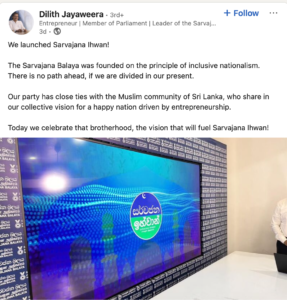
While there is no claim of coordination between these initiatives, their simultaneous emergence reflects a broader and troubling shift toward the normalization of ethno-religious political structuring — a trajectory that historical evidence suffices to show how such can polarize society & be prone to external manipulation.
Dilith Jayaweera’s, recently commenced new venture leverages ethnic exclusivity within his political party – Sarwajana Ikhwaan (using the Arabic term for “Brotherhood,” a phrase globally associated with the Muslim Brotherhood movement, which has been designated extremist or terrorist by multiple states including Egypt, Saudi Arabia, UAE, Russia, Bahrain, Jordan, Syria and Austria.
Muslim Brotherhood is banned in Egypt, Saudi, UAE, Jordan, Russia, Bahrain, Syria, Austria, while France, Germany view it as a threat. It has support of Qatar & Turkey.
If so, what due diligence was conducted before using term? If not, what does this reveal about the ideological vetting and geopolitical awareness shaping this political strategy?
This concern does not imply that the use of Arabic terminology itself is extremist, but rather highlights the responsibility of political leaders to ensure that terminology with globally politicized and securitized associations is not deployed carelessly in fragile multi-ethnic societies.
No political justification — however framed — can ethically or democratically legitimize the deliberate creation of an exclusive ethno-religious unit within a political party, because doing so institutionalizes division, violates the principle of national unity, and reduces governance to narrow identity politics rather than striving to serve all citizens equally.
By institutionalizing ethnic and religious identity in political mobilization, this approach invites international patterns of identity exploitation, raising ethical and national security concerns.
The strategy is deeply unethical because it prioritizes narrow identity agendas and personal power accumulation over national unity, democratic fairness, and social cohesion. By aligning with transnational ideological frameworks, it risks introducing foreign influence into domestic politics, further fragmenting Sri Lanka’s political landscape. The creation of a party along these lines is not simply a political exercise; it is a potential platform for strategic manipulation, with far-reaching consequences for the country’s security, social harmony, and governance integrity.
The application of the Muslim Left Front for registration should not be viewed in isolation. Historical and global patterns demonstrate the risks of identity-based, ideologically-driven political parties: they can become channels for foreign influence, platforms for extremist narratives, and instruments of societal division.
Sri Lanka’s demographic realities, strategic location, and post-war vulnerabilities amplify these risks when combined with a weak government.
In light of these concerns, it is imperative that the Election Commission apply strict constitutional scrutiny, national security risk assessment, and long-term societal impact evaluation, and reject registration of this party to prevent institutionalizing ethnic political fragmentation.
Beyond the specific case of the Muslim Left Front, the Election Commission itself carries a broader responsibility to the nation. It must ensure that its decisions do not institutionalize the creation of additional ethno-religious parties, which could fracture national cohesion, embolden exclusive identity politics, and create grounds for future conflict. Upholding constitutional principles, safeguarding electoral integrity, and preventing the formalization of communal divisions are obligations that rest squarely with the Commission.
Sri Lanka’s constitutional recognition of Sinhala and thereafter Tamil (from 1987 as a result of the Indo-Lanka Accord) as official languages, with English as the link language, already provides a balanced framework for inclusion, administrative efficiency, and national unity. There is no constitutional, governance, or national necessity for introducing a fourth official or administrative language. Governments & political parties should desist from encouraging such for votes.
Globally, the expansion of official language recognition has often been used as a tool of identity politics, institutional fragmentation, and long-term political segmentation. Language policy is not merely cultural; it shapes administrative power, identity alignment, and political leverage.
In Sri Lanka’s post-war and geopolitically sensitive context, any attempt to institutionalize additional official languages must be viewed as a strategic risk, capable of entrenching communal divisions and weakening national cohesion. Preserving a unified administrative framework is essential to safeguarding sovereignty, social harmony, and long-term stability.
Furthermore, domestic actors exploiting ethnic or religious identity for personal political gain must be held to account. Upholding national unity, ethical politics, and democratic fairness is paramount to preserving Sri Lanka’s sovereignty and social stability.
There can never be unity if ethno-religious exclusivity is formalized for personal political votes.
Political parties carry a responsibility to the nation. If their stated aim is to promote unity, peaceful coexistence, and inclusive governance, then organizing along exclusive ethno-religious lines directly contradicts that mandate.
While representing community interests is legitimate, institutionalizing identity-based exclusivity fosters division, weakens national cohesion, and undermines the very values of inclusivity and democracy that all parties claim to uphold.
Shenali D Waduge