
SRI LANKA: Silent shift from Sovereign Control to India-Centric System Dependence
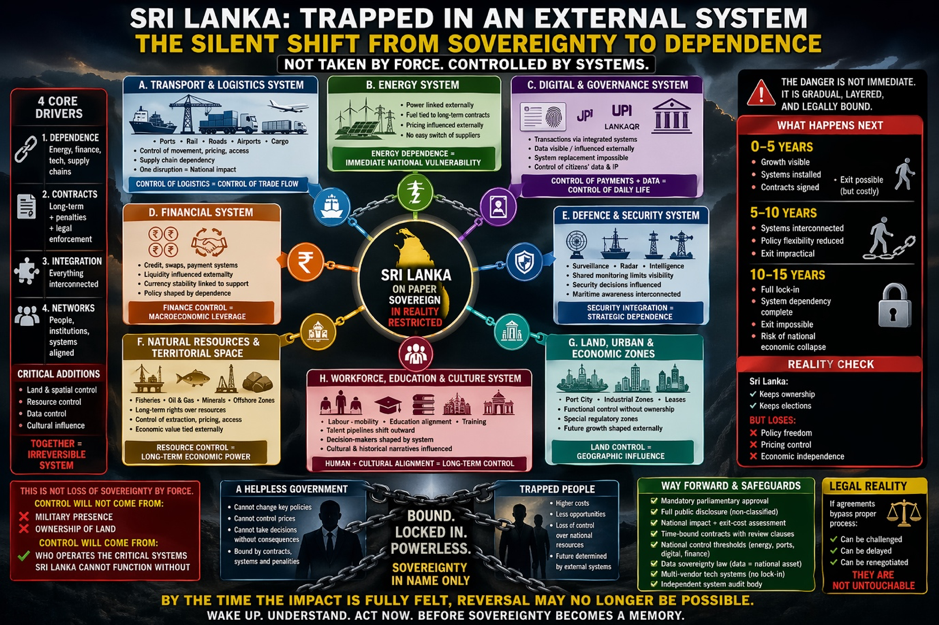
Sri Lanka is not being taken over by force. No foreign troops. No invasion. No declaration of surrender. What is happening is far more dangerous. History has shown us that sovereignty was not lost in the battlefield. The 1815 Kandyan Convention is a grim reminder of how power shifted via agreement. Authority was ceded. The consequences were long term & irreversible. Fast forward to present century, Sri Lanka appears to have a penchant for repeating its mistakes. Strategic sectors are being interconnected to externally controlled systems. Many have not passed through form legal parliamentary approved & constitutionally defined processes. But the agreements are linking Sri Lanka’s energy, transport, finance, digital infrastructure, resources, and even its culture & workforce into externally dependent networks. A dangerous structural shift is taking place. Sri Lanka is moving from a nation that controls its own systems to a country that will have to operate within external systems that its govts will have no power to change. The dangers are not immediate but soon the Govt & people will realize they have no power to change policies, no power to control prices & no power to take decisions without facing consequences. Sri Lanka will remain sovereign in paper, may hold glamorous independence day parades but in reality control over how these assets operate is increasingly shaped by external system linkages arising from agreements already signed.
- WHAT IS BEING BUILT (NOT PROJECTS — SYSTEMS)
Sri Lanka is not signing isolated deals.
It is signing agreements that build externally-interconnected local systems across all of Sri Lanka’s strategic sectors:
- TRANSPORT & LOGISTICS SYSTEM
(Ports + Rail + Roads + Airports + Cargo)
Assets / Agreements
- Colombo West Terminal (51%)
- Dockyard (51%)
- Trincomalee port & oil tanks
- Port–rail–airport corridors
- Freight & cargo hubs
How control works
- Controls movement of imports/exports
- Can influence pricing, access, priority
- Sri Lanka’s entire supply chain becomes dependent
- One disruption = national impact
Control of logistics = control of trade flow
AIRPORTS / TRANSPORT INFRASTRUCTURE)
Assets / Agreements
• Bandaranaike International Airport (BIA) – expansion & management partnerships
• Mattala Rajapaksa International Airport – operational partnerships / lease interest
• Domestic airport network upgrades
• Aviation fuel, cargo handling, and ground services integration
• Air cargo + logistics corridor alignment with ports and trade hubs
How control works
• Air cargo routes influence import/export priority flow
• Airport operations affect tourism, trade, and supply chain speed
• Strategic aviation assets become part of wider logistics network
• Coordination of air–sea–land transport reduces independent operational flexibility
Air transport becomes the “aerial extension” of the logistics control system
- ENERGY SYSTEM
(Electricity + Fuel + Grid + Pipelines)
Assets / Agreements
- Wind/solar (North, Mannar, Pooneryn)
- Trincomalee energy hub
- Grid interconnection
- LNG + pipelines
How control works
- Power linked externally
- Fuel tied to long-term contracts
- Pricing influenced externally
- Sri Lanka cannot switch suppliers easily
Energy dependence = immediate national vulnerability
STRATEGIC MINERALS & SUBSURFACE RESOURCES
(Land + Seabed + Industrial Minerals)
Resources included
• Cobalt (emerging battery supply chain material)
• Graphite (Sri Lanka is already globally significant)
• Ilmenite, titanium sands
• Phosphate deposits
• Rare earth elements (exploration stage / potential reserves)
• Offshore seabed mineral zones
• Oil & gas exploration blocks
• Fisheries + deep-sea resources
How control works
• Long-term exploration and extraction agreements define access rights
• Value chains tied to external industrial demand (energy transition supply chains)
• Processing, pricing, and export routes influenced through contractual frameworks
• Strategic minerals become integrated into global supply networks
Resource control = long-term industrial leverage + future energy transition relevance
- DIGITAL & GOVERNANCE SYSTEM
(ID + Payments + Data + Public Services)
Assets / Agreements
- Digital ID
- UPI–LankaQR
- DPI stack (ID + banking + welfare)
How control works
- Transactions flow through integrated systems
- Data becomes externally visible/influenced
- System replacement becomes impossible
- Control of Sri Lankan citizens private data / intellectual property
Control of payments + data = control of daily life
- FINANCIAL SYSTEM
(Credit + Currency + Trade Mechanisms)
Assets / Agreements
- $4B support + swaps
- Payment systems
- Trade facilitation
- Currency swap
How control works
- Liquidity influenced externally
- Currency stability linked to external support
- Policy shaped by financial dependence
Finance control = macroeconomic leverage
- DEFENCE & SECURITY SYSTEM
(Surveillance + Maritime + Intelligence)
Assets / Agreements
- Defence MoU
- Radar systems
- Maritime surveillance
- Intelligence sharing
How control works
- Shared monitoring limits independent visibility
- Security decisions influenced externally
- Maritime awareness interconnected
Note:
LTTE’s use of India as a hub and its initial training India show that national security concerns of both nations may not necessarily match.
Security integration = strategic dependence
- NATURAL RESOURCES & TERRITORIAL SPACE
(Land + Sea + Minerals + Fisheries)
Assets / Agreements
- Offshore wind zones
- Fisheries zones
- Oil/gas exploration
- Mineral extraction (land + seabed)
How control works
- Long-term rights over resources
- Control of extraction, pricing, access
- Economic value tied externally
Resource control = long-term economic power
- LAND, URBAN & ECONOMIC ZONES
(Port City + Industrial Zones + Leases)
Assets / Agreements
- Port City
- Industrial zones
- Long-term leased land
How control works
- Functional control without ownership
- Special regulatory zones
- Future growth shaped externally
Land control = geographic influence
- WORKFORCE, EDUCATION & CULTURE SYSTEM
(People + Skills + Narrative) Even Sri Lanka’s 2500 history/heritage at risk
Assets / Agreements
- ETCA (labour mobility)
- Education alignment
- Training systems
- Tourism narratives as per external requirements
How control works
- Talent pipelines shift outward
- Decision-makers shaped by system
- Cultural narratives influenced
Human + cultural alignment = long-term control
- WHAT THIS ACTUALLY CREATES
Not projects.
One integrated operating system
- Transport → trade network
- Energy → supply system
- Digital → control layer
- Finance → economic system
- Workforce → cross-border pipeline
No sector stands alone anymore
- HOW CONTROL EMERGES (THE REAL MECHANISM)
This is not takeover.
This is structural lock-in.
STRATEGIC CHOKE POINTS (WHERE CONTROL CONCENTRATES)
- Ports (entry/exit of goods)
• Energy supply (fuel + electricity)
• Payment systems (money flow)
• Data systems (information control)
• Logistics corridors (movement control)
If these are externally influenced → entire nation becomes system-dependent regardless of ownership
4 CORE DRIVERS:
- Dependence
Energy, finance, tech, supply chains
- Contracts
Long-term + penalties + legal enforcement
- Integration
Everything interconnected
- Networks
People, institutions, systems aligned
+ CRITICAL ADDITIONS
- Land & spatial control
- Resource control
- Data control
- Cultural influence
Together = irreversible system
- WHAT HAPPENS NEXT (TIMELINE)
0–5 YEARS → ENTRY
- Projects begin
- Contracts signed
- Dependency starts
5–10 YEARS → DEPENDENCE
- Systems interconnected
- Policy flexibility reduces
10–15 YEARS → LOCK-IN
- Exit becomes economically impossible
- System defines national choices
- REALITY CHECK
Sri Lanka:
- Keeps ownership
- Keeps elections
BUT loses:
- Policy freedom
- Pricing control
- Economic independence
- FINAL TRUTH
Control will NOT come from:
- Military
- Land ownership
Control WILL come from:
Who operates the systems Sri Lanka depends on
This is not loss of sovereignty in law
This is loss of freedom in practice
- CORE QUESTION
Sri Lanka will still vote.
But:
The elected government has to govern or manage systems they cannot change.
THE REAL QUESTION
What is the use in spending on elections after such integration has been signed off?
What good comes of voting for individuals or parties that India may even help come to power to in turn govern the nation on their behalf. Who will they serve?
- WAY FORWARD & SAFEGUARDS
If we have now understood the dangerous outcomes.
The question is do we want to stop becoming system controlled externally?
If yes, then we must demand:
- Mandatory parliamentary approval for all strategic agreements
• Full public disclosure (non-classified)
• National impact + exit-cost assessment before signing
• Time-bound contracts with review clauses
• National control thresholds (energy, ports, digital, finance)
• Data sovereignty law (data = national asset)
• Multi-vendor tech systems (no lock-in)
• Independent system audit body
LEGAL REALITY
If agreements bypass proper process: We must declare that all such agreements
• Can be challenged
• Can be delayed
• Can be renegotiated
They are NOT untouchable
This is not loss of sovereignty by force.
Control will NOT come from:
• Military presence
• Ownership of land
Control will come from:
• Who operates the critical systems Sri Lanka cannot function without
This is loss of flexibility by design.
This is handing over control of governance by Sri Lanka’s elected Govts to an external system not controlled by Sri Lanka’s elected government.
How foolish can a govt be?
Shenali D Waduge


