Dangerous outcomes of Digital Learning & why it Is no longer recommended
The world’s greatest civilizations and iconic structures—temples, irrigation systems, cities, monuments, philosophies, sciences, and legal systems—were not built through digital learning, artificial intelligence, or machines. They were built through the full use of the human mind: observation, memory, discipline, apprenticeship, critical reasoning, and moral responsibility. Human intelligence flourished without computer screens or laptops.
- Human Brains were designed to Think — not to be Replaced
The human brain is not a machine interface.
It is designed for:
- deep concentration
- problem-solving through effort
- learning through repetition, failure, and reflection
- human-to-human transmission of knowledge
Digital learning reverses this process:
- It trains dependency instead of mastery
- It replaces thinking with searching
- It replaces understanding with shortcuts
As reliance on machines increases, human cognitive effort declines.
This is not progress—it is intellectual outsourcing & intellectual lethargy.
- Over-Reliance on Technology weakens Human Capability
Digital learning conditions children to:
- wait for prompts instead of initiating thought
- rely on tools instead of memory
- expect instant answers instead of reasoning
Over time, this produces:
- weaker analytical ability
- reduced problem-solving resilience
- lower tolerance for difficulty and uncertainty
Ironically, while populations increase and natural resources decline, societies are training humans to become less capable, while empowering machines to replace them.
This is a dangerous contradiction.
- Dehumanisation: Technology Redefining Human Identity
Modern digital ecosystems do not merely deliver information—they shape perception, identity, and behaviour.
There is a significant pattern taking place.
- education is being handed over to screens (thus euthanizing children)
- biological roles are being questioned and redefined (taking away femininity & masculinity)
- children and adults are pumped with medications of all kinds while feeding themselves chemicals & artificial foods.
- human limits are treated as design flaws that computers can replace
- technology is promoted as a solution to identity, purpose, and meaning
What happens when the above spills across the global populace?
Instead of helping humans understand themselves better, digital systems increasingly override natural human development, encouraging dependence on external systems—technological, pharmaceutical, or surgical—to resolve human struggles.
This reflects a deeper crisis:
technology is no longer serving humanity; humanity is adapting itself to technology.
This is not how humans should function.
- Digital Learning Trains Obedience, Not Wisdom
Traditional education:
- formed character
- demanded discipline
- transmitted cultural memory
- encouraged moral reasoning
these are essential for children to build their personality.
Digital learning:
- standardizes thought
- fragments attention
- discourages deep questioning
- reduces teachers to content facilitators
When education becomes screen-based, children are shaped more by algorithms and platforms than by parents, teachers, or cultural values.
This produces compliant users, not independent thinkers.
Adults using computers & children using computers differ & cannot be compared.
- The Civilisational Risk
Civilisations rise when:
- human intelligence is strengthened
- values are transmitted across generations
- skills are mastered, not automated away
- wisdom is nurtured.
Civilisations decline when:
- thinking is outsourced
- memory is abandoned
- responsibility is shifted to systems … is this not what we now see happening?
A society that trains its children to rely on machines for thinking will eventually be governed by those who control the machines.
What we need to understand is that digital learning weakens children’s natural cognition, removes discipline, dehumanizes their identity, replaces wisdom with data eventually prepares humans to be replaced not empowered.
We agree technology must assist education but technology cannot redefine education.
True progress comes in strengthening the human mind not surrendering it.
There are reasons that Sri Lanka should seriously address the issue without creating newer issues.
Over the past two decades, Western countries aggressively promoted digital learning, tablets in classrooms, online lessons, and screen-based education—claiming it was modern, efficient, and future-ready. Many in Sri Lanka think that progressive learning is following all that the West does.
The West however are now reversing course.
Not because of ideology—but because of measurable cognitive, psychological, and educational damage that has occurred to children of the West.
- Neuroscience: The Human Brain Does NOT Learn Best on Screens
New findings show:
- Deep learning requires physical interaction(reading books, writing, eye movement across pages)
- Screens encourage skimming, not thinking
- Digital reading reduces comprehension, memory retention, and critical reasoning (removing textbooks in Sri Lanka is inviting for trouble)
The brain processes screen text differently from printed text:
- Screens trigger rapid visual scanning
- Paper triggers linear, reflective thinking
Result: Surface learning replaces deep understanding. The room for wisdom is all but lost.
This makes it easier for children to be easily influenced by the wrong people for the wrong reasons.
This is why students who read on paper consistently outperform digital readers in comprehension tests—even when digital students spend more time studying.
- Returning to Writing – Writing by Hand Builds Intelligence — Typing Does Not
Western studies now confirm:
- Handwriting activates multiple brain regions linked to memory, language, and reasoning
- Typing activates far fewer neural pathways
Children who write by hand:
- Remember more
- Understand concepts better
- Develop stronger problem-solving skills
Countries like Finland, France, and parts of the US are re-introducing handwriting after abandoning it (If Sri Lanka claims to follow Finland example – why is digital learning the norm)
Digital learning weakened cognitive development, especially in young children.
- Attention Span Collapse: A Documented Crisis
https://santamaria.wa.edu.au/decreasing-attention-spans-jennifer-oaten/
Digital learning environments:
- Train children to expect constant stimulation
- Reduce attention span
- Increase impulsivity and distraction
Scientific observation:
- Children exposed to screens early show reduced ability to focus on complex tasks
- Multitasking culture damages executive function (planning, self-control)
This has led Western educators to admit:
“We created learners who cannot sit, listen, or think deeply.” (Is this what Sri Lanka’s so-called “education experts” are trying to do to Sri Lanka’s children?)
Education systems produced digitally dependent but intellectually fragile students
- Mental Health Damage: Anxiety, Depression & Isolation
Western school systems now report:
- Sharp rise in anxiety and depression
- Increased social withdrawal
- Reduced emotional resilience
Why?
- Digital learning replaces human interaction
- Children lose social cues, empathy development, and real-world problem solving
Screens also:
- Disrupt sleep cycles
- Increase dopamine dependency
- Lower stress tolerance
The classroom became psychologically unsafe, not empowering.
- Learning Inequality Worsened — Not Improved
Digital learning was sold as “equal access.”
Reality in the West:
- Wealthier children had supervision, structure, and offline balance
- Poorer children had unrestricted screen exposure
- Learning gaps widened dramatically
Teachers observed:
- Less discipline
- Less parental involvement
- More behavioural issues
Technology amplified inequality instead of solving it. This is exactly what we see will happen in Sri Lanka. Surely, the so-called “intellectuals” should be able to see this – then why are they introducing digital learning knowing the harm that will emerge?
- Teachers Lost Authority — Algorithms Took Over
Digital platforms:
- Reduce teacher-student interaction
- Replace judgment with automated content
- Standardize learning at the lowest level
Western teachers now say:
- Students treat learning as entertainment
- Authority eroded
- Discipline collapsed
Education shifted from character-building to content consumption
- Western Reversal: A quiet admission of Failure
What Western countries are now doing:
- Banning smartphones in schools – Australia has even banned social media for below 16 year olds.
- Limiting screen exposure in classrooms
- Returning to books, handwriting, discussion, and teacher-led instruction
- Warning parents against early digital exposure
They are not saying this loudly—because the same institutions promoted digital learning for years and even funded developing nations to implement.
But the reversal is real.
The Core Scientific Conclusion
Technology is a tool — not the teacher. A physical teacher can never be replaced by algorithms.
Children learn best through:
- Human interaction
- Structured discipline
- Physical books
- Handwriting
- Discussion and debate
- Moral and cultural grounding
Digital learning:
- Weakens cognition
- Damages attention
- Undermines mental health
- Replaces wisdom with information
What this means for Countries like Sri Lanka
Sri Lanka is being pushed to adopt the very models the West is abandoning.
WHY?
That is not progress – that is knowingly putting the lives of Sri Lanka’s children in jeopardy.
That is importing failure with a delay.
True education reform should:
- Strengthen teachers, not devices
- Protect childhood, not digitize it
- Build thinkers, not screen users
- Develop character, discipline, and national values
Lets look at the changes now taking place in the West.
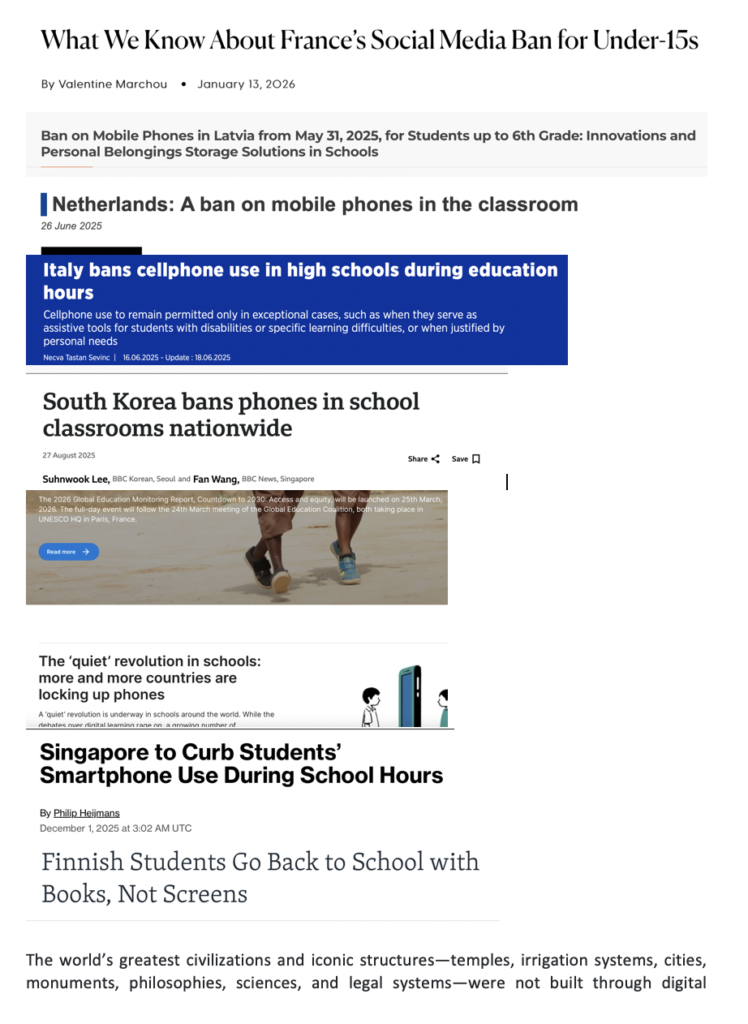
Europe: Smartphone Restrictions & Bans
France
France banned mobile phone use in schools for children in recent years to reduce distraction and improve concentration in class — part of a broader pushback against constant digital device use in learning environments.
https://frenchly.us/france-social-media-ban/
Latvia
Latvia introduced rules in 2025 restricting phones for younger students
Spain
Several regions in Spain have introduced policies limiting or banning phones in schools to help students focus on lessons rather than screens.
https://phonelocker.com/mobile-phone-restrictions-in-spanish-schools/
Netherlands
A 2024 bill bans smartphone use in secondary schools — reflecting concerns about distraction and social impacts of screens.
https://eurydice.eacea.ec.europa.eu/news/netherlands-ban-mobile-phones-classroom
Italy
Italian law extended bans on smart devices in schools so they cannot be used for non-academic purposes at all.
Even South Korea
Starting 2026, South Korea is rolling out bans on smart devices and phones during class hours in schools across the country.
https://www.bbc.com/news/articles/c776ye6lrvzo
These measures reflect a broader trend: many European nations are limiting digital distractions in school because they believe unrestricted screen use harms attention, learning outcomes, and classroom discipline.
UNESCO’s Global Findings on Digital Learning Risks
Global Smartphone Bans
According to UNESCO’s Global Education Monitoring Report, around 79 education systems globally had policies banning smartphone use in schools by the end of 2024.
The report also noted that excessive or inappropriate use of digital technology often does not improve learning outcomes and that technology should only be used when it clearly supports education goals.
https://www.unesco.org/en/digital-education
https://www.unesco.org/gem-report/en
Then why is UN agencies actually promoting digital learning in developing nations even partnering programs & initiatives?
Evidence on Distraction
UNESCO and other studies found that even having a phone nearby — even when not actively used — distracts students, making it harder to concentrate and learn.
Finland: Scaling Back Screens in Schools
Parts of Finland began phasing out digital devices like laptops and heavy screen use in classrooms and reverting to traditional books and pen-and-paper teaching in 2024–25, as educators became concerned about students’ ability to focus and retain information.
Singapore: New Restrictions on Student Devices
Singapore’s Ministry of Education announced that from 2026 secondary students will not be allowed to use smartphones or smartwatches during school hours, including breaks, to cultivate healthier screen habits.
Digital Learning Challenges Beyond Screens
Inequality in Access
In many developing countries digital technology widened gaps instead of closing them:
For example, in places like Ethiopia, large portions of the population still lack reliable internet or electricity, meaning digital learning simply wasn’t accessible to many students — leading to deep inequality in education outcomes.
Is this not what was raised about Sri Lanka with majority of public schools being rural?
What this Shows
Across nations — from Europe to Asia — governments are beginning to question the digital-first education model and are adopting policies like:
- banning or restrictingsmartphones in schools
- reducing reliance on screens for core lessons
- returning totraditional books and handwriting where possible
- setting limits on unsupervised digital learning
These examples suggest a global re-evaluation digital learning.
The former idea that ‘more tech provides better learning’ has been proved wrong & is being reversed.
A bunch of protestors asking for the digital learning claiming it allows their children to be aligned to the modern world – they have got the message wrong.
The modern world is returning to fundamentals—because those fundamentals were never the problem.
When the current EDUCATION REFORMS give step-motherly treatment to the mother tongue, history, and aesthetics, it is clear these are not education reforms. They are structural distortions that will mature into educational nightmares in the future.
Shenali D Waduge