Colonial Divide & Rule in Sri Lanka — How the Dutch Legalized Racial Separation & Institutionalized Communal Fragmentation
Before European intervention, Sri Lanka’s people lived under a civilizational order that was not structured around rigid racial majorities and minorities. Indigenous social organization was shaped by:
- Buddhist cultural traditions
- Buddhist-based royal rule
- Agrarian economy & irrigation civilization
- Regional polities (Rata, Korale, Pattuwa)
- Religious identities — not racial categories
There was no formal racial majority–minority framework, no census-based demographic hierarchy, no communal political representation, and no institutionalized ethnic division — not even structured ethnic conflict.
The Portuguese introduced racial labeling and demographic engineering.
The Dutch formalized this fragmentation into law, laying the structural foundation for ethnic compartmentalization that the British would later weaponize politically.
Dutch Entry into Sri Lanka
The Dutch did not arrive in Sri Lanka as benevolent traders or neutral partners. They arrived as a corporate-imperial power pursuing military, commercial, and territorial domination under the Dutch East India Company (VOC), the world’s first multinational corporation.
They arrived as a hostile imperial power seeking to:
- Destroy Portuguese dominance
- Capture the cinnamon monopoly
- Control maritime trade routes
- Establish VOC commercial supremacy
- Their arrival was driven bycorporate colonialism, not diplomacy.
Kandyan–Dutch Alliance — Tactical Partnership, Strategic Trap (1638)
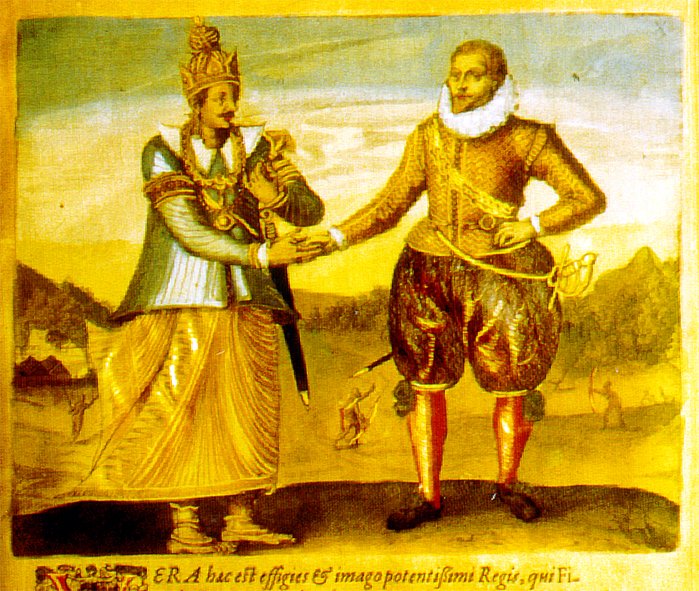
In 1638, the Dutch entered Sri Lanka invited by King Rajasinha II of Kandy, who sought assistance to expel the Portuguese from coastal strongholds – the infamous inguru di miris gaththaawage
Kandyan Objective:
→ Expel Portuguese → Restore indigenous sovereignty
Dutch Objective:
→ Replace Portuguese → Establish Dutch monopoly
This alliance was purely tactical.
The Dutch never intended to return captured territories to the Kandyan Kingdom, betraying the treaty once Portuguese power collapsed. These are lessons for even present day leaders.
Chronology of Dutch–Kandyan Military Conquest of Portuguese Ceylon (1638–1658)
This military campaign was not a Dutch conquest alone, but a joint Sinhalese–Dutch war effort led by the Sinhala Kingdom of Kandy under King Rajasinghe II, aimed at expelling Portuguese colonial rule from the island.
The Dutch acted as maritime allies and suppliers, while the Sinhalese monarchy provided territorial legitimacy, inland military power, and political authority.
1638 — Battle of Gannoruwa (Decisive Sinhalese Victory over the Portuguese)
Combatants:
Kingdom of Kandy (Sinhalese forces) + Dutch logistical support
vs
Portuguese colonial army
Outcome:
- Total annihilation of Portuguese land forces by the Sinhalese army.
- Portuguese military power inland was permanently shattered.
Significance:
- ConfirmedSinhalese military supremacy over the island interior.
- Opened the path for Dutch naval offensives against Portuguese coastal forts.
- Demonstrated thatsovereign territorial authority rested with the Sinhalese monarchy, not foreign powers.
1638 — Capture of Batticaloa (Dutch naval assault, Kandyan strategic backing)
Combatants:
Dutch East India Company naval forces, operating with Kandyan approval and alliance
vs
Portuguese garrison
Outcome:
- Portuguese defeat.
- Dutch seizure of the eastern coastal gateway.
Significance:
- Secured eastern maritime supply routes.
- Facilitated Kandyan–Dutch coordination against remaining Portuguese positions.
- ReinforcedSinhala strategic control over eastern territorial access.
1640 — Capture of Galle (Dutch naval siege with Kandyan alliance)
Combatants:
Dutch fleet + Kandyan military alliance
vs
Portuguese defenders
Outcome:
Portuguese defeat.
Dutch takeover of the island’s main cinnamon export port.
Significance:
- Crippled Portuguese commercial dominance.
- Enabled Kandyan monarchy to weaken Portuguese economic power.
- Established Dutch maritime superiority, butterritorial sovereignty remained Kandyan.
1656 — Fall of Colombo (Joint Dutch–Kandyan decisive victory)
Combatants:
Dutch siege forces + Kandyan military pressure inland
vs
Portuguese colonial headquarters
Outcome:
- After a7-month siege, Portuguese Colombo Fort fell.
- Portuguese imperial rule collapsed in the southwest.
Significance:
- Marked thedestruction of Portuguese imperial control in Sri Lanka.
- Enabled Kandyan kingdom to reassert authority over coastal territory.
- Confirmed thatEuropean survival depended on Kandyan political consent.
1658 — Capture of Jaffna (Final expulsion of Portuguese from the island)
Combatants:
Dutch naval forces acting under Kandyan sovereignty
vs
Portuguese northern garrison
Outcome:
- Final Portuguese defeat.
- Complete elimination of Portuguese rule from Sri Lanka.
Significance:
- Ended150 years of Portuguese occupation.
- RestoredSinhalese sovereign authority over the entire island.
- Dutch replaced Portuguese ascoastal administrators, not sovereign rulers.
The Dutch controlled:
- Colombo
- Galle
- Jaffna
- Mannar
- Negombo
- Batticaloa
- Trincomalee
- Kalpitiya
Entire western, southern, northern & eastern coasts
They never conquered the Kandyan Kingdom, which remained independent until British annexation in 1815.
Major Battles: Dutch & Sinhalese vs Portuguese
| Year | Battle | Outcome | |
| 1638 | Gannoruwa | Decisive Sinhalese Victory | |
| 1638 | Batticaloa | Dutch capture | |
| 1640 | Galle | Dutch capture | |
| 1656 | Siege of Colombo | Dutch capture | |
| 1658 | Jaffna | Dutch capture | |
Dutch Territorial Control (1658–1796)
Dutch Rule — Cultural Destruction, Religious Suppression & Economic Exploitation
Cultural & Religious Damage
- Destruction of Buddhist temples
• Confiscation of temple lands
• Suppression of monastic education
• Conversion of religious sites into forts and warehouses
Religious Policy
- Promotion of Dutch Reformed Calvinism
• Christian registration required for employment
• Administrative religious coercion
Economic Exploitation-Dutch monopolies:
- Cinnamon
• Areca nut
• Elephants
• Pearls
• Shipping
They imposed:
- Forced cinnamon peeling
• Compulsory labor
• Criminalization of private trade
• Food transport control
This crippled local economies and created dependency.
Dutch Population Manipulation & Demographic Engineering
The Dutch:
- Imported Malabar labor
• Consolidated Malabar settlements
• Legalized Malabar racial identity
• Segregated ethnic communities
• Protected Malabar inheritance
This restructured northern demography.
Infrastructure — Extractive, Not Developmental
Dutch construction served commercial and military needs only:
- Fortifications
• Cinnamon transport canals
• Warehouses
• Ports
• Customs checkpoints
They did not build irrigation systems, rural infrastructure, or welfare networks.
Sinhalese Civilization in the North — before Malabar arrival
Long before South Indian political incursions or European colonial intervention, Sinhalese civilization flourished in Northern Sri Lanka.
Archaeological and epigraphic evidence confirms habitation at:
- Nagadipa (Nainativu)
• Kantharodai / Kandarodai
• Vallipuram (1st century BCE inscription of King Vasabha)
• Keerimalai
• Tissa wewa irrigation networks
These predate Chola and Pandya invasions by centuries, proving the North was never an exclusive Tamil or Malabar region.
Strategic and Demographic Implications: Tamil Presence & Colonial Manipulation
During this entire military period:
- The North and East were not Tamil homelands.
- They werefrontier provinces of the Sinhalese Buddhist civilization.
- Indigenous populations wereSinhalese, Vedda, and mixed coastal trading groups, not Tamils
Malabar Migration Reality
- The Tamils referred to historically wereMalabars from South India.
- They weremigratory traders, laborers, and military auxiliaries, not indigenous inhabitants.
- Their settlementincreased mainly under Dutch and British labor import policies.
Colonial Rebranding in 1911
The term “Ceylon Tamil” was not a historical identity, but a colonial census invention of 1911, created to:
- Separatelocally born Malabars from previous/newly imported Indian labor
- Manufacturea false claim of indigeneity and homeland rights
- Construct apolitical minority category useful for divide-and-rule strategies
This means:
The identity “Ceylon Tamil” has a recorded political history of only about 100 years, not 2,000+ years — and therefore cannot logically sustain a claim of ancestral homeland status.
Under international law, self-determination and homeland claims require demonstrable indigenous continuity, which census-engineered identities cannot satisfy.
Thus, for over 400 years of European records, Tamil-speaking populations were never called “Ceylon Tamils.”
They were consistently identified as “Malabars” — migrants from South India.
Queiroz (1687):
“The Malabars are not natives of the island, but come from the coast of Coromandel.”
Ribeiro (1685):
“The Chingalas are the true natives of the land. The Malabars crossed from the Coromandel coast and settled in Jaffna.”
Dutch records categorized:
- Sinhalese – Indigenous
• Malabars – South Indian migrants
• Moors – Muslim traders
The term “Ceylon Tamil” did not exist during Portuguese rule nor Dutch rule.
The Homeland Claim — A Historical Impossibility
A legitimate homeland claim requires:
- Indigenous origin
- Continuous habitation
- Archaeological continuity
- Civilizational presence
- Political sovereignty history
The so-called Tamil homeland fails every criterion.
A political identity invented in 1911 cannot claim:
- a 2,500-year homeland
• ancestral sovereignty
• indigenous exclusivity
Thesavalamai Law (1707) — Legal Segregation
The Dutch institutionalized ethnic separation through Thesavalamai Law, applied exclusively to Malabars of Jaffna.
It regulated:
- Property
• Inheritance
• Marriage
• Dowry
• Land tenure
This:
- Prevented assimilation
• Locked ethnic identity into law – even amongst Malabars & Tamils born later in Sri Lanka.
• Hardened communal boundaries
• Territorialized migrant settlement
Sri Lanka’s first legal segregation system.
Parallel Legal Systems — Institutionalizing Ethnic Compartmentalization
| Community | Legal System |
| Sinhalese | Kandyan Law |
| Malabars | Thesavalamai Law |
| Muslims | Muslim Law |
| Europeans | Roman–Dutch Law |
This embedded race into governance and fragmented society into parallel legal universes.
Dutch Divide & Rule Strategy — Triangular Fragmentation
The Dutch systematically pitted:
| Group | Against |
| Malabars | Sinhalese |
| Christian converts | Buddhists |
| Muslim traders | Sinhalese commerce |
| Burghers | Indigenous elites |
Objective: Fragment loyalty → fracture unity → monopolize power
Strategic Outcome of Dutch Rule
By 1796, the Dutch had:
- Legalized racial separation
• Institutionalized communal identity
• Territorialized ethnic settlement
• Fragmented indigenous governance
• Laid foundations for British ethnic politics
Portuguese → racial labeling + forced conversion
Dutch → racial law + legal segregation
British → racial politics + separatist mobilization
Sri Lanka’s ethnic divisions are:
Not ancient
Not organic
Not civilizational
They are colonial constructions, deliberately engineered to fragment society for imperial control.
This ground reality must be understood by all – it is only those agents of either the colonial architects or those that benefit by using “Malabar” dimension to merge parts of Sri Lanka to its neighbor that are peddling this imperial legacy into a modern demand.
Shenali D Waduge