
A NATIONAL CALL TO ACTION: DEFEND SRI LANKA – STOP THE INTERNATIONAL SEPARATIST OFFENSIVE
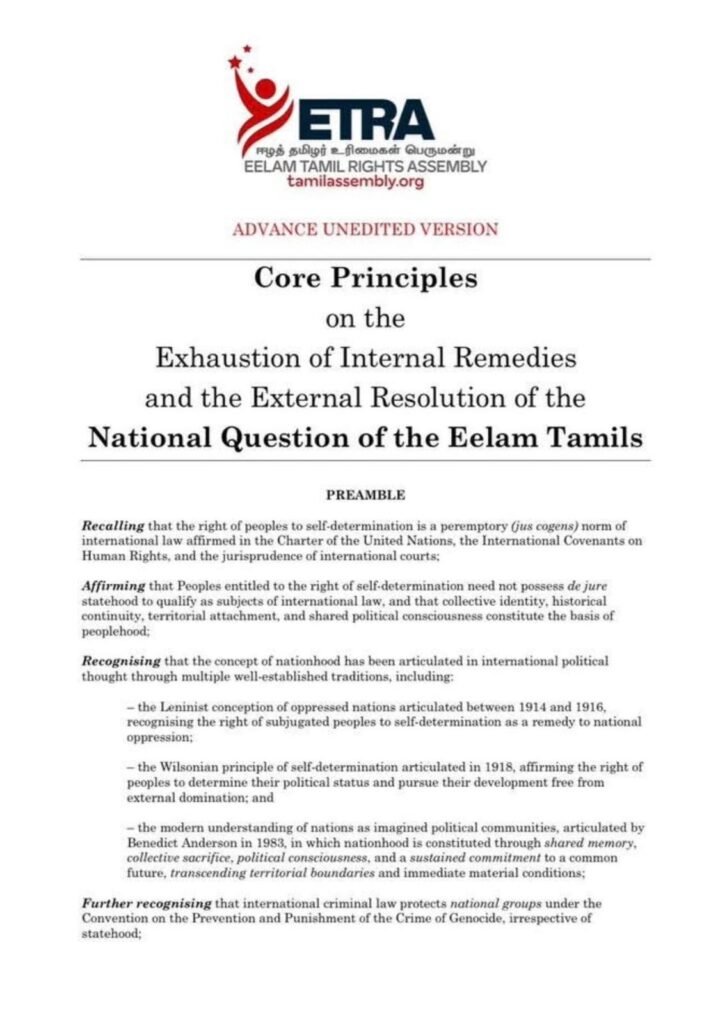
Sri Lanka today faces an externally coordinated legal and political assault designed to:
- Undermine territorial integrity
• Weaken constitutional sovereignty
• Revive separatist ideology
• Internationalise domestic governance
• Legitimize territorial division
This campaign is conducted through propaganda, foreign lobbying, and NGO activism.
Under international law, Sri Lanka has the legal right and obligation to defeat this threat. Under international law, externally coordinated propaganda, legal warfare, foreign lobbying and NGO-based political activism aimed at dismantling a State’s territorial integrity constitute hybrid warfare and unlawful intervention.
UN General Assembly Resolution 2625 (1970) — Declaration on Friendly Relations
“No State shall organize, assist, foment, finance, incite or tolerate subversive, terrorist or armed activities directed towards the violent overthrow of the regime of another State, or interfere in civil strife in another State.”
THE LEGAL FOUNDATION OF SRI LANKA’S SOVEREIGNTY
-
UN CHARTER – TERRITORIAL INTEGRITY IS ABSOLUTE LAW
Article 2(4) — Jus Cogens (Peremptory Norm)
“All Members shall refrain from the threat or use of force against the territorial integrity or political independence of any state.”
Any doctrine, advocacy, lobbying or international maneuver designed to fracture Sri Lanka’s territorial integrity is therefore void in law and invalid ab initio.
QUOTE:
Vienna Convention on the Law of Treaties – Article 53
“A treaty is void if, at the time of its conclusion, it conflicts with a peremptory norm of general international law (jus cogens).”
This is non-derogable law.
No:
• NGO
• Diaspora group
• Foreign government
• International agency
has legal authority to challenge or fragment Sri Lanka’s territorial unity.
Article 2(7) — NON-INTERVENTION DOCTRINE
“Nothing contained in the present Charter shall authorize the United Nations to intervene in matters which are essentially within the domestic jurisdiction of any state.”
Sri Lanka’s:
• Constitutional order
• Territorial structure
• Internal governance
are beyond foreign legal interference.
-
INTERNATIONAL LAW DOES NOT GRANT SECESSION
THE DOCTRINE OF REMEDIAL SECESSION — LEGALLY INAPPLICABLE
International law recognizes remedial secession only as an exceptional remedy where:
- A people are undercolonial rule
- Subjected toforeign military occupation
- Or deniedmeaningful political participation
Sri Lanka meets none of these criteria.
QUOTE:
Supreme Court of Canada – Quebec Secession Reference (1998)
“The right to secession only arises in the most extreme circumstances and is limited to situations of colonial domination, foreign occupation or where a people is denied meaningful access to government.”
Sri Lanka is:
- Not colonized
• Not occupied
• Not under apartheid
• Not under foreign domination
Therefore:
There exists ZERO international legal pathway to territorial secession.
This is affirmed by:
- International Court of Justice (Kosovo Advisory Opinion)
• Supreme Court of Canada (Quebec Secession Case)
• UN Human Rights Committee jurisprudence
-
GENOCIDE CONVENTION — LEGALLY IMPOSSIBLE CLAIM
LEGAL REQUIREMENT OF JUDICIAL DETERMINATION
Allegations do not constitute genocide.
Only judicial determination by a competent international tribunal can legally establish genocide.
QUOTE:
ICJ – Bosnia v Serbia (2007)
“The determination of genocide requires proof of specific intent established beyond reasonable doubt.”
Under the Genocide Convention (1948):
Genocide requires:
- Proven intent
- Judicial determination
- Targeted destruction
No international judicial body has ever ruled genocide against Sri Lanka.
Nor have those making allegations produced 40,000 names or skeletons.
Dead LTTE do not constitute civilian dead.
Therefore:
The legal trigger for “remedial secession” does not exist.
THE INTERNATIONAL COUNTER-TERRORISM LEGAL FRAMEWORK
Sri Lanka is bound by binding UN Counter-Terrorism Conventions:
- International Convention for the Suppression of the Financing of Terrorism (1999)
- UN Security Council Resolution 1373 (2001)
- UN Global Counter-Terrorism Strategy
- FATF Terror Financing Protocols
UN SECURITY COUNCIL RESOLUTION 1373 — BINDING LAW
Requires all states to:
- Criminalize terrorist financing
• Freeze terrorist assets
• Suppress recruitment & propaganda
• Prevent ideological continuation of terrorist movements
PROHIBITION OF IDEOLOGICAL CONTINUATION OF TERRORISM
QUOTE:
UN Security Council Resolution 1373 – Operative Paragraph 1(c)
“All States shall prohibit their nationals and any persons and entities within their territories from making any funds, financial assets or economic resources available, directly or indirectly, for the benefit of persons who commit or attempt to commit terrorist acts.”
This includes legal, political, lobbying, propaganda, and organizational activity aimed at continuing the ideological objectives of terrorist organizations.
LEGAL REALITY
The LTTE was:
- UN-listed terrorist organization
- Banned in33+ countries
Responsible for:
- Suicide bombing
- Child recruitment
- Ethnic cleansing
- Political assassinations
- Mass civilian killings including Tamils
Therefore:
Any organization continuing LTTE ideological objectives is legally subject to counter-terror laws.
THE LEGAL STATUS OF POST-LTTE SEPARATIST LAWFARE
THE CLEAN HANDS DOCTRINE & PRIORITY OF LTTE ACCOUNTABILITY
LEGAL PRINCIPLE: CLEAN HANDS DOCTRINE
Under international law, a party seeking equitable relief must come with clean hands.
QUOTE:
ICJ – Case Concerning Military and Paramilitary Activities in and against Nicaragua (1986)
“A party cannot rely on equitable principles when its own conduct has been unlawful.”
Therefore, no diaspora organization or lobbying entity connected to LTTE ideology, financing, or propaganda can claim legal standing until full accountability for LTTE crimes is achieved.
When terrorist groups lose militarily, international law recognizes:
Ideological, financial, legal and propaganda continuation as EXTENSION OF TERRORISM
This includes:
- Diaspora financing networks
• Legal activism for separatism
• Propaganda campaigns
• Political lobbying for division
• NGO-based legitimacy laundering
Under international counter-terror doctrine, these constitute:
TERRORIST CONTINUITY OPERATIONS & this is why LTTE continues to remain banned by the countries that originally banned it from 1997, 2001 onwards.
SRI LANKA’S LEGAL RIGHT TO ACT
Under international law, Sri Lanka has full authority to:
- Criminalize separatist advocacy
- Investigate NGO funding
- Freeze foreign-linked financial flows
- Ban extremist propaganda
- Prosecute ideological continuation networks
- Conduct international legal counter-offensives
THIS IS A NATIONAL SECURITY IMPERATIVE
Under international law:
Territorial fragmentation is an existential threat to state survival.
Therefore:
- Prevention islegal obligation
• Counter-action issovereign right
• Suppression is internationally lawful
LEGAL PRECONDITION FOR INTERNATIONAL ENGAGEMENT
Sri Lanka asserts that no international discussion on accountability, reconciliation, or governance reform is legally valid unless and until the full criminal record of the LTTE and its global financing networks is formally investigated, prosecuted, and adjudicated under international counter-terror law FIRST.
WHAT WE DEMAND — AS CITIZENS UNDER INTERNATIONAL LAW
We demand of the Government of Sri Lanka:
-
FORMALLY DECLARE SEPARATIST LAWFARE A NATIONAL SECURITY THREAT
This falls under:
- UN Charter Article 51 – Inherent Right of Self-Defense
• International counter-terror doctrine
-
ACTIVATE INTERNATIONAL COUNTER-TERROR FINANCIAL INVESTIGATIONS
Using:
- UN Terror Financing Convention
• FATF frameworks
• UNSC 1373 obligations
Targeting:
- Diaspora funding networks
• NGO financial pipelines
• Lobbying funding sources
MANDATORY INTERNATIONAL COOPERATION OBLIGATION
QUOTE:
International Convention for the Suppression of the Financing of Terrorism — Article 8
“Each State Party shall take appropriate measures for the identification, detection and freezing or seizure of any funds used or allocated for the purpose of committing terrorist offences.”
-
ENACT DOMESTIC COUNTER-SEPARATISM LEGISLATION – instead of diluting existing terror laws:
Criminalizing:
- Secession advocacy
• Foreign territorial lobbying
• Internationalization of sovereignty claims
As practiced by:
- Spain
• China
• India
• Russia
• Israel
• Turkey
-
LAUNCH GLOBAL LEGAL COUNTER-OFFENSIVE
Sri Lanka must:
- Submit counter-dossiers
• Invoke UN Charter protections
• Expose lawfare operations
• Initiate international legal counter-cases
MESSAGE TO THE PEOPLE OF SRI LANKA
- This isnot political repression.
- This isinternational legal self-defense.
- No nation allows: Foreign-funded movements to dismantle its territorial existence.
MESSAGE TO TAMIL BROTHERS & SISTERS
- Your equality
• Your political rights
• Your cultural identity … is protected.
It does not permit external actors to fragment your homeland and plunge your future into permanent instability.
MESSAGE TO THE INTERNATIONAL COMMUNITY
Sri Lanka demands:
Respect for the UN Charter, not selective human rights weaponization.
NATIONAL MOBILISATION CALL
We call upon:
- Religious institutions
• Legal community
• Academic bodies
• Professional organizations
• Trade unions
• Youth & student movements
• Media institutions
• Civil organizations
to form a NATIONAL SOVEREIGNTY DEFENSE FRONT
To:
Compel decisive legal and institutional state action.
HUMAN RIGHTS NON-DEROGATION CLAUSE
Sri Lanka reaffirms its absolute commitment to:
- Equality
- Minority rights
- Religious freedom
- Linguistic parity
However, international law does not permit human rights doctrines to be weaponized to dismantle sovereign territorial integrity.
QUOTE:
ICCPR – Article 19(3)
Freedom of expression may be restricted for the protection of national security, public order, and territorial integrity.
THE PROPOSED DEPARTMENT OF PUBLIC PROSECUTION (DPP): IS A DIRECT THREAT TO THE CONSTITUTION, RULE OF LAW & NATIONAL SECURITY
WHY THE DPP IS DANGEROUS
The proposed Department of Public Prosecution (DPP) represents a fundamental restructuring of Sri Lanka’s criminal justice system with grave constitutional and national security consequences.
If enacted, it would:
- Bypass the Constitution
• Undermine the Attorney General’s constitutional authority
• Fragment prosecutorial power
• Enable foreign legal interference
• Facilitate international lawfare
• Politicize criminal justice
This is not reform. This is institutional subversion.
CONSTITUTIONAL VIOLATION
Article 3 – Sovereignty of the People
Sovereignty is inalienable.
Any attempt to restructure prosecutorial authority outside constitutional architecture amounts to: Erosion of the People’s sovereignty.
Article 4(c) – Judicial Power of the People
Judicial power is exercised only through institutions recognized by the Constitution.
The Attorney General’s Department is constitutionally embedded.
Creating a parallel prosecutorial authority:
- Fragments judicial authority and violates constitutional structure.
NATIONAL SECURITY THREAT
Sri Lanka defeated one of the world’s most ruthless terrorist organizations.
Post-conflict environments are prime targets for international lawfare.
A newly created DPP structure:
- Can be externally pressured
• Can be NGO-influenced
• Can be diplomatically manipulated
• Can be weaponized against national leadership
This exposes:
Sri Lanka’s military, political leadership and national security architecture to foreign legal attack.
INTERNATIONAL LAWFARE WARNING
Global hybrid warfare doctrine identifies prosecution systems as prime targets for destabilization.
Foreign lawfare strategies aim to:
- Capture prosecution authority
• Engineer selective prosecutions
• Criminalize military victory
• Internationalize domestic courts
Fragmenting prosecutorial authority creates systemic vulnerability.
NO LEGAL NECESSITY FOR A DPP
Sri Lanka already possesses:
- Attorney General’s Department
• Courts & judicial review
• Parliamentary oversight
• Constitutional safeguards
There is no legal vacuum requiring a DPP.
Reform can occur within existing constitutional structures.
GLOBAL PRECEDENT
States facing terrorism and hybrid warfare centralize prosecution, they do not fragment it:
- USA
• India
• Israel
• Russia
• China
Only weak or destabilized states fragment prosecutorial authority.
TIMING IS STRATEGICALLY ALARMING
The DPP proposal emerges precisely when:
- International lawfare pressure is rising
• Diaspora legal lobbying is intensifying
• UNHRC activism is escalating
• Foreign-funded NGO influence is expanding
This convergence signals systemic vulnerability creation.
The proposed DPP:
Bypasses constitutional safeguards, weakens prosecutorial integrity, and exposes Sri Lanka to foreign legal warfare.
Therefore:
The People of Sri Lanka must oppose this proposal in its entirety.
IMMEDIATE WITHDRAWAL OF THE PROPOSED DPP LEGISLATION
We demand:
- Immediate suspension of the DPP proposal
• Full Supreme Court constitutional review
• Parliamentary inquiry into foreign influence
• Public disclosure of all stakeholder involvement
• National consultation before any reform
Because:
Sri Lanka cannot afford institutional vulnerability in an era of global lawfare.
The DPP is not reform.
It is constitutional bypass.
It is institutional infiltration.
It is national security erosion.
DECLARATION
Under international law:
Sri Lanka is indivisible.
Sri Lanka is sovereign.
Sri Lanka is legally protected.
We will not allow:
Terrorism defeated on the battlefield to re-emerge through courtrooms, NGOs, and foreign lobbies.
THIS IS OUR LEGAL LINE OF DEFENSE.
ONE NATION.
ONE SOVEREIGNTY.
ONE FUTURE – — Defend Sri Lanka from external lawfare and separatist resurgence
Shenali D Waduge


