Sri Lanka’s Conflict: Civilians – Civilian Deaths & LTTE Dead
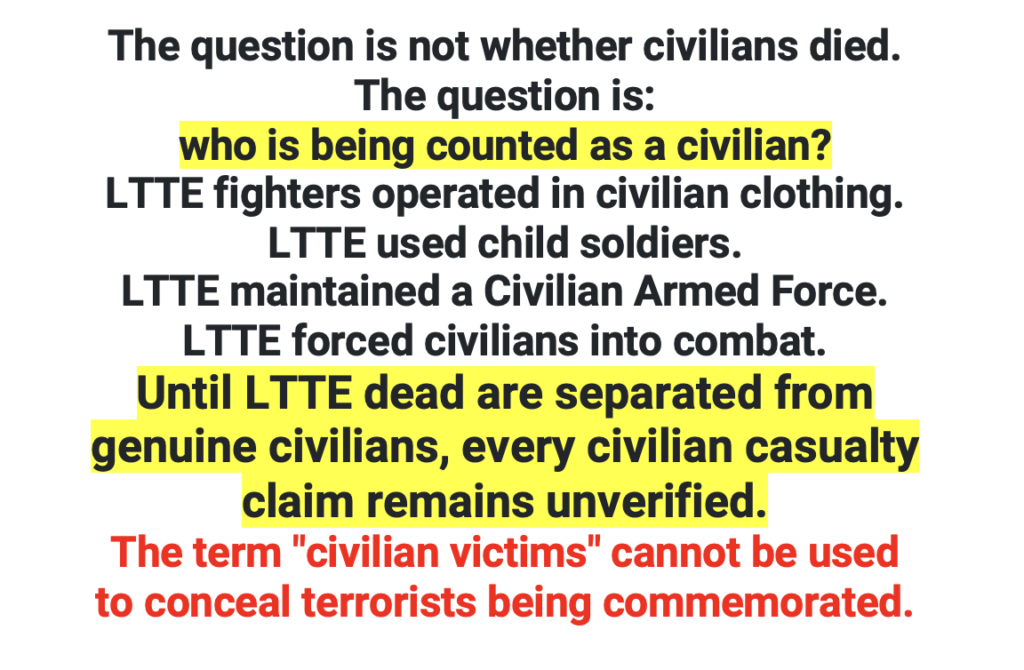
BEFORE CLAIMING “40,000 CIVILIANS”KILLED
The following must first be established:
- How many LTTE combatants were killed/died in battle?
- How many LTTE child soldiers were killed/died in battle?
- How many belonged to the LTTE Civilian Armed Force & killed/died in battle?
- How many LTTE members were operating in civilian clothing?
- How many civilians were forcibly recruited into combat?
- How many genuine civilians took no part in hostilities?
- Without first deducting LTTE deaths from total deaths, no one can claim a civilian death figure.
- No credible civilian casualty figure can be produced until LTTE combatants, LTTE child soldiers, LTTE Civilian Armed Force members, and civilians forced into hostilities are separated from genuine civilians.
A SIMPLE QUESTION
If the Sri Lankan Armed Forces intended to exterminate Tamil civilians:
Why did over 290,000 civilians emerge alive from LTTE control saved by Sri Lanka’s military?
If the objective was extermination, the Armed Forces had complete military control at the end of the conflict. Instead, almost 300,000 civilians emerged alive.
Why were they received into Government-controlled areas?
Why were they fed, housed and medically treated after crossing?
A policy of extermination is incompatible with the survival of the overwhelming majority of civilians who exited the conflict zone making it the world’s biggest hostage-rescue humanitarian operation alongside a military operation.
CLAIM: “Civilians were deliberately targeted by the Armed Forces”
WHO ARE THESE “CIVILIANS”?
- LTTE combatants, including child soldiers, who engaged in hostilities while in civilian clothing
- LTTE civilian armed force operating in combat while in civilian clothing
- Civilians forced to engage in combat/hostilities under coercion
- Genuine Civilians who had no role in hostilities/combat
- LTTE support personnel engaged in military functions while dressed as civilians.
Only civilians who were not directly participating in hostilities retain civilian protection under International Humanitarian Law.
WHAT WERE CIVILIANS DOING INSIDE A WAR ZONE?
- LTTE took civilians as hostages
- LTTE used civilians as human shields
- LTTE forced recruitment of civilians including children
- LTTE trained civilians in combat and used forced labour
- LTTE prevented civilians leaving the conflict zone
- LTTE shot at civilians attempting to escape to Govt controlled areas
- LTTE placed military assets among civilians
- LTTE fired at the Armed Forces from within civilian concentrations
- LTTE operated media channels from war zone & inflated situation
- LTTE used suicide bombers among civilians who attacked refugee centres killing both civilians and military personnel
LTTE RESPONSIBILITY
LTTE stands guilty of all above and by their own actions is the cause of civilian casualties.
In taking civilians and keeping civilians with LTTE, LTTE showed no concern for Tamil civilians (men, women, elderly, pregnant, sick, children).
LTTE should have faced its enemy directly instead of using the very people they claimed to represent.
WHAT THE ABOVE CLEARLY SHOWS
- The LTTE exercised physical control over civilian movement – LTTE held the sole decision to allow civilians to escape to safety or not
- The LTTE deliberately increased civilian exposure to combat – LTTE compromised the lives of its own people
- The LTTE used civilians as a tactical protective layer – LTTE betrayed its own people
- The LTTE actively prevented civilian evacuation to safe areas
LTTE placed civilians in a vulnerable situation.
LTTE compromised civilian lives.
LTTE’s conduct is directly responsible for civilian casualties.
LTTE fired from civilian areas and expected the Armed Forces not to respond.
The LTTE deliberately destroyed the civilian–combatant distinction by removing separation between armed cadres and civilian population
UNDER INTERNATIONAL HUMANITARIAN LAW
- Civilians are protected unless and for such time as they take direct part in hostilities
- The presence of civilians does not prohibit attacks on legitimate military objectives
- The use of human shields is a serious violation of IHL by the party employing them
LEGAL CONTEXT
Where:
• Civilians are forcibly retained in combat zones
• Combatants are embedded within civilian populations
• Civilians are used as shields against military attack
Then:
Civilian casualties occurring in such conditions cannot be interpreted as deliberate targeting by the opposing force.
- The LTTE systematically embedded civilians within its military operations
- Civilian harm resulted from this deployment strategy
- LTTE deliberately dismantled the separation between civilians and combatants
- The Armed Forces operated in a context where civilian-combatant separation had already been destroyed by LTTE actions
- An attack directed at a legitimate military objective does not become “deliberate targeting of civilians” simply because civilians are present or harmed in the vicinity
- Where one party unlawfully creates conditions that place civilians in harm’s way, responsibility for resulting civilian risk exposure must be assessed in light of those actions
This invalidates the allegation of “deliberate targeting of civilians by the Armed Forces”, as LTTE used civilians as shields, hostages, and operational cover.
If civilians are intermingled with combatants
If civilians are forcibly retained in combat zones
If military positions are embedded within civilian structures
If LTTE fires from these positions
Then civilian casualties cannot automatically be interpreted as deliberate targeting.
CLAIM: “40,000 or more Civilians were killed by the Armed Forces”
The primary reason for civilian casualties are:
- LTTE taking civilians to be used as hostages and human shields
- LTTE decision to take, keep and prevent civilians going to safety
- LTTE keeping its military assets among civilians & firing from among civilians
- LTTE using civilians as forced labor and in combat operations
- LTTE had its own civilian armed force
- LTTE fought in civilian clothing to pose as civilians
- LTTE shot at civilians attempting to flee them
Therefore casualties arising from above has not been ascertained as a result any of the above deaths do not constitute civilian deaths and can be attributed to the armed forces.
Firstly, the need to establish
WHO IS A CIVILIAN
- Who is a civilian – a civilian is one who does not take part in hostilities either voluntarily or by force.
- Who claim civilians deaths
- What is the source
- What is the nature of the civilian casualties & the number against each, The important distinction is that all deaths cannot be conveniently credited to the armed forces.
- natural death – primary responsibility falls on LTTE for forcibly taking Tamil civilians
- lack of medical treatment – primary responsibility falls on LTTE for forcibly taking the old, vulnerable and even the pregnant & refusing to release them
- killed while in combat – primary responsibility falls on LTTE for forcibly engaging civilians in combat
- killed during cross fire – primary responsibility falls on LTTE for putting civilians in the line of fire.
- killed by LTTE – none of those who quote civilian deaths have counted the Tamils killed by LTTE
- killed by armed forces – these must be proven deliberate killings and not civilians dying in the line of fire.
- Deliberate killings: Who killed them & how many
- How many did LTTE kill
- How many did Sri Lanka Armed Forces kill
WHO CLAIMS CIVILIAN DEATHS
- 2009 – UN Country Team
7721 deaths
- 2009 – Survey by Govt in the North after end of conflict -7400 dead including LTTE killed in combat, 2600 missing of whom 1600 were LTTE
- July 2011Tamil teachers of the North did a population survey of the North covering migration, deaths, untraceable persons from 2005 to 2009 – their report revealed 7896 dead including LTTE while the dead from natural illness and sickness was 1102. http://www.statistics.gov.lk/PopHouSat/VitalStatistics/EVE2011_FinalReport.pdf
- 2009 – Tamilnet (pro-LTTE website)
7398 deaths (regular figures added)
- UK Siobhain McDonagh declared 100,000 dead
She serves as the Chair of the All Party Parliamantary Group for Tamils
She is a regular attendee of Mahaveer Naal (LTTE Heroes Day) events in UK
She has never been to Sri Lanka
How is she claiming this number?
- Gordon Weiss – former UN Spokesman
Originally quotes 7000 dead
At the launch of his book “The Cage” he inflated the figure to 40,000 and changed number to 10,000 when challenged by a member in the audience.
- Amnesty International
Quoted 10,000 civilian deaths in a report titled “When will they get justice”
Anna Niestat of Amnesty International speaks of LTTE not allowing civilians to leave and shooting at civilians.
- 2011 – UNSG Ban Ki Moon’s Privately Commissioned Darusman Panel
claimed 40,000 civilians “may have been killed” – key word is “may have”. This does not say that such a number was killed.
- 2012 – Charles Petrie reviewing the UNSG’s report claimed 70,000 deaths ignoring the UN Country Team figure of 7721.
- 2011 – UNICEF sponsored Family Tracing & Verification and Verification Unitcompilation listed 2564 untraceable persons out of which 676 were children (64% of them were kidnapped by LTTE)
- Satellite analyst report of the American Association for the Advancement of Science
Identified 3 graveyards – one with 1346 bodies.
1 of the 3 was a LTTE graveyard with 960 bodies
No satellite images detected 40,000 or even 200,000 dead.
- The University Teachers for Human Rights-Jaffnain a Special Report no. 32 of 10 June 2009 and Special Report No 34 of 13 December 2009 placed the dead between 20,000-40,000
- The Times of London– 20,000
- Bishop of Mannar, Rayappu Joseph– claims 147,000 as missing (It is strange that he has not placed one single name of the missing with the Commission though he can rally numerous priests to sign letters and send to the UNHRC calling for international investigations against Sri Lanka.
- Alan Keenan the Project Director of International Crisis Group Sri Lankaplaced civilians killed in the Vanni between 40,000 – 147,000
- TheInstitute of Conflict Management, Delhi– 11,111
- Independent Diaspora Analysis Group-Sri Lanka– 15,000-18,000
- Data compiled by the South Asia Terrorism Portal, data “primarily based on figures released by the pro-LTTE Website Tamil Net”, put the casualty figure for civilians inside Mullaithivu at 2,972 until 5 April 2009.
- 13 March 2009 – UN Human Rights Commissioner Navi Pillay’s press release said that ‘as many as 2800 civilians ‘may have been killed’
- The Guardian editorial(Sri Lanka: Evidence that won’t be buried(June 15, 2011),) – quoted 40,000
- Editorials by The Timesand The Sunday Timesin late May 2009 related investigations the papers had conducted that revealed more than 20,000 Tamil civilians were killed in the final
- Publication titled “Genocidio: (Primera entrega) – La masacre de los Tamils en Sri Lanka,” [Genocide: (First Delivery) The Slaughter of Tamils in Sri Lanka], the Argentinean periodical La Tarde (diario)in a Spanish language article – 146,679 Tamils disappeared or killed between 2008 and 2009, of which 40,000 deaths occurred in the 48 hours of the final assault
- ICRC press statementof 21 April 2009 declared that their estimates of Tamil civilians inside the no fire zone was 50,000 (In other words upto 21stApril 2009, the ICRC did not know that LTTE had 300,000 people with them.
http://www.dailynews.lk/?q=features/icrc-sri-lanka-during-final-phase-war#sthash.JT9KUOgA.dpuf
- The International Crisis Groupquoting ICRC says 150,000 were in the NFZ in early March 2009.
- UN estimated on 13 May 2009that about 50,000 civilians were trapped by the conflict, in a 300sq.km strip of land
http://www.dailynews.lk/?q=features/icrc-sri-lanka-during-final-phase-war#sthash.JT9KUOgA.dpuf
- Indian embedded journalist Murali Reddyreported that from 13 May 2009 there were no civilians in thekm strip LTTE was restricted to.
All of the claims for civilian fatalities come from 3rd party or 4th party sources majority which are linked to LTTE lobbies.
WHAT IS THE SOURCE FOR QUOTING CIVILIAN DEATHS:
Have the following given their sources for quoting civilian dead numbers:
- UK Siobhain McDonagh declared 100,000 dead
- Gordon Weiss – former UN Spokesman
- Amnesty International
- 2011 – UNSG Ban Ki Moon’s Privately Commissioned Darusman Panel
- 2012 – Charles Petrie
- The University Teachers for Human Rights-Jaffna
- The Times of London– 20,000
- Bishop of Mannar, Rayappu Joseph
- Alan Keenan the Project Director of International Crisis Group Sri Lanka
- The Guardian UK
- The Times and The Sunday TimesUK
- The International Crisis Group
WHAT IS THE NATURE OF CIVILIAN DEATHS – how did they die
- How many civilians died from natural causes
- How many civilians died due to insufficient food, fatigue
- How many civilians died because LTTE did not allow medical treatment
- How many civilians who were forced into combat died engaged in hostilities
- How many civilians who were not engaged in combat died during cross fire
- LTTE in uniform or in civilian clothing do not fall into category of civilians.
LTTE HAD THE POWER TO END CIVILIAN SUFFERING
At any point LTTE could have:
- Released civilians
- Allowed civilians to move to safety
- Stopped firing from civilian areas
- Accepted surrender
- Ceased forced recruitment
Instead LTTE continued to hold civilians inside the battlefield.
Legal framework
- Civilian deaths do not automatically equal war crimes.
- IHL permits proportional attacks on military objectives
- Incidental civilian casualties (collateral damage) is accepted
- Presence of civilians does not prohibit military engagement if target is military & proportionality threshold is not exceeded (note ICRC is on record to say the Sri Lanka Armed Forces could have finished the conflict earlier by using heavy artifllery but chose not to do so because of civilian presence – this cost the military over 6000 lives during the final stages of the conflict)
- SL Armed Forces conduct was consistent with IHL Principles. They adhered to:
- Distinction principle (all of the close to 12,000 LTTE fighters surrendered in civilian clothing)
This confirms that armed LTTE members were operating among civilians and were not readily distinguishable by clothing alone.
- Military necessity principle
- Proportionality principle
- No systematic or deliberate policy targeting civilians – leaflets in Tamil were dropped from air for civilians to go to safety
- Any allegations must be taken up case-by-case individual accountability supported by verifiable evidence.
- LTTE dismissed opportunities to lay down arms & surrender
- The President of Sri Lanka offered 3 opportunities to surrender which the LTTE refused
- LTTE not only refused to surrender – LTTE refused to release the civilians LTTE kept as human shields/hostages
- LTTE continued artillery & suicide attacks from within civilian presence
- LTTE did not cooperate to evacuate civilians
- LTTE intentionally blurred the distinction between combatants & civilians & compromised civilian lives.
- Thus, blanket attribution of criminal liability against Sri Lanka’s Armed Forces is devoid verifiable evidence.
- Individual specific acts must be presented with facts & evidence & shall be legally determined as a case-by-case basis.
Claim of Indiscriminate attack requires:
- lack of distinction OR
- failure to direct attack at legitimate military objective
BUT:
If LTTE kept military targets:
- embedded among civilians
- shielded unlawfully
- firing from civilian areas
Then:
engagement remains lawful if proportionality is maintained.
Allegations of “indiscriminate attacks” cannot stand in isolation & must be evaluated against LTTE’s role in forcibly keeping civilians, refusing to allow them to seek refuge from harm and firing at the Sri Lankan military keeping civilians among them.
Civilian deaths (again a reminder that only civilians who were not engaged in hostilities can be termed civilians) were primarily caused by LTTE intentionally keeping them in harms ay.
The legal context of this action is clear.
If one party:
- unlawfully concentrates civilians in combat zones
- uses them as shields
Then:
That party bears primary responsibility for increased civilian exposure.
As such LTTE must bear that responsibility.
WHO WAS THE LTTE?
Armed Non-State Actor responsible for
- Terrorism campaign
- Child soldier recruitment
- Suicide bombings
- Assassinations – including foreign assassinations (Indian PM)
- International criminal financing networks
- Drug smuggling
- Human smuggling
- Killing of Tamils – Sinhalese – Muslims & Foreigners
- Created its own currency – courts/lawers – police
- Extortion and intimidations & other fear tactics
THE UNANSWERED QUESTION ABOUT MULLIVAIVKAL COMMEMORATIONS
Before any number is presented as “civilian deaths”, several questions must first be answered:
Who are being commemorated?
Are they:
- LTTE combatants killed in battle?
- LTTE child soldiers forcibly recruited and sent into combat?
- LTTE members who fought in civilian clothing?
- Members of the LTTE Civilian Armed Force?
- Civilians forced by LTTE into combat or military labour?
- Civilians shot by LTTE while attempting to escape?
- Civilians killed by LTTE shelling, suicide attacks, or other LTTE actions?
- Genuine civilians who took no part in hostilities and were caught in the fighting?
- Civilians who died when Sri Lanka Armed Forces returned fire as LTTE was firing from among civilians.
LTTE deliberately blurred the distinction between civilians and combatants through the use of hostages, human shields, forced recruitment, civilian clothing, and civilian armed formations.
The party that destroys the distinction between civilian and combatant cannot later rely on that destroyed distinction to make allegations against the opposing force.
Therefore, not everyone who died in the conflict zone can automatically be classified as a civilian.
A FURTHER QUESTION
Close to 12,000 LTTE cadres surrendered at the end of the war, many having emerged from among the civilian population and many not wearing military uniforms.
If thousands of LTTE members were indistinguishable from civilians at surrender, how can all those who died inside the same battlespace automatically be classified as civilians?
THE BURDEN OF PROOF
Before any commemoration is described as a commemoration of “civilian victims”, it must first establish:
- How many were LTTE combatants?
- How many were members of LTTE auxiliary forces?
- How many were forcibly recruited civilians?
- How many were genuine non-participating civilians?
- What caused each death?
Without this distinction, there is no factual basis to claim that all those being commemorated were civilian victims.
No commemoration can honestly claim to represent only civilian victims unless it first distinguishes LTTE combatants from genuine civilians.
Use of the term “civilian victims” is a convenient label to avoids scrutiny of who is actually being commemorated.
When organizers refuse to separate LTTE combatants from genuine civilians, they are guilty of shielding who the commemorations are being organized for.
Such events posing as civilian commemoration is misleading.
The label “civilian victims” cannot be used to conceal the identity of those being commemorated.
The issue is not the right to mourn. The issue is the use of the term “civilian victims” without first establishing who among the dead were LTTE combatants and who were genuine civilians. Without that distinction, the civilian label becomes a mechanism to obscure rather than clarify.
THE REAL ISSUE
The right to mourn genuine civilian victims is not in dispute.
The dispute is whether events presented as commemorations of civilians are, in whole or in part, commemorations of LTTE combatants and LTTE structures.
Until the dead are properly distinguished between combatants and non-combatants, it is impossible to assert that Mullivaikkal commemorations are exclusively civilian commemorations.
When these annual commemorations are decorated with LTTE insignia, organized by LTTE lobbies we reserve every right to call them LTTE dead commemorations posing as civilian deaths.
Shenali D Waduge