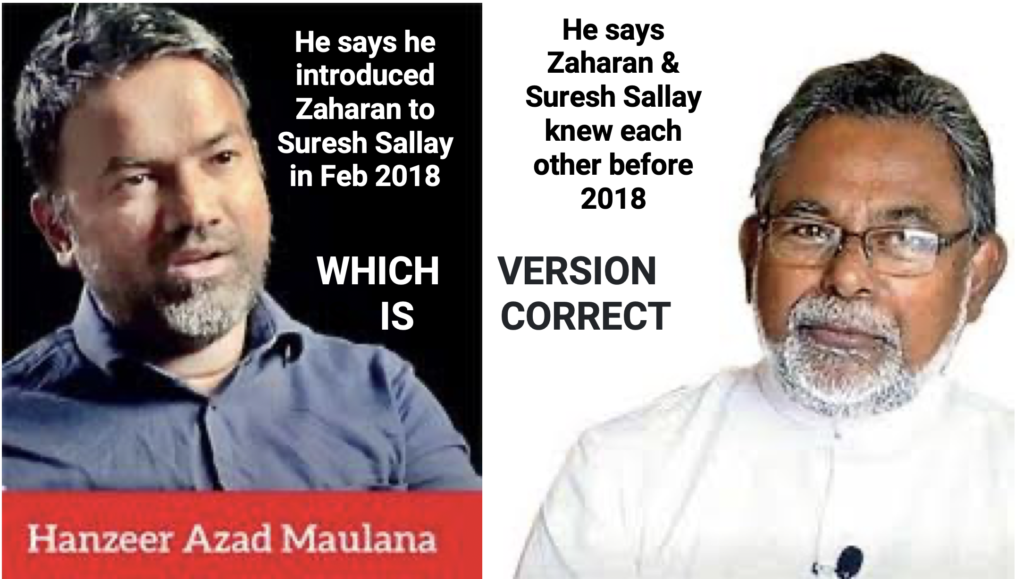
Channel 4 – Whose version is correct – Asad Maulana or Fr. Cyril: Did Suresh Sallay Know Zahran Before 2018?
This is the second follow-up article examining the contradictions surrounding the September 2023 Channel 4 documentary “Sri Lanka’s Easter Bombings: Dispatches.”
The first article questioned whether the alleged February 2018 meeting between Zahran Hashim and Maj. Gen. Suresh Sallay could even have taken place, given Sallay’s overseas diplomatic posting during the relevant period. This article examines an even more damaging contradiction — whether Suresh Sallay and Zahran allegedly already knew each other before 2018. This contradiction strikes at the heart of the entire Channel 4 narrative.
According to Asad Maulana in the Channel 4 documentary:
- Pillayan instructed him to arrange a meeting between Zahran Hashim and Suresh Sallay (Pillayan was in prison from 2015-2020)
The meeting allegedly took place in February 2018 at a house in a coconut estate in Puttalam.
Asad claims he coordinated the venue, communicated with the parties, attended the location, and introduced Sallay to Zahran and the NTJ group.
However, statements associated with Fr. Cyril Gamini during a 2021 Zoom presentation appear to imply that Sallay and Zahran already knew each other before 2018 and that NTJ allegedly had prior intelligence links & this is subject of an ongoing defamation case.
Both claims cannot stand together without contradiction.
- If Sallay and Zahran already knew each other before 2018, why would Asad Maulana need to “introduce” them in February 2018?
- If Asad Maulana genuinely introduced them for the first time in February 2018, then claims of earlier operational links should be challenged.
This contradiction is not minor.
It is central to the credibility of the entire Channel 4 narrative.
The issue becomes even more serious because the alleged February 2018 meeting is now being treated as a foundational event used to justify suspicion, detention, and public allegations under PTA-related investigations.
Yet critical evidentiary questions remain unanswered.
THE CHANNEL 4 WORDING PROBLEM
The documentary presenter states:
“This is Hanzeer Asad Maulana. He claims he saw a senior Sri Lankan intelligence agent meet with the suicide bombers prior to the Easter Sunday attacks.”
But Asad Maulana’s own narrative goes far beyond merely “seeing” a meeting.
According to his own account:
- he organized the meeting
- coordinated communication
- secured access to Zahran
- arranged the venue
- attended the location
- introduced the participants
This distinction is legally important.
A witness claiming to have merely observed a meeting is fundamentally different from a person claiming direct operational involvement in arranging and facilitating it.
So which is it?
Was Asad merely an observer — or was he functioning as an intermediary between intelligence-linked actors and NTJ?
If he was an intermediary, then serious questions arise:
- How did he establish contact with Zahran while Zahran was allegedly in hiding from 2017?
- What prior relationship existed between Asad Maulana and NTJ?
- Why was he entrusted with arranging such a sensitive meeting?
- Was he already functioning as a communication link between the parties before February 2018?
THE INTERMEDIARY PROBLEM
The more central Asad Maulana becomes to the Channel 4 narrative, the more operationally implausible the story becomes.
According to Asad Maulana’s own account:
- he allegedly communicated with both sides
- coordinated the meeting
- arranged access to Zahran and the NTJ group
- attended the location
- introduced the participants
Yet the narrative then takes an even more bizarre turn.
According to Asad’s version, the purpose of the alleged meeting was extraordinarily sensitive – allegedly involving discussions about using NTJ to create an “unsafe environment” to influence the 2019 Presidential Election.
However, despite allegedly being the very person who:
- arranged the meeting,
- coordinated the participants,
- secured access to Zahran,
- facilitated the introduction,
- and allegedly acted as the intermediary between the parties,
Asad was tkept outside for almost three hours while the alleged discussion took place inside a house that is being challenged for not existing in February 2018.
This raises serious logical and operational questions.
If Asad was trusted enough to:
- establish contact with an extremist group,
- organize the meeting,
- transport or coordinate participants,
- and allegedly facilitate contact between intelligence-linked actors and NTJ,
- why would he suddenly be excluded from the actual discussion itself?
The contradiction becomes even more striking because Asad later claims to know the alleged political intentions, operational objectives, and strategic purpose of the meeting.
How?
According to the narrative, after the meeting concluded, Suresh Sallay – allegedly a senior intelligence official engaged in a covert and highly sensitive operation – supposedly emerged and explained to Asad what had allegedly been discussed and planned inside.
This creates an extraordinary operational improbability.
If this was genuinely a covert intelligence-linked operation involving extremist actors:
- why would sensitive operational intentions allegedly be casually disclosed to a civilian intermediary afterward?
- why would an intelligence officer allegedly brief a non-operational outsider about a covert political-terror strategy?
- why exclude Asad from the meeting itself, only to allegedly reveal the contents to him afterward?
- if he was trusted enough to know the operational objectives afterward, why keep him outside in the first place?
The narrative becomes internally inconsistent.
Either:
Asad was an insignificant outsider who merely arranged logistics and therefore could not reliably know what was discussed inside,
OR
he was deeply involved operationally, in which case far more questions arise regarding his relationship with NTJ, his access to Zahran, and his alleged role as intermediary between the parties and why he was kept outside for the duration of the meeting.
Both positions create major credibility problems for the Channel 4 narrative.
The more closely the sequence is examined, the more the story appears structurally inconsistent rather than operationally credible.
THE FR. CYRIL CONTRADICTION
The October 2021 Zoom presentation linked to Fr. Cyril Gamini appears to go even further.
The presentation reportedly refers to:
- “credible evidence” existing prior to 2015
- alleged intelligence links with NTJ
- alleged funding and payroll relationships
- alleged operational use of Zahran and NTJ
If such allegations were publicly made in 2021:
- what was the source of this alleged “credible evidence”?
- was it independently verified?
- was it submitted to investigators?
- did any official investigation confirm these claims?
- where are the reports?
- was the information based on evidence, intelligence briefings, testimony, or hearsay?
These questions become critical because Channel 4’s 2023 narrative simultaneously claims Asad Maulana introduced Sallay to Zahran in February 2018.
One version implies a pre-existing relationship.
The other claims the relationship began through Asad’s introduction.
Both versions cannot operate simultaneously.
THE CORE CONTRADICTION
The contradiction is simple:
Did Suresh Sallay know Zahran before 2018?
OR
Did Asad Maulana introduce them for the first time in February 2018?
If prior knowledge existed:
the alleged “introduction meeting” collapses.
If the introduction story is true:
prior intelligence-link allegations collapses.
Either way, evidence is required — not repetition of unverified allegations over social media.
THE EVIDENTIARY GAP
Despite the seriousness of the accusations, critical corroborative evidence remains publicly absent.
Where is:
- proof Sallay was physically in Sri Lanka in Feb2018?
- immigration and travel records?
- phone records?
- CCTV evidence?
- toll data?
- mobile tower records?
- vehicle logs?
- proof the alleged house even existed and operated as described in February 2018?
Without independently verifiable evidence, the alleged February 2018 meeting remains an assertion — not an established fact.
DIRECT OBSERVATION OR RETROSPECTIVE RECONSTRUCTION?
Another major problem concerns evidentiary consistency.
Asad Maulana claims:
- NTJ members arrived together
- Zahran was introduced as “Amir”
- the meeting lasted several hours
- he himself waited outside during much of the discussion
Yet despite allegedly waiting outside, he later attributes detailed political motives, strategic objectives, and operational intentions to the meeting.
This raises critical questions:
- what did he directly witness?
- what was allegedly told to him later?
- what is interpretation?
- what is retrospective reconstruction after the Easter attacks?
Direct evidence, hearsay, interpretation, and retrospective narrative construction are not evidence.
THE PILLAYAN PROBLEM
The Channel 4 documentary claims Pillayan allegedly proposed using NTJ to create instability that would politically benefit Gotabaya Rajapaksa.
But major factual problems arise.
- Pillayan was arrested in October 2015 and remained in remand custody until 2020.
- He was granted bail in November 2020 and acquitted in January 2021.
- He was arrested again in April 2025 under separate allegations and detained under PTA orders.
- Yet no Easter Sunday-related charges were filed against him although political rhetoric to public said otherwise.
This creates a major contradiction.
- If investigators genuinely possessed evidence linking Pillayan to operational planning of the Easter attacks:
- why were such allegations absent from charges?
- why were no Easter-related indictments produced despite years of custody and investigation?
Even according to Asad Maulana’s own version, it was allegedly Pillayan — not Sallay — who suggested “using” NTJ.
So how does this suddenly transform Suresh Sallay into the alleged “mastermind”?
Additional questions arise:
- Did Sallay ever visit Pillayan in prison between 2015–2018?
- How could Sallay coordinate such activities while overseas from 2016–2019?
- Where is the documentary evidence connecting the two?
THE DANGER OF PUBLIC NARRATIVE REPLACING EVIDENCE
Another serious concern is whether repeated allegations gradually became publicly treated as established truth before foundational contradictions were resolved.
In complex national security cases:
- allegations cannot be based on assumptions
- assumptions cannot become narratives
- narratives cannot be accepted as “fact”
This is dangerous.
For example:
- an alleged meeting becomes treated as a proven operational conspiracy
- an alleged introduction becomes proof of terrorism coordination
- alleged acquaintance becomes proof of intelligence control
- political speculation becomes treated as evidence
Each step requires separate evidentiary proof.
THE CENTRAL QUESTION REMAINS UNRESOLVED
At the center of this issue lies a contradiction that neither Channel 4, Asad Maulana, Fr. Cyril Gamini, nor investigators have properly resolved.
Did Suresh Sallay and Zahran Hashim already know each other before February 2018?
OR
Did Asad Maulana introduce them for the first time in February 2018?
Both propositions cannot simultaneously operate without contradiction.
- If prior knowledge existed, the “introduction” narrative becomes questionable.
- If no prior relationship existed, then earlier intelligence-link allegations require proof.
It is deeply unjust to vilify a decorated intelligence officer who has served the nation by relying on distortions, contradictions, assumptions, and unverified interpretations — particularly while he remains under presidential detention and unable to publicly defend himself freely.
The media is not a court of law. Media narratives cannot replace due process, evidentiary standards, judicial scrutiny, or independently verified facts. Allegations repeatedly circulated through documentaries, presentations, and public commentary do not automatically become truth simply through repetition.
This is precisely why these contradictions, inconsistencies, and evidentiary gaps must be examined carefully and logically rather than accepted through emotionally driven or politically shaped narratives. The public deserves facts, evidence, consistency, and independent verification — not conclusions reached in advance.
It is for this reason that we invite the public to critically and logically analyze the competing claims, contradictions, and unanswered questions instead of being led toward pre-determined conclusions before the evidence itself has been independently established.
Shenali D Waduge