Claiming Persecution Internationally While Practicing Religious Intolerance Against Buddhists in Sri Lanka: The Jaffna University Vesak Attack
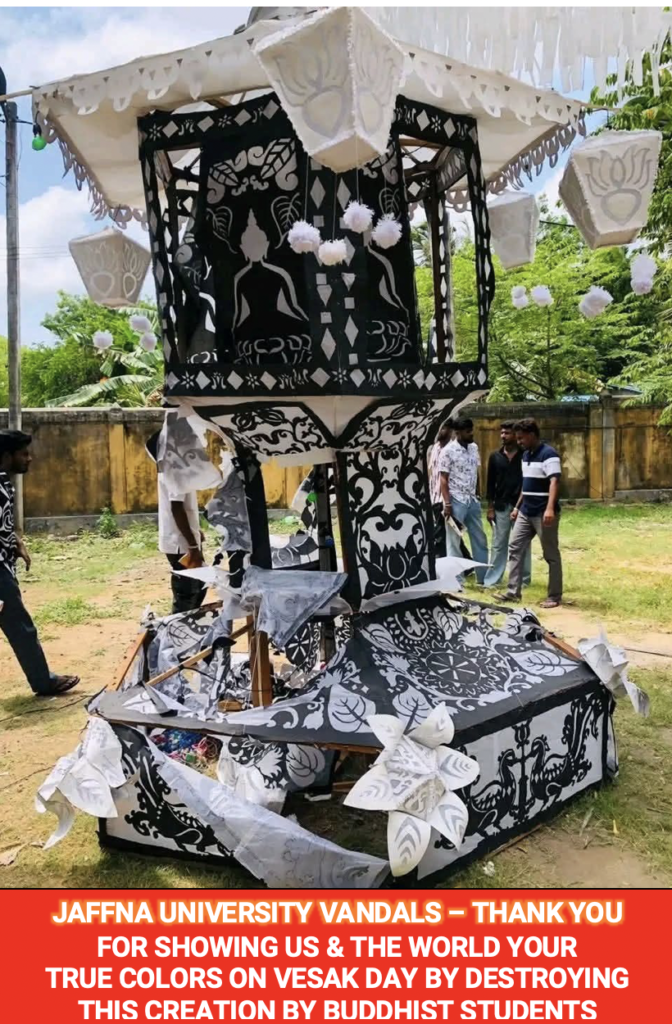
For Buddhists the Vesak holds an emotionally significant place. It is an event looked forward to and celebrated. The destruction of Vesak decorations erected by Buddhist students at Jaffna University is not a minor act of vandalism. It is a serious incident that exposes the dangerous contradiction at the center of Sri Lanka’s so-called “reconciliation” narrative and exposes the growing gap between internationally promoted narratives of minority victimhood and the reality of rising intolerance toward Buddhist religious expression within Sri Lanka.
For decades, the international community has been presented with a carefully cultivated narrative portraying minorities in Sri Lanka as perpetual victims of discrimination while the Buddhist majority is depicted almost exclusively as the aggressor. Billions of rupees in foreign-funded activism, diaspora lobbying, NGO campaigns, media advocacy, and international political pressure have reinforced this one-dimensional portrayal of Sri Lanka before the world.
Yet the events at Jaffna University raise a deeply uncomfortable question:
If those who speak most loudly about tolerance, coexistence, discrimination, and minority rights cannot tolerate even peaceful Buddhist religious observances inside a State university, what exactly does “reconciliation” mean?
Jaffna University is not a private ethnic institution.
It is a public university established, maintained, and funded by the taxes of all Sri Lankans — the majority of whom are Buddhists.
Buddhist students therefore possess every constitutional and democratic right to commemorate Vesak peacefully within university premises.
Instead, what the country witnessed was the deliberate destruction of Buddhist religious decorations during the most sacred religious season for Buddhists.
This incident cannot be viewed in isolation.
Across Northern & Eastern Sri Lanka, Buddhist monks face organized verbal abuse, online hate campaigns, intimidation, defamation, and public humiliation. Buddhist pilgrims travelling to the North and East have repeatedly faced hostility and obstruction. Buddhist religious symbols, temples, and archaeological heritage sites have become targets of political confrontation and ethnic agitation.
Such incidents occur during sensitive religious or nationally significant occasions, thereby intensifying public tensions and attracting wider political attention.
Yet these incidents rarely attract international outrage, NGO campaigns, diplomatic statements, or global media concern.
This silence reveals a growing problem: human rights advocacy in Sri Lanka has become dangerously selective.
Such selective silence raises serious concerns.
When hostility toward Buddhists is minimized, ignored, or politically rationalized while every grievance against minorities is amplified internationally, the credibility of reconciliation itself begins to collapse and highlights hypocrisy.
Human rights cannot survive under selective application.
Religious freedom cannot apply only to some communities and target another.
Tolerance cannot be demanded from Buddhists while intolerance against Buddhists is normalized, excused, or ignored.
The Jaffna University Vesak attack therefore exposes something far larger than vandalized decorations. It exposes the widening gap between Sri Lanka’s international image of reconciliation and the reality experienced by many Buddhists on the ground.
The responsibility for addressing this crisis lies first with the Government of Sri Lanka.
The Constitution guarantees religious freedom, equal protection under the law, and the duty of the State to protect all citizens equally. Those obligations do not disappear because the victims are Buddhists.
A State university cannot become a space where Buddhist religious expression is attacked while authorities remain passive or silent.
Jaffna University is also associated with LTTE remembrance, including participation by elements within the academic community. Such developments further intensify public concerns regarding ideological extremism, institutional neutrality, and the selective application of standards within State institutions that are being ignored by the Education/High Education Ministry.
The Government must therefore:
- conduct a transparent investigation,
- identify those responsible and apply the law for such vandalism
- guarantee protection for all religious observances within State institutions,
- and demonstrate that constitutional rights apply equally to Buddhists as they do to every other community.
Failure to act decisively will only deepen public perceptions that anti-Buddhist hostility is being institutionally ignored for political convenience a sentiment that the Sinhala Buddhist majority are feeling.
The international community must also confront an uncomfortable reality.
For too long, Sri Lanka has been discussed internationally through a simplistic framework of “majority oppressor versus minority victim.”
That framework has prevented honest examination of extremist intolerance, selective activism, and anti-Buddhist hostility emerging within parts of the country itself.
Sri Lanka’s experience with the Easter Sunday attacks demonstrated the dangers of ignoring extremist warning signs, ideological radicalization, and politically inconvenient threats until tragedy occurred.
Acknowledging this reality does not weaken minority rights.
It strengthens the principle that rights must apply equally to all communities.
Importantly, many amongst the minorities themselves reject such acts of intolerance. However, highly organized international lobbying and advocacy networks continue to shape global narratives highlighting the destructive acts by a minority in the minority ignoring the goodwill amongst the majority of the minority with the majority among the majority.
The destruction of Vesak decorations at Jaffna University is therefore not merely a university disciplinary matter. It is a warning sign that selective reconciliation, selective outrage, and selective human rights advocacy are steadily eroding trust, equality, and genuine coexistence in Sri Lanka.
Vandals aloud to run loose is a future danger. History demonstrates that societies ignore early warning signs at great cost. Extremist movements rarely emerge overnight; they often begin through the normalization of intimidation, vandalism, ideological hostility, and the gradual tolerance of unlawful conduct for political convenience. Sri Lanka’s past experiences — including separatist terrorism and later Islamist extremism — should remind policymakers that selective enforcement and political silence can carry devastating long-term consequences.
Shenali D Waduge