WHY DOES CHEMMANI GET PROCESSIONS BUT THUNUKKAI DOES NOT? WHY IS INTERNATIONAL ATTENTION ON CHEMMANI — BUT NOT THUNUKKAI?
Justice, we presume, is for all victims. That is why it is necessary to ask whether we are witnessing a change in the status quo — where some victims are receiving unprecedented mobilisation, international attention and public mourning, while other victims remain largely forgotten. Why do those demanding investigation into Chemmani conveniently omit Thunukkai? Why has Chemmani suddenly produced powerful mobilisation after years of international claims concerning 40,000 people killed during the final phase of Sri Lanka’s conflict — claims that have yet to be proved.
Why does that mobilisation not also demand justice for Tamil victims of LTTE torture, abduction, detention, disappearance and killing? Why do these victims not receive the same mourning, international campaigns and Church-led protests?
For those who may claim these are exaggerations — let us look at the facts.
LOOK AT WHO IS MOBILISING AROUND CHEMMANI
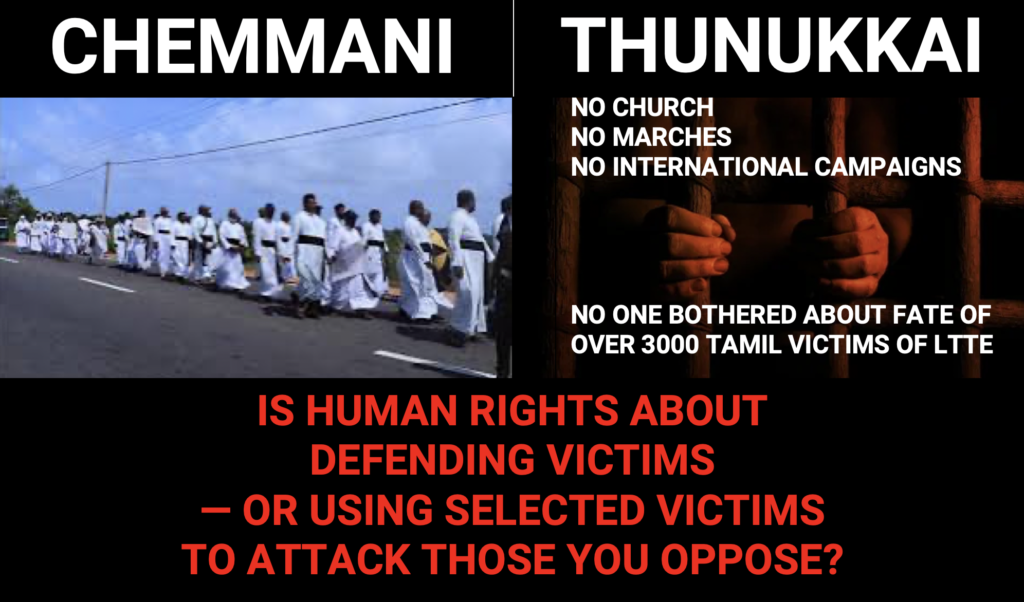
A procession was held in Jaffna on 30 July 2026, with more than 100 Catholics — including priests, religious men and women and laypeople — marching from the St Jude Thaddeus area towards Chemmani.
The procession was organised through the Justice and Peace Commission of the Diocese of Jaffna.
The organisers called for truth and justice and appealed for an independent international investigation, forensic examination, DNA testing and application of the Minnesota Protocol.
If DNA, forensic dating, identification of remains and scientific attribution are essential at Chemmani, why should exactly the same forensic standard not be applied to former LTTE detention sites?
The Catholic Bishops’ Conference of Sri Lanka has also called for an impartial investigation.
But the Chemmani mobilisation does not stop with the Catholic Church.
Tamil nationalist and diaspora organisations have also mobilised.
Tamil Eelam Solidarity held a rally calling for justice for those it described as having been “murdered” by the Sri Lankan Army and buried at Chemmani.
A “Cry for Justice II” campaign was subsequently held at Chemmani, involving relatives of the disappeared, civil-society groups and political activists, with demands for an international investigation and UN involvement.
Other Tamil diaspora organisations have taken Chemmani to the streets of foreign countries, raised banners, approached governments and called for international intervention.
Human-rights organisations (whose actions are based on funding) have also incorporated Chemmani into their current accountability campaigns.
Human Rights Watch has reported more than 580 skeletal remains recovered by mid-August 2026 and placed Chemmani within the wider question of accountability for past abuses.
So let us put the picture plainly:
- Catholic clergy.
- Catholic religious sisters.
- Lay Catholics.
- Tamil political activists.
- Tamil diaspora organisations.
- Human-rights organisations.
- International advocacy.
- UN demands.
All mobilising around Chemmani.
There is nothing wrong with that so long as the same principle is applied to every victim.
But there is an important point that cannot be ignored.
Even Vatican News, while reporting on the Catholic mobilisation, acknowledged that the remains have not yet been conclusively linked to the separatist conflict and that it has not yet been established whether the deaths were caused by either side.
That means one thing:
INVESTIGATION MUST COME BEFORE CONCLUSION.
So let us apply that same principle everywhere.
SO WHERE IS THE SAME MOBILISATION FOR THUNUKKAI?
THUNUKKAI WAS NOT A POLITICAL INVENTION
The LTTE operated a detention system in the North and East.
One of the locations documented by University Teachers for Human Rights (Jaffna) was Thunukkai.
The evidence is not come from a Sri Lankan military press release. It comes from University Teachers for Human Rights — Jaffna, a Tamil human-rights organisation that documented abuses affecting the Tamil community.
If their documentation is considered credible when it records abuses by the State, why should their documentation concerning LTTE abuses suddenly become inconvenient?
UTHR’s own documentation recorded that a detainee taken to Thunukkai was blindfolded, fettered and kept in a bunker with approximately 300 others for three months.
That is not a story created decades later by someone defending the Sri Lankan military.
It is a Tamil human-rights record.
And it gets worse.
UTHR documented the killing of a detainee named Mampalam at Thunukkai.
According to the UTHR account, after torture, other LTTE members beat Mampalam to death with wooden and metal rods.
Read that again.
A Tamil man.
A Tamil detention facility.
Tamil captors.
Tamil human-rights investigators documenting what happened.
A Tamil victim.
Where is the march for him?
HERE IS ANOTHER TAMIL VICTIM
This is where the issue becomes personal.
Thangathurai Thayani, the wife of Arun Siddharth, has publicly recounted what happened to her father, Sellan Thangathurai.
Her account states that on the night of 20 February 1990, LTTE men came to her family’s home and forcibly took her father away.
He was a bus driver running between Jaffna and Kankesanthurai.
That night, she says, nine other men were also taken from their village.
The families went to the LTTE camp at Chunnakam.
She identifies the commander there as Saleem Shiva.
The family saw her father imprisoned behind wire.
They were later given his driver’s licence and the Rs.36 that had been in his pocket.
The family was then told that he had been transferred to the LTTE camp at Thunukkai, Mullaitivu, for further questioning.
Thayani has described Thunukkai as the place where the LTTE had its torture chambers.
Her mother searched for her husband.
She went to LTTE camps.
She approached the Red Cross.
She approached the Human Rights Commission.
She continued looking for him.
In 1993, the family received a file from LTTE members alleging that Sellan Thangathurai had transported weapons, helped an enemy group and acted as a spy.
The family was told that the LTTE had imposed a death sentence.
They realised that he had been killed.
This is the story of one Tamil family.
It is not an allegation made by a government spokesperson.
It is the testimony of a Tamil daughter describing what happened to her father.
And her question was simple:
If the LTTE had its own administration, police and courts, why was her father not tried — but instead taken away, tortured and killed?
That question deserves an answer.
Her testimony also describes meeting another former detainee who had shared her father’s cell and who she says was left psychologically damaged by what he experienced.
Why is there no comparable international campaign demanding that these allegations be investigated?
HOW MANY WERE HELD AT THUNUKKAI?
UTHR’s historical estimate is even more disturbing.
Its Briefing No. 1 stated that the best estimate was that approximately 3,000 prisoners had been held at Thunukkai, based on information from multiple sources and an escapee’s description of the camp.
It estimated approximately another 1,000 prisoners in other LTTE centres, including Chavakachcheri, Kachchai and Kopay.
UTHR therefore estimated that the LTTE detention system at that stage could involve approximately 4,000 prisoners, with a margin of error.
This was not one isolated room.
This was a detention system.
UTHR recorded allegations of torture, disappearances and killings within that system.
One account concerning a former Thunukkai detainee identified as “Rolex” Mudalali described prisoners being taken away after being told they were being released.
According to the account, he remained until the final group was released and came to believe that many of those taken away earlier had been killed.
These are precisely the kinds of allegations that demand investigation.
SO WHY IS THERE NO “THUNUKKAI JUSTICE” MARCH?
Let us ask the organisations demanding justice for Chemmani.
TO THE CATHOLIC CHURCH & CATHOLIC BISHOPS CONFERENCE
You marched for Chemmani.
Where is your march for the Tamil victims of Thunukkai?
Where is the procession for the people allegedly tortured there?
Where is the memorial Mass?
Where is the public demand for an independent investigation into the LTTE detention system?
Where is the demand for justice for families whose relatives disappeared from LTTE custody?
If justice is for victims, should the identity of the alleged perpetrator determine whether the Church mourns?
TO THE TAMIL NATIONALIST ORGANISATIONS
You demand international investigations into Chemmani.
You demand that the UN become involved.
You describe Chemmani as evidence of crimes against Tamils.
Why does the same demand not apply to Tamil victims of the LTTE – why have none of you said a word on Thunukkai?
Why should a Tamil victim receive international attention because the alleged perpetrator was the Sri Lankan State, but receive silence when the alleged perpetrator was the LTTE?
TO THE TAMIL DIASPORA ORGANISATIONS
You organise demonstrations in foreign countries for Chemmani.
You raise banners.
You raise funds
You approach governments.
You approach international institutions.
Where are your campaigns for the Tamil families whose relatives disappeared into LTTE detention?
Where is the diaspora campaign for Thunukkai?
Where is the demand that former LTTE detention sites be investigated?
Where are the memorials for the Tamil victims of LTTE detention?
TO INTERNATIONAL HUMAN-RIGHTS ORGANISATIONS
You demand forensic investigations at Chemmani.
Fine.
Demand forensic investigations everywhere.
Investigate every suspected mass grave.
Investigate every disappearance.
Investigate every torture chamber.
Investigate every detention facility.
Investigate crimes allegedly committed by the State.
But why don’t you want to investigate crimes committed by the LTTE.
That is what impartial human-rights advocacy means.
THIS IS NOT ABOUT CHOOSING BETWEEN CHEMMANI AND THUNUKKAI
This is the crucial point.
Investigate Chemmani.
But do not stop there.
Investigate Thunukkai.
Investigate the other LTTE detention centres documented by Tamil victim families.
Investigate the people who disappeared from those facilities.
Investigate the families who have lived for decades without knowing what happened to their relatives.
Investigate the Tamil victims whose stories have never produced international marches.
Investigate the Buddhist victims of LTTE massacres.
Investigate Muslim victims of LTTE massacres.
Investigate police officers and soldiers who surrendered and were subsequently killed.
Let us never forget that there are 5000 missing Sri Lankan Armed Forces names that have been given to the UNHRC but not a line has been mentioned about them in any of the High Commissioners reports or UNHRC statements. Its now 17 years since the end of the conflict.
Is it too much to demand
One standard.
One definition of victim.
One demand for truth.
Terrorists should not get precedence over those who fight to defend the sovereignty & safety of the Nation & its people.
THE QUESTION IS NOT “WHOSE SIDE ARE YOU ON?”
The question is:
DO YOU BELIEVE EVERY VICTIM DESERVES JUSTICE?
If the answer is YES, then investigate Chemmani.
But so must Thunukkai. So must every site that LTTE tortured & killed.
If the answer is YES, then Tamil victims of the LTTE must receive the same attention
If the answer is YES, then the Church must be prepared to mourn victims regardless of the identity of their alleged killer.
If the answer is YES, then Tamil diaspora organisations must speak for Tamil victims who were killed by the LTTE.
If the answer is YES, then international human-rights organisations must apply the same standard to every perpetrator.
THERE CAN BE NO SELECTIVE VICTIMS
Because that is precisely what selective remembrance begins to look like.
Chemmani has become a place of protest.
WHERE IS THE PROTEST FOR THUNUKKAI?
Chemmani has become a demand for international investigation.
WHERE IS THE DEMAND FOR AN INVESTIGATION INTO THE LTTE DETENTION SYSTEM?
Chemmani has produced banners demanding justice.
WHERE ARE THE BANNERS FOR THE TAMIL VICTIMS OF LTTE TORTURE?
Chemmani has produced marches.
WHERE IS THE MARCH FOR THUNUKKAI?
We are not asking anyone to abandon Chemmani.
We are asking them to apply their own principle consistently.
JUSTICE CANNOT BE SELECTIVE.
A VICTIM DOES NOT BECOME LESS OF A VICTIM BECAUSE THE WRONGDOER WAS THE LTTE.
The victim does not change because the perpetrator changes.
And if those demanding justice for Chemmani genuinely believe in truth, justice and accountability, then there should be no reason whatsoever to object to investigating Thunukkai — and every other place where Tamil victims were detained, tortured, disappeared or killed.
But we are baffled why suddenly the entire Church is going on protest marches for Chemmani when the proof of 40,000 killed in the last phase has become impossible to prove.
BEFORE DEMANDING THAT THE WORLD EXCAVATE ONE SIDE’S GRAVES, HAVE YOU BEEN WILLING TO OPEN THE FILES ON THE OTHER SIDE’S DEAD?
BEFORE DEMANDING JUSTICE FOR CHEMMANI, SHOW US WHERE YOU STOOD FOR THUNUKKAI.
The real test of human rights is not whether you can speak loudly & en masse for victims whose alleged perpetrators you oppose.
The real test is whether you can speak for all victims — irrespective of who they are, or how they became victims.
Shenali D Waduge