SEX EDUCATION OR SEXUALITY EDUCATION — WHAT EXACTLY ARE WE TEACHING OUR CHILDREN?
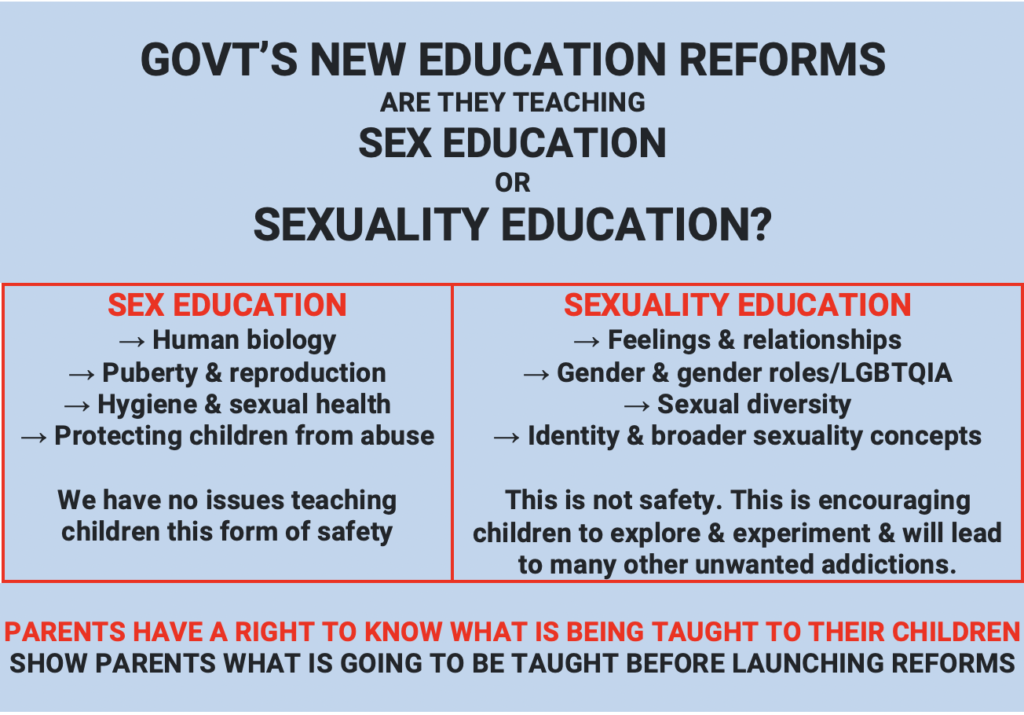
There is an important distinction that must not be lost in the debate over Sri Lanka’s education reforms. No responsible parent would oppose children being taught about puberty, menstruation, reproductive biology, personal hygiene, sexually transmitted infections, abuse, grooming, inappropriate touching, personal safety, consent and how to seek help.
Our concern is when age-appropriate sex and child-protection education become a broader programme of “sexuality education” — and how far parents are aware or have been told about what is being added?
A closed knit group of people have been secretly involved in Comprehensive Sexuality Education (CSE) for years. The Ministry of Education produced a CSE curriculum that was launched in Parliament in 2017. UNFPA’s Sri Lankan policy material defines CSE as covering the cognitive, emotional, physical and social aspects of sexuality, reproductive health and rights, and expressly states that CSE goes beyond simply providing information on sexual and reproductive health.
Many do not stop to think that sexuality education differs greatly from sex education. This is where the dangers have got ignored.
The UNFPA policy recommendations for Sri Lanka identify areas including gender, sexual diversity, legal and sociocultural aspects of sexuality and sexual and reproductive health and rights. This slowly removes parental consent & parental control over their children until they become adults.
That is precisely why the public discussion must not remain at the level of labels.
SHOW PARENTS THE MATERIAL.
INVITE PARENTS TO QUESTION THE MATERIAL.
In February 2024, the Sri Lankan Parliament itself reported that the Ministry of Education was preparing educational publications on sexuality covering preschool children, schoolchildren up to Grade 13 and the adult community. Parliament reported that these publications were being prepared by subject experts under the supervision and approval of the Ministries of Education and Health.
So parents are entitled to ask:
WHAT EXACTLY IS MEANT BY “SEXUALITY EDUCATION” — AND HOW DOES IT DIFFER FROM CONVENTIONAL SEX EDUCATION?
If the programme extends from early childhood through Grade 13, this is not a minor terminology issue.
IT IS A QUESTION OF WHAT CHILDREN ARE BEING TAUGHT, AT WHAT AGE, AND UNDER WHAT EDUCATIONAL FRAMEWORK
In July 2026, Sri Lanka launched a National Communication Guideline on Age-appropriate Sexuality Education together with a Grade 6 & 7 Teachers’ Handbook on Age-Appropriate Sexuality Education Communication.
The Government should therefore make the complete handbook and related teaching materials publicly accessible — not merely announce that they are “age appropriate”.
Parents have the right to see:
- what is taught;
- at what age it is taught;
- the exact learning outcomes;
- the exact textbook or handbook pages;
- the terminology used;
- who prepared the material;
- which organisations or international frameworks were consulted;
- what external resources teachers are expected to use;
- and how parents can raise objections or seek clarification.
PARENTS MUST LOOK AT THE ACTUAL CONTENT — NOT THE LABEL
There is nothing controversial about teaching a child that his or her body deserves protection.
Teaching children about privacy, inappropriate touching, trusted adults, personal boundaries and the right to say “no” can be valuable child-protection education.
But when the curriculum moves into subjects such as gender stereotypes, gender roles, family diversity and broader social concepts surrounding sexuality, the Government should be transparent about the educational purpose, the age at which each concept is introduced and the evidence supporting its inclusion.
The concern is more as these very subjects rolled out in Western nations have resulted in parental backlash & damage to children both mentally & physically. These are often irreversible.
No Govt can be allowed to roll out programs that have been proven failures & commit the same errors and reverse after the damage is done.
England’s revised statutory Relationships, Sex and Health Education guidance came into force on 1 September 2026. The revised framework places greater emphasis on age-appropriate teaching, openness with parents and allowing parents to see the materials being used. It also makes clear that schools should not endorse a particular view on contested LGBT-related issues and should teach relevant facts and law accurately.
So why should Sri Lanka simply import yesterday’s international approach when other countries are already reviewing, revising and placing additional safeguards around what children are taught?
IF OTHERS ARE REVIEWING THEIR APPROACH, WHY IS SRI LANKA SIMPLY ROLLING FORWARD?
Children should receive sex education.
The issue is what are these additional concepts being brought under the heading of sexuality education — and whether Sri Lankan parents have been given the opportunity to examine them.
If the Government’s intention is simply to strengthen:
PUBERTY + REPRODUCTIVE HEALTH + HYGIENE + CHILD PROTECTION + CONSENT + ABUSE PREVENTION + ONLINE SAFETY,
say so clearly.
BUT
If the programme goes further into:
GENDER + GENDER ROLES + FAMILY DIVERSITY + SEXUAL DIVERSITY + SOCIAL NORMS + BROADER SEXUALITY CONCEPTS,
then they must come out and say so clearly – instead of fooling parents & the general public.
They cannot hide behind terminology.
Sri Lankan parents are perfectly capable of reading a textbook and deciding whether its contents are appropriate for their children.
DO NOT ASK PARENTS TO TRUST A LABEL
Especially when these new concepts are backed by sponsorships or aligned personally to those promoting them.
SHOW PARENTS THE TEXTBOOK.
Show the page.
Show the age group.
Show the learning outcome.
Show the teacher guidance.
Show the external resources.
Show who prepared it.
And allow Sri Lankan parents, genuine child-protection specialists (not those funded by foreign entities), psychologists, medical professionals and legal experts to examine the material before it becomes embedded throughout the national education system.
Even England’s revised guidance recognises the importance of parental transparency and says parents should be able to view curriculum materials on request.
WHO DECIDES WHAT A SRI LANKAN CHILD IS TAUGHT?
Who actually decides the curriculum?
International organisations can provide research.
They can publish guidelines.
They can offer technical assistance.
They can share international experience.
But an international organisation has no mandate to decide what a Sri Lankan child should be taught.
Sri Lanka is a sovereign country.
Its education curriculum must ultimately reflect Sri Lankan law, Sri Lankan educational priorities, Sri Lankan society, culture and the interests of Sri Lankan children and parents.
International frameworks may be consulted.
They must not become a substitute for national curriculum authority.
This distinction becomes particularly important when the subject involves values, gender, sexuality, family, relationships, rights and social behaviour.
These are not merely technical subjects like mathematics or computer coding.
They intersect with:
- Sri Lankan law;
- parental responsibility;
- child protection;
- culture;
- religion;
- social norms;
- family structures;
- constitutional principles;
- and the developmental maturity of the child.
Therefore, the Government must tell the public clearly:
WHO WROTE THE CURRICULUM?
WHO DESIGNED THE LEARNING OUTCOMES?
WHICH INTERNATIONAL FRAMEWORKS WERE USED?
WHICH INTERNATIONAL ORGANISATIONS WERE INVOLVED?
DID THEY PROVIDE TECHNICAL ADVICE — OR DID THEY INFLUENCE THE ACTUAL CONTENT?
WHO APPROVED THE FINAL MATERIAL?
And most importantly:
Was the final curriculum designed for Sri Lankan children — or was an international model adapted and introduced into Sri Lanka?
There is nothing wrong with learning from the world.
There is everything wrong with allowing external frameworks to become de facto curriculum authorities without transparent public scrutiny.
Sri Lanka should be capable of developing its own education policy.
International organisations may advise.
Sri Lanka must decide.
International organisations may provide evidence.
Sri Lanka must determine what is appropriate for Sri Lankan children.
International organisations may share educational models.
Sri Lanka must retain the final authority over its national curriculum.
That is not isolationism.
It is educational sovereignty.
Sri Lankan children are not experimental subjects for imported educational models.
Shenali D Waduge