A TERRORIST COMMEMORATED FOR 12 DAYS – POLICE & STATE INTERVENED ONLY AFTER THE THILEEPAN COMMEMORATIONS WERE OVER
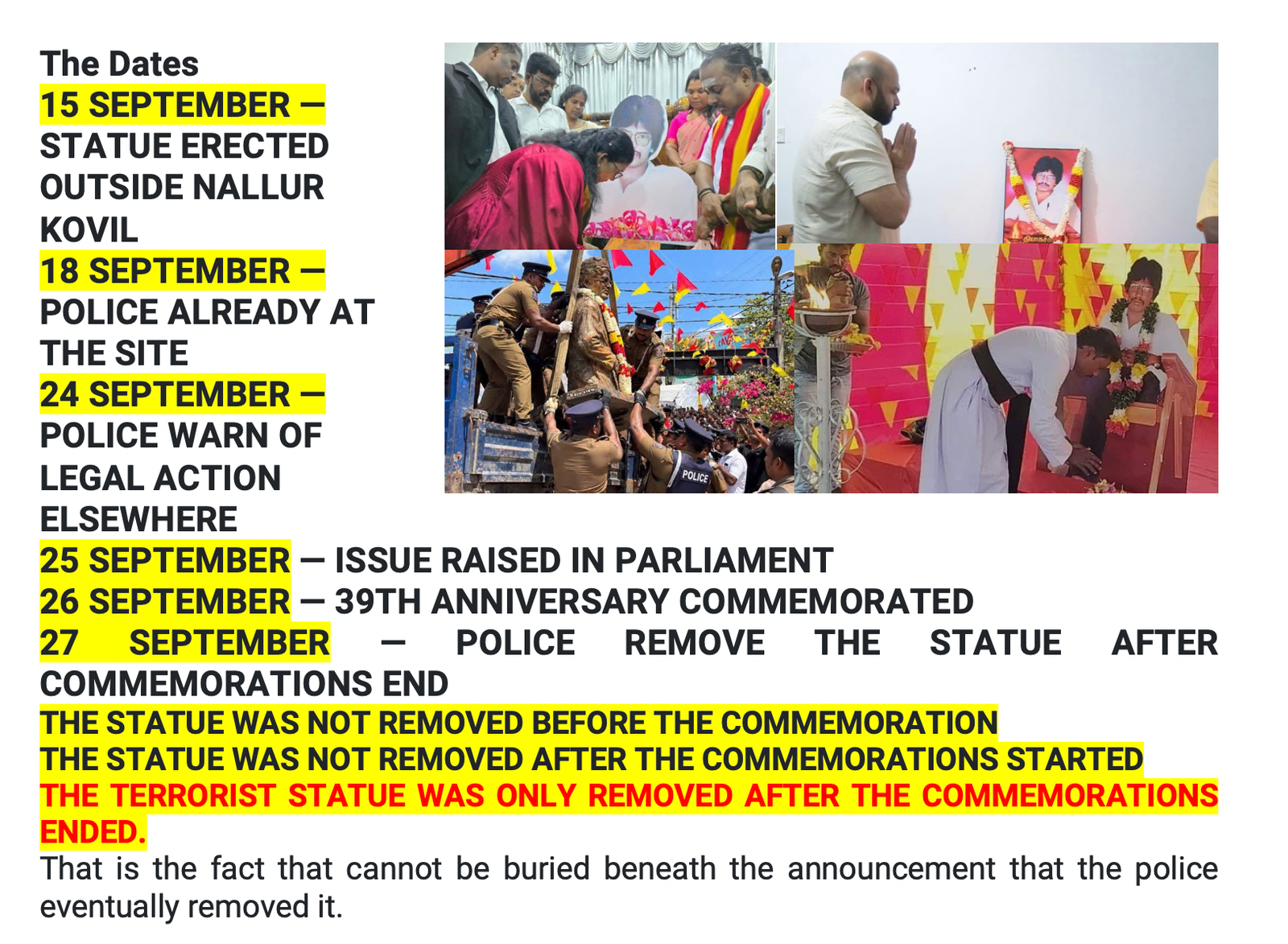
A new bronze statue of Thileepan was unveiled near Nallur kovil on 15 September 2026,. Garlands were placed around the statue and flowers were laid before it.
For the next twelve days, the commemorations continued.
On 18 September, police were already at the Nallur memorial. They seized loudspeakers, stating that they were not authorised for use. Reports also stated that a plain-clothed officer recorded those present. Yet the statue remained.
On 24 September, police at Nelliady reportedly refused permission for preparations connected with the commemorations and warned that organisers or those assisting could face legal action.
On 25 September, the issue of schoolchildren participating in a Thileepan commemoration — including allegations that they were in school uniform and attending during school hours — was raised in Parliament, along with questions about the erection of statues commemorating LTTE cadres.
And yet the Terrorist statue remained.
Then came 26 September.
The 39th anniversary of Thileepan’s death was commemorated.
https://www.facebook.com/share/v/1N1fgdraYa/ – nothing but a terrorist
Hundreds gathered.
The statue was again garlanded.
Flowers were laid.
The commemorative programme took place.
THEN THE ANNIVERSARY WAS OVER.
Then came 27 September.
The police arrived.
More than 20 officers, including the Jaffna OIC, were reported to have gone to the memorial in the early hours and removed the statue.
The Daily Mirror reported the sequence plainly: the removal took place following the conclusion of the final day of the commemoration on 26 September.
Police Media Spokesperson ASP F. U. Wootler said police had acted after a complaint, after reporting the relevant facts to court, and that the statue was removed under Penal Code provisions to maintain public order and enforce the law.
However, the reality is simple – THE POLICE & STATE INTERVENED ONLY AFTER THE THILEEPAN COMMEMORATIONS WERE OVER.
WHAT EXACTLY DID THEY PREVENT after doing nothing for 12 days?
THE STATE DID NOT STOP THE COMMEMORATION
Did the State stop the statue being unveiled on 15 September?
NO.
Did the State order to remove the statue when police arrived at the site on 18 September?
NO.
Did the State prevent the 12 days of commemorative activity that followed?
NO.
Did the State prevent the 26 September anniversary commemoration?
NO.
Thileepan the terrorists anniversary was commemorated.
THEN, ON 27 SEPTEMBER, THE STATUE WAS REMOVED.
WHY DID THEY ACT ONLY AFTER THE EVENT THEY WERE SUPPOSED TO PREVENT HAD ALREADY TAKEN PLACE AND RELAYED ALL OVER THE WORLD?
How foolish has Sri Lanka looked?
DAY 1 — 15 SEPTEMBER
The new bronze statue was publicly unveiled at the Nallur memorial.
Police took no action.
It was publicly displayed at the very beginning of the commemorative period.
Police took no action.
The statue immediately became the centre of the twelve-day programme.
Police took no action.
Participants placed garlands and flowers around it.
IF THE STATUE OF A TERRORIST WAS THE PROBLEM, WHY WAS IT NOT REMOVED ON DAY ONE?
DAY 4 — 18 SEPTEMBER
This is where the chronology becomes particularly difficult to explain.
If Police could intervene to remove loudspeakers claiming it was not authorized was the bronze statue of a terrorist authorized not to remove it on day 1 itself?
https://www.facebook.com/share/r/1DmnCBskyJ/
If the statue was unlawful, why was the loudspeaker dealt with but not the statue?
If the commemorative activity itself was considered unlawful, why was the statue allowed to remain at the centre of the activity?
And if the Police & State did not consider the statue unlawful on 15th September, what changed later?
DAY 9 — 23 SEPTEMBER
The commemorations were still taking place around the statue.
Reports described people gathering daily at Nallur from 15 September onwards, with floral tributes being placed before the statue.
NO REMOVAL.
DAY 10 — 24 SEPTEMBER
At Nelliady, police reportedly took a very different approach. Does this mean the police covering Nallur had given permission for the commemorations?
Organisers seeking permission for commemorative arrangements were reportedly told not to proceed.
The Nelliady OIC allegedly warned that preparations would be removed and that those organising or assisting could face legal action.
So by 24 September, police were clearly aware of the commemorative activities and were prepared to warn organisers about possible legal consequences.
Yet at Nallur:
THE BRONZE STATUE REMAINED.
Why the difference?
DAY 11 — 25 SEPTEMBER
The matter had reached Parliament.
Questions were raised about schoolchildren participating in the commemoration and about statues commemorating LTTE cadres.
The Education Minister was asked what action would be taken if an offence had been committed.
If there were concerns about the involvement of schoolchildren:
WHO AUTHORISED THEIR PARTICIPATION?
Was the school involved?
Was the principal aware?
Were teachers involved?
Was the participation during school hours authorised?
Did the Education Ministry investigate?
If the Government considered school children being taken to commemorate a terrorist an offence what action followed?
They are questions about responsibility, authorisation and the enforcement of the law.
DAY 12 — 26 SEPTEMBER
The 39th anniversary of Thileepan’s death was commemorated.
The bronze statue was part of the commemorative setting.
Floral tributes were made.
The event took place.
THE COMMEMORATIONS THE STATE SHOULD HAVE STOPPED HAD TAKEN PLACE AND ENDED ON THE DAY THILEEPAN DIED.
DAY 13 — 27 SEPTEMBER
Only now did the police remove the statue.
The removal occurred in the early hours of the morning following the conclusion of the final commemorative day.
Police could only say action followed a complaint.
https://www.facebook.com/share/v/1BzJzqcLqh/
That explanation creates an obvious question:
WHEN WAS THE COMPLAINT MADE?
And:
WHEN DID POLICE FIRST DETERMINE THAT THE STATUE REQUIRED REMOVAL?
If the complaint existed before 15 September:
WHY DID THE STATUE REMAIN FOR TWELVE DAYS?
If the complaint was made after 15 September:
WHEN?
If the police approached court before 27 September:
WHEN WAS THE COURT APPROACHED?
Was an order obtained?
If so, WHAT ORDER?
Under what provision?
If no court order authorised removal, what precise legal power was exercised by the police?
The public should not have to reconstruct this chronology from media reports.
WHAT DOES THE LAW SAY?
The LTTE was proscribed under Gazette Extraordinary No. 1721/02 of 29 August 2011, issued under section 27 of the Prevention of Terrorism (Temporary Provisions) Act No. 48 of 1979. The Gazette is officially listed by the Government.
The regulations prohibit specified forms of association with, support for, and participation in LTTE activities and events.
Therefore the legal question is not complicated:
DID THE 2026 STATUE OF AN LTTE LEADER AND THE ACTIVITIES ASSOCIATED WITH IT FALL WITHIN ANY OF THESE PROHIBITIONS?
If they did, then the public is entitled to know:
WHY WAS ACTION NOT TAKEN WHEN THE STATUE WAS FIRST ERECTED?
WHY WAS IT NOT REMOVED WHEN POLICE WERE ALREADY AT THE SITE ON 18 SEPTEMBER?
THE POLICE DOES NOT NEED A COURT ORDER TO STOP THE EVENT – AS LTTE IS BANNED BY GAZETTE.
The Government cannot simultaneously invoke the law as the reason for removal on 27 September and leave unanswered the twelve-day period during which the same object stood openly at the same location.
THIS WAS NOT A CASE OF POLICE NOT KNOWING
15 SEPTEMBER: statue publicly unveiled.
18 SEPTEMBER: police at the memorial and loudspeakers seized.
23 SEPTEMBER: commemorations continuing around the statue.
24 SEPTEMBER: police warn organisers elsewhere of legal action.
25 SEPTEMBER: Parliament raises the schoolchildren and LTTE-statue issue.
26 SEPTEMBER: anniversary commemorated.
27 SEPTEMBER: statue removed.
The police were already present during the commemorative period.
They knew the location.
They knew the event.
They knew the statue was there.
And yet:
THE STATUE REMAINED UNTIL THE COMMEMORATION WAS OVER.
AND THEN THERE IS THE SCHOOLCHILDREN QUESTION
Parliament raised the participation of schoolchildren in the commemoration on 25 September.
The Education Minister & Ministry must forward an explanation & take legal action against the schools, principals & teachers who participated to commemorate terrorists.
If permission was sought & given then the Ministry officials who gave approvals need to be equally dealt by law.
If authorities now say that the commemoration involved unlawful conduct, what action — if any — was taken regarding those who organised or facilitated the participation of minors?
The statue being removed on 27 September does not answer those questions.
WHAT ABOUT PUBLIC PROPERTY AND PUBLIC RESOURCES?
Who authorised the erection of the statue at that location?
Who authorised the use of the premises?
If the location was public property – how foolish is the Govt & State looking when a banned terrorist is being commemorated?
Who controlled the site?
Were electricity, water, public buildings, public officers, municipal resources or other State resources involved?
If public resources were used, under whose authority?
And if the State says the activity was unlawful, how did an apparently permanent bronze statue remain in place for twelve days without an administrative or law-enforcement response?
Again:
WHO AUTHORISED WHAT — AND WHEN?
WHO PARTICIPATED?
There is a difference between:
ATTENDING A COMMEMORATION
LIGHTING A FLAME
GARLANDING A PORTRAIT
and
PERSONALLY GARLANDING A BRONZE STATUE FOR A TERRORIST.
who attended;
who addressed the gatherings;
who lit the commemorative flame;
who garlanded the portrait;
who personally garlanded the bronze statue;
which public officials or elected representatives were present;
and what role each person actually performed.
That is a matter for evidence, photographs, videos and official records — not assumptions.
MPs / political figures
- Gajendrakumar Ponnambalam — TNPF MP
Named in connection with the 15 September Nallur inauguration/commemoration.
https://tamilguardian.com/content/commemorations-lt-col-thileepans-39th-martyrdom-anniversary-begin-nallur - Shanakiyan Rasamanickam — ITAK MP
His own Facebook post should be retained as the primary source for his participation. I am not going to substitute a secondary article for his own record. His status as Batticaloa District MP is also confirmed by Parliament.
https://www.facebook.com/share/1EeXgNJfRX/ - Ilayathamby Srinath — Batticaloa District MP
His participation and remarks at the 26 September Batticaloa commemoration are explicitly reported.
https://tamilwin.com/article/srinath-emphasizes-the-rights-of-tamil-people-1790453298 - P. Ariyanethran — former Batticaloa MP
Named in the report of the 26 September Batticaloa commemoration.
https://ibctamil.com/article/thileepan-39th-commemoration-in-batticalo-1790407023? - Thurairasa Ravikaran — MP
Tamil Guardian reports his participation in the 2026 commemorations, including the event at his public-relations office.
https://www.tamilguardian.com/node/955499
Jaffna local government
- Mathivathani Vivekanandarajah — Mayor of Jaffna
She visited the Nallur memorial grounds before the commemorations and is identified in the contemporary reporting concerning the preparations.
https://lankaleader.lk/news/22346-thileepan-remembered-39-years-after-his-fast-unto-death?
People specifically documented around the Nallur statue
- Muthukkumar Manoharan — reported as placing the garland on the bronze statue on 26 September.
https://www.tamilguardian.com/content/tamils-jaffna-commemorate-thileepans-sacrifice-39-years - Basheer Kakka — identified as the veteran fighter/father of fallen fighters who lit the common flame on 15 September, after which attendees garlanded the statue.
https://tamilguardian.com/content/commemorations-lt-col-thileepans-39th-martyrdom-anniversary-begin-nallur - Jeyaraj — former fighter, brother of fallen fighter Kalanambi; lit the flame on 21 September, after which a garland was placed before Thileepan’s portrait.
https://tamilguardian.com/index.php/content/seventh-day-thileepan-commemoration-held-nallur - Prakalathan Marysanthi — sister of three fallen LTTE fighters; lit the flame on 25 September, followed by the garlanding of Thileepan’s portrait.
https://tamilguardian.com/content/sister-three-maaveerar-lights-flame-eleventh-day-thileepan-commemorations
REMOVAL IS NOT THE END
The statue has been removed.
But where is it now?
Was it:
SEIZED AS EVIDENCE?
TAKEN INTO POLICE CUSTODY?
PRODUCED BEFORE COURT?
SUBJECT TO A COURT ORDER?
FORFEITED?
DESTROYED?
Or simply stored somewhere for 2027 unveiling?
Who has custody of it?
Under what authority?
And what happens if someone attempts to erect it again?
Because if the Government’s position is that the statue itself was unlawful, the legal basis for its continued custody and final disposition should also be clear.
Otherwise we will be returning to the same question in September 2027.
THE 2020 PRECEDENT MAKES THE QUESTION EVEN HARDER TO IGNORE
This is not the first time Thileepan commemorations have raised legal questions.
In earlier years, police have gone before courts seeking restrictions on commemorative activities.
The 2020 episode resulted in police approaching the Jaffna Magistrate’s Court in relation to the proposed commemoration, with proceedings invoking the legal restrictions relating to the LTTE.
Does the police have to go to the courts to stop banned terrorist events?
In 2023, reports stated that the Attorney General had indicted former MP M.K. Sivajilingam over the 2020 commemoration, with reference to the 2011 LTTE proscription regulations.
So there is a historical legal framework.
There is also a known enforcement history.
Which makes the 2026 chronology even more important.
WHY WAS THIS CASE DIFFERENT?
Why was the statue permitted to remain throughout the commemorative period?
Why was the anniversary allowed to proceed?
And why was enforcement carried out the following morning?
THE INTERNATIONAL QUESTION
International observers examining Sri Lanka’s approach to memorialisation should examine the whole chronology, not simply the final photograph of a statue being removed.
The relevant questions are factual:
WHO WAS THE STATUE FOR – a terrorist leader
WHEN WAS THE STATUE ERECTED?
WHEN DID POLICE FIRST KNOW?
WHEN DID POLICE FIRST INTERVENE?
WHEN WAS THE COMPLAINT MADE?
WHEN WAS THE COURT APPROACHED?
WHAT LEGAL PROVISION WAS INVOKED?
WHY DID THE COMMEMORATION PROCEED?
WHY WAS THE STATUE REMOVED ONLY AFTER 26 SEPTEMBER?
And if the State’s position is that the statue or associated conduct violated Sri Lankan law, then the same standard should apply consistently — before, during and after commemorative events, not only after they have concluded.
THE REAL QUESTION IS NOT WHY THE POLICE REMOVED THE STATUE
The police have now removed it.
The real question is:
WHY DID THE POLICE & STATE WAIT UNTIL AFTER THE COMMEMORATIONS WERE OVER TO REMOVE IT?
A statue stood openly from 15 September.
Police were already at the site on 18 September.
Other police interventions occurred during the commemorative period.
The issue was raised in Parliament on 25 September.
The anniversary was commemorated on 26 September.
And only then, on 27 September, the statue was removed.
Do not take the People for fools.
Why should the public applaud State/Police action after allowing terrorist commemorations for 12 days?
Why should the public thank the State/Police when, after the commemoration was over, they simply removed the statue — using a Police vehicle to do what the organisers did not have to spend on?
If the statue was illegal:
WHY WAS IT NOT REMOVED ON 15 SEPTEMBER?
WHY IS LEGAL ACTION NOT BEING TAKEN AGAINST THOSE WHO ORGANISED THE COMMEMORATIONS?
THE ANNIVERSARY WAS COMPLETED.
THE COMMEMORATION TOOK PLACE.
THEN THE STATUE WAS REMOVED.
The State/Police not only failed to uphold the law during 12 days of commemorations; by waiting until the commemorations were over and then removing the statue themselves — instead of requiring the organisers to remove it — they have created a second problem: generating fresh local protests, international attention and further campaigns against Sri Lanka.
THEY FAILED TO ACT WHEN THE COMMEMORATION WAS TAKING PLACE — THEN ACTED AFTER IT WAS OVER, CREATING THE VERY CONTROVERSY THAT COULD HAVE BEEN AVOIDED.
THAT IS NOT ONE FAILURE. IT IS TWO.
Shenali D Waduge
https://www.facebook.com/share/p/19fFpVoNrh/ The Jaffna mayor denies her council or party ordered the pre-dawn removal of the Thileepan bust, and says she rejected repeated police demands for a written pledge to take it down.
https://www.facebook.com/share/p/1GgHDkrKVD/
https://www.facebook.com/share/v/1DKYb3YUpe/
https://www.facebook.com/share/v/1Ejg1QmvVA/