TERRORIST THILEEPAN GETS A BRONZE STATUE – WHAT ABOUT ACADEMIC DR. RAJANI THIRANAGAMA?
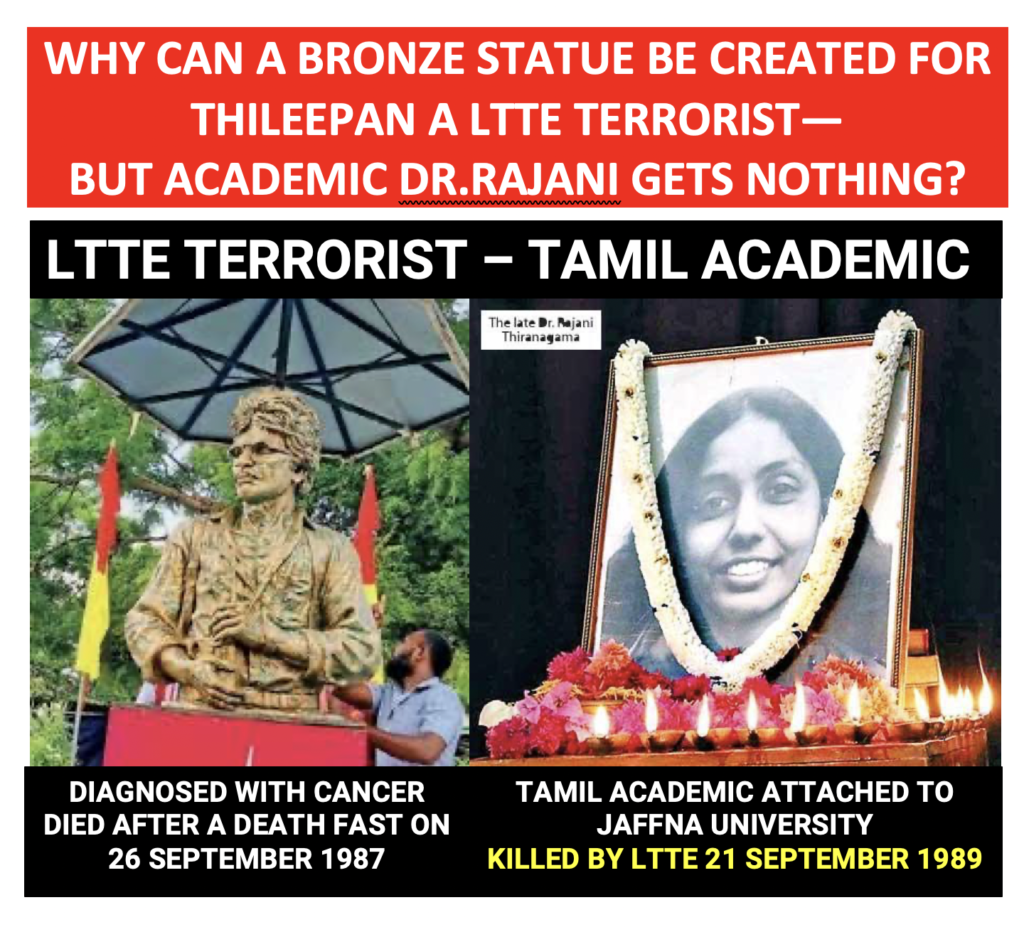
21 SEPTEMBER — DR. RAJANI THIRANAGAMA – KILLED BY LTTE
26 SEPTEMBER — THILEEPAN – DIAGNOSED WITH CANCER HELD DEATH FAST & DIED
Deaths Fell Five days apart.
One was a Tamil doctor, University of Jaffna academic and human-rights activist who helped establish the University Teachers for Human Rights and co-authored The Broken Palmyrah.
The other was a political wing leader of the LTTE whose 39th death anniversary was commemorated with a newly installed bronze statue at Nallur with even the Mayor of Jaffna playing a key role.
So let us ask the question that appears to be missing from the debate:
WHERE IS RAJANI’S BRONZE STATUE?
Not a photograph.
Not an annual article.
Not an academic seminar.
Not a passing reference.
Where is the comparable public memorial to the Tamil woman academic who documented the suffering of Tamil civilians and challenged violence committed by the very organisation whose political leader is now being commemorated with a bronze statue?
Does she not get a statue because she is not LTTE?
RAJANI DID NOT WRITE WHAT PEOPLE WANTED TO HEAR.
She and her colleagues wrote what they believed had to be recorded.
The Broken Palmyrah documented abuses by the Sri Lankan State, the IPKF and Tamil militant groups. UTHR(J)’s own later account described their decision as one of “telling the whole truth.”
The uncomfortable part of telling the whole truth means there is no convenient side to protect.
No political movement is above scrutiny.
No armed organisation becomes immune from criticism merely because it claims to speak for a community.
No victim becomes less of a victim because the perpetrator belonged to the same ethnicity.
THIS IS WHERE WE HIGHLIGHT THE HYPOCRISY.
- LOCAL TAMIL SOCIETY — WHERE IS THE SAME OUTRAGE FOR RAJANI?
- DIASPORA TAMILS — WHERE IS THE SAME GLOBAL CAMPAIGN TO HONOUR RAJANI?
- INTERNATIONAL HUMAN-RIGHTS ORGANISATIONS — WHERE IS THE SAME ATTENTION?
- UNIVERSITY ACADEMICS— WHERE IS THE SAME PUBLIC RECOGNITION FOR ONE OF YOUR OWN?
And most uncomfortable of all:
UNIVERSITY OF JAFFNA — WHAT DOES IT MEAN TO COMMEMORATE AN LTTE TERRORIST WHILE THE UNIVERSITY does not honor a woman academic who was killed after challenging violence and documenting abuses of LTTE?
WE ARE QUESTIONING WHAT IS BEING REMEMBERED — AND WHAT IS BEING LEFT OUT.
WHO ACTUALLY DECIDES?
Since 2009 – only LTTE martyrs are being commemorated.
Have you ever seen a single non-LTTE Tamil militant leader commemorated?
THE UNIVERSITY CANNOT CLAIM NOT TO KNOW RAJANI’S STORY.
Rajani was not an outsider.
She was a doctor and lecturer in anatomy at the University of Jaffna.
She was a member of the University Teachers for Human Rights (Jaffna).
And The Broken Palmyrah emerged from that academic community’s attempt to document what was happening around them.
But why do the university staff hold annual commemorations for LTTE but not one for the Head of the Dept of Anatomy who was killed by LTTE on 21 Sept 1989?
Amnesty International recorded that Rajani was shot dead in Jaffna on 21 September 1989 while returning home from work.
UTHR(J) had documented abuses by the LTTE, the IPKF and other Tamil militant groups.
That historical disagreement makes one thing even more important:
Rajani’s story should not be erased because it is inconvenient.
LOOK AT THE CONTRAST.
September 2026:
- 15 SEPTEMBER
A new bronze statue of Thileepan was unveiled at Nallur as the commemorations began.
- 18 SEPTEMBER
Police were already at the memorial and seized loudspeakers.
- 21 SEPTEMBER
Rajani Thiranagama’s death anniversary.
- 26 SEPTEMBER
Hundreds gathered at Nallur.
Flowers were laid.
The bronze statue was garlanded.
The University of Jaffna was part of the commemorative activity, with students marching from the campus to the memorial.
- 27 SEPTEMBER
Final day of commemoration concluded. Police remove statue.
WHY CAN A BRONZE STATUE BE CREATED FOR THILEEPAN A TERRORIST—
BUT ACADEMIC RAJANI GETS NOTHING?
WHY DOES THE TAMIL DIASPORA MOBILISE SO POWERFULLY AROUND LTTE-ASSOCIATED MEMORY
— BUT WHERE IS THAT SAME ENERGY FOR A TAMIL WOMAN WHO DOCUMENTED ABUSES AND PAID WITH HER LIFE?
The Broken Palmyrah was not written to create a comfortable mythology.
UTHR(J) later described the purpose in terms of truth, objectivity and confronting the political forces that had trapped the community in violence.
That raises an uncomfortable question for today’s academics, activists and diaspora organisations:
DOES “TAMIL MEMORY” INCLUDE ONLY THOSE WHO CAN BE PRESENTED AS LE MARTYRS OF THE LTTE SEPARATIST STRUGGLE?
Or does it also include:
THE TAMIL DOCTOR WHO QUESTIONED THE MILITANTS?
THE TAMIL ACADEMIC WHO DOCUMENTED ABUSES?
THE TAMIL WOMAN WHO REFUSED TO REMAIN SILENT?
THE TAMIL VICTIMS OF VIOLENCE COMMITTED BY TAMIL MILITANT GROUPS?
If the answer is yes —
WHERE ARE THEIR STATUES?
AND WHERE ARE THE UNIVERSITY TEACHERS PROTESTING ON BEHALF OF HER?
WHERE ARE THE JAFFNA UNIVERSITY ACADEMICS DEMANDING A STATUE FOR RANJANIE?
- CAN A UNIVERSITY CELEBRATE MEMORY WITHOUT CONFRONTING HISTORY?
- CAN ACADEMICS HONOUR ONE POLITICAL NARRATIVE WHILE IGNORING THE ACADEMIC WHO CHALLENGED THAT NARRATIVE?
- CAN “HUMAN RIGHTS” BE UNIVERSAL IF THE IDENTITY OF THE PERPETRATOR DETERMINES WHETHER THE VICTIM IS REMEMBERED?
They are questions about academic integrity, human rights and historical honesty.
THE DIASPORA QUESTION
The Tamil diaspora makes a lot of noise.
It can organise events across continents.
It can mobilise political representatives.
It can campaign internationally.
It can preserve monuments, photographs, literature and commemorations.
And this year’s Thileepan commemorations again extended beyond Nallur across the North-East and diaspora.
Then why is there not an equally visible international campaign saying:
REMEMBER RAJANI THIRANAGAMA.
REMEMBER THE TAMIL VICTIMS OF ALL SIDES.
REMEMBER THE ACADEMICS WHO SPOKE TRUTH TO POWER.
REMEMBER THE WOMEN WHO REFUSED TO BOW TO ARMED ORGANISATIONS.
If memory is genuinely about justice —
WHY SHOULD JUSTICE HAVE A POLITICAL FILTER?
THE INTERNATIONAL COMMUNITY QUESTION
International organisations routinely speak about human rights, disappearances, accountability, minority rights, women’s rights and protection of civilians.
Great.
Then here is a simple test:
DO HUMAN RIGHTS APPLY TO TAMILS KILLED BY TAMIL MILITANTS TOO?
WHERE ARE THE INTERNATIONAL PETITIONS?
WHERE ARE THE PARLIAMENTARY LOBBYING CAMPAIGNS?
WHERE ARE THE MEMORIALS PROJECTS?
WHERE ARE THE SOCIAL-MEDIA CAMPAIGNS DEMANDING THAT RAJANI’S LEGACY BE HONOURED?
Why doesn’t Tamil MPs like Shanakiyan/Sritharan/Gajendra Ponnambalam lay flowers or light a lamp for Dr. Ranjani?
When they do not, then the language of universal human rights becomes selective.
That is precisely why Rajani’s story matters.
Not because she was Tamil.
Not because she was a woman.
Not because she was a university academic.
But because she represents something much more difficult:
THE RIGHT TO TELL THE TRUTH ABOUT YOUR OWN SIDE.
RAJANI’S LEGACY IS ACTUALLY MORE DANGEROUS TO POLITICAL MYTHS THAN A STATUE.
A statue can be garlanded.
A photograph can be honoured.
A flame can be lit.
But The Broken Palmyrah asks people to read.
To examine evidence.
To confront uncomfortable facts.
To recognise that Tamil civilians suffered from multiple sources of violence.
To recognise that political movements can themselves become oppressive.
To recognise that nationalism does not automatically make violence legitimate.
And to recognise that truth cannot belong to one side.
That was Rajani’s challenge.
And perhaps that is why her legacy is so much more inconvenient.
If Thileepan is to be remembered, then remember the whole historical context.
If Tamil victims are to be remembered, remember all Tamil victims.
If human rights are to be defended, defend them regardless of who committed the abuse.
And if universities are to be centres of knowledge —
LET THEM TEACH THE WHOLE HISTORY.
Not the convenient history.
Not the selective history.
Not the history that protects yesterday’s political heroes.
THE WHOLE HISTORY.
WHO DESERVES A STATUE?
It is not for politicians to decide.
It is not for governments to decide.
It is not for diaspora organisations to decide.
And it certainly should not depend upon which political narrative is fashionable.
But if Sri Lanka is going to watch bronze statues being erected, commemorations being held and competing histories being asserted —
then the public has every right to ask:
- WHERE IS ONE FOR DR. RAJANI THIRANAGAMA?
- WHERE IS THE MEMORIAL TO THE TAMIL ACADEMIC WHO HELPED WRITE THE BROKEN PALMYRAH?
- WHERE IS THE RECOGNITION FOR THE TAMILS WHO DIED BECAUSE THEY DARED TO QUESTION VIOLENCE FROM THEIR OWN SIDE?
The most uncomfortable truth is – if Dr. Rajani had died serving the LTTE instead of challenging it – she would have got a bronze statue – for sure!
Shenali D Waduge