SURESH SALLAY: WHAT DID THE UN ASK — AND HOW THE SRI LANKAN GOVERNMENT ACTUALLY ANSWERED
The United Nations Joint Urgent Appeal concerning the detention of Suresh Sallay raised specific questions about the legal and factual basis for his arrest and continued detention, the evidence against him, due process, medical treatment, detention conditions, allegations of ill-treatment, and the independence of the investigation.
https://spcommreports.ohchr.org/TMResultsBase/DownLoadPublicCommunicationFile?gId=31125&
The Government of Sri Lanka responded.
However, the Government’s response leaves the key question unanswered: what specific evidence justified Sallay’s arrest and continued detention?
-
WHY WAS SURESH SALLAY ARRESTED?
What the UN asked:
What was the factual and legal basis for his arrest and continued detention under the PTA, and what was the status of investigations, charges or proceedings?
WHAT DID THE GOVERNMENT TELL THE UN?
The Government states that:
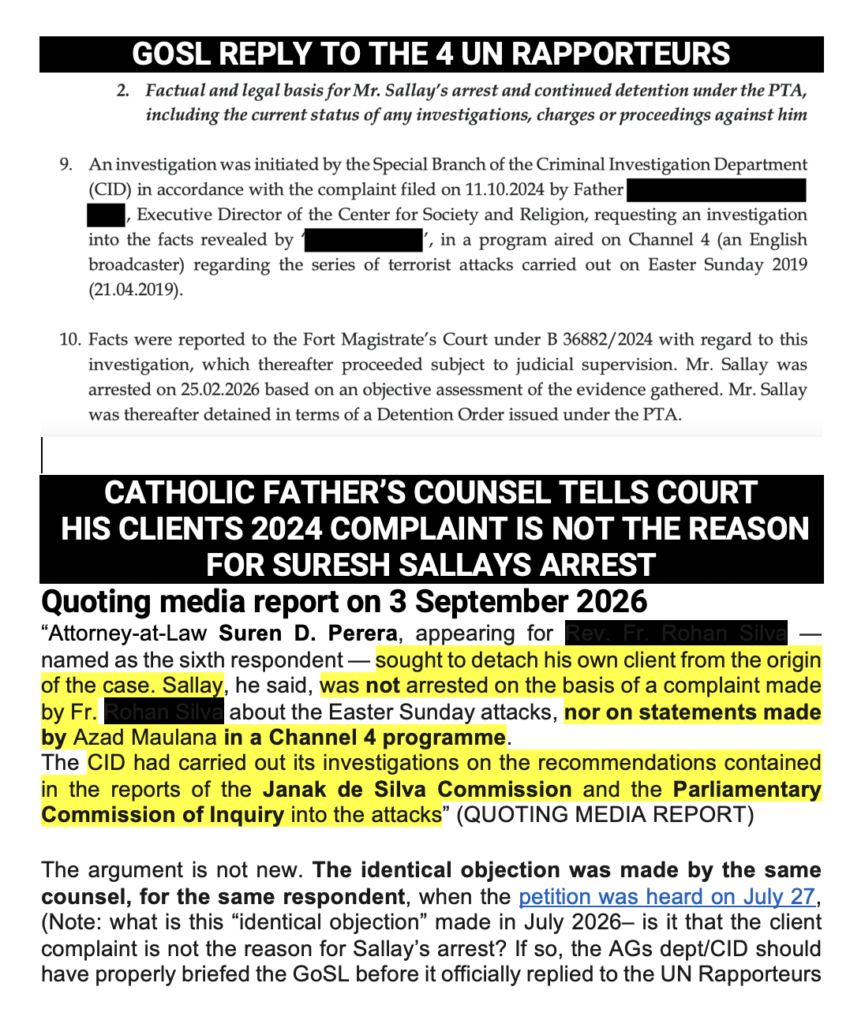
- A CID Special Branch investigation began following a complaint made on 11 October 2024 by the Executive Director of the Centre for Society and Religion (a Catholic Father).
- The complaint concerned information contained in the Channel 4 programme on the Easter Sunday attacks.
- The matter was reported to the Fort Magistrate’s Court.
- The investigation continued under judicial supervision.
- Sallay was arrested on 25 February 2026 following an “objective assessment of the evidence gathered.”
- He was subsequently detained under a PTA Detention Order.
DISCREPANCIES / QUESTIONS REQUIRING CLARIFICATION
- WHAT WAS THE EVIDENCE?
The Government says “evidence gathered” led to the arrest.
What was that evidence?
- WHICH B-REPORT?
- The Government refers to B/36882/2024.
- The Sallay proceedings refer to B/35882/24.
The Government refers to B/36882/2024, while the Sallay proceedings refer to B/35882/24. Which reference is correct?
Is this a clerical error, or does it refer to a different proceeding?
- WHAT NEW EVIDENCE EMERGED?
- The Imam Committee report was submitted in June 2024.
What specific new evidence emerged after the June 2024 Imam Committee report that allegedly linked Sallay to the offences?
- COURT OF APPEAL ACCOUNT CONTRADICTS GOVERNMENT VERSION
- On 3 September 2026, counsel for the Catholic Father told the Court of Appeal that Sallay was not arrested on the basis of the Father’s complaint or the Channel 4 statements.
- The Court was instead told that the investigation leading to the arrest followed the Janak de Silva report and recommendations of the Parliamentary Select Committee/Commission of Inquiry.
Why is this different from the Government’s account to the UN?
- WHAT WAS THE ACTUAL BASIS FOR THE ARREST?
Was Sallay arrested on the basis of:
- the October 2024 complaint and subsequent CID investigation;
OR
- the Janak de Silva report and the recommendations of the Parliamentary Select Committee/Commission of Inquiry?
What specific evidence justified his arrest under the PTA on 25 February 2026?
UN QUESTION REMAINS UNANSWERED
- The Government says the investigation began with the Catholic Father’s complaint.
- But the Father’s own counsel told the Court of Appeal that Sallay was not arrested on the basis of that complaint or the Channel 4 statements.
Until the Government explains this contradiction, the UN’s original question remains unanswered.
-
WHY WAS HIS DETENTION NOT ARBITRARY?
What the UN asked:
Why should the detention not be regarded as arbitrary?
What the Government said:
The Government rejected the characterisation of arbitrary detention.
It said the detention:
- was based on domestic legal authority;
- was connected to an ongoing criminal investigation;
- was subject to judicial review and supervision;
- was taken in view of evidence disclosed during the investigation.
The Government does not explain in detail:
- what outstanding investigative step requires Sallay’s continued detention;
- what specific risk he allegedly presents;
- why continued detention is necessary;
- why a less restrictive measure would not suffice.
-
WHAT PROCEDURAL SAFEGUARDS WERE PROVIDED?
What the UN asked:
What safeguards existed against arbitrary detention?
What the Government said: Sallay
- was given access to legal counsel;
- was taken to his residence and shown to close relatives;
- had the reasons for arrest explained;
- had the HRCSL informed;
- had relatives informed of the Detention Order;
- was produced before a Judicial Medical Officer;
- was reported to the Fort Magistrate;
- was thereafter regularly produced before court.
GOSL stated that
- communications with legal counsel are confidential and that statements obtained through torture or ill-treatment cannot be used as evidence.
What remains unanswered?
The UN does not wish to know the existence of the safeguards. They want to know whether these safeguards are applied in practice, particularly the alleged limitations on confidential lawyer-client communication.
-
WAS SALLAY HELD INCOMMUNICADO?
What the UN asked:
Was he denied communication with the outside world?
What the Government said:
The Government expressly rejected this allegation.
Government says Sallay was permitted:
- to meet his lawyer every Wednesday;
- to telephone close relatives every Friday;
- to meet close relatives and receive food, beverages and clothing from home every Saturday.
- Fort Magistrate regularly visited the CID and observed him in his cell, and that Sallay was regularly produced before court.
THE GOVERNMENT’S ACCOUNT VERSUS THE FAMILY’S ALLEGATIONS
The Govt did answer. But the answers were not straight & clear.
- Govt says legal counsel was available – but it was in the presence of CID officers until lawyers had to file a motion on 26th However, according to the family meetings continued in the presence of at least 3 CID officers.
- Family members were also never given private time with him. At certain visits about 7-8 CID officers were present when family went to visit him in CID. In the hospital 3-5 CID officers were always present. Even in the ICCU – 3 CID officers were present inside the room
- Not only were these officers present they even took notes of the conversation & even taped the conversation with their mobile phone.
- On the day of the arrest – he was brought home but with 20 officers in 4 vehicles who searched the house for almost 4-5hours.
- On the day of the arrest – his wife was presented a piece of paper but the reason for the arrest was not explained.
- Family members claim HRCSL was not informed of the arrest. Therefore the UN will need to directly verify this with HRCSL.
- 3 days after the arrest he was produced to the JMO and after the doctor left, he had been put into the “punishment cell”.
- CID had not reported the arrest to the Fort Magistrate within the stipulated time – the UN can verify this.
- He was not brought to the courts from the beginning
-
WHAT ABOUT HIS HEALTH?
What the UN asked:
What medical care had Sallay received and what safeguards existed regarding his health?
What the Government said:
This was one of the most detailed portions of the response.
It listed medical examinations and treatment involving:
- a Judicial Medical Officer;
- ENT/dental specialists;
- dermatology;
- nutrition;
- laboratory testing;
- neurology;
- MRI;
- mental health;
- ophthalmology;
- National Hospital treatment;
- monitoring during his hunger strike;
- hospital admission.
The Govt stated that Sallay was then receiving inpatient treatment at the Cardiology Unit of the National Hospital and that no statement had been recorded from him following admission.
The Government also stated that any decision to return him from hospital to detention would take account of his medical condition and medical advice.
What remains unanswered?
The UN did not question the Govt regarding providing medical treatment. The Govt failed to respond to the UN’s concerns regarding return to custodial detention and the post-medical condition after transfer.
-
WERE THE ALLEGATIONS OF TORTURE INVESTIGATED?
What the UN asked:
What action had been taken concerning allegations of torture and cruel, inhuman or degrading treatment?
What the Government said:
It stated that: “no such allegation has been substantiated or established to date.”
It added that any allegation supported by credible evidence would be dealt with through appropriate investigative and judicial mechanisms.
What remains unanswered?
The Government says the allegations have not been substantiated or established.
However, the Government does not explain how it reached this conclusion in light of the family’s complaint to the HRCSL, the reported HRCSL investigation, and the allegations of physical and mental torture raised by lawyers before the Court.
The Government also fails to explain whether the following matters were investigated and, if so, what the findings were:
- investigation into Sallay’s allegations that HRCSL conducted;
- evidence examined;
- statements taken;
- CCTV, detention records or medical evidence that were examined;
- HRCSL report sent & recommendations therein and actions taken against those responsible for the torture.
-
WHAT PROTECTION WAS PROVIDED AGAINST RETALIATION?
What the UN asked:
What measures were being taken to prevent retaliation, torture or further ill-treatment?
What the Government said:
It stated that retaliation, intimidation and ill-treatment are prohibited and that any specific allegation brought to the authorities would be examined according to law.
What remains unanswered?
The Government gives a general legal assurance.
It does not identify specific protective measures relating to Sallay’s alleged risk.
That is particularly relevant to the UN’s concern about what would happen if he were returned from hospital to custodial detention.
-
WHAT ARE THE CONDITIONS OF HIS DETENTION?
What the UN asked:
What were his detention conditions and what access did he have to family?
What the Government said:
It stated that the CID facility is a legally authorised detention facility subject to oversight and inspection by the Magistrate and HRCSL.
The Govt also said family access had been provided, subject to legal and security considerations, and that restrictions would be lawful, necessary and proportionate.
What remains unanswered?
The Government describes the oversight mechanism, but does not provide the findings of those inspections.
It therefore leaves unanswered:
What did the Magistrate and HRCSL actually observe or find regarding Sallay’s specific complaints about his conditions?
He was not provided anything to read even when requested.
He was not allowed to write anything even when requested.
-
WAS THE INVESTIGATION INDEPENDENT AND IMPARTIAL?
What the UN asked:
Concerns were raised regarding independence and impartiality, including allegations involving officers potentially connected to the Easter Sunday investigation.
What the Government said:
It said the investigation was being conducted by competent law-enforcement authorities and that the judiciary remained independent. It also stated that the question of officers suspected of being implicated in the Easter Sunday attacks was before the Court of Appeal and therefore sub judice.
What remains unanswered?
Here again, the UN expects a precise answer.
The Government asserts that the authorities are competent and the judiciary is independent. However, it does not explain what safeguards ensure that the investigation itself is independent and impartial.
The Government does not explain the institutional safeguards demonstrating that the investigation itself is independent and impartial where questions have been raised about officers connected to the investigation.
That is different from judicial independence.
Also there is no case filed by the State against Suresh Sallay in courts.
Nevertheless, several individuals handling the case have been directly named in the Commission reports & even recommendations for actions against negligence.
From those who handled the file on Zaharan in 2017 to those who directly were handling investigations & arrests are directly involved in the case against Suresh Sallay who did not hold any military or intel position from 2016 to end of 2019.
THE REAL ISSUE
The Government tells the UN that the CID investigation began with the October 2024 complaint and that Sallay was arrested on 25 February 2026 following an “objective assessment of the evidence gathered.”
However, counsel for the very Catholic Father whose complaint the Government identifies reportedly told the Court of Appeal on 3 September 2026 that Sallay was not arrested on the basis of that complaint or the Channel 4 statements. Counsel instead identified the Janak de Silva report and recommendations of the Parliamentary Select Committee/Commission of Inquiry as the basis for the investigation leading to the arrest.
The Government must clarify this apparent contradiction and identify the actual evidence relied upon to arrest Sallay.
The key question raised by the UN remains unanswered:
What was the factual and legal basis for Suresh Sallay’s arrest and continued detention under the PTA?
Shenali D Waduge