WHO HAS THE RIGHT TO REWRITE A CIVILISATION – SRI LANKA ASKS? The Global Struggle to Protect Ancient Heritage, Sacred Landscapes and Historical Identity
A global warning – and a responsibility Sri Lanka cannot afford to ignore
A civilisation does not disappear overnight.
Its monuments may remain standing. Its ancient temples may continue to attract visitors. Its historical sites may retain their names. Yet, gradually, the identity of its sacred landscapes can be altered, its historical ownership contested, its religious traditions diluted, its surrounding environment transformed and its original custodians pushed into the background.
This is how civilisational displacement can occur without even demolishing a single ancient monument.
Sri Lanka’s own history provides examples of how invasions and colonial occupation affected its Buddhist civilisation. South Indian invasions included episodes of destruction and desecration of Buddhist institutions, while subsequent religious and political changes continue to impact Buddhist sacred places. Colonial occupation brought another dimension of religious displacement. Historical records document the destruction, appropriation and conversion of Buddhist places of worship during colonial periods. There are also documented allegations concerning kovils/churches established over or in the vicinity of earlier Buddhist temple sites. These historical claims must be examined through archaeological findings, colonial records, inscriptions and other primary evidence rather than dismissed or ignored.
Across the world, ancient heritage civilisations face growing pressures arising from religious expansion, competing historical claims, changes in land use, tourism-led development, commercialisation, foreign-funded projects and political decisions.
The concern is not simply the construction of a building or the arrival of visitors. It is the cumulative transformation of places whose historical, religious and cultural identities were established over centuries or millennia.
Those who view ancient heritage landscapes merely as real estate do not see their archaeological, architectural or civilisational value. They see the commercial returns from erecting condominiums, shopping malls, hotels and other developments, often at the expense of an irreplaceable historical inheritance and to be enjoyed only by them and never passed down for the next generation.
A civilisation must not have to surrender its identity in order to accommodate the ambitions of those who arrive later.
-
HISTORICAL APPROPRIATION: CLAIMING WHAT WAS NEVER ORIGINALLY YOURS
One recurring feature of religious and cultural disputes is the emergence of competing claims over ancient sacred locations.
Sri Pada is a particularly important Sri Lankan example.
Buddhism predates Christianity by approximately six centuries and Islam by more than a millennium. Yet Sri Pada, or Samanala Kanda, an ancient Buddhist pilgrimage destination associated with the Buddha’s footprint, is also associated with later Christian and Islamic traditions identifying the footprint with Adam. The historical chronology raises an important question: how did an ancient Buddhist sacred landscape acquire competing religious identities, and how did these later interpretations enter the historical and public narrative as a multicultural site? Why is it only Buddhist sites that must be turned into multicultural sites while other religious sites remain exclusively for those faiths?
The question is not whether later religious traditions developed their own interpretations.
The question is why an ancient Buddhist sacred landscape should have its original historical identity diluted through claims that arose much later.
Historical precedence, archaeological evidence, ancient chronicles, inscriptions, religious records and continuous custodianship matter.
A later religious interpretation must not automatically be treated as equivalent to an ancient civilisation’s established historical inheritance.
The same scrutiny must apply wherever ancient temples, mountains, archaeological remains and sacred landscapes acquire competing identities.
-
RELIGIOUS EXPANSION AROUND ESTABLISHED HERITAGE SITES
Civilisational displacement does not always begin inside an ancient monument.
It can begin around it.
The establishment of new religious buildings, institutions and activities in the immediate surroundings of ancient sacred places can gradually change their physical and cultural environment.
The Dalada Maligawa is today surrounded by non-Buddhist religious and other structures, raising questions about how the historical character of its surrounding sacred landscape has changed over time. The 1918 Kandy riots provide an important historical reminder of tensions surrounding Buddhist religious processions and access to public streets. The dispute involved objections to the passage of the Buddhist Esala Perahera through Perahera Mawatha, and the subsequent colonial administration’s handling of the controversy. The incident deserves examination as part of the wider history of restrictions and disputes affecting Buddhist religious observances.
The concern is not simply the presence of structures belonging to other communities. It is whether successive land-use decisions, construction and administrative changes have gradually altered the physical and historical environment surrounding Sri Lanka’s most sacred Buddhist institutions – what has become Dalada Maligawa cannot happen to Anuradhapura or Matale’s Aluvihara Rock Temple.
Now in Sri Lanka, concerns have emerged around:
- Anuradhapura’s ancient Buddhist sacred city.
- Subtly insertion of a non-Sri Lankan mythological Ramayana Trail promoted by India.
- Aluvihare, associated with the writing of the Pali Tripitaka.
- Sri Pada and its surrounding pilgrimage landscape.
- Other ancient Buddhist sites facing disputes over archaeological boundaries, land ownership, religious structures, access and the conduct of protests that disturb pilgrims and the Sangha. Kurundi Vihara, Muhudu Maha Vihara and Vaddamana Pabbatha Vihara are among the examples that require urgent examination. Protests involving placards and demonstrations at sacred locations must also be examined in terms of their impact on religious observances, pilgrims and the preservation of archaeological sites.
The reported proposal for a mosque with a 10,000-square-foot hall near Aluvihare deserves particularly close scrutiny. How can approval be sought or granted for a development of this scale in the vicinity of an internationally significant Buddhist heritage site, particularly when archaeological objections have reportedly been raised? Whether lobbying has influenced the approval process, whether archaeological and sacred-site protection policies have been followed, and which authorities have authorised the proposed development must be examined legally and publicly and stopped.
A sacred site cannot be examined only by looking at the monument itself. Its surrounding landscape, traditional access, religious activities and archaeological environment are integral to its heritage.
The public must ask why the surroundings of an ancient Buddhist heritage site should become subject to developments that could fundamentally alter its character.
-
TOURISM, CULTURAL EXCHANGE AND THE RECLASSIFICATION OF SACRED GEOGRAPHY
Another important development is the transformation of ancient religious landscapes into general tourism and cultural-development destinations, sometimes accompanied by the promotion of historical and mythological narratives originating outside Sri Lanka that compete with, overshadow or contradict the island’s own documented history and civilisational traditions.
Tourism is frequently presented as an economic opportunity. But tourism planning without honoring heritage culture can also change the purpose, administration and physical character of sacred locations.
Look at the language increasingly used in heritage and development discussions:
- Multi-faith heritage.
- Shared sacred spaces.
- Joint religious heritage.
- Cultural exchange.
- Interfaith tourism.
- Peaceful coexistence.
- Inclusive development.
The public must examine what these terms actually mean when incorporated into land-use plans, funding agreements and development proposals, and what they can gradually become through successive administrative decisions.
What begins as cultural exchange or tourism promotion can, over time, establish new institutional arrangements, competing historical narratives and changes to the character of an established sacred landscape and its eventual replacement. Sri Lanka is mindful of all the Buddhist nations that are now referred to as “once-Buddhist nations” – Bangladesh, Maldives, Afghanistan to name a few.
Are they merely descriptions of historical activities, or are they being used to justify new religious institutions, competing narratives, construction and changes to the administration of established sacred places?
A Buddhist sacred city should not gradually become a collection of competing religious attractions.
A pilgrimage destination should not be reclassified as a commercial tourism zone at the expense of its original purpose.
Tourism must serve heritage preservation, not replace it.
-
EUROPE: WHAT HAPPENS WHEN HISTORICAL RELIGIOUS INSTITUTIONS LOSE THEIR ORIGINAL IDENTITY?
Europe provides documented examples of historic Christian religious buildings changing their religious use.
The former Jesuit Church of St Ignatius in Amsterdam became the Fatih Mosque in 1982 after being sold to a Muslim congregation.
Hagia Sophia in Istanbul underwent successive changes from Byzantine cathedral to Ottoman mosque, museum and, in 2020, mosque again.
The Córdoba Mosque-Cathedral in Spain demonstrates another long historical succession of religious authority and use.
Germany has also experienced extensive church closures and deconsecrations, although most should not be misrepresented as conversions into mosques.
These examples demonstrate that religious buildings and their surrounding institutional environments can undergo substantial transformations over time.
The question for heritage civilisations everywhere is:
What happens when a society loses the institutional, cultural and religious continuity that originally gave its sacred places their identity?
A civilisation must understand the consequences of such transformations before similar pressures affect its own ancient heritage.
Governments led by individuals who do not personally subscribe to religious beliefs must nevertheless recognise that their personal convictions cannot override the civilisational heritage, constitutional responsibilities and fundamental rights of the people they govern. Elected representatives are not elected to impose their personal religious or anti-religious preferences upon generations of people. They are entrusted with protecting the national inheritance passed down by previous generations, including the historical, cultural and religious foundations of the country.
-
DEMOGRAPHIC, INSTITUTIONAL AND ADMINISTRATIVE CHANGES
Heritage displacement can also occur through cumulative changes in the environment surrounding ancient sites.
These may include:
- New religious institutions.
- Changes in land ownership and land use.
- Construction around protected monuments.
- New access routes and commercial developments.
- Changes in the interpretation of historical sites.
- Administrative decisions affecting traditional custodianship.
- Development approvals that disregard archaeological and cultural significance.
A single development decision may appear insignificant.
But multiple decisions over time can fundamentally change the character of an ancient sacred landscape.
This is why every proposal must be examined not merely for its immediate impact but also for its cumulative, geographical, demographic, institutional and long-term consequences. What may appear to be an innocent, insignificant change today could establish the precedent for much larger irreversible changes to the sacred landscape tomorrow.
-
FOREIGN FUNDING AND THE ECONOMIC COMPROMISE OF CIVILISATIONAL HERITAGE
This is perhaps one of the most serious vulnerabilities facing ancient heritage civilisations.
Many of the world’s oldest civilisations are located in developing countries struggling with economic difficulties, colonial-era institutional legacies, colonial mindsets among sections of their political leadership, debt, political instability and dependence on foreign assistance. The continuation of colonial thinking among post-colonial leaders can be particularly damaging when foreign approval, external funding and diplomatic relationships are prioritised over the preservation of national civilisational identity.
Governments facing economic pressure may become increasingly dependent on foreign grants, investments, tourism projects and diplomatic relationships.
The danger arises when immediate economic and political interests take precedence over the preservation of national heritage.
Foreign assistance can influence infrastructure priorities, tourism strategies, institutional arrangements and the development of historic landscapes.
Governments may change. Political alliances may change. Foreign funding priorities may change.
But the destruction or dilution of an ancient civilisation’s heritage may be irreversible.
Sri Lanka: The Anuradhapura question
Sri Lanka must examine the proposed Rs.7.7 billion Indian-funded Anuradhapura Sacred City development with particular care.
The Government has confirmed that a proposal was submitted to the Indian High Commission. The full project documentation, funding conditions, detailed maps, proposed activities and implementation arrangements must be made public.
This question becomes especially important when examined alongside India’s official promotion of the Ramayana Trail in Sri Lanka and the continuing public celebration of Ravana’s defeat in India.
Ravana, traditionally identified in the Ramayana as the King of Lanka, in parts of India, annually Ravana’s effigies are burnt as a public celebration, with events receiving political and institutional patronage. This raises a deeper question: Is the historical hostility towards Ravana merely a story of the past, or is its symbolism being carried into the present through continued public celebrations that portray Lanka’s King as an enemy to be destroyed? At the same time, why is a narrative that casts Ravana as an antagonist/enemy in another country’s epic being given official tourism and institutional prominence on Sri Lankan soil? Could this amount to the continuation of an old civilisational narrative in a new form, gradually overshadowing Sri Lanka’s own historical identity and Buddhist civilisational inheritance?
India’s High Commissioner has publicly discussed the Ramayana Trail, Buddhist Circuit, tourism development and cultural diplomacy as part of India–Sri Lanka relations.
These are documented initiatives. What remains to be established is whether the Ramayana Trail has any place in the Rs.7.7 billion Anuradhapura proposal.
The public is entitled to ask:
- Why should the development of Sri Lanka’s foremost Buddhist sacred city depend on foreign funding?
- Who decides the historical interpretation and development priorities?
- Will the project preserve the Buddhist identity of Anuradhapura?
- Will the proposed development introduce commercial or religious activities incompatible with its sacred character?
- What safeguards prevent the gradual reclassification of Buddhist sacred geography?
Anuradhapura is not an empty development zone. It is the inheritance of an ancient Buddhist civilisation.
Aluvihare: Another warning
The reported proposal for a 10,000-square-foot mosque in the vicinity of Aluvihare raises another serious heritage-protection question.
Aluvihare is associated with the preservation of the Pali Tripitaka through its writing down in the 1st century BC.
A government cannot treat the surroundings of a site of such historical importance to construct a new mosque or renovate it with intent to be larger than the temple itself thereby impacting its historic Buddhist environment.
No government should compromise an irreplaceable civilisational inheritance for short-term political, financial or diplomatic advantage.
It is particularly important to examine why such proposals and lobbying efforts emerge at times when governance is weak, public confidence is low, economic pressures are severe and governments are seeking financial or political support to sustain themselves. Are political vulnerabilities being exploited to secure decisions that would otherwise face greater public, archaeological and legal scrutiny? This question must be investigated.
-
WHO PROTECTS THE HERITAGE OF FUTURE GENERATIONS?
Ancient heritage does not belong to the government in office.
This principle was recognised in the landmark Eppawala phosphate case, Bulankulama and Others v Secretary, Ministry of Industrial Development and Others (SC FR 884/99), in which the Supreme Court examined the State’s responsibilities as trustee of national resources and the rights and interests of present and future generations. The judgment is an important reminder that the Government of the day cannot treat the nation’s irreplaceable inheritance as its private property to dispose of at will.
Ancient heritage does not belong to any foreign donor.
It does not belong to commercial developers or tourism operators.
It does not belong to those who arrive later and seek to redefine its history.
It is an inheritance passed down through generations.
Governments are temporary custodians of a national inheritance that must survive long after their terms of office.
Every nation has the responsibility to preserve its ancient monuments, sacred geography, historical records, religious traditions and cultural identity.
These responsibilities must be reflected in actual decisions, not merely repeated in ceremonial speeches.
Sri Lanka has a particular constitutional responsibility concerning Buddhism under Article 9 of its Constitution, alongside the country’s archaeological and heritage-protection obligations.
It is noteworthy that proposals for constitutional change always bring Article 9 into the debate. Arguments presented in the name of constitutional reform must not become a means of gradually dislodging the foremost place accorded to Buddhism in Sri Lanka’s constitutional framework and historical identity.
The freedoms enjoyed by non-Buddhists in Sri Lanka deserve recognition.
An equally important question is whether Buddhists enjoy comparable freedoms in countries where another religion holds the dominant position.
Would Buddhist temples, religious institutions, pilgrimage activities, construction and public religious observances receive the same latitude?
Would Buddhist communities enjoy the same freedom to preserve and expand their religious institutions?
This question of reciprocity deserves an honest international discussion.
THE MESSAGE TO THE WORLD
Heritage civilisations must not be replaced, appropriated, commercially exploited or gradually stripped of their historical identity.
A civilisation should not have to wait until its ancient monuments are surrounded by competing institutions, its sacred landscapes are transformed, its traditional custodians are marginalised and its history is rewritten before it is permitted to defend its inheritance.
Economic assistance must not purchase the right to influence, redefine or gradually alter another nation’s civilisational identity.
Tourism must not become a mechanism for changing sacred geography.
Cultural exchange must not become a pretext for importing competing historical narratives, appropriating ancient heritage or changing the identity of established sacred landscapes.
Religious expansion must not be allowed to disregard established archaeological and sacred boundaries.
And governments must not be permitted to bargain away what belongs to generations of their people.
A nation may recover from economic bankruptcy. It may rebuild destroyed infrastructure. It may replace failed governments. But once its civilisational identity and irreplaceable heritage are lost, no foreign grant can restore them.
Sri Lanka must protect Anuradhapura, Aluvihare, Sri Pada and every other sacred landscape that carries the inheritance of its ancient Buddhist civilisation.
Other nations must do the same for their own heritage.
Ancient civilisations cannot be expected to repeatedly defend what should already be protected by their governments. It is the responsibility of the State to ensure that archaeological boundaries are respected, sacred landscapes remain protected, historical records are preserved and future generations inherit the same civilisational identity that previous generations entrusted to them.
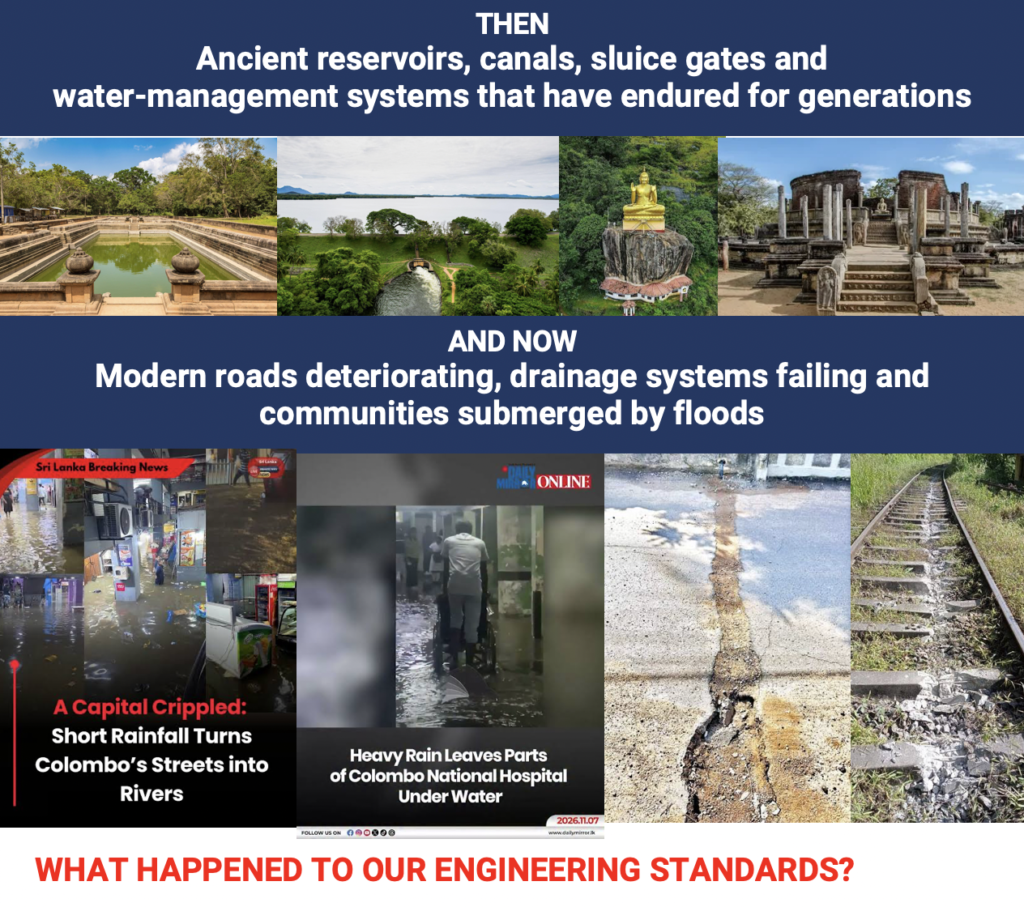
At a time when modern engineering projects struggle to produce roads and drainage systems that endure even a decade, the neglect of ancient engineering marvels that have survived for centuries exposes a sobering reality: our present generation has yet to demonstrate that it can match the vision, skill and engineering excellence of its forefathers. We cannot allow what they built to be neglected, altered or destroyed by those who have failed to demonstrate the same standard of stewardship.
PROTECT CIVILISATIONS. PRESERVE SACRED LANDSCAPES. DEFEND HISTORICAL IDENTITY.
HERITAGE IS AN INHERITANCE — NOT A BARGAINING CHIP.
Shenali D Waduge