EKNELIGODA CASE: 16 YEARS OF ALLEGATIONS – WHERE IS THE EVIDENCE AGAINST NINE INTELLIGENCE OFFICERS?
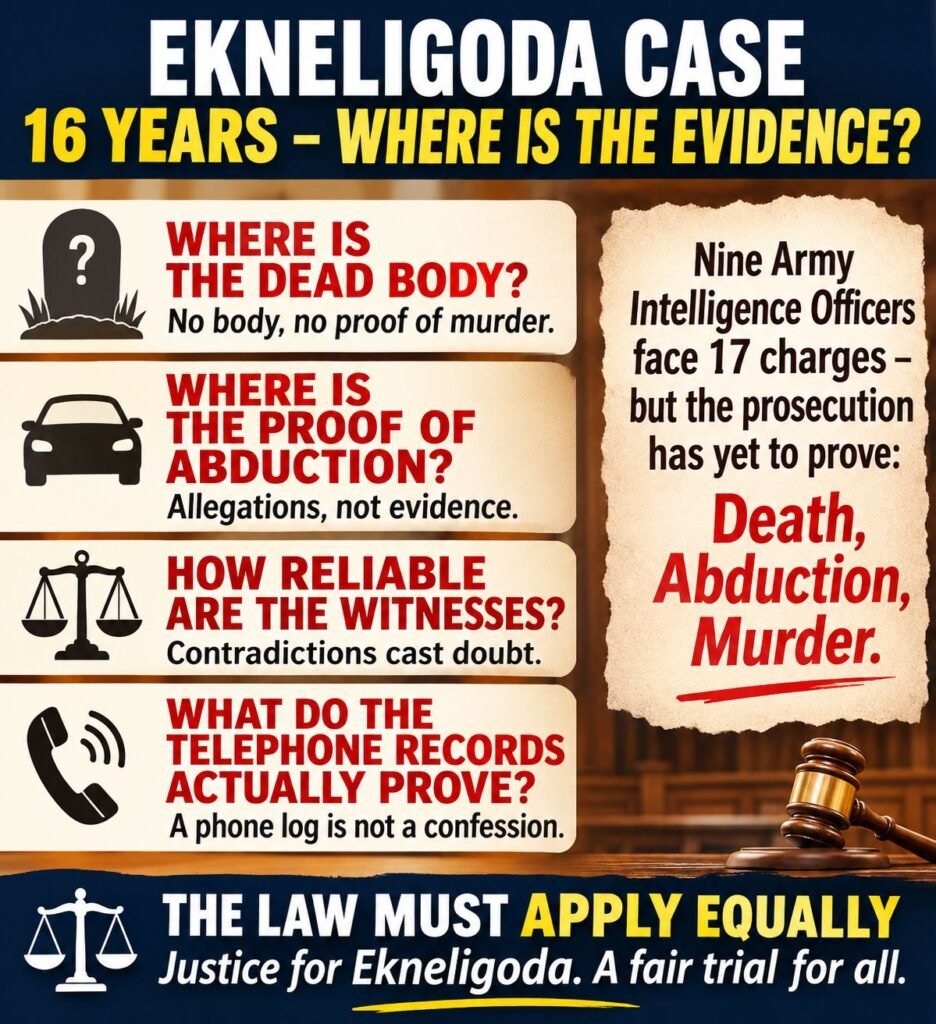
On 27 November 2019, the Attorney General filed 17 charges against nine Army intelligence officers in connection with the alleged abduction, unlawful detention and murder of journalist Prageeth Ekneligoda, who disappeared on 24 January 2010
The prosecution has concluded presenting its case.
The defence applied for the nine accused to be acquitted without being called upon to present a defence under Section 200(1) of the Code of Criminal Procedure, arguing that the prosecution had failed to establish sufficient evidence to sustain the charges. The three-judge bench unanimously rejected the application, reportedly holding that the evidence presented provided sufficient grounds for the trial to proceed. The court accordingly called upon the accused to present their defence on 12 and 13 November 2026.
However, several fundamental evidentiary questions raised by the defence deserve public understanding.
-
WHERE IS THE DEAD BODY?
Sixteen years have passed. No dead body has been recovered.
The prosecution must establish that Ekneligoda is dead and that his death resulted from a criminal act before establishing murder.
The evidence must establish the fact of death, the commission of murder and the responsibility of the accused beyond reasonable doubt.
Where is that evidence?
-
WHERE IS THE PROOF OF ABDUCTION?
The alleged abduction on 24 January 2010 must be proved with evidence.
The defence challenged whether the principal witnesses reliably established that Ekneligoda was abducted, taken to Battaramulla and subsequently detained at the Giritale Army Intelligence Camp.
Telephone records indicating activity in a particular area do not, without further evidence, establish an abduction or identify the persons responsible.
-
HOW RELIABLE ARE THE PRINCIPAL WITNESSES?
The defence raised questions about the testimony of Murali and Ran Banda, including:
- Reported contradictions in their accounts of meetings with Ekneligoda.
- The circumstances surrounding Murali’s identification of Ekneligoda.
- The reported failure to recognise Ekneligoda when shown his photograph.
- The Habarana Watta security guard’s reported failure to identify the accused as the persons he had seen.
- The 20 contradictions reportedly identified in Ran Banda’s testimony.
Witness credibility and corroboration must be assessed against the actual evidence given in court.
-
OTHER CIRCUMSTANCES REQUIRE EXPLANATION
- Murali was a former LTTE member who testified about his close relationship with Ekneligoda and his communications with senior LTTE figures. This included discussions in August 2009 to assassinate President Mahinda Rajapakse and other officials using missiles.
- Ekneligoda had reportedly been abducted in August 2009 and released the following morning. That incident is the subject of separate proceedings involving seven accused and should not be confused with the present trial
- Evidence reportedly referred to three telephone conversations between Murali and Ekneligoda on 24 January 2010, the very day Ekneligoda allegedly disappeared. Their timing and content require examination.
- Ekneligoda had reportedly been abducted in August 2009 and released the following morning. This earlier incident also deserves consideration.
- Earlier investigations reportedly examined his Matale living arrangements and associations, including contacts with Douglas Devananda.
Were these circumstances and alternative investigative leads adequately examined?
-
WHAT DO THE TELEPHONE RECORDS ACTUALLY PROVE?
The defence questioned the attribution of the telephone number said to have been used by Ekneligoda, as it was reportedly registered in another person’s name.
It also challenged the telephone analysis concerning the second accused, arguing that the relevant number could not be detected beyond Pothuhera.
A telephone number registered in someone’s name does not automatically establish who used it.
Nor does telephone activity alone establish participation in a criminal offence.
-
HAVE ALL DOCUMENTS BEEN PROPERLY PROVED?
The defence questioned the evidentiary status of seven documents reportedly admitted subject to subsequent proof.
It also raised questions about other documentary material and amendments to the prosecution’s witness list.
The court must determine what evidence is admissible and what weight it can properly carry.
-
WHAT IS THE EVIDENCE AGAINST EACH ACCUSED?
Nine individuals face criminal charges.
Their responsibility cannot be assumed collectively.
The prosecution must establish the specific acts, participation and legally required mental elements of each accused in relation to the offences charged.
The defence specifically questioned the evidence against the ninth accused, including the reported failure of the principal witness to identify him.
It also raised a legal objection concerning the charges of direct participation and aiding and abetting.
-
HAVE THE INVESTIGATIVE METHODS ALSO BEEN PROPERLY EXAMINED?
The defence raised a discrepancy between Murali’s evidence that SI Premathilaka had not visited his residence and Premathilaka’s subsequent evidence acknowledging that he had visited.
It also questioned the circumstances in which witness statements were obtained and the handling of identification evidence.
These matters require assessment against the complete court record.
THE LAW MUST APPLY EQUALLY TO EVERYONE
Article 14(2) of the International Covenant on Civil and Political Rights guarantees the presumption of innocence.
The prosecution bears the burden of proving the charges. The accused are not required to establish their innocence.
The court’s decision to call upon the accused to present a defence under Section 200 does not amount to a conviction. The final determination must follow the defence proceedings and the court’s assessment of the entire case.
The disappearance of a person deserves a proper investigation. But the seriousness of an allegation cannot replace proof.
Military intelligence personnel are not above the law. Neither should they be deprived of the protection of the law because of their profession.
SIXTEEN YEARS OF INVESTIGATION AND 17 CHARGES MUST ULTIMATELY STAND OR FALL ON EVIDENCE.
The right to justice for Ekneligoda and the right to a fair trial for the nine accused must both be respected.
Shenali D Waduge