FROM WALISINGHE HARISCHANDRA TO PALLEGAMA HEMARATHANA THERO: HAS ANURADHAPURA’S STORY CHANGED?
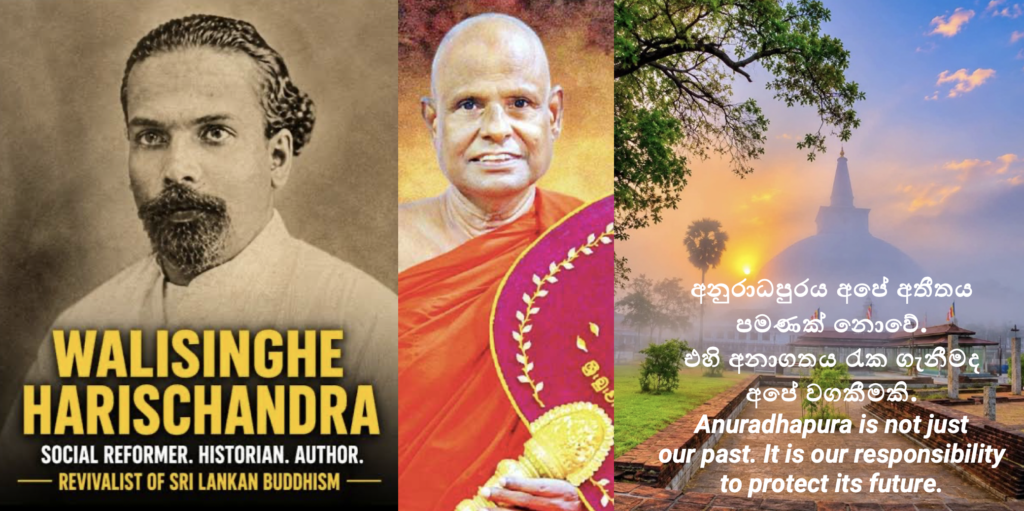
In June 1903, a man stood up to defend Anuradhapura. A man who challenged the desecration of Buddhist sacred places by the colonial British.
Brahmachari Walisinghe Harischandra believed that the ancient capital was not an ordinary town. It was a sacred inheritance, a civilisation’s spiritual heart and a national treasure that had to be protected. He campaigned not only to restore ancient ruins but fought to protect the identity of Anuradhapure as a sacred Buddhist city.
Harischandra objected to government buildings being erected on lands regarded as sacred, the treatment of ancient Buddhist remains, the presence of meat markets and setting up of other non-Buddhist religious establishments within sacred precincts.
He did not confine his objections to speeches. He organised the Maha Bodhi Society’s activities in Anuradhapura, worked to restore ancient shrines, established the Ruwanweliseya Restoration Society and published a book titled The Sacred City of Anuradhapura, appealing for the protection of its sacred character.
Then came June 1903. 9th June to be precise. Poson pilgrimage began and thousands of devotees gathered in Anuradhapura. Reports of ancient Buddhist stones being removed for road repairs was already causing resentment. Tensions escalated when the Kachcheri Mudaliyar Mr. Amarasekera rode through the crowd and knocked down a woman pilgrim. Her husband was also injured.
Violence broke out. Four days later, on 13 June 1903, Walisinghe Harischandra was arrested.
He was accused of aiding and abetting riot, arson and sacrilege. The very man who had been campaigning against the colonial administration’s treatment of sacred Anuradhapura was now accused of being a ringleader of the disturbances.
There was, however, a remarkable contradiction in the proceedings.
The magistrate who had him produced in court had reportedly thanked him on the day of the disturbances for helping to calm the crowd.
Harischandra was tried before the Supreme Court in Kandy from 5 to 12 October 1903. The prosecution attempted to link his campaign to protect sacred lands with the violence that had occurred.
But the trial judge observed that the evidence did not show that Harischandra had taken part in the riot.
On 12 October 1903, the jury found him not guilty of all charges.
This is an important chapter in Anuradhapura’s history.
Harischandra’s campaign was about more than buildings, roads or administrative arrangements. It was about whether the ancient capital would retain its sacred Buddhist identity or be treated as an ordinary settlement where the historical and religious claims of its civilisation could be disregarded.
More than a century has passed. We find ourselves in the same predicament.
Today, Anuradhapura is again at the centre of questions concerning its sacred identity, its custodianship and its future.
The proposed development of Anuradhapura is not a recent matter.
Discussions and proposals had been taking place long before the development plan was gazetted. The position of the former Atamasthanadhipathi, Ven. Pallegama Hemarathana Thero, towards the proposed changes is therefore important.
There is also an Indian dimension that cannot be overlooked. India’s mission had engaged with Ven. Pallegama Hemarathana Thero, the then Atamasthanadhipathi.
India is associated with the proposed financial support for the newly created Sacred City development programme.
- What was discussed with the religious leadership?
- Was the proposed development raised?
- What position did the Atamasthanadhipathi take?
Within days of this discussion Ven. Pallegama Hemarathana Thero, finds himself at the centre of a controversy.
There are allegations against him which must be determined through due process.
No one should be above the law, including a Buddhist monk.
But he has been suspended as the Atamasthanadhipathi.
He is replaced by an acting Atamasthanadhipathi.
- Who now exercises the duties of the Atamasthanadhipathi?
- What authority supports that arrangement?
- What is the legal basis of this new appointment?
- Has the position of the institution towards the proposed development changed following the replacement of the former Atamasthanadhipathi?
- Why is the present Atamasthanadhipathi leadership asking the public to cooperate with the development programme when serious objections remain unresolved?
- Does abandoning selective aspects of the project, address the wider concerns about the Sacred City’s boundaries, land, residents, archaeological heritage and religious character?
- Why should Anuradhapura sacred city be turned into an economic zone?
Meanwhile, the concerns surrounding the proposed development have now spilled into public protest.
They take us back to 1903 when people came out in protest to virtually the same scenario.
Buddhist monks and members of the public have taken to the streets and commenced a Satyagraha near the Ruwanweliseya.
The protests have escalated, with monks undertaking a fast unto death.
Altercations have resulted in arrests and injuries.
The public protects concern the proposed expansion of the Sacred City, changes to its existing character, fencing and access, the denial of basic rituals that are part and parcel of Buddhist theros (ex: carrying the pathraya) the future of residents and their lands, and the lack of adequate public consultation. These are regarding as a violation of the Public Trust Doctrine and a violation of the Governments duty as only custodian and not ownership of sacred lands or heritage to hand over to external parties.
These are matters affecting not merely those living in Anuradhapura but every Sri Lankan who considers the ancient capital part of the nation’s sacred inheritance.
But should the public stop examining events there?
- What about the discussions surrounding the proposed development of Anuradhapura?
- What was presented to the religious authorities long before anything was gazetted?
- What objections were raised?
- What was the position of the Atamasthanadhipathi?
- Was the objections the reason for his sudden removal?
- Is there a connection in his objecting to the economic development project and the sudden allegation against him?
- Was this why he was suddenly replaced and the incumbent is now calling all to cooperate?
- Who now exercises the duties of the Atamasthanadhipathi?
- What authority supports that arrangement?
- How legal is this appointment?
- Has the position of the institution towards the proposed development changed?
These are legitimate questions.
In 1903, the colonial authorities were the power confronting those who sought to protect Anuradhapura’s sacred character.
Today, the circumstances are different. The authorities, the institutions, the legal framework and the nature of development proposals are different.
But the question we must ask has not changed:
- In 1903, Walisinghe Harischandra faced accusations and prosecution after campaigning to protect Anuradhapura’s sacred character.
- In 2026, the circumstances are different, but we must still examine whether legal controversy, institutional decisions and changes in custodianship can have the effect of weakening the voice of those who oppose decisions affecting the Sacred City.
We are not declaring that the circumstances are identical.
We are asking whether the sequence of events, the timing of decisions and the change in institutional positions deserve public scrutiny.
What happens to those who stand in the way of decisions affecting Anuradhapura?
Is opposition always defeated through direct confrontation? Or can a person’s ability to influence events be diminished through other circumstances, including legal controversy, character assassination, institutional action or replacement?
We are asking whether the events of 1903 and 2026 should be examined together rather than dismissed as unrelated incidents.
The public must look beyond personalities and individual allegations. It must examine the sequence of events, the decisions taken, the authority exercised, the beneficiaries and the consequences.
Walisinghe Harischandra’s story reminds us that protecting Anuradhapura has never been merely about protecting ancient buildings.
It is about protecting a civilisation, its sacred identity and the right of future generations to inherit it.
If Walisinghe Harischandra’s generation had remained silent, what would have happened to Anuradhapura?
And if those entrusted with protecting it today cannot question decisions affecting it, who will speak for the Sacred City tomorrow or in the future – will there be a sacred Anuradhapura or a modern metropolis for generations to see?
Shenali D Waduge