
ARE YOU BEING DENATIONALISED?
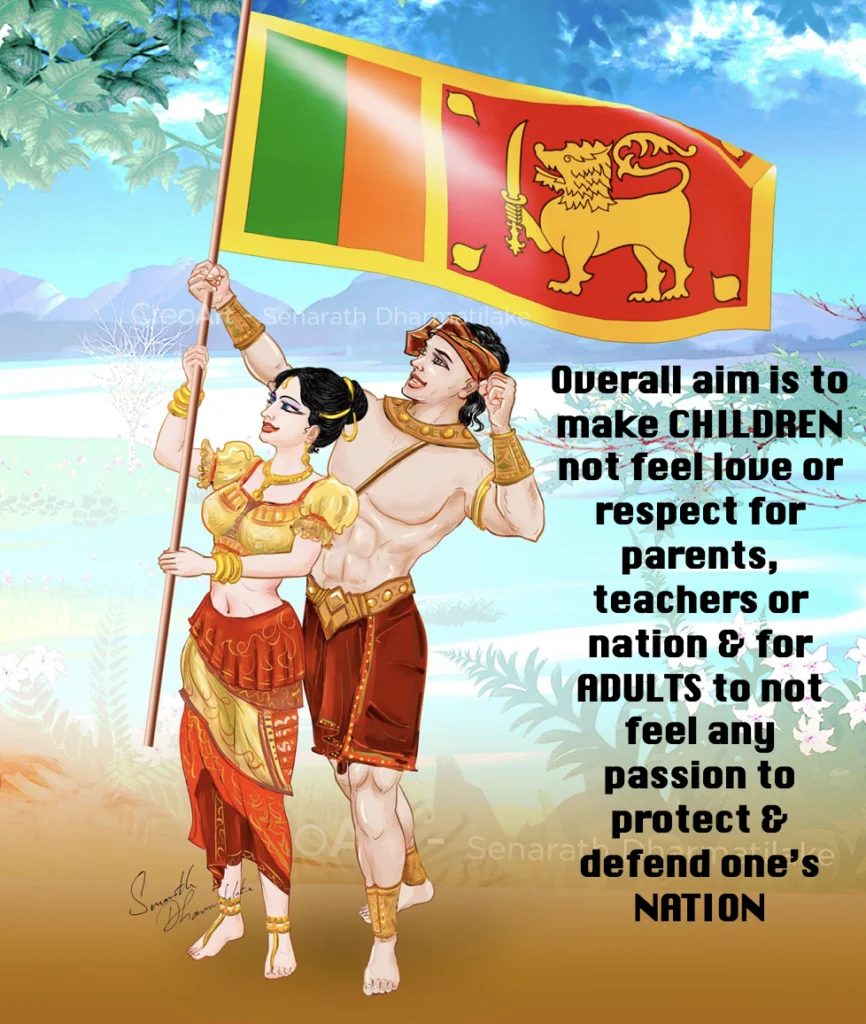
We had a proud past. That proud past withstood invasions, conquests and occupations. Magnificent monuments, renowned irrigation works, handicrafts a new language & culture evolved over 2600 years. That proud past became a victim of systematic denationalization by numerous forces that we embraced as friends, who we welcomed to our homes, gave shelter and provided livelihood. Today they demand pieces of the land without respecting or serving the land they demand. The land belongs to only those that treasure it, defend it, protect it and nurture it for future generations. This is why we need people to understand how our Nation was built. Who built it. Who protected it from enemies. Who nurtured it for future generations.
-
Erasing your history
Who is involved? Education authorities, curriculum designers, textbook authors, historians, media organisations, cultural institutions and political decision-makers.
How is it done?
- Historical periods and achievements are omitted or given little attention in textbooks, state and private media, and programmes of organisations aligned with a denationalisation agenda.
- The people’s historical continuity with their homeland is questioned, ignored or mocked, making them feel ashamed of their heritage. (A tactic to brainwash the mind)
- Historical events are selectively presented to support contemporary political narratives. Historical achievements are downplayed or displaced by greater emphasis on foreign histories and achievements at educational, social, political and cultural levels.
- Ancient knowledge, inventions, literature and achievements receive less attention than foreign histories and their achievements.
Tools used: School curricula, textbooks, university syllabuses, museum displays, media programmes, historical publications, public commemorations, public discussions/debates.
ARE YOU A VICTIM?
- Do you or your children know the history of your own civilisation?
- Can you or your children identify its ancient kingdoms, historical achievements and contributions to the world?
- Have you or your children been taught your history comprehensively, or only selected portions of it?
- Is you and your children’s perception of our history based on facts or someone else’s interpretation?
Having read this passage, what has crossed your mind?
-
Rewriting your historical narrative
Who is involved?
Political authorities, curriculum committees, researchers, publishers, media commentators, advocacy organisations and institutions that influence which historical interpretations receive public recognition.
How is it done?
- Historical events are selectively interpreted.
- Some communities’ historical claims receive greater recognition than others, while the history of the people who built the civilisation is downplayed or diluted.
- Established historical evidence is dismissed without adequate examination, while unverified claims are repeated and given prominence.
- Historical monuments and events are presented without their wider context, while receiving inadequate state patronage.
Tools used: Historical commissions, official statements, textbooks, academic publications, documentaries, public exhibitions, commemorations and political statements.
ARE YOU A VICTIM?
- Are you being taught to question your own historical existence while accepting other people’s historical claims without scrutiny?
- Are you made to feel ashamed of being from the community that built this civilization?
- Are you afraid to publicly acknowledge that you are Sinhala Buddhist?
- Are archaeological findings, inscriptions and primary documents being erased, damaged or destroyed, with little political or legal action taken to protect and preserve them?
- Can you distinguish documented history from political interpretation?
What do you feel after reading this passage?
-
Weakening your language
Who is involved?
Education policymakers, public-sector administrators, employers, media institutions, publishers, cultural policymakers, donors and international organisations.
How is it done?
- The mother tongue is marginalised in higher education, professional advancement or administration.
- Indigenous vocabulary and knowledge are displaced without adequate preservation.
- Children are encouraged to regard their own language as inferior or unsuitable for intellectual achievement, and to believe that adopting another language is necessary to fit into the global community.
- Literature and scholarship in the mother tongue receive insufficient state support and promotion.
- International bodies discourage the use of the mother tongue in state and private-sector institutions
- Even where the mother tongue is being used, new initiatives have been introduced that may discourage its continued use. Sinhala appears to be a particular target, including in day-care centres, daham pasal and Montessori settings.
Tools used: Language policies, examinations, recruitment practices, education systems, publishing decisions, broadcasting and digital platforms.
ARE YOU A VICTIM?
- Do your children speak, read and write their mother tongue fluently?
- Are you and your children made to feel ashamed when speaking your mother tongue?
- Is your mother tongue being developed and used in modern science, technology and scholarship?
- Have you begun to associate your mother tongue with inferiority?
- Do you realise the damage being done if the world’s only Sinhala language becomes extinct?
- Do you realise how actively other nations and their people protect their mother tongues?
- Why are you being led to forget your mother tongue? Do you not wish to preserve it for future generations?
-
Disconnecting your children from their heritage
Who is involved?
Education ministries, teachers involved in foreign-funded teaching programmes, curriculum developers, textbook committees, school administrators, teacher-training institutions and educational content providers.
How is it done?
- Children’s education becomes detached from their own civilisation.
- Teachers are discouraged from instilling pride in their nation’s past and heritage. Its historical achievements and glories are left out of the syllabus.
- Local history, literature, philosophy, heritage and indigenous knowledge receive inadequate attention. Few excursions or school field trips take children to ancient historical sites.
- Foreign cultural references dominate learning materials without meaningful local context.
- Children are taught to acquire qualifications without understanding the historical inheritance of their society. They risk becoming a generation of rootless youth and adults who do not know what to defend or why it must be defended
- Children, youth and adults who are disconnected from their roots become like wanderers without a sense of belonging—unable to feel pride in their own land, yet happy to feel proud of other lands.
Tools used: National curricula, textbooks, teacher-training programmes, examinations, digital learning platforms and supplementary educational materials.
ARE YOU A VICTIM?
- Do your children know more about foreign popular culture than their own historical heritage?
- Can they explain the significance of their country’s ancient monuments and cultural traditions?
- Are parents able to inspect and question educational materials?
- Are your children being equipped to inherit their civilisation, or simply to participate in the global economy?
-
Undermining religious and moral foundations
Who is involved?
Political authorities, education policymakers, religious institutions, media organisations, cultural commentators and advocacy groups.
How is it done?
- The people’s religious and philosophical traditions are routinely portrayed as backward or irrelevant.
- Ancient customs and rituals are ridiculed and portrayed as backward through social media content, algorithms and AI-based tools.
- Moral frameworks and duties are discussed in isolation from rights, without understanding their historical and philosophical foundations.
- Religious institutions are weakened through neglect, cuts to resources or unjustified restrictions.
- Cultural practices become commercial spectacles rather than living traditions whose underlying rationale and significance are understood and preserved.
- Religious leaders are targeted through smear campaigns or inducements that exploit their weaknesses, with the resulting allegations or content circulated through social media.
Tools used: Education, legislation, institutional funding, media narratives, cultural programming and public policy.
ARE YOU A VICTIM?
- Are your children learning the philosophy behind their religious and cultural traditions, or simply following them as customs?
- Can they distinguish genuine reform from the denigration of their heritage?
- Are ancestral practices being understood in context or dismissed without examination?
- Are you passing down ancient wisdom as it has been passed down through generations, or have you become a victim of trends that interrupt this transmission from one generation to the next?
- Are you preserving your traditions as a living inheritance, or merely observing them on ceremonial occasions? Is this the attitude you have passed on to your children?
Having read this, do you feel a sense of responsibility? If so, what would you do differently?
-
Breaking the chain between generations
Who is involved?
Families, education institutions, community organisations, cultural institutions, employers and media systems. This stage often develops through social change rather than deliberate direction by any one actor.
How is it done?
- Oral histories, family traditions and ancestral knowledge are no longer transmitted because people have repeatedly been told, or made to feel, that these are no longer ‘fashionable’
- Traditional skills and local knowledge are abandoned without documentation
- Elders and cultural custodians are excluded from passing on knowledge, while the value of their memories is belittled.
- Successive generations become unfamiliar with the customs and responsibilities inherited from their ancestors, eventually becoming rootless citizens who are easier to manipulate.
Tools and mechanisms:
Family and school practices, migration, changes in work and lifestyle, entertainment, digital media, the decline of community institutions and programmes introduced by foreign-funded organisations.
ARE YOU A VICTIM?
- Can your children explain the history of your family, your community and your nation?
- Do they know the customs, literature, skills and traditions passed down by earlier generations?
- Have you recorded family histories and local knowledge before they disappear?
- What inheritance, other than property and money, will your children receive from you?
How can you help reverse this damaging trend?
-
Making you ashamed of your identity
Who is involved?
Political commentators, media personalities, advocacy organisations, educational institutions, public figures and social groups that shape social approval and disapproval.
How is it done?
- National pride is equated with extremism and, increasingly, with hate speech
- Protecting cultural heritage is equated with hostility towards other communities.
- People are pressured to apologise for asserting their historical identity, regardless of the evidence.
- Those who raise legitimate questions about cultural preservation are dismissed instead of answered.
- Those who remind people of atrocities committed by invaders and colonisers are portrayed as wanting to live in the past rather than move forward—an attempt to suppress the past and prevent lessons from history’s mistakes from being learned.
Tools used:
Public commentary, social media campaigns, professional and social pressure, selective reporting, institutional disciplinary processes, reporting social media posts and political rhetoric.
ARE YOU A VICTIM?
- Do you hesitate to express pride in your civilisation because you fear being labelled?
- Have you stopped defending your heritage to avoid criticism?
- Are you applying the same standards to everyone, or accepting that only your own community must feel ashamed?
- Do you not feel you have a right to say that you will take pride in your heritage while respecting the equal dignity and rights of others?
- What has taken away your confidence to speak for your identity and your roots?
-
Reducing a civilisation to just another interest group
Who is involved?
Political parties, policymakers, constitutional and legal institutions, advocacy groups and organisations that shape public debate.
How is it done?
- Historical continuity and cultural preservation are treated as irrelevant to national policy and future planning.
- The historical continuity and cultural heritage of the people who built the civilisation are excluded from public discussion.
- Latter-day norms and thinking are given preference and prominence. These can contribute to the denationalisation of citizens, who become increasingly influenced by digital algorithms and AI-based tools rather than thinking and analysing independently. They risk becoming walking robots, programmed to think according to the versions promoted by those who dictate the new narrative.
- The majority’s cultural interests and inherited customs and rituals are treated as inherently illegitimate and gradually excluded from state patronage
- Citizenship is discussed without considering the cultural inheritance that connects generations. It is increasingly framed in terms of a ‘global citizenship’ that disconnects people from their past and roots them in a mechanical framework of thinking
Tools used:
Political messaging, legislation, constitutional interpretation, administrative policy, public-sector decisions, social media algorithms, AI-based tools and institutional representation
ARE YOU A VICTIM?
- Are you permitted to discuss the preservation of your civilisation without being accused of seeking superiority over others?
- Are your historical and cultural interests considered in national policymaking?
- Are the same principles of cultural preservation applied consistently to all communities?
- Has your understanding of equality been reduced to the belief that your own heritage must never receive recognition, while your civilisation’s heritage is gradually erased from public consciousness?
Important distinction: equal citizenship and equal protection do not require erasing a country’s historical identity. Nor does historical continuity justify denying the rights of other citizens.
-
Fragmenting your collective identity
Who is involved?
Political parties, interest groups, media organisations, campaign networks and, sometimes, foreign influence operations.
How is it done?
- People are divided into competing political, social and economic camps. Economic support is also provided to those who distance themselves from their cultural and historical heritage. The logic is simple: people who do not know their past, take pride in it or resolve to protect it are easier to manipulate. A person who has no commitment to preserving their country’s identity and dignity is easier for an adversary to influence and manipulate.
- Shared historical interests are subordinated to short-term political loyalties.
- Cultural issues become instruments of partisan conflict.
- Communities lose the ability to cooperate on matters affecting their common inheritance as foreign funding and initiatives support contemporary demands that challenge historical and cultural continuity.
Tools used: Political campaigns, partisan media, social media algorithms, targeted messaging, patronage networks and polarising public discourse.
ARE YOU A VICTIM?
- Do you defend your party even when it neglects your historical and cultural inheritance?
- Are people from your own community treated as enemies because they disagree politically?
- Can people unite around protecting heritage regardless of party affiliation?
- Have political divisions made you incapable of defending interests you share?
Do you realise that when you are made to feel ashamed of, or hostile towards, the nation you were born into, you can be manipulated into acting against its interests? You risk becoming a tool in someone else’s agenda.
-
Disconnecting a people from their physical heritage
Who is involved?
Land and planning authorities, archaeological and heritage departments, local government authorities, developers, political decision-makers and institutions responsible for protecting historical sites.
How is it done?
- Historical sites are neglected or inadequately protected.
- Development projects proceed without sufficient heritage assessment.
- Illegal encroachments and incursions continue, while legal provisions intended to prevent or remedy such violations are inadequately enforced.
- Archaeological evidence is damaged, removed or left undocumented.
- Encroachments and unauthorised occupation are allowed to continue under the oft-quoted formula of “compromise”, rather than being resolved through the proper application of the law.
- Traditional place names and historical associations disappear from public records, while funding is used to justify or promote new uses of historically significant places
- Access to heritage sites is restricted without adequate justification, while new memoranda of understanding (MOUs) and foreign-funded initiatives may alter how these sites are managed or accessed.
Tools used:
Land-use plans, development permits, archaeological surveys, heritage registers, conservation budgets, administrative decisions and naming policies.
ARE YOU A VICTIM?
- Are the historical sites in your area documented and protected?
- Have officials and State institutions responsible for protecting these sites failed in their duties, or are their decisions influenced by interests that conflict with heritage protection?
- Are archaeological findings independently recorded and made accessible?
- Are historical place names being preserved alongside any lawful changes?
- Do you know who is responsible for protecting your community’s historical inheritance?
- Will future generations still be able to identify the places that connect them to their ancestors, or will damage, destruction, encroachments and the rewriting of history sever that connection?
-
Losing control over the interpretation of your own civilisation
Who is involved?
Universities, academics, research institutions, publishers, funders, international organisations, government departments and domestic institutions that commission or conduct foreign-funded historical and cultural research.
How is it done?
- Research agendas become dependent on the priorities of particular funders and their stated objectives.
- Some historical questions receive funding and publicity, while other questions and evidence important to understanding the civilisation remain unexplored.
- Foreign interpretations are adopted without adequate independent verification.
- Domestic researchers may lack the resources to document, investigate and defend evidence about their own heritage, while selected researchers may prioritise funders’ expectations or prevailing narratives over independent scrutiny.
Tools used:
Research grants, foreign fellowships and scholarships, publishing decisions, academic appointments, institutional partnerships, conferences and documentary production.
ARE YOU A VICTIM?
- Are local researchers equipped to investigate their own history independently?
- Can you identify the evidence behind a prominent historical claim?
- Are alternative interpretations assessed fairly?
- Does your country possess the archives, research capacity and expertise needed to investigate its own civilisation?
Foreign funding or international collaboration is not itself evidence of an attempt at denationalisation. The relevant questions concern transparency, research independence, evidentiary standards and whether alternative work is possible.
-
Turning historical continuity into a source of guilt
Who is involved?
Political actors, media commentators, advocacy organisations, educational institutions and public authorities that frame debates about history, identity and collective responsibility.
How is it done?
- A whole community is assigned collective guilt for historical events without distinguishing individuals, institutions and generations.
- The historical suffering of one group is recognised while that of another is ignored.
- Historical claims are evaluated according to political convenience rather than consistent standards.
- Legitimate cultural preservation is confused with demands for political dominance.
Tools used:
Public statements, commemorations, school materials, media coverage, political speeches, historical reports and advocacy campaigns.
ARE YOU A VICTIM?
- Are you being asked to accept collective guilt simply because you belong to a particular community?
- Are historical allegations supported by reliable evidence?
- Are the same standards of accountability applied to all groups?
- Can you acknowledge historical wrongdoing without surrendering your right to preserve your own heritage?
-
Weakening the institutions that sustain the civilisation
Who is involved?
Government authorities, funding bodies, educational institutions, religious and cultural organisations, heritage administrators and community leadership.
How is it done?
- Institutions responsible for transmitting knowledge are neglected.
- Cultural and archaeological preservation depends on political patronage.
- Archives, libraries, traditional learning systems and heritage organisations lack adequate support, or become dependent on foreign-funded programmes that influence what is preserved, promoted or neglected.
- Institutional decisions prioritise immediate political or commercial benefits over long-term continuity.
Tools used:
Budgets, grants, appointments, administrative regulations, institutional governance, land management and heritage conservation policy.
ARE YOU A VICTIM?
- Are your cultural and educational institutions adequately funded and professionally managed?
- Are historic documents and traditional knowledge being preserved?
- Can these institutions operate according to their legitimate purposes without undue political interference?
- Are you contributing to institutions that will still be functioning for your grandchildren?
-
Separating political independence from civilizational sovereignty
Who is involved?
Governments, political parties, public administrators, international financial institutions, external partners, domestic interest groups and decision-makers responsible for national policy.
How is it done?
- National policy is adopted without adequately assessing its long-term consequences for cultural continuity.
- External financial or diplomatic pressures narrow domestic policy choices.
- Strategic assets, natural resources or essential institutions become subject to arrangements that reduce national autonomy.
- Cultural and historical considerations are excluded from decisions affecting education, land, heritage and national development.
Tools used:
Treaties, loan agreements, development programmes, administrative reforms, investment contracts, policy conditionalities and international commitments.
ARE YOU A VICTIM?
- Do you know which agreements and policies affect your country’s long-term autonomy?
- Are their terms transparent and subject to appropriate public scrutiny?
- Can national institutions independently assess the consequences of external commitments?
- Is your country retaining the ability to determine its future while meeting its legitimate international obligations?
International cooperation is not inherently a loss of sovereignty. The issue is whether decision-making remains accountable, informed and consistent with the country’s lawful national interests.
-
Normalising the loss until the next generation does not recognise it
Who is involved?
Potentially every institution and social actor involved in the preceding stages, but also families, communities and individuals who have ceased to transmit their heritage.
How is it done?
- Historical omissions become accepted as normal, while concerns about heritage are dismissed as unimportant or secondary to other problems.
- Cultural decline is treated as inevitable, while little attention is given to how distancing from inherited duties, values and accumulated wisdom may contribute to that decline.
- The loss of language, knowledge and heritage gradually ceases to generate public concern.
- The next generation inherits the consequences without knowing what has disappeared, why it mattered or how to critically examine the changes that have taken place.
Tools used:
Repeated institutional practices, educational omissions, public narratives, cultural neglect, generational habits and the absence of sustained preservation programmes.
ARE YOU A VICTIM?
- Do you know what your civilisation has lost during your lifetime?
- Can you identify which languages, traditions, historical records or cultural practices are disappearing?
- Are you taking any steps to preserve them, and do you recognise your responsibility to do so?
- If your children ask what you did to protect their inheritance, what will your answer be?
Are you a victim of denationalisation?
Answer each statement honestly. This is a reflection tool, not a scientific test or proof that a coordinated campaign exists.
- I know the history of my civilisation and can distinguish evidence from political interpretation.
Yes
Partly
No
Unsure
- My children can access our language, literature and historical inheritance.
Yes
Partly
No
Unsure
- I can express pride in my heritage without fear of unfair labelling.
Yes
Partly
No
Unsure
- The historical sites, records and cultural institutions of my community are being preserved.
Yes
Partly
No
Unsure
- I examine policies affecting national identity and sovereignty rather than accepting them blindly.
Yes
Partly
No
Unsure
- I actively transmit my heritage to the next generation.
Yes
Partly
No
Unsure
The question every citizen must ask
If your children inherit your citizenship but lose your history, language, cultural confidence, institutions and connection to your ancestral heritage, what exactly have you passed on to them?
A civilisation does not survive simply because its people remain within the borders of a country. It survives when its people understand their inheritance, protect it through functioning institutions, exercise informed control over their collective future and transmit that inheritance to the next generation.
The first defence against denationalisation is awareness. The second is evidence. The third is organised, lawful action to preserve what must not be lost.
Shenali D Waduge


