Before demanding a Separate Tamil State, Tamil MPs must first learn to sit next to each other.
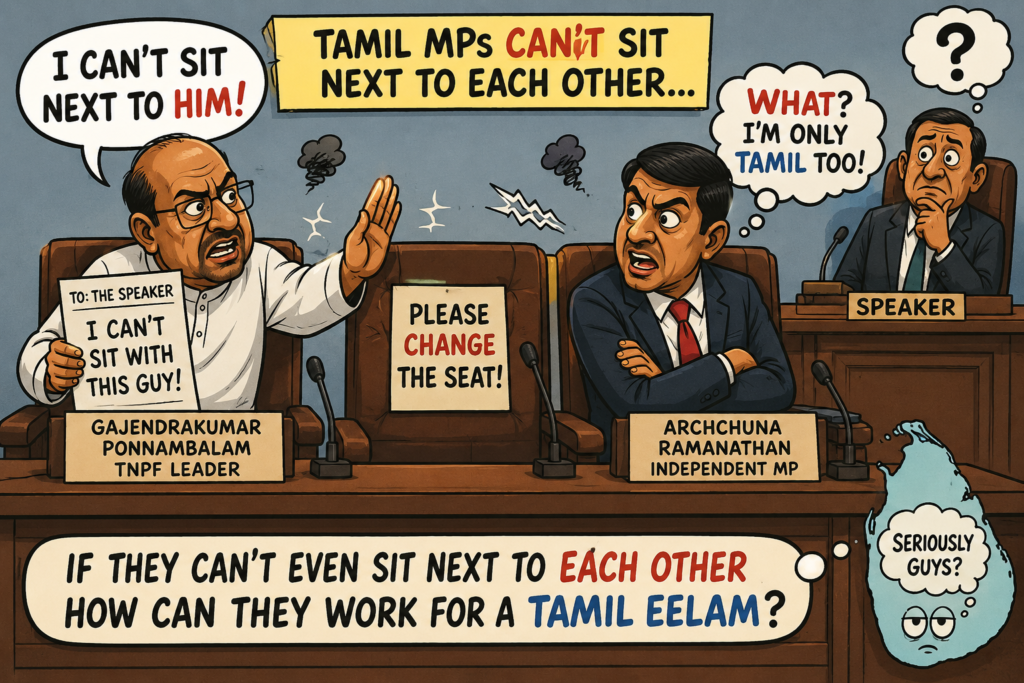
To the best of public knowledge, this appears to be an unprecedented request in Sri Lanka’s parliamentary history. It is difficult to recall any previous occasion on which a Member of Parliament formally asked the Speaker to change seating arrangements because he did not want to sit beside another elected Member.
For decades, the international community has been fed a story.
Sri Lanka’s Tamils, they have been told, cannot live with the Sinhalese.
They need a separate homeland.
They need a separate administration.
They need a separate state.
They need “Tamil Eelam.”
Yet this week, the Tamil nationalist narrative collided with reality—and the Sinhalese had nothing whatsoever to do with it.
The contradiction came entirely from within Tamil politics itself.
The leader of a party advocating Tamil nationalism has informed the Speaker of Parliament officially that he cannot even sit next to another Tamil Member of Parliament. This is indeed a first.
A Tamil Member of Parliament says he cannot sit next to another Tamil.
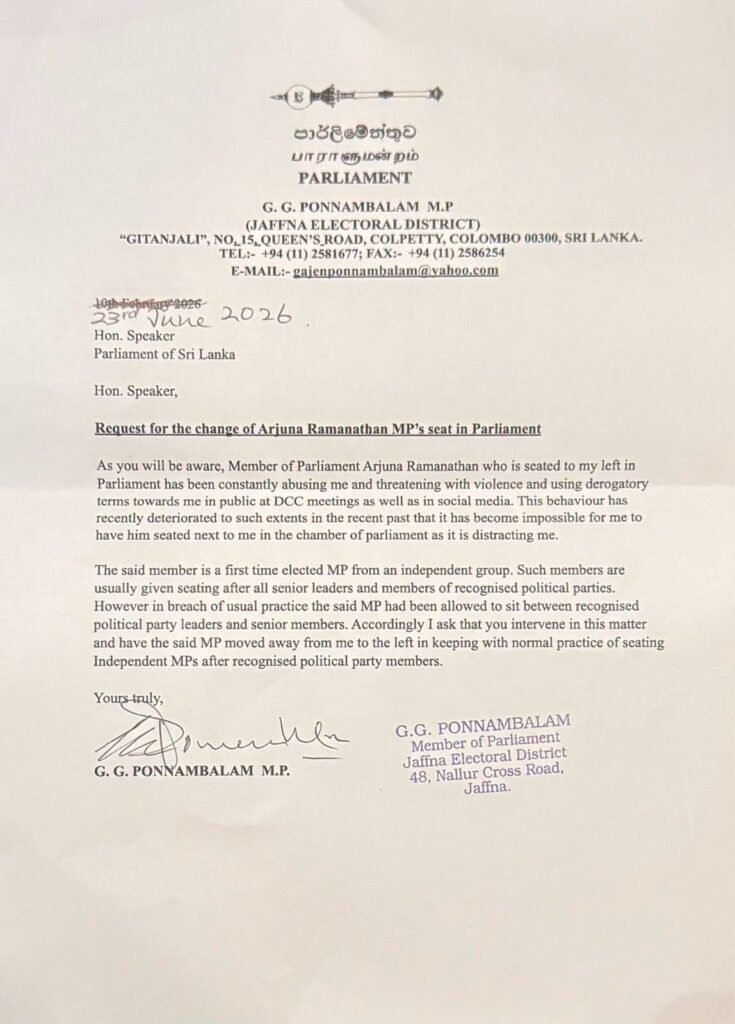
The incident destroys one of the central assumptions behind decades of separatist lobbying.
If leaders who claim to represent the same people cannot even sit side by side inside one Parliament, how exactly do they propose to govern an independent Tamil state?
Parliament is the simplest test of political coexistence. Every Member is expected to work alongside colleagues with whom they may profoundly disagree. If that basic democratic obligation cannot be discharged within one parliamentary chamber, it raises legitimate questions about the ability to administer an entirely separate state built on cooperation, compromise and collective governance.
Would Tamil Eelam require:
- Separate parliamentary chambers?
- Separate seating plans?
- Separate security details?
- Separate administrations for rival Tamil factions?
- Or perhaps several Tamil Eelams instead of one?
The irony is difficult to ignore.
For decades, Sri Lanka has been accused of being incapable of accommodating diversity, coexistence and power-sharing.
Yet this incident demonstrates that the first failure of coexistence was not between Sinhalese and Tamils—but within the Tamil political leadership itself.
The inability to coexist appears to exist within the very political movement demanding separation.
The issue before the Speaker was not Sinhala versus Tamil.
The issue arose entirely within the Tamil political leadership itself.
It was Tamil versus Tamil.
The grievance presented to the Speaker was not discrimination by the State.
It was discomfort caused by another Tamil elected by the same electorate.
Not Colombo versus Jaffna.
But one Tamil MP refusing to sit beside another Tamil MP.
This is not merely parliamentary theatre.
It exposes a deeper contradiction that the international community should carefully consider.
The campaign for a separate Tamil state has long rested on the assertion that Tamils constitute a politically unified nation seeking self-government.
But recent events demonstrate what Sri Lankans have known for years—that Tamil politics is deeply fragmented, driven by competing personalities, rival factions and personal animosities and using the Tamil ethnic card for their own political gains.
If political leaders cannot cooperate inside one democratic Parliament under established parliamentary rules, what confidence should anyone have that they could administer a stable, united and democratic separate state on their own?
The question is legitimate.
For decades, sections of the international community accepted separatist claims with remarkably little scrutiny, often treating Tamil nationalist politicians as speaking with one voice on behalf of all Tamils.
International advocacy has frequently portrayed Tamil politics as representing a single national will. This episode illustrates something rather different—that Tamil political leadership, like every other political movement, is divided by rivalries, personalities and competing ambitions. That reality deserves equal attention whenever claims are made in the name of a single unified Tamil nation.
This episode should prompt an important question: if those claiming to represent a separate nation cannot even demonstrate unity within Parliament, on what basis were their far larger political claims accepted so readily?
Sharing one parliamentary seat is infinitely easier than governing a separate country.
This week, Tamil nationalist politicians demonstrated that they could not accomplish the easier task.
Before asking the international community to redraw internationally recognised borders, they should first demonstrate that they can manage something far less ambitious:
Sharing a parliamentary bench without demanding the Speaker’s intervention.
Perhaps the international community should apply the same standard of evidence to separatist political claims that it expects of every other constitutional proposal.
If the architects of Tamil Eelam cannot even sit together, why should anyone believe they can govern together?
May be UNHRC can design a conflict-resolution workshop via its NGOs!
The demand for a separate state is one of the most serious constitutional claims that can be made. It requires evidence not only of grievance but also of political capacity, institutional maturity and the ability to govern collectively. This week’s events did not strengthen that case—they undermined it.
Shenali D Waduge