DID PRAGEETH EKNALIGODA PLAN TO ASSASSINATE PRESIDENT MAHINDA RAJAPAKSA?
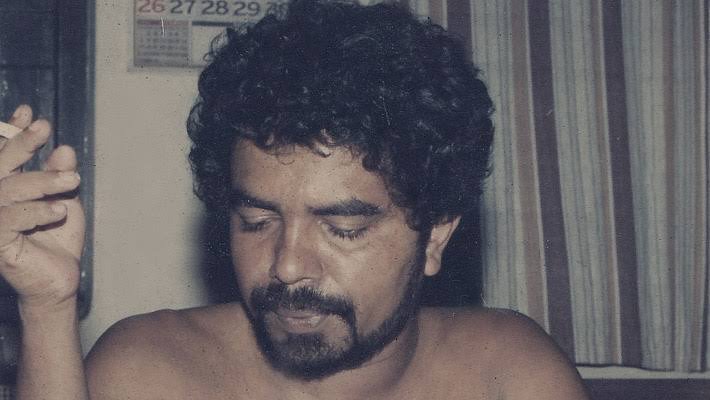 October 2026 testimony by a rehabilitated LTTE cadre raises questions about Eknaligoda’s political contacts, a meeting in Habarana, and an alleged discussion about firing a missile at an aircraft carrying President Mahinda Rajapaksa.
For more than 16 years, the disappearance of Prageeth Eknaligoda has been presented internationally through a dominant narrative: that a journalist disappeared because of investigating alleged chemical-weapons use by the Sri Lankan military, and that military intelligence personnel were responsible for his abduction.
That narrative has had serious consequences. Intelligence officers have faced arrest, detention and prosecution. Sri Lanka has faced continuing international scrutiny. The case also became the backdrop to the contempt proceedings against Ven. Galagodaaththe Gnanasara Thero, who challenged the treatment of the accused military intelligence officers in court in 2016.
in court in 2016.
The testimony of former LTTE cadre Sumathipala Suresh Kumar, alias Murali, has raised questions about Eknaligoda’s political contacts and activities.
According to The Island report of 12 October 2026, Murali testified that Eknaligoda proposed firing a missile at an aircraft carrying President Mahinda Rajapaksa and other senior figures.
According to 9 October The Morning Telegraph, Murali was cross-examined in the case concerning Eknaligoda’s January 2010 disappearance.
Asked whether he had met Eknaligoda, Murali said that he had met him once at a garden in Habarana. Asked what they discussed, the witness reportedly stated:
“Eknaligoda told me that the rulers at the time should be driven out, that they should be massacred. He also said missiles should be fired.”
The Island also reported the more specific allegation that Eknaligoda proposed firing a missile at an aircraft carrying President Mahinda Rajapaksa and other senior figures.
Sources:
- The Island — Ex-Tiger witness claims Eknaligoda proposed to fire missile at MR’s plane
- The Morning Telegraph — “Eknaligoda Said the Former Rulers Should be Massacred”
Questions that require answers include:
- When did this Habarana meeting take place?
- What was Murali’s relationship with Eknaligoda before the meeting?
- Who else was present? The Island reported that another person, identified as Nadan, was there.
- Was there a concrete plan to assassinate President Rajapakse?
Murali’s testimony also warrants closer examination of Eknaligoda’s contacts, movements and disappearance.
Jaffna Monitor reported on 5 October 2026 that Murali had testified in the separate Homagama High Court case that military intelligence officers instructed him to make telephone calls, including calls to Eknaligoda, while Murali was held at the Girithale military intelligence camp.
Whether military intelligence officers instructed Murali to telephone Eknaligoda is a separate question from whether Murali & Ekneligoda discussed an assassination attempt. The central issue here is the content of the alleged Habarana conversation. Murali affirmed that such a discussion took place.
Source: Jaffna Monitor, 5 October 2026
FAR MORE THAN A STORY ABOUT A JOURNALIST DISAPPEARING?
The international narrative has repeatedly linked Eknaligoda’s disappearance to his alleged investigation of chemical-weapons use by the Sri Lankan military.
Has international media & organizations verified the credibility of this assertion?
Uvindu Kurukulasuriya later questioned this explanation and attributed its promotion to Lanka e-News editor Sandaruwan Senadheera.
Is this claim supported by independently verifiable evidence.
Publishing an article does not prove the truth of its allegations, and being a journalist does not establish why someone disappeared. Eknaligoda’s political criticism, like that of other cartoonists, cannot by itself prove either the motive for his disappearance or the responsibility of any accused person.
What evidence did Eknaligoda personally possess regarding the alleged chemical-weapons use?
https://prageethranjan.blogspot.com/2013/04/ethnic-war-and-chemical-weapons.html
His blog was created in April 2010 – 3 months after his disappearance.
Eknaligoda’s online blog contains only two articles and 53 cartoons.
The Sinhala version was uploaded in February 2011 while the English version of the article was uploaded in April 2013.
The English post identifies the article to a lecture by Prageeth at “Auswin Labour School” on 22 December 2008. But the online publication dates do not independently establish that the lecture took place in 2008.
A January 2011 BBC Sinhala report quotes Sandya saying
“In 2008, Prageeth wrote and informed the diplomats about the Sri Lankan government’s usage of chemical weapons against the people in the north.”
Why have the diplomats who received these letters not come forward & why have none of their missions issued any statements?
If Sandya knows Prageeth wrote & informed diplomats – she must also know who the diplomats were. Why does she not appeal to them to disclose the letters or documents given by her husband, if such existed?
Her contradictory statements:
In a 2016 interview Sandya says Prageeth was
“in the process of researching and gathering information” on chemical weapons.
“And there is evidence that chemical weapons were used in Sri Lanka despite the government’s denial.”
Then she says
“With his disappearance, all this information was lost.”
https://jrmora.com/en/interview-sandya-eknaligoda/
Prageeth’s article on chemical weapons is supposed to have been written on 22 December 2008.
But there has to be evidence more than 1 article to accuse a national army of using chemical weapons.
Where is the evidence? If no one has evidence why are international entities quoting her?
There is a fundamental difference between:
“Prageeth was researching the allegation.”
and
“Prageeth produced conclusive evidence.”
Sandya Eknaligoda and those who continue to promote chemical weapons narrative as reason for his disappearance must first provide the evidence for the allegation.
She claims the source of information came from “a meeting of religious dignitaries in the north”. Who were these religious dignitaries, when & where was the meeting held.
Why does she refer “only to the North” – the army began its military-humanitarian operation in the East in July 2006.
If Prageeth and Sandya claim chemical weapons were used in the North – why was chemical weapons not used in the East.
If used in the East – why were there no religious people giving evidence to Prageeth?
However, International Committee of the Red Cross, US and Indian representatives, and foreign medical teams and even foreign journalists travelling with the armed forces never reported of victims suffering from any chemical weapon usage.
SEVENTEEN YEARS OF A NARRATIVE: WHERE IS THE EVIDENCE?
For more than 16 years, and now approaching 17, the public has repeatedly been told that Eknaligoda disappeared because he was a journalist who wrote about alleged chemical-weapons use by the Sri Lankan military.
Repetition has made this explanation convenient. It has not removed the need to prove it.
A report concerning former Daily Mirror News Editor Sandun Jayasekera raised another question. Jayasekera reportedly said that during his 30 years in journalism, he had never read an article by Eknaligoda, seen him on television or encountered him at a press conference.
His reported comments challenge the public portrayal of Eknaligoda as an established media figure. They deserve a direct answer supported by publication records, editorial evidence and testimony from those who worked with him.
On 17 September 2011, Uvindu Kurukulasuriya challenged the chemical-weapons explanation in an article published by Colombo Telegraph. He attributed the theory to Lanka e-News editor Sandaruwan Senadheera and questioned the lack of corroborating evidence.
Source: Colombo Telegraph — “Disappearance of Ekneligoda and the Chemical Weapons Saga”
WHAT WAS BEING REPORTED IN 2011? THE HUMAN-ASH ALLEGATION (BURNT FIREWOOD)
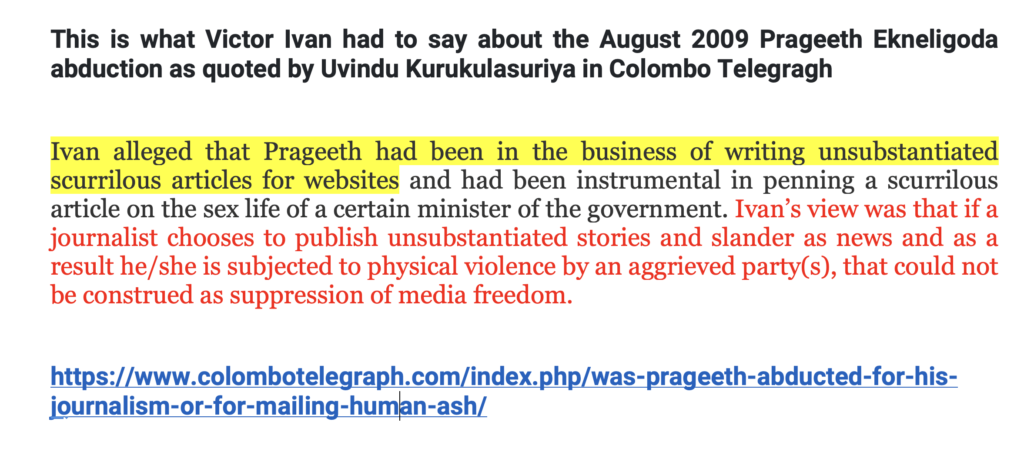
An article published by Colombo Telegraph on 14 September 2011, written by Uvindu Kurukulasuriya, raised questions about whether Prageeth Eknaligoda’s disappearance was connected to his other activities.
The article examined several competing explanations, including the alleged chemical-weapons investigation, a political document associated with the Sarath Fonseka election campaign, and an allegation that Eknaligoda had discussed sending human ash in envelopes to President Mahinda Rajapaksa.
Kurukulasuriya attributed the human-ash account to information by Ravindra Chandralal who confirmed Eknaligoda had discussed the idea. The article also reported that Chandrapala Liyanage confirmed an incident involving an envelope and said two people had been questioned.
If the first reported abduction occurred on 27 August 2009, what evidence connects it to Eknaligoda’s journalism? What evidence, if any, connects it to the alleged envelopes or handwriting? What did investigators establish about these competing explanations?
AUGUST 2009: “YOU ARE OF NO USE TO US” — WHAT CHANGED BY JANUARY 2010?
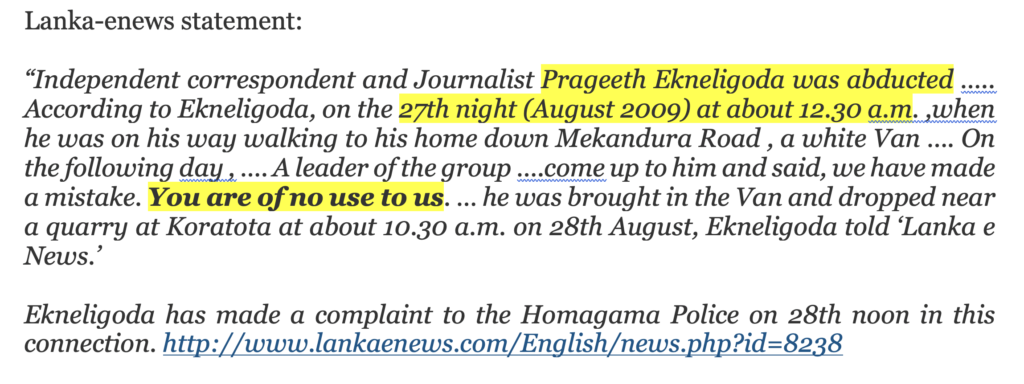
According to a Lanka e News report, Prageeth Eknaligoda was abducted on 27 August 2009, held overnight, and released the following morning after the group’s leader examined his identity card and told him: “We have made a mistake. You are of no use to us.”
Eknaligoda had written the article on chemical weapons in December 2008 – why would it take 8 months to be kidnapped for that & then to be told by the abductors he was of no use to them and yet be kidnapped again in January 2010 for the same reason?
If he was of no use in August 2009, what changed by January 2010?
WHY AUGUST 2009? WHY JANUARY 2010?
The chronology of Eknaligoda’s disappearance raises another set of questions.
Eknaligoda was reportedly abducted on 27 August 2009 and released the following morning. Court-petition records state that he complained to Homagama Police on 28 August 2009, although Sandya Eknaligoda later stated that police denied receiving the complaint.
He was reported missing again in January 2010 and has not been seen since.
What happened to the police complaint reportedly made in August 2009?
What did investigators establish about his movements between August 2009 and January 2010? What evidence connects the two incidents, and what evidence distinguishes them?
Why did the January 2010 disappearance produce a different public response from the August 2009 incident?
What explains the timing and content of the media alerts circulated after his final reported disappearance – he could have returned again in January 2010 as he did in August 2009?
THE MATALE MISTRESS, SANDYA AND THE JVP CONNECTION
A Colombo Telegraph report published on 27 August 2015 raises questions about Eknaligoda’s living arrangements and personal contacts.
“Prageeth’s Matale Mistress and Douglas Devananda’s Secretary to be Questioned; First Abduction Was Exactly Six Years Ago Today”, reported that the CID had found evidence that Eknaligoda lived with a woman in Matale rather than with Sandya. It also reported that, when in Colombo, he stayed at the residence of Nelson Edirisinghe, who was identified as Douglas Devananda’s media secretary.
Was Eknaligoda living with Sandya, with the woman in Matale, or between different residences in August 2009-January 2010?
How frequently did he stay in Matale? When was he last independently seen there? Who can confirm his stays at Nelson Edirisinghe’s residence?
The same Colombo Telegraph report stated that a couple of days after Eknaligoda’s January 2010 disappearance, Sandya and JVP activist Kelly Senanayake visited the Matale residence, reportedly suspecting that Eknaligoda might be hiding there. According to the report, the woman confirmed the visit.
This raises an obvious question: what information led Sandya and Kelly to that particular residence so soon after the disappearance?
Did Sandya already know about the woman and Eknaligoda’s reported stays in Matale? Had someone informed her that he might be there? What exactly did Sandya and Kelly ask the woman? What did the woman tell them?
Were formal statements obtained from Sandya, Kelly and the woman?
The 2015 report stated that the woman and Edirisinghe had previously been questioned informally and were expected to be questioned formally. What ultimately happened, and what did their evidence establish?
The public should not have to guess. These are matters that can be answered through investigative records, witness statements and court evidence.
WHAT WAS KELLY SENANAYAKE’S ROLE?
Kelly Senanayake is identified in the reporting as a JVP activist and the owner of Navamaga Printers. He was also described as a close associate of Lionel Bopage. The Colombo Telegraph featured a photo given by Lionel Bopage.
The Colombo Telegraph article raises two separate matters involving Kelly: his visit with Sandya to the Matale residence and a document allegedly prepared in connection with General Sarath Fonseka’s 2010 presidential election campaign.
The fact that someone had political contacts, worked on an election document or had a personal relationship does not prove criminal conduct. But these activities may be relevant to reconstructing a person’s movements, associations and activities before a disappearance.
The same applies to the reported relationship between Eknaligoda and the woman in Matale.
The issue is not to condemn Sandya, Kelly, the woman, Edirisinghe or Devananda based on a newspaper report. It is to ask why these reported details have not been fully explained in the public account of Eknaligoda’s life and disappearance and why the public are fed a narrative that is not factual.
WAS HE SIMPLY A MAN WHO FAILED TO RETURN HOME?
International reporting has often presented Eknaligoda’s disappearance as though his failure to return home was sufficient to establish what happened to him.
But if the 2015 report accurately reflected his living arrangements, Eknaligoda did not necessarily stay at the marital home.
That makes the chronology important.
Where was he living in the months before January 2010? When did Sandya last see him? What information did she have about his whereabouts? What evidence established that his failure to return on the particular evening meant that he had been abducted? When he was not living with her, why did she go to police the next day to claim he was missing? Did she inform the police to check Matale?
The visit to the Matale residence raises further questions about what Sandya knew and what she suspected immediately after he disappeared.
TWO SEPARATE CASES, TWO SETS OF QUESTIONS
1. The alleged August 2009 abduction
Seven Army intelligence officers are on trial in the Homagama High Court over the 27 August 2009 kidnapping incident though he returned the following day.
Murali is testifying in the 2009 & 2010 cases.
In August 2026, when Murali attempted to give evidence about conversations with Eknaligoda in January 2010, defence counsel objected on the ground that these matters belonged to the separate Colombo trial.
This raises questions about the scope of the evidence permitted in each prosecution, the distinction between the two incidents, and the specific evidence against each accused.
2. The January 2010 disappearance
The Morning Telegraph report of 9 October 2026 concerns Murali’s testimony in the separate Permanent High Court Trial-at-Bar case involving nine Army intelligence personnel accused in connection with Eknaligoda’s disappearance in January 2010.
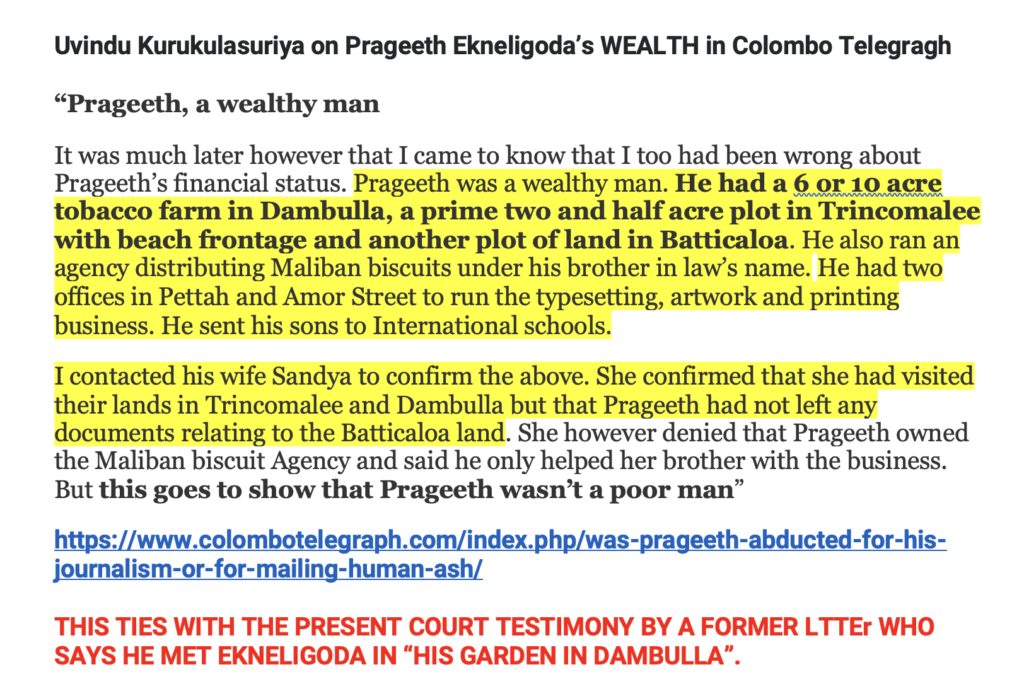
During cross-examination, Murali testified that he had met Eknaligoda at a garden in Habarana and attributed statements about overthrowing the rulers, massacring them and firing missiles to that conversation.
The fact that the two prosecutions are separate makes it essential to distinguish the evidence relevant to each incident.
THE EMPLOYER, THE MEDIA ALERTS AND THE INTERNATIONAL NARRATIVE
Eknaligoda worked for Lanka e-News, whose editor, Sandaruwan Senadheera, subsequently left Sri Lanka and continued operating the website from abroad.
What did Senadheera know about Eknaligoda’s activities, movements and contacts? What records did the employer maintain? What did he tell investigators about Eknaligoda’s final working day and his whereabouts?
He left his office in the evening – Sandya says he did not come home – but the next day even international media presume him “missing”. This chronology of incidents against the Colombo Telegraph reports clash.
BEFORE EVERY GENEVA SESSION: A PATTERN THAT DESERVES SCRUTINY
There is a pattern that deserves examination: before UN Human Rights Council sessions in Geneva, Sri Lankan intelligence personnel have been arrested or detained, followed by media coverage highlighting their alleged involvement in abductions or disappearances.
The question is whether the timing, evidentiary basis and public presentation of these cases warrant systematic scrutiny.
Are arrests based on independently verified evidence? Are allegations reported as allegations, or presented as established guilt? Are international narratives checked against the actual court record? Who is accountable when unverified claims damage the lives of personnel who have not been convicted?
International scrutiny cannot substitute for investigation. Nor should the repetition of an allegation by media outlets and international organisations be mistaken for independent corroboration.
If the evidence establishes wrongdoing, the law must take its course. If the evidence does not establish the allegations, the accused must not be condemned by a narrative that has outrun the facts.
The same standard must apply to every witness, every accused person and every public claim.
GNANASARA THERO: THE CONTEMPT CASE IS NOT THE DISAPPEARANCE CASE
The Eknaligoda case also became the setting for the contempt proceedings against Ven. Galagodaaththe Gnanasara Thero.
In January 2016, the Thero intervened at the Homagama Magistrate’s Court after proceedings relating to Eknaligoda’s disappearance. He challenged the treatment of the accused military intelligence personnel and the conduct of the proceedings. His conduct resulted in contempt proceedings and convictions.
In August 2018, the Court of Appeal imposed a sentence of 19 years’ rigorous imprisonment, to be served concurrently over six years. Former President Maithripala Sirisena subsequently pardoned him. In September 2026, the Supreme Court invalidated that pardon, and in October the Court of Appeal ordered that the remaining sentence be enforced.
The legal distinction is essential.
Gnanasara Thero’s conviction concerned contempt of court and his conduct during the proceedings. It was not a judicial determination that the intelligence officers were guilty of Eknaligoda’s disappearance.
The Thero’s challenge to the treatment of the accused officers must therefore be distinguished from the question of whether his own conduct in court amounted to contempt.
The wider issue remains: when military intelligence personnel are accused in a case with major national and international consequences, how can the public scrutinise the evidence and question the prosecution without those questions automatically being treated as proof of guilt or dismissed as illegitimate?
The law must protect the administration of justice. It must also ensure that allegations against intelligence personnel are tested fairly and that the public distinguishes a contempt conviction from a finding on the underlying disappearance.
WHAT MUST NOW BE ESTABLISHED?
After more than 16 years, the public deserves clear answers.
About Murali’s testimony
- When did the Habarana meeting take place?
- Does the conversation of assassinating President Rajapakse reveal a link between LTTE & Ekneligoda?
- Did the witness describe a concrete operational plan?
About Sandya, Matale and the JVP connection
- If Ekneligoda was not staying with Sandya (as per the CT article) why did she file complaint that he did not come home?
- What information led Sandya and Kelly Senanayake to visit the Matale residence days after the January 2010 disappearance?
- What did the woman tell them, and what did investigators establish from her evidence?
- What were Eknaligoda’s actual living arrangements and movements before both incidents?
- What did investigators establish about Kelly Senanayake’s contacts with Eknaligoda and the alleged election document?
- What did Nelson Edirisinghe and Douglas Devananda tell investigators about their contacts with Eknaligoda?
About the two incidents and the chemical-weapons narrative
- What do the original records establish about the alleged August 2009 abduction and release?
- What evidence connects that incident to the January 2010 disappearance?
- What evidence establishes that Eknaligoda personally investigated chemical-weapons allegations and possessed independently verified material?
- Who first advanced the claim that his disappearance was caused by that work, and what evidence supported it?
- For Sandya to continue the chemical weapons narrative what evidence is in her possession?
These questions cannot be answered by slogans, media repetition or assumptions. They require documents, testimony, dates and evidence that can withstand scrutiny.
THE BOTTOM LINE
For more than 16 years, the disappearance of Prageeth Eknaligoda has been presented internationally through a narrative centred on his work as a journalist and the alleged responsibility of military intelligence personnel.
But the public account must be tested against the complete evidence.
The reported Matale relationship, the visit by Sandya and Kelly Senanayake, Eknaligoda’s alleged stays at different residences, his reported contacts with Nelson Edirisinghe and Douglas Devananda, the alleged election document, the August 2009 incident and the January 2010 disappearance all raise questions about his actual movements and activities.
Murali’s reported testimony adds another serious line of inquiry: what was discussed during the Habarana meeting, and was there any concrete plan involving an attack on President Mahinda Rajapaksa?
None of these questions, individually or collectively, proves that Eknaligoda staged his disappearance, that Sandya knew what happened to him, or that an assassination plan existed. But neither should they be ignored because they complicate an established public narrative.
The evidence must be examined in full. The chronology must be established. The reported contacts and living arrangements must be investigated. And allegations against military intelligence personnel must be tested fairly, not treated as established guilt through years of repetition.
The contempt case against Gnanasara Thero must remain distinct from the prosecution of the intelligence officers. A witness’s testimony must remain distinct from a judicial finding. An allegation about chemical weapons must remain distinct from independently verified evidence.
Military intelligence personnel and their families cannot be sacrificed to protect the reputation of a government, the media or international organisations that may have promoted unverified claims.
After more than 16 years, the public deserves answers—not another repetition of allegations as conclusions, and not the condemnation of accused personnel before the evidence has been properly tested.
The demand is simple: establish the facts, examine the complete record and apply the law on the evidence.
Shenali D Waduge