PRESIDENT: DO NOT BECOME A RUBBER STAMP FOR CID Before Extending the Detention Order on Maj. Gen. Suresh Sallay — 20 Questions the President Should Ask
Retired Maj. Gen. Suresh Sallay was arrested on 25 February 2026 without warrant under PTA and kept in custody using extraordinary powers vested in the President. Two detention orders have so far been signed by the President. The third is due to be signed.
The police media spokesman were unable to answer media as to why Suresh Sallay was arrested.
The CID could not answer the Magistrate when questioned as to what the charges were against Suresh Sallay.
In this backdrop & with 6 months already passed with CID having even his phone and laptop, the general public have been alert & asking questions. It is now time for the President himself to demand answers before signing a further detention.
BASIS OF THE ARREST
- On what exact facts and evidence was Maj. Gen. Suresh Sallay arrested on 25 February 2026 and identified as the third accused?
- What evidence existed in February 2026 that had not emerged during the previous seven years of investigations into the Easter Sunday attacks?
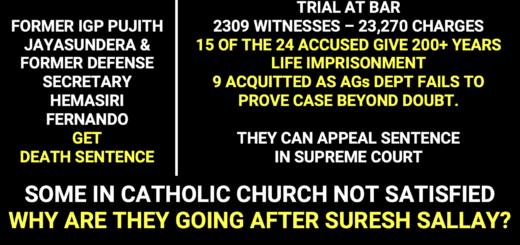
- Was this evidence available when the Attorney General’s Department proceeded against approximately 25 accused on more than 23,000 charges?
If not, when exactly did it emerge?
- Who produced it, when was it obtained, and how was it independently verified?
THE SOURCE OF THE PRESENT CASE
- Is the present investigation based wholly or partly on the allegations of Azad Maulana/Channel 4 in 2023, the allegations publicly made by Fr. Cyril Gamini in 2021, or both?
- If so, what independent investigation did the CID conduct to establish the reliability of those allegations before using them against Sallay?
- Did the CID examine the findings of the Justice S.I. Imam-led Committee before arresting Sallay?
- What evidence does CID now possess that was not available to the Imam Committee and which justifies reaching a different conclusion?
THE DMI CLAIM — THE CRITICAL CONTRADICTION
- Is CID relying on the proposition that Sallay was Director of Military Intelligence during the Easter Sunday attacks, as publicly claimed by Fr. Cyril Gamini in 2021 and subsequently stated in Cardinal Malcolm Ranjith’s 2026 intervening petition?
- If so, what evidence supports that assertion when Sallay’s documented service history places him overseas during the relevant period?
- If CID is not relying on the DMI allegation, what independent evidence actually establishes Sallay’s alleged involvement and made him the third accused?
SIX MONTHS OF CID INVESTIGATION
- What has CID actually discovered during the six months Sallay has already been detained with laptop & phone already in CID possession?
- What new evidence, if any, has been obtained during those six months?
- What specific investigation remains incomplete?
- Why could that investigation not be completed without keeping Sallay in detention?
WHY ANOTHER DETENTION ORDER?
- If CID now has sufficient evidence against Sallay, why has he not been charged and brought before a court through the ordinary criminal process?
- If CID does not yet have sufficient evidence to charge him, why should another three months of extraordinary detention be authorised?
- Did CID obtain advice from the Attorney General’s Department before the arrest? If so, what was the legal basis relied upon for the arrest and continued detention?
- When did the CID first place the evidence or allegations against Maj. Gen. Suresh Sallay before the Attorney General’s Department, and was this before or after his arrest?
- What precisely is CID asking the President to certify, accept or take responsibility for by signing a further Detention Order?
The President should not be asked to act as a rubber stamp for an investigation that has still not publicly identified the evidence justifying the continued deprivation of liberty of a decorated retired military/intel officer.
Before signing another Detention Order, the President should require the CID to answer these 20 questions and place the relevant evidentiary and legal basis before him.
If there is new evidence, let it be identified and tested through the law.
If there is sufficient evidence to prosecute, prosecute.
If there is neither new evidence nor sufficient evidence to charge, why should extraordinary detention continue?
The President should also consider that decisions taken in office do not necessarily end with the office-holder’s term.
The legal and constitutional basis for the exercise of executive power may subsequently be subjected to scrutiny once he is out of power.
He should therefore ensure that the record placed before him is complete, accurate and capable of independently supporting the decision he is being asked to make.
He should not sign simply because the CID recommends an extension.
He should sign only after he is satisfied that the evidence, the law and the necessity for continued detention have been properly established.
The President’s signature should follow answers — not replace them.
And the question he should ask before signing is simple:
“What exactly am I being asked to authorise — and what evidence allows me to justify that decision?”
Shenali D Waduge