RETURNING TO EASTER SUNDAY: WHAT THE PSC REPORT FATALLY FAILS TO ADDRESS – AND WHY THIS ENDANGERS SRI LANKA
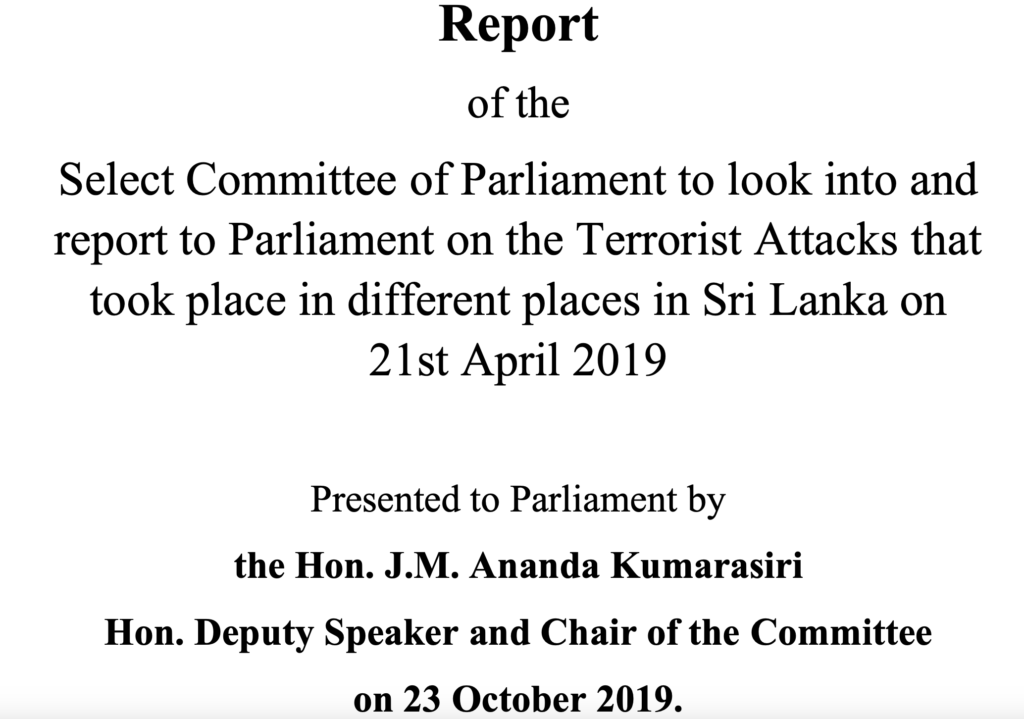
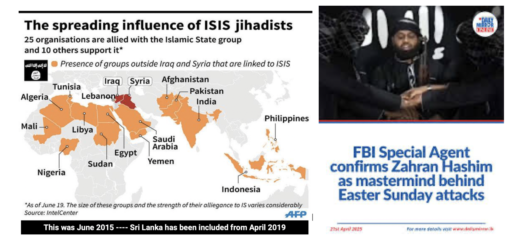
On 21 April 2019, exactly ten years after the defeat of the LTTE, eight Islamic extremists carried out a coordinated mass-casualty suicide operation across Sri Lanka. The Parliamentary Select Committee (PSC) report deliberately avoids confronting the deeper systemic and ideological dimensions of the Easter Sunday terror attacks. These omissions cannot be accidental. They ensure that the root ecosystem of extremism remains untouched, leaving Sri Lanka structurally vulnerable to repeat mass-casualty attacks.
https://www.parliament.lk/uploads/comreports/sc-april-attacks-report-en.pdf
1) FAILURE TO INVESTIGATE FOREIGN IDEOLOGICAL INFILTRATION NETWORKS
While the PSC acknowledges radicalization, extremist ideology, and the background of the NTJ network, it avoids serious forensic investigation into the transnational ideological machinery that produced these attackers.
No meaningful inquiry was conducted into:
- Foreign ideological financing
- Gulf-linked religious funding networks
- International extremist preacher circuits
- Overseas indoctrination pipelines
- Transnational clerical training pathways
- Madrassas and their influence
- Cyber-based ideological grooming of youth
This is a critical failure because the Easter attacks were not the product of isolated domestic radicalization, but the endpoint of long-term transnational ideological grooming, financing, and doctrinal engineering.
Without dismantling:
- Funding pipelines
- Clerical influence chains
- Overseas ideological training routes
Sri Lanka can never dismantle the extremist production system — only its temporary manifestations.
2) FAILURE TO FORENSICALLY EXAMINE MOSQUE & MADRASA RADICALIZATION SYSTEMS
The PSC confirms that:
- Zahran preached extremist ideology openly
- Radical sermons existed
- Radicalization occurred locally
Yet the report avoids naming:
- Which mosques
- Which madrassas
- Which clerics
- Which sponsors
- Which funding channels
This creates a dangerous protection shield around institutional radicalization hubs.
Terrorist ideology does not emerge spontaneously.
It grows inside organized religious ecosystems, sustained by:
- Clerical authority
- Institutional legitimacy
- Foreign financing
- Doctrinal indoctrination
By not investigating these institutional networks, the PSC ensures extremist regeneration remains structurally possible.
This omission is not merely investigative negligence — it is a national security blind spot.
3) FAILURE TO EXAMINE WHY GRASSROOTS WARNING SIGNALS WERE IGNORED
The PSC acknowledges:
- Prior violent clashes
- Prior extremist behavior
- Prior intelligence fragments
- Prior community-level alerts
But avoids investigating:
- Why local intelligence never triggered operational escalation
- Why repeated red flags were downgraded
- Why Zahran remained operational despite public extremism
This indicates systematic institutional reluctance to confront Islamist extremism post-2015, likely driven by:
- Political sensitivities
- International pressure
- Ideological appeasement
This paralysis directly enabled:
- Continued radical preaching
- Open recruitment
- Undisturbed operational preparation
4) FAILURE TO FORENSICALLY EXAMINE NATIONAL SECURITY COUNCIL PARALYSIS
While the PSC documents dysfunction inside the National Security Council, it deliberately avoids identifying who engineered the paralysis.
It does not examine:
- Who blocked intelligence coordination
- Who dismantled command integration
- Who neutralized operational authority
- Who engineered institutional disunity
By treating national security paralysis as mere political disagreement, the PSC avoids confronting what amounts to deliberate national security sabotage.
5) FAILURE TO ANALYZE FOREIGN POLICY REALIGNMENT & SECURITY CONSEQUENCES POST-2015
The PSC avoids examining how Sri Lanka’s post-2015 foreign policy realignment reshaped domestic security doctrine.
After 2015, national security architecture shifted from:
Counter-terror operational dominance → International compliance prioritization
This produced:
- Reduced surveillance authority
- Weakened military intelligence operational reach
- Increased political sensitivity toward Islamist extremism
- Strategic hesitation in intelligence enforcement
This foreign-influenced recalibration directly degraded Sri Lanka’s counter-terror preparedness, leaving the nation structurally exposed.
6) FAILURE TO EXAMINE WHY CHURCH SECURITY WAS NEVER ACTIVATED
Despite:
- Precise religious targeting warnings
- Detailed church location intelligence
- Repeated alerts
There was:
- No emergency church security deployment
- No national religious security alert
- No police–military coordination activation
This represents gross operational negligence by those holding direct command authority, yet the PSC avoids mapping:
- Individual command responsibility
- Decision-chain failures
- Operational command accountability
7) FAILURE TO BUILD A PERMANENT NATIONAL COUNTER-EXTREMISM DOCTRINE
The PSC concludes with administrative recommendations but fails to establish a permanent national counter-extremism doctrine, including:
- Ideological counter-radicalization frameworks
- Mosque monitoring structures
- Clerical vetting systems
- Foreign religious funding regulation
- Community intelligence integration
Without this doctrine, Sri Lanka remains structurally incapable of preventing ideological terror regeneration.
When examined collectively, a clear pattern emerges:
The PSC has only documented surface-level failures but has avoided investigating & identifying
- Ideological ecosystems
- Institutional dismantling
- SIS command accountability as well as other intel units
- Mosque madrasa network
- Foreign ideological pipelines
As a result – no permanent solution to nip the Islamic extremism was sought.
THE PRESENT DANGER
Instead of holding accountable those who:
- Received multiple foreign intelligence warnings
- Held command authority
- Possessed legal power to act
- Failed to deploy preventive security
the state is now arresting retired intelligence officers who:
- Held no operational command
- Held no military authority
- Were not in service
- Were not even in the country when the attacks occurred
This is not justice.
This is institutional scapegoating.
By criminalising professional intelligence service while shielding those who exercised operational authority, Sri Lanka is:
- Destroying morale within intelligence services
- Paralyzing proactive counter-terror operations
- Driving experienced officers into silence
- Weakening early-warning intelligence culture
Most dangerously, this diverts national focus away from dismantling Islamic extremism itself.
- Extremist networks remain active.
- Radical ideology continues to spread.
- Foreign ideological financing persists.
- Online recruitment accelerates.
- Even the region is made vulnerable as extremists can easily use Sri Lanka as a soft-base for terror launches to neighboring nations or target sensitive architecture/investments.
Yet enforcement energy is being redirected away from terror prevention and toward political scapegoating.
This is how the next Easter Sunday becomes inevitable.
A nation that survived thirty years of terrorism cannot afford to:
- Criminalize intelligence officers by framing them.
- Protect political failure
- Ignore ideological extremism
- Blind itself to structural vulnerability
Sri Lanka does not need scapegoats.
Sri Lanka needs security accountability.
Sri Lanka needs institutional courage.
If intelligence professionals are hunted while extremists remain untouched, every Sri Lankan life is placed in renewed and permanent danger.
Shenali D Waduge