Sri Lanka Black July 1983: Questions the Numbers, History and Logic cannot ignore 43 years later
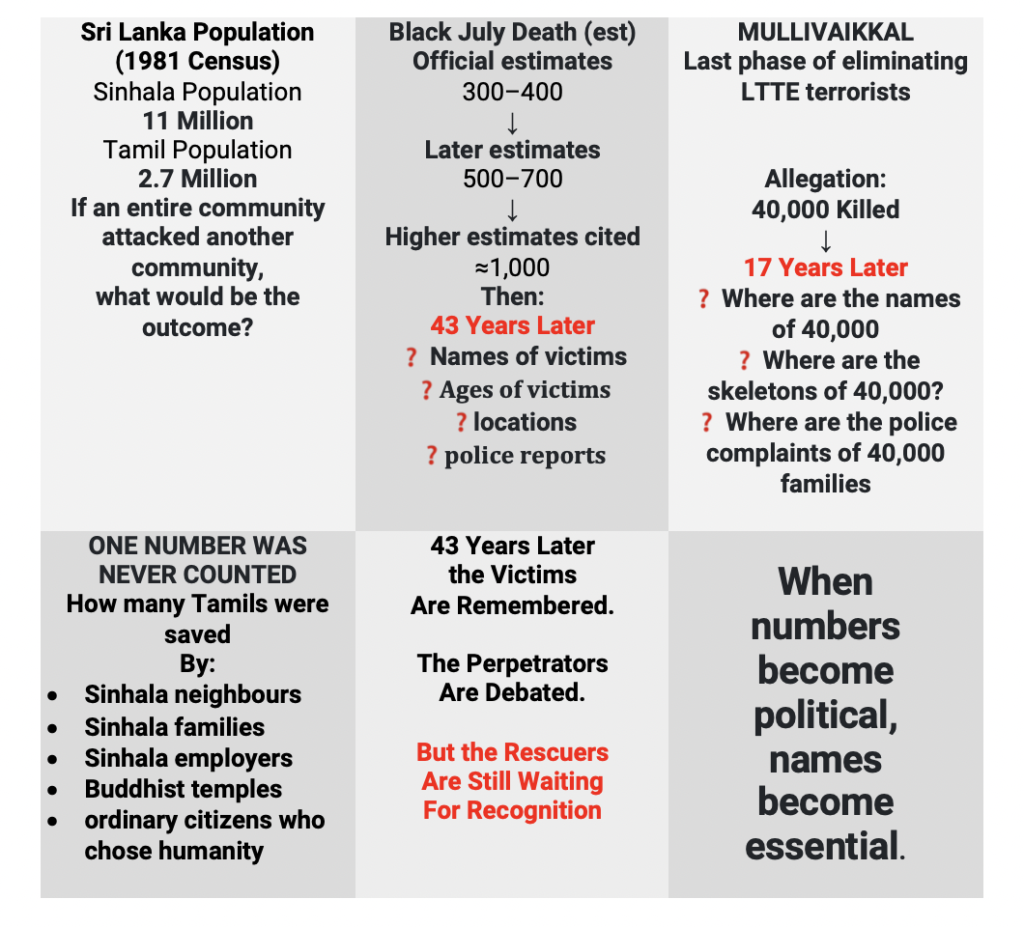
Black July is just one of many painful chapters in Sri Lanka’s modern history. The suffering, the destruction of homes and businesses, and the failure of the State to protect citizens are historical realities that must never be denied. But history demands more than remembering only one part of an event. History requires questions. History requires evidence. History requires logic.Does the commonly repeated narrative explain and answer all the facts?
The Numbers: How Many Died During Black July?
The official figures and estimates vary:
| Source / Estimate | Reported Death Toll |
| Official Government estimates at the time | Approximately 300–400 deaths |
| Some later estimates | Approximately 500–700 deaths |
| Higher estimates cited by some organisations | Around 1,000 deaths |
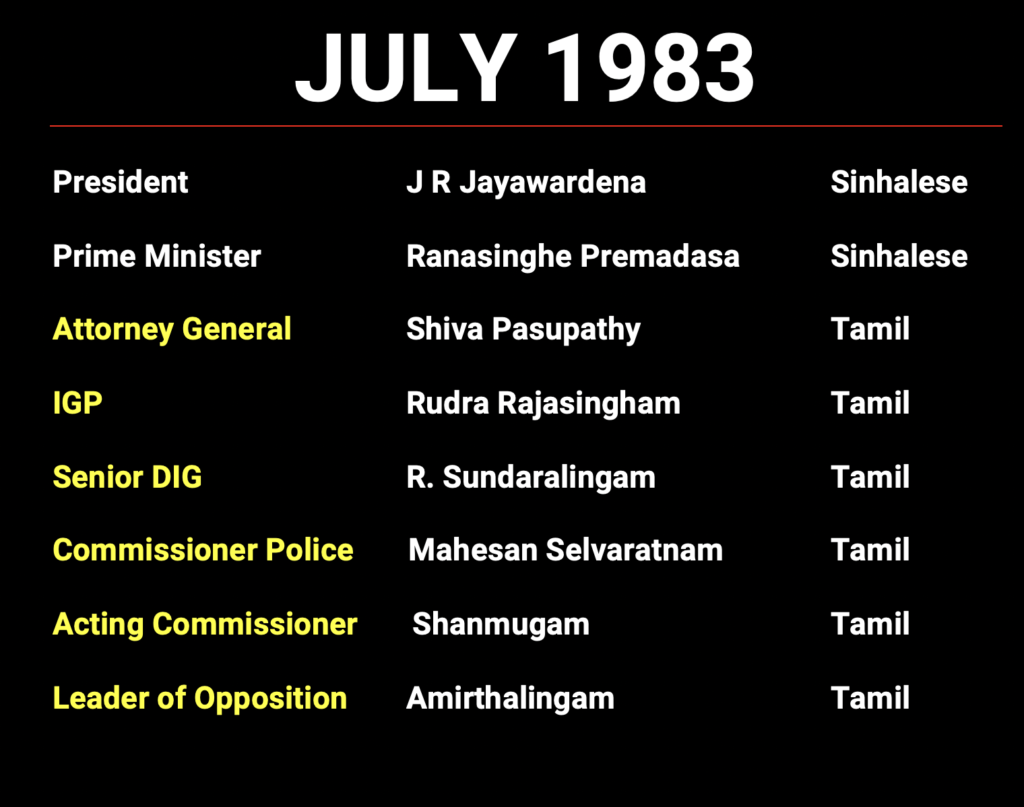
Before examining responsibility, consequences and competing narratives, history must first establish the human cost.
The variation itself raises an important historical question:
Why has there never been a universally accepted, independently verified final list of victims with names?
A complete historical record must identify:
- Tamil civilians killed;
- Sinhalese civilians killed;
- others killed during the violence;
- locations of deaths;
- circumstances of each death;
- injuries suffered;
- families displaced;
- homes, businesses and livelihoods destroyed;
- perpetrators responsible.
Numbers are not merely statistics.
Behind every number was a human being with a family, a history and a story.
Regardless of the final verified figure, every life lost represents a human tragedy.
However, recognising the suffering of one community must never require ignoring the suffering of another.
History must count every victim before it assigns collective blame.
Numbers must have Names: The Demand for Evidence
When a death toll becomes central to shaping national and international narratives, a basic question must be asked:
Who are the people behind the numbers being quoted?
If the figure is:
- 300,
- 500,
- 700,
- or 1,000,
where is the complete list of names?
Where are:
- the names?
- ages?
- places of death?
- circumstances?
- police records?
- death certificates?
- family testimonies?
A victim is not a statistic.
A victim is a person.
Sri Lanka’s history has witnessed many instances where casualty figures have become connected to political narratives and geopolitical agendas.
Therefore, every figure —must face the same standard:
Evidence.
Can every claimed number be independently verified?
History cannot operate on repetition alone.
History requires:
- names;
- records;
- evidence;
Without verification, numbers risk becoming symbols used for political purposes rather than accurate records of human loss.
A Complete Historical Record requires more than Counting Deaths
When casualty figures are presented, society has the right to ask:
Who are the victims? Where are the names? Where are the records?
Demanding evidence is not disrespecting victims.
It is respecting them.
The dead deserve to be remembered accurately, not reduced to political numbers.
This principle must apply to every tragedy in Sri Lanka’s history, regardless of community.
The Missing Statistics
History has recorded:
- deaths;
- displacement;
- destruction of property.
But history has rarely attempted to calculate:
- how many people participated in violence;
- how many people refused to participate;
- how many Sinhalese protected Tamil neighbours;
- how many Tamil lives were saved by ordinary citizens.
Numbers also Require Perpetrators
If casualty numbers are used to define an entire community, then another question must also be asked:
Who were the perpetrators?
Where are:
- their names?
- their identities?
- their affiliations?
- their convictions?
- their sentences?
A truthful historical record requires both:
- Victim identification.
- And perpetrator identification.
A society cannot achieve justice by remembering victims while leaving perpetrators anonymous and transferring their actions onto millions of innocent people from one ethnic community.
A complete historical record requires all these numbers.
Because history must record not only destruction.
It must also record humanity.
A complete historical record requires all these numbers.
Question 1: If this was an attack by the Sinhala People, how many Sinhalese actually participated?
The 1981 Census recorded approximately 11 million Sinhalese in Sri Lanka.
The Tamil population was approximately 2.7 million.
The violence was carried out by mobs.
But who comprised these mobs?
A mob is not an ethnicity.
A mob is not a nation.
A mob consists of individuals who make individual choices.
Therefore, a fundamental historical question remains:
Who were the individuals who participated in the violence?
Were they:
- politically organised groups?
- criminal elements?
- ordinary citizens?
- individuals from different communities?
Without identifying perpetrators, how can responsibility be transferred to an entire ethnic population?
Another question remains:
- How many people actually participated in the violence?
- Hundreds?
- Thousands?
- Tens of thousands?
- No official study has established this.
Yet over time, the actions of unidentified mobs have often been transferred to an entire ethnic community.
Is that historically accurate and fair?
Are Individual Crimes the Same as Collective Guilt?
A country must distinguish between:
- perpetrators who committed crimes;
- authorities who failed in their duty;
- ordinary citizens who had no involvement.
- The failure of a government to protect citizens is a matter of accountability.
- The crimes committed by mobs are matters of individual criminal responsibility.
- But neither can justify assigning guilt to an entire ethnic community.
- Millions of citizens cannot inherit the crimes of individuals they did not know, support or participate with.
- Justice identifies perpetrators.
- Justice does not punish communities.
Question 2: If an entire Community intended to attack another Community, why was there only upper limit of 1000 deaths out of 2.7million Tamils?
Logic requires us to examine the scale and pattern of events.
If 11 million Sinhalese had collectively decided to attack 2.7 million Tamils:
- Would the violence have resulted in only several hundred to around 1,000 reported deaths?
- Would violence have remained limited to certain areas rather than occurring uniformly across the country?
- Would thousands of Tamil families have survived?
- Would Sinhala neighbours have protected Tamil families?
- Would Tamil-owned homes, businesses and property have remained untouched in many locations?
The evidence reveals a far more complex reality.
There were perpetrators.
There were victims.
But there were also rescuers.
The question rarely asked is:
How many Tamil lives were saved by ordinary people who rejected violence?
How many Tamils were protected by:
- Sinhala neighbours?
- Sinhala friends?
- Sinhala employers?
- Buddhist temples?
- religious institutions?
- others who chose humanity over hatred?
The existence of perpetrators is a historical fact.
The question is whether the actions of those perpetrators can legitimately be transferred to an entire ethnic population of millions who did not participate.
Question 3: Why has Sri Lanka never Counted the Protectors?
Every conflict records those who died.
Every tragedy records destruction.
But where is the national record of:
- families who opened their homes?
- people who hid Tamil neighbours?
- people who protected Tamil possessions, including gold and jewellery?
- people who risked their own safety?
Why is this part of history missing?
Why don’t those who accuse Sinhalese count the Sinhalese who saved Tamils.
Question 4: My Family Story?
During Black July, my own family sheltered neighbouring Tamil families.
My grandfather safeguarded their jewellery and valuables.
Every item was carefully marked and preserved.
My grandmother suffered a heart attack due to the trauma she witnessed to Tamil neighbors to whose homes my mother had gone to spend school holidays in Jaffna.
When those families emerged from refugee camps, everything was returned to them.
Decades later, those same families continued to remember that act of humanity and that friendship remains ever strong.
They remained connected with my grandparents, my parents and myself. That chain continues whatever fake narratives prevail.
They remain precious friends to this day.
This was not an isolated act.
The unanswered question is:
How many similar stories remain undocumented, unheard and ignored?
Question 5: Was Black July entirely Spontaneous?
This is a question that deserves serious examination.
A spontaneous riot and an organised operation are not the same.
- How were Tamil homes identified?
- Why were electoral lists reportedly used?
- Who had access to those lists?
- How were groups transported?
- How did violence occur simultaneously in different locations?
The existence of organisation does not automatically answer who organised it.
But the question itself cannot be ignored.
The Aftermath: Why Consequences Matter
History does not only examine who acted.
It also examines what changed afterwards.
An event can have consequences that benefit certain actors regardless of whether those consequences were intended or unintended.
Therefore, the next question is not an accusation.
It is an examination of outcomes.
Question 6: Who Benefited from the Aftermath of Black July?
What changed after July 1983?
- Tamil militancy expanded.
- Tamil militant organisations gained increased visibility.
- Recruitment increased.
- The international Tamil diaspora expanded significantly through migration and asylum movements.
- International attention intensified.
- India became more directly involved in Sri Lanka’s ethnic conflict after its earlier involvement with Tamil militant groups.
The Economic Consequences
Black July did not only affect communities emotionally.
It transformed Sri Lanka economically.
- Businesses were destroyed.
- Investment confidence declined.
- Migration increased.
A country that had been seen as a stable democracy became associated internationally with ethnic conflict.
The question history must examine is:
- Who gained from Sri Lanka’s instability?
- Who lost economically, politically and internationally?
The question is who gained strategic advantage from the consequences that followed. This often answers how the sudden outcome resulted.
Question 7: What happened to Sri Lanka’s Image?
Before July 1983:
Sri Lanka was viewed internationally as a functioning democracy.
After July 1983:
The country became increasingly defined internationally through the lens of ethnic conflict.
Who benefited from that change?
Who suffered because of it?
Question 8: Who has been left out of the Historical Record?
Black July is usually discussed through one dimension.
But violence affected more than one group.
Sinhalese civilians were also killed.
Sinhalese property was also damaged.
Families from all communities suffered loss.
Acknowledging Sinhala victims does not reduce Tamil suffering.
Remembering Tamil victims does not require forgetting Sinhala victims.
A mature historical record has enough space to recognise every innocent life lost.
The historical record must also include:
- those who refused violence;
- those who protected others;
- those who chose humanity.
The Difference between Perpetrators and A People
Justice requires identifying perpetrators.
It does not require assigning guilt to millions who did not commit crimes.
The actions of violent mobs must be investigated, punished and remembered.
But the actions of those mobs cannot automatically become the identity of an entire ethnic community.
A country cannot heal by replacing individual accountability with collective blame.
The Final Question
After forty-three years, should history continue to label an entire community based on the actions of unidentified mobs?
Or should history also tell the story of those who protected lives?
Black July was a tragedy.
The victims deserve remembrance.
The perpetrators deserve accountability.
But a truthful history must contain:
- all victims;
- all perpetrators;
- all actors;
- all acts of courage and gratitude to the saviors.
The Missing Recognition
For 43 years, Sri Lanka is remembering the violence.
But has Sri Lanka remembered the humanity?
Where is the national recognition for:
- the Sinhala families who sheltered Tamil families?
- the citizens who protected neighbours?
- the people who returned valuables?
- the people who risked their own lives?
A nation cannot heal by remembering only hatred.
It must also remember courage.
History is not complete when only one side of humanity is counted.
Shenali D Waduge