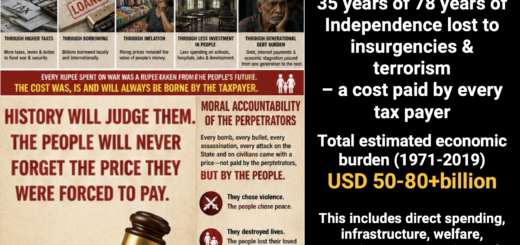
LTTE Diaspora honour Prabhakaran today — But they abandoned him in Death – not even claiming his dead body or performing funeral rites.
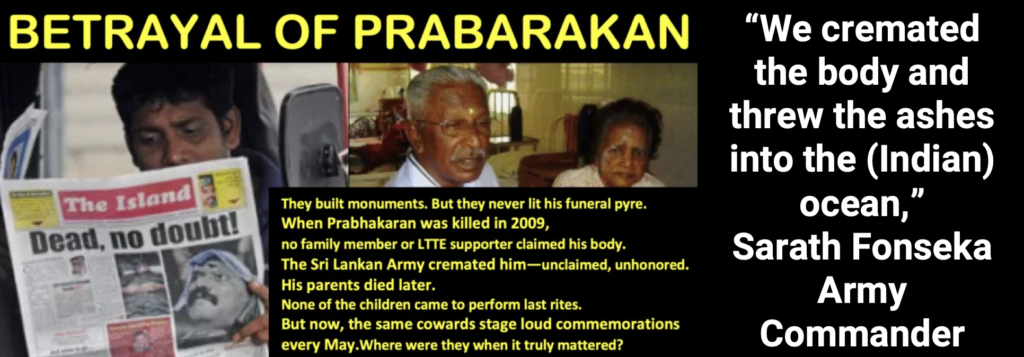
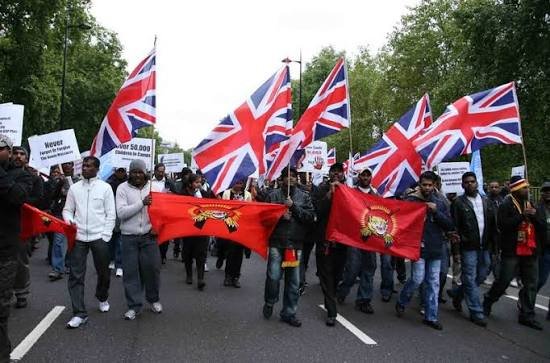
Today, sections of the LTTE diaspora are proudly honouring Velupillai Prabhakaran., the leader of an internationally proscribed terrorist organization – the LTTE. They display his photographs, commemorate his birth anniversary, hold martyr’s day commemorations, raise LTTE symbols/Eelam flag, and claim to preserve his legacy. Annually, a segment of them are thriving selling LTTE mementos to their own. But one question remains unanswered. A question must therefore be asked by the very Tamil community whose emotions are being mobilized: Who benefits from keeping Prabhakaran’s image alive year after year? Is this only about remembrance, or has a defeated armed movement been transformed into a political and commercial identity from which some individuals and organisations continue to gain influence, funding and relevance?
When Prabhakaran died in 2009, where were those who now claim to represent him? Where were the self-proclaimed guardians of the LTTE legacy when there was no longer a battlefield, no territory to control, and no political power to gain?
Where were those who today speak in his name when his own remains required someone to step forward and claim it?
- Where were the organisations that now celebrate his name?
- Where were the voices that now speak in his honour in May 2009?
- Where were those who claim he was a great leader in May 2009?
The truth is:
Those who commemorate him today did not come forward to claim his remains.
They did not come forward to give their leader his final farewell for an armed conflict he claimed was on behalf of them.
They did not come forward to show their loyalty with courage and responsibility.
They did not carry the burden of the legacy they now proudly claim.
A true supporter does not appear only after the danger has passed.
A true supporter stands forward when there are consequences and faces them.
The question is not whether a person has the right to remember history.
The question is whether those who claim ownership of a legacy are prepared to accept the responsibilities attached to that legacy.
Instead, after the battlefield fell silent and the danger had passed, his image was resurrected into a political and business template.
Scores of organizations that did not exist when Prabakaran was alive sprang into being. They re-branded along the same theme but Prabakaran became only a useful tool in that campaign. A trophy-image to be used for their advantage.
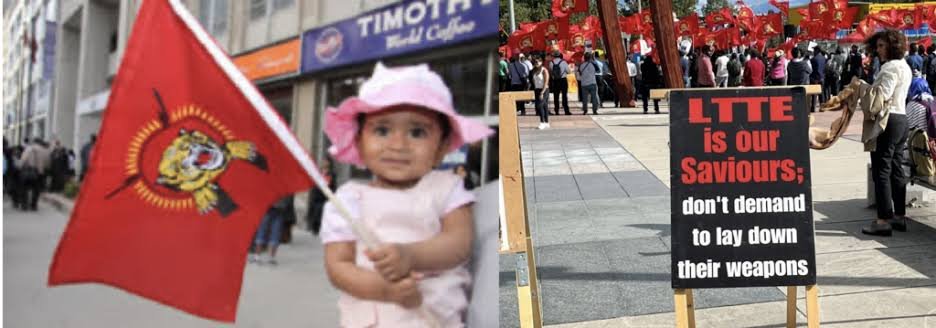
The Prabakaran became a symbol.
The symbol became a brand.
The brand became a source of political & business relevance.
For many ordinary Tamils living in Sri Lanka, the question is simple:
Are these organisations preserving the suffering and history of their people, or are they preserving an identity that allows certain groups to continue exercising influence from a distance?
The Questions that cannot be avoided
If Prabhakaran was truly the leader they claim him to be:
- Why did nobody step forward to claim his dead body?
If he was a leader worthy of annual celebrations:
- Why was there no public movement to give him the final rites they now claim he deserves?
If his cause was worth sacrificing thousands of lives for:
- Why was there no willingness to accept responsibility when that cause reached its final moment?
If the LTTE diaspora truly represents his legacy:
- Why did they embrace the symbol but avoid the responsibility?
If Prabhakaran’s leadership was so important,
- why was responsibility missing when his life ended?
If he was a leader worthy of public celebration,
- why was there no public act of loyalty at the moment of his death?
If the LTTE cause demanded sacrifice from thousands of Tamil youth,
- why are those promoting that legacy today not asking their own children living overseas to make the same sacrifices? Why should children in Sri Lanka sacrifice their education, opportunities and lives for a cause promoted mainly by those living safely overseas – people who take oaths to be loyal to foreign countries?
A leader is not honoured only through photographs, flags, and speeches.
A leader is honoured through responsibility.
A movement is not measured only by the slogans it repeats after defeat.
It is measured by who stands forward when there are consequences.
The people of Sri Lanka —who suffered through decades of conflict — deserve to ask: Who paid the price of the war, and who is now benefiting from its memory?
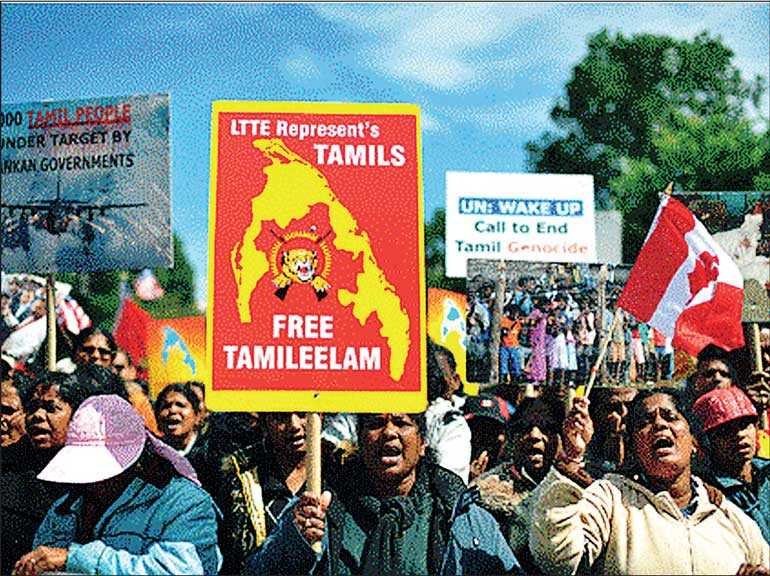
Selective Memory
Why remember the leader but avoid the difficult questions?
Why celebrate the victories and ignore the failures?
Why display the symbols but avoid accountability?
Why demand recognition for the LTTE legacy while refusing to answer for the actions committed in its name?
Why ask future generations to remember a movement while refusing to confront the suffering caused by that movement?
The Sacrifices
For years, ordinary Tamil families in Sri Lanka carried the consequences of the war.
- Children lost education.
- Children became child soldiers
- Families lost loved ones.
- Communities endured displacement and fear.
But many of those now promoting the LTTE legacy live thousands of kilometres away, in countries where their own children enjoy peace, education, security, and opportunity.
So another question must be asked:
Why should another generation of Tamil children be asked to sacrifice their futures for a cause whose strongest voices remain safely outside the territory they claim to fight for?
Are their own children being asked to abandon education and take the same risks?
Are their own families willing to pay the same price?
Or is sacrifice expected only from those who have the least power and the fewest choices mostly because of their caste?
Today, carrying a photograph of Prabhakaran requires no battlefield sacrifice.
Raising a flag requires no personal risk.
Selling memorabilia requires no accountability.
The difficult question is not who can display his image today.
The difficult question is who was willing to stand beside that image when it carried consequences.
A symbol is easy to carry when the danger has disappeared.
A photograph is easy to display when there is no personal cost.
A legacy is easy to claim when others have already paid the price.
The unanswered question remains:
Those who honour Prabhakaran today — why did you not stand beside him when he needed you most?
None of the so-called Eelamists came forward to honor him.
It was Sri Lanka’s Armed Forces who performed his funeral rites & no one else.
It was also Sri Lanka’s Armed Forces who not only looked after his parents but performed their funeral rites.
The LTTE diaspora cannot claim only the glory of Prabhakaran’s name while avoiding the responsibility attached to it.
A leader cannot be claimed only when it is safe to do so.
A legacy cannot be embraced only after others have paid the price.
The question Sri Lankan Tamils must ask is:
Were these voices truly standing for Prabhakaran — or did they discover his value only after his death and transformed him into a useful symbol?
Questions for Tamils to ponder …..
Shenali D Waduge