
SURESH SALLAY – WHAT EXACTLY IS THE CID TRYING TO PROVE?
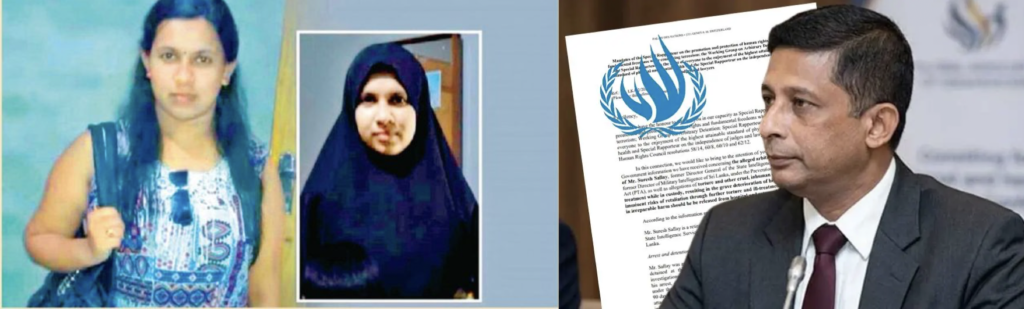
Sarah Jasmine DNA, Katuwapitiya Church Reconnaissance, Vavunathivu, Rajan and Other Allegations – What Is the Evidence Connecting Them to Easter Sunday?
The Easter Sunday terrorist attacks of 21 April 2019 killed 269 people. On 26 April 2019, the Sainthamaruthu explosion killed 17 people, including members of Zaharan Hashim’s family except his wife & daughter who were the sole survivors. They chose to commit suicide to prevent being taken into custody.
The Sainamaruthu explosion also revealed
- Zaharan’s network was far more than the suicide bombers that attacked the churches & hotels
- That members of his own family had explosives inside the house & were prepared to commit suicide reveals something far more complex than a mastermind ordering a suicide attack.
- If the theory of a mastermind is to apply to Zaharan & team deciding to commit suicide attacking people for political revenge – what prompted 17 people to lay down their lives? A video relayed before their suicide does not speak of any political objective.
However – with over 94 reports on Zaharan / ISIS and Islamist extremism available:
- Why were Zaharan and his extremist network not arrested despite years of intelligence reports – a question the CID/TID/IGP & Police have not sufficiently answered.
- Why were repeated Indian intelligence warnings received from 3 April 2019 not translated into effective preventive action even at the last hour?
- Why were churches and hotels not adequately protected even when specific targets had been identified?
- Inspite of being aware of the targets – why were no preventive actions taken?
These questions cannot be overshadowed by allegations against one individual 7 years after the attacks.
Suresh Sallay, a former Director of the State Intelligence Service (SIS), was arrested on 25 February 2026 and named as the third suspect in the Easter Sunday investigation.
The CID has since presented several allegations involving:
- Post-attack – The Sarah Jasmine DNA investigation.
- Pre-attack – The alleged use of an Army informant to show St. Sebastian’s Church, Katuwapitiya, to extremists.
- Pre-attack – The Vavunathivu police killings and alleged withholding of intelligence.
- Pre-attack – The alleged suppression of information supplied by Army informant Rajan.
- Post-attack – Allegations by Azad Maulana, and an alleged meeting with Zaharan.
- Pre-attack/irrelevant to Easter attacks – Allegations concerning the issuance of a diplomatic passport to Karuna Amman.
These allegations must be examined separately. An allegation relating to an investigation conducted after the attacks cannot automatically establish participation in planning the attacks.
The central question is not how many allegations can be accumulated against Sallay. It is whether each allegation establishes his personal involvement in a criminal offence and, where the allegation concerns the Easter attacks, how it connects him to their planning, preparation or execution.
PART I – WHERE WAS SALLAY DURING THE EASTER ATTACKS?
This is important because several allegations concern alleged meetings and contacts with Zaharan and his associates before Easter Sunday.
The Ministry of Defence stated in September 2023 that:
- December 2016–December 2018: Sallay served as Minister Counsellor at the Sri Lankan High Commission in Malaysia.
- 3 January 2019: He left for India.
- 30 November 2019: He returned to Sri Lanka after completing the National Defence College course in New Delhi.
- During December 2016–November 2019, he was not employed in the country’s intelligence and military/security apparatus or holding official responsibilities in those fields.
The Justice S.I. Imam Committee Report of 25 June 2024 also records his overseas service and his attendance at the National Defence College in New Delhi during the Easter attacks.
The committee rejected the Channel 4 allegations against him as unproved at its inquiry and found no evidence of his involvement with Zaharan or NTJ during the material period though the committee recommended to investigate Asad Maulana’s links to Zaharan & team.
Sources:
Ministry of Defence statement, 9 September 2023
Justice S.I. Imam Committee Report, 25 June 2024
This establishes:
- Sallay’s overseas posting and training contradict allegations that he physically attended meetings with Zaharan or his associates in Sri Lanka during 2018 and April 2019.
- The CID must produce evidence of the travel, communications with Maulana, meeting at coconut estate, instructions and movements.
PART II – WHAT DID THE JUSTICE S.I. IMAM COMMITTEE ESTABLISH?
The Presidential Committee comprising retired Supreme Court Judge S.I. Imam, retired Air Chief Marshal Jayalath Weerakkody and President’s Counsel Harsha Soza was appointed to examine the allegations made in the Channel 4 documentary aired on 5 September 2023.
Its report dated 25 June 2024 examined the allegations against Sallay and Pillayan.
The committee recorded that:
- Azad Maulana did not appear before the committee to give evidence.
- He did not respond to its requests to testify.
- He was therefore not subjected to questioning or cross-examination before the committee.
- Sallay and Pillayan gave evidence.
- The evidence of Sallay and Pillayan did not support Maulana’s allegations.
- The committee found the Channel 4 allegations unproved at its inquiry.
- It found no evidence of Sallay’s involvement with Zaharan or NTJ during the relevant period.
- It rejected the alleged February 2018 meeting at the coconut farm as unproved.
What new corroborating evidence has emerged since the June 2024 inquiry that now justifies pursuing the allegations against Sallay based on a complaint filed by a Catholic Fr on 11 Oct 2024 (4 months after the Imam Report & over a year after the release of the Channel 4/Maulana allegations?
The CID must identify the new evidence, its source, when it was obtained and how it changes the earlier evidential position that makes Sallay the 3rd suspect.
PART III – THE SARAH JASMINE DNA ISSUE
Though not directly related to the Easter attacks – this allegation is keeping the public perturbed.
DNA investigation chronology
- 21 April 2019 – Easter Sunday attacks.
- 26 April 2019 – Sainthamaruthu explosion.
- 28–29 April 2019 – Initial post-mortem examinations and biological sample collection.
- 15 May 2019 – Government Analyst reportedly informed court that three biological samples had deteriorated.
- 7 June 2019 – Further sampling following court permission.
- 19 September 2019 – First DNA findings reported to court.
- 9 December 2019 – Sallay appointed SIS Director.
- 2 February 2020 – Sallay reportedly raised the need for further DNA testing at a National Security Council meeting (6months after first DNA findings)
- 3 March 2021 – Second DNA report issued (while Sallay was SIS Director – why have no allegations of interference been raised against him)
- 7 May 2021 – Senior police officers and Government Analyst conducted a further site inspection.
- 16 August 2021 – Government Analyst submitted observations and recommendations to CID.
- 21 March 2022 – Police obtained court authority for further sampling.
- 27 April 2022 – Third sampling and exhumation.
- 15 February 2023 – Report relating to the third examination prepared for submission to the Kalmunai Court, according to the subsequent CID account.
- 29 March 2023 – Police publicly announced a DNA match with Sarah Jasmine’s mother’s DNA.
Sources:
Daily FT, 13 May 2022 – Unfolding the Enigma of Sara Jasmine
News 1st, 29 April 2026 – Fresh Revelations in Easter Attacks Case
- The initial DNA examinations
The original sampling process had documented problems.
The Daily FT account records deterioration of biological samples and subsequent sampling following court permission. It also records that the September 2019 results could not identify everyone believed to have been inside the house.
The CID’s April 2026 account states that the September 2019 and March 2021 reports did not identify Sarah Jasmine among the remains.
But an important distinction must be made:
Failure to identify Sarah Jasmine in the samples examined does not scientifically establish that she escaped from the house. It establishes that she was not identified in those particular samples.
- Why was another examination requested?
Sallay reportedly raised the matter at the National Security Council on 2 February 2020.
The CID now alleges that he repeatedly insisted that another examination be conducted.
The subsequent published chronology records that:
- A further site inspection was conducted on 7 May 2021.
- The Government Analyst submitted observations and recommendations on 16 August 2021.
- An investigating officer was instructed to retrieve biopsy samples.
- Police subsequently obtained court authority for the exhumation and further sampling.
The CID must explain the relationship between the original request in February 2020 and the Government Analyst’s subsequent recommendations in August 2021.
Did the later examination arise from new forensic recommendations?
What precisely did the Government Analyst recommend?
The actual reports and National Security Council minutes must be produced.
The CID must also explain why it treats the request for further DNA testing as suspicious when the Government Analyst subsequently conducted a site inspection and submitted further observations and recommendations on 16 August 2021
What documentary evidence establishes that Sallay improperly influenced the process?
- The black polythene bags and fragment 17-D
The recovered human remains were placed in black polythene bags, with identifiable remains separated from other body fragments.
The CID’s April 2026 account raises the following questions:
- A black polythene bag containing bone fragments was reportedly found adjacent to grave 16 and labelled as grave 17.
- Two small bone fragments were reportedly identified by the Government Analyst as belonging to a daughter of Sarah Jasmine’s mother.
- The Government Analyst reportedly stated that the fragments were consumed during DNA extraction.
- The JMO reportedly questioned the identification of fragment 17-D, stating that it appeared to be a lower vertebra not observed during the original recovery.
The CID must produce:
- Original recovery and post-mortem records.
- Original photographs of all remains and bags.
- The grave allocation and identification records.
- Records showing where bag 17 originated and who labelled it.
- Exhumation and sampling records of 27 April 2022.
- Government Analyst’s original laboratory notes and DNA profiles.
- DNA comparison data, statistical calculations and quality-control records.
- Evidence establishing the chain of custody from recovery to laboratory examination.
If the physical bone fragments were consumed, the laboratory must disclose what DNA extracts, digital profiles, electropherograms and other scientific records remain available for independent review.
The existence of multiple bags or separated fragments does not, by itself, prove manipulation. Equally, a DNA match cannot eliminate questions about whether the material tested was correctly identified and documented.
- Who collected and released the final DNA report?
The CID alleges that the IGP personally collected the Government Analyst’s report on 15 February 2023, with Sallay present, and that the result was subsequently announced through the Police Media Spokesman.
The CID describes this as unusual and alleges that it interfered with an ongoing investigation.
The actual questions are:
- Who authorised the IGP to collect the report?
- Was this an instruction from the President or another authority?
- Why was Sallay present?
- Who was legally responsible for receiving the report?
- Was the report first submitted to court?
- Who authorised the Police Media announcement?
- Did the announcement accurately represent the complete scientific findings?
Personal attendance at the collection of a report does not, by itself, establish manipulation of its scientific contents.
The CID must demonstrate the actual unlawful intervention and its effect.
- What is the relevance of the DNA to the Easter attacks?
Even if the CID establishes that Sallay requested another DNA examination, that does not establish that he:
- Planned the Easter attacks.
- Had prior knowledge of the bombings.
- Assisted the suicide bombers.
- Manipulated the DNA results.
- Fabricated a forensic report.
- Participated in a terrorist conspiracy.
The CID must establish the specific criminal offence allegedly committed and the connection between that offence and the Easter attacks.
-
WHAT IS THE CID TRYING TO ESTABLISH THROUGH THE DNA INTERFERENCE ALLEGATION?
The central question is why the CID considers this relevant to the Easter Sunday attacks/mastermind theory and what is CID trying to prove through this allegation.
If the CID is suggesting that Sallay sought to manipulate the identification of Sarah Jasmine to conceal her survival, whereabouts or involvement in the attacks, it must explain how this alleged post-attack conduct connects to the planning, preparation or execution of the Easter Sunday bombings.
If the CID is using the DNA episode to support its wider theory that Sallay was the mastermind or part of the conspiracy behind the attacks, what evidence establishes that connection? An alleged attempt to influence a forensic investigation after the attacks does not, by itself, establish prior knowledge of or participation in their planning.
If the CID’s position is that Sarah Jasmine survived the Sainthamaruthu explosion and escaped to India, where is the evidence establishing her identity, route of travel and subsequent whereabouts?
Has the Government formally sought India’s assistance to locate her? If not, why not? Most importantly, what evidence connects Sallay personally to her alleged survival, movement or concealment after April 2019?
Government has not officially requested India’s assistance in locating her.
There is a specific chronological issue the CID must answer.
- Sallay reportedly raised the need for further DNA testing on 2 February 2020. The second DNA report was issued on 3 March 2021, while he was SIS Director.
- If the CID considers his involvement in requesting further testing evidence of interference, why has it not clearly identified what interference occurred in relation to the March 2021 examination and report?
- Was the March 2021 report altered, suppressed, withheld or improperly influenced? If so, who did it, how and on whose instructions?
- If the allegation instead concerns the subsequent examination and the 2023 report, what changed after March 2021 to justify treating the later process as evidence of criminal interference?
- The CID must identify the specific act, the person responsible, the date, the instruction and the evidence. A request for further testing cannot, by itself, establish manipulation of a forensic investigation.
The CID must clarify whether it is alleging:
- interference with the DNA investigation as a separate offence;
- an attempt to conceal or manipulate Sarah Jasmine’s identification as part of an alleged cover-up; or
- conduct intended to support its wider theory of Sallay’s involvement in the Easter Sunday conspiracy.
Unless the CID establishes the specific criminal act and its connection to the Easter Sunday attacks, the DNA interference allegation cannot, merely by being placed alongside the other allegations, establish that Sallay planned or masterminded the attacks.
PART IV – THE VAVUNATHIVU POLICE KILLINGS: WHAT DID THE 2024 COMMITTEE FIND?
Two police officers were killed at Vavunathivu on 30 November 2018.
The initial CID investigation focused on former LTTE cadres.
Rasanayagam Sarvanandan, also known as Emiyavan, and Ajanthan were arrested in connection with the investigation.
The Justice A.N.J. de Alwis Committee examined the Vavunathivu investigation in its September 2024 report.
Its findings are particularly important.
The committee recorded that:
- The CID had relied on information supplied by the DMI and local police.
- The DMI had submitted several reports indicating an LTTE connection.
- However, on 12 April 2019, the DMI informed the CID that Rilwan and Army Mohideen, associated with NTJ, had carried out the killings.
- The CID had not properly investigated this information.
- The committee found that the SIS had failed to share critical information about NTJ with the DMI, contributing to the delayed recognition of NTJ as a threat.
- The committee criticised the CID’s failure to conduct a comprehensive investigation.
The committee recommended that former SDIG-CID Ravi Seneviratne and former CID Director Shani Abeysekara be prosecuted for negligence in conducting the investigation.
Source: Justice A.N.J. de Alwis Committee Report, September 2024
These incidents took place while Sallay was not in the country & was not holding any military or intelligence portfolio.
What is the CID alleging now?
On 15 September 2026, the prosecution presented a further account involving a military intelligence informant known as Thambiyan.
According to the prosecution:
- Thambiyan allegedly provided intelligence about Zaharan and his associates soon after the Vavunathivu killings.
- The information allegedly passed through an officer named Suranga and Colonel Ranawera.
- The information was expected to reach the then Director of Military Intelligence, Chula Kodituwakku.
- The prosecution alleged that the information was not passed to investigators in time.
- The CID was reportedly informed that Zaharan’s group was responsible only nine days before Easter Sunday.
Source: News 1st, 15 September 2026
The questions the CID must answer:
- Where is Thambiyan’s original intelligence report?
- On what date was the information first received?
- Who recorded and handled the information?
- What did Suranga report to Colonel Ranawera?
- What did Colonel Ranawera report to the DMI Director?
- Why was the information not passed to CID?
- How does the alleged Thambiyan reporting chain correspond with the DMI reports examined by the de Alwis Committee?
- What evidence establishes that Sallay knew of or authorised the alleged withholding?
The de Alwis Committee identified Nilantha Jayawardena as SIS Director until December 2019.
Sallay became SIS Director only on 9 December 2019 and was overseas during the Vavunathivu killings and subsequent investigation.
The committee’s findings about the SIS’s failure to share information in 2018–19 must not automatically be attributed to Sallay.
The CID must identify the individual officers responsible for the original reporting and explain what evidence connects Sallay personally to their conduct.
A further question arises: If the DMI, CID and SIS had different responsibilities, why is the public being presented with an allegation against Sallay (who did not hold any posts before Easter) without first being shown the complete chain of intelligence reporting and the decisions of the officers who actually held responsibility at the time?
PART V – THE ALLEGED KATUWAPITIYA CHURCH RECONNAISSANCE
The CID reportedly alleged in March 2026 that an intelligence informant was used to show St. Sebastian’s Church, Katuwapitiya, to Muslim extremists before the Easter attacks.
Source: Newswire, 12 March 2026
This allegation is different from the DNA investigation and the Vavunathivu intelligence issue.
The prosecution must establish:
- Who was the informant?
- When did he allegedly show the church?
- Who were the persons shown the church?
- What evidence establishes their identities?
- Did the informant know that the persons were planning a terrorist attack?
- Was the visit documented in an original intelligence report?
- What evidence establishes that Sallay instructed or authorised the visit?
- How was the alleged instruction communicated, considering Sallay’s overseas position at the time?
- How does this connect with the safe houses and reconnaissance missions conducted by Zaharan & his team separately?
The de Alwis Committee separately examined the failure to protect churches despite prior intelligence warnings. It identified shortcomings by police officers responsible for distributing warnings and securing the relevant areas, including the Katuwapitiya area.
That finding does not establish the separate allegation that an Army informant deliberately showed the church to terrorists.
The CID must establish that allegation independently.
Showing a building, without proof of criminal knowledge and intention, does not automatically establish intentional assistance to a terrorist attack.
Under Section 100 of the Penal Code, abetment includes intentionally aiding an offence by an act or illegal omission. The prosecution must establish the relevant criminal intention and conduct.
PART VI – THE RAJAN ALLEGATION: WHO SUPPRESSED THE INFORMATION?
On 21 October 2026, the CID presented an allegation concerning Army informant Mikel Xavier Vilvarasingham alias Rajan.
According to the prosecution’s account:
- Rajan was instructed to monitor a residence associated with the uncle of Easter Sunday bomber Inshaf Ahmed.
- He allegedly encountered a woman wearing a burqa.
- After the Easter attacks, he reportedly identified the woman from media photographs as Sarah Jasmine.
- He informed Army Corporal Suranga.
- Suranga allegedly instructed him to forget the matter.
- The prosecution alleged that the suppression occurred with Sallay’s knowledge.
Source: News 1st, 21 October 2026
The CID must produce:
- Rajan’s original statement.
- The date on which he first reported the information.
- His original intelligence reporting records.
- Corporal Suranga’s statement.
- Suranga’s superior officer and reporting chain.
- Evidence showing how the information reached Sallay.
- Any communication establishing that Sallay instructed or authorised suppression.
An alleged instruction by an Army corporal to an informant to remain silent does not establish that Sallay knew of or authorised that instruction.
There is also an important distinction between the alleged post-attack suppression of information and participation in planning the Easter attacks.
Even if an offence of obstruction or suppression were established, the prosecution must separately establish its criminal connection to the Easter Sunday conspiracy.
PART VII – THE KARUNA PASSPORT ALLEGATION AND OTHER COLLATERAL CLAIMS
On 21 October 2026, the prosecution also raised an allegation that two intelligence officers, including Sallay, had arranged a diplomatic passport for Karuna Amman to travel to the United Kingdom and that Sallay subsequently travelled to meet him.
The prosecution referred to a passport allegedly issued under the name Dushmantha Gunawardena.
Sallay’s counsel disputed the allegation and submitted that he was serving at the Sri Lankan Embassy in France at the relevant time.
Counsel requested the passport numbers and supporting particulars.
Source: News 1st, 21 October 2026
The CID must produce:
- The original passport application.
- Passport number and issuing records.
- The identity and particulars of the alleged passport holder.
- The relevant Ministry of Foreign Affairs records.
- The alleged travel dates.
- Immigration records.
- Evidence of Sallay’s involvement.
This is a separate allegation. Asad Maulana mentioned Pillayan but nowhere was Karuna mentioned. What relevance is Karuna to Easter Sunday?
Unless the prosecution establishes its connection to the Easter Sunday attacks, it cannot automatically establish participation in the terrorist conspiracy.
Similarly, the prosecution’s reference to statements by three convicted Easter Sunday attackers that others connected to the attacks remain outside must be followed by the actual recorded statements, their supporting evidence and an opportunity to test their claims.
A statement made by a convicted person is not automatically proof against another individual.
PART VIII – WHAT DOES THE LAW REQUIRE?
The public must understand the difference between negligence, misconduct, obstruction, abetment and conspiracy.
These are not interchangeable.
- Penal Code Section 100 – Abetment
Abetment includes:
- Instigating another person to commit an offence.
- Engaging in a conspiracy to commit an offence.
- Intentionally aiding an offence through an act or illegal omission.
A failure to act, a poor administrative decision or a request for an investigation does not automatically establish intentional abetment.
If the prosecution relies on an alleged omission, it must establish the relevant duty, the illegality of the omission and the required intention.
- Penal Code Section 113A – Criminal conspiracy
This provision requires persons to agree to commit or abet an offence, or to act together with a common purpose in committing or abetting an offence.
A previous meeting or lengthy deliberation is not essential.
Conspiracy can be established through circumstantial evidence.
However, the prosecution must establish the common criminal purpose and the accused person’s participation in it.
The public should therefore ask:
- What was the alleged agreement?
- Between whom?
- When was it formed?
- What was the common criminal purpose?
- What conduct demonstrates Sallay’s participation?
- What evidence establishes his knowledge and intention?
- Evidence Ordinance Section 10 – Acts and statements of conspirators
This provision makes certain acts, statements and writings of persons believed to be conspiring together relevant against one another where there are reasonable grounds to believe a conspiracy existed and the acts or statements relate to their common intention.
It does not mean that every association, meeting, telephone call or professional relationship automatically proves conspiracy.
The evidential basis for treating individuals as conspirators must be established.
- Constitution Article 13(5) – Presumption of innocence
Every person is presumed innocent until proved guilty.
A person being arrested, detained, named as a suspect or questioned under the Prevention of Terrorism Act is not thereby found guilty.
The prosecution must establish criminal liability through admissible evidence at trial and prove the charges beyond reasonable doubt.
Legal references:
Penal Code – Sections 100 and 113A
Evidence Ordinance – Section 10
Constitution of Sri Lanka – Article 13
PART IX – WHAT MUST THE CID PRODUCE?
CID must provide documentary evidence rather than rely on repeated press accounts of allegations.
The following records are essential:
DNA investigation
- All original Government Analyst reports from 2019, 2021 and 2023.
- Government Analyst’s recommendations dated 16 August 2021.
- National Security Council minutes of 2 February 2020 and subsequent relevant meetings.
- IGP’s written instructions concerning further DNA testing.
- Instruction issued to Chief Investigating Officer Saman Weerasinghe.
- Kalmunai Magistrate’s exhumation order.
- Original recovery, burial, exhumation and sampling records.
- Photographs, labels and records relating to the black polythene bags and fragment 17-D.
- Complete laboratory records, DNA profiles and chain-of-custody documentation.
- Records concerning collection and public release of the February 2023 report.
Vavunathivu and military intelligence
- Thambiyan’s original intelligence reports.
- Suranga’s original statement and reporting records.
- Colonel Ranawera’s records and communications.
- DMI reports C20A onwards, including the 12 April 2019 report.
- Records showing when the information was received by CID.
- Evidence establishing any communication with Sallay.
Church reconnaissance
- Informant’s original statement.
- Identification of the persons allegedly shown the church.
- Original intelligence reports and communications.
- Evidence connecting Sallay personally to the alleged instruction.
Rajan
- Rajan’s original statement and date of recording.
- Corporal Suranga’s statement.
- Army reporting and command records.
- Evidence showing how the information allegedly reached Sallay.
Other allegations
- Original passport application and issuance records concerning Karuna Amman.
- Immigration and travel records.
- Complete records and supporting statements concerning any further allegations made by convicted persons.
The public must be able to distinguish the original documents from the CID’s interpretation of those documents.
PART X – THE FIVE QUESTIONS THAT THE PROSECUTION MUST ANSWER
- CHRONOLOGY
What did Sallay personally do before, during and after the Easter Sunday attacks? Which allegations concern periods when he was overseas, and which concern his subsequent appointment as SIS Director?
- AUTHORITY
Who actually controlled the CID investigations, the military intelligence reporting chain, the DNA examination and the release of forensic findings? Where are the written instructions and records?
- EVIDENCE
Where are the original statements, intelligence reports, laboratory findings, National Security Council minutes and documentary corroboration?
- PERSONAL INVOLVEMENT
What specific act did Sallay personally commit, instruct, authorise or knowingly participate in? What establishes his knowledge and intention?
- CRIMINAL CONNECTION
How does each alleged act satisfy the legal elements of a criminal offence? How does it establish his participation in planning, facilitating or executing the Easter Sunday attacks?
ALLEGATIONS ARE NOT PROOF
The Easter Sunday attacks demand accountability. The victims and their families deserve the truth, and every person responsible must face the law.
But accountability cannot be achieved by replacing evidence with suspicion or by attributing the actions of an entire security establishment to one individual without establishing his personal responsibility.
The public record raises several matters that require proper examination:
- Sallay was overseas during the Easter attacks and was appointed SIS Director only in December 2019.
- The Justice S.I. Imam Committee found the Channel 4 allegations against him unproved at its inquiry.
- The first DNA examination and September 2019 findings preceded Sallay’s appointment as SIS Director. The second report was issued on 3 March 2021, during his tenure. The CID must specify what interference it alleges in relation to each examination.
- The third DNA examination involved the Government Analyst, JMO, CID, police authorities and judicial authorisation.
- The de Alwis Committee documented serious failures in the Vavunathivu investigation and the handling of intelligence by several institutions and officers.
- The allegations concerning church reconnaissance and Rajan require evidence of Sallay’s personal knowledge, instructions and participation.
- The passport allegation requires independent documentary verification.
None of these matters should be dismissed without investigation. Equally, none should be presented as proof of guilt without the necessary evidence.
The fundamental weakness in any prosecution narrative would be the failure to establish the links between the individual allegations, Sallay’s personal conduct, the relevant criminal intention and the Easter Sunday attacks.
A DNA request is not automatically DNA manipulation. An intelligence failure is not automatically a terrorist conspiracy. A reporting failure by an Army corporal is not automatically evidence of the SIS Director’s knowledge. A professional association is not automatically criminal participation.
The prosecution must establish each link rather than expect the public to connect separate allegations through assumption.
THE PUBLIC IS ENTITLED TO ASK:
- What exactly did Sallay do wrong
- What evidence proves that he did it?
- What law did his alleged conduct violate?
- Who actually made the relevant decisions?
- How does the evidence establish his personal involvement in the Easter Sunday attacks?
Until these questions are answered with verifiable evidence, allegations must remain allegations.
The objective must be the truth about Easter Sunday, accountability for every responsible person and justice for the victims – not the substitution of one unproven narrative for another.
Shenali D Waduge


