THE WAR INDIA EXPECTS BETWEEN US & CHINA MAY NEVER COME — SO WHY IS SRI LANKA BEING ASKED TO PREPARE FOR IT?
India increasingly presents the Indian Ocean through the prism of great-power competition. China is described as a strategic challenge; the United States is increasingly seen as India’s strategic partner; and Sri Lanka is consequently being viewed as a critical piece of the security architecture between the two. But there is a question India needs to answer before asking Sri Lanka to make strategic choices on its behalf while Sri Lanka’s leader should not be naïve to sign any dotted line without considering the consequences.
Is a direct confrontation between the United States and China—or between the United States and Russia—actually inevitable?
The evidence suggests otherwise.
The United States and China are strategic competitors.
They impose tariffs on each other, restrict sensitive technologies, compete for influence and strengthen their military capabilities.
But they are also deeply connected through trade, investment, manufacturing, finance, technology and global supply chains.
China is not simply another country with which America trades.
China is part of the global commercial system in which American businesses operate. Chinese manufacturing feeds American companies and consumers. American companies have spent decades building businesses around Chinese production and the Chinese market. Chinese financial institutions continue to hold and transact in dollar assets.
Even amid intense strategic rivalry, Washington and Beijing continue to negotiate over trade, investment and economic relations.
This is not what we expect to see in two countries preparing themselves for an unavoidable total war.
Their behavior is of 2 powers who compete without destroying the economic system from which they both benefit. The business calculation matters for both.
A US-China war is much more than 2 militaries fighting each other.
A war disrupts manufacturing, shipping, semiconductors, energy markets, finance, insurance, technology and supply chains across the world.
The consequences impact both nations too.
American corporations would be affected. American consumers would be affected. American financial markets would be affected. The same would happen in China.
This is why US wants to constrain China’s strategic rise – but it does not have an economic interest in destroying China.
Likewise, China wants to challenge American dominance—but it does not have an economic interest in destroying the American economy.
What this means is that the two are competitors without becoming enemies at war.
Russia-US relations presents another lesson
The US-Russia relationship is very different from the US-China relationship.
Sanctions and the Ukraine conflict have severely reduced normal economic relations.
Yet even here, economics has not disappeared from the equation.
Washington continues to explore negotiations with Moscow.
And when the possibility of ending the Ukraine conflict arises, the discussion quickly extends beyond military matters to the possibility of restoring economic and trade relations.
What does this reveal about international politics?
Even severe geopolitical confrontation does not necessarily eliminate the possibility of economic renewed relations.
Russia is a nuclear power. The United States is a nuclear power.
Neither can afford to treat direct war as an ordinary policy instrument.
China and Russia have their own economic logic
China and Russia have also expanded their economic relationship, particularly in energy, trade, transport and infrastructure.
China needs energy and resources.
Russia needs markets, investment and trade.
Their strategic relationship is therefore reinforced by commercial interests.
This shows us that the world does not divide into two permanent camps.
It is a network of competition, cooperation, trade, bargaining and strategic hedging.
And India knows this better than most.
India has a strategic partnership with the United States.
But India continues to maintain important economic, energy and defence relationships with Russia.
India competes strategically with China.
Yet India also conducts enormous trade with China and has strong economic reasons to maintain that relationship.
India has learnt lessons – it can compete with another major power without cutting itself off from that power.:
So why should Sri Lanka be expected to behave differently?
If Washington can compete with Beijing while continuing to negotiate with Beijing…
If Washington can confront Moscow while simultaneously exploring the restoration of relations…
If China and Russia can deepen economic cooperation…
If India can maintain strategic relations with Washington while continuing economic and strategic engagement with Moscow and Beijing…
Why must Sri Lanka surrender strategic autonomy on the assumption that a US-China or US-Russia confrontation is inevitable?
India may be positioning Sri Lanka for a great-power confrontation that the major powers themselves have powerful economic, financial and strategic reasons to avoid—while using that possibility to advance India’s own interests in Sri Lanka.
The major powers have something India cannot ignore:
they have too much to lose.
- They have businesses to protect.
- Markets to preserve.
- Supply chains to maintain.
- Financial systems to stabilise.
- Energy to trade.
- Technology to develop.
- Investments to protect.
And, above all, nuclear arsenals that make uncontrolled escalation potentially catastrophic.
India knows the value of Sri Lanka for India.
But what exactly is India seeking when it asks Sri Lanka for deeper strategic, economic, energy, connectivity and security integration?
BUT WHAT IS SRI LANKA ACTUALLY BEING GIVEN?
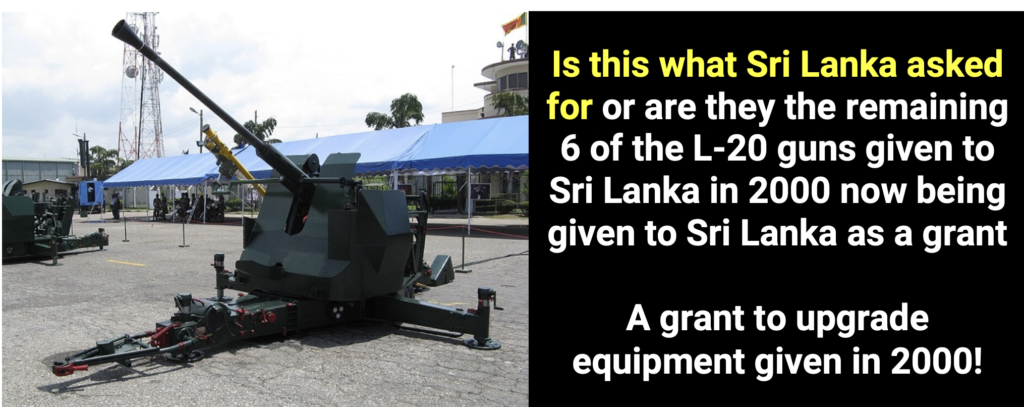
During Rajnath Singh’s visit, India agreed to upgrade six L-70 anti-aircraft guns under a Government of India grant.
But is this what Sri Lanka has identified as a defence priority — or what India is agreeing to grant?
And if Sri Lanka is being asked to prepare for a possible US-China confrontation, how relevant are these systems to such a war?
A grant may cost Sri Lanka nothing upfront. But accepting what another country chooses to fund can also shape what Sri Lanka prepares for.
Sri Lanka must decide its defence priorities — not inherit someone else’s.
Sri Lanka needs strategic autonomy—not symbolic defence gifts that could create strategic dependence.
India does not need Sri Lanka because Sri Lanka is a large or powerful country.
India needs Sri Lanka because of what Sri Lanka possesses—its location, ports, maritime position, energy potential, minerals, connectivity and proximity to India’s own coastline.
Sri Lanka’s strategic value belongs to Sri Lanka and Sri Lanka alone.
And this is where Sri Lanka must be careful.
A project can be presented as economic cooperation, connectivity or development while its cumulative effect may also create strategic dependence.
One agreement may appear harmless. Another may appear commercially beneficial. A third may appear necessary for security.
But when energy, digital infrastructure, connectivity, trade, investment and security arrangements increasingly converge around one country, Sri Lanka must ask a much bigger question:
Are we creating cooperation—or creating dependency?
But Sri Lanka’s leaders have undermined Sri Lanka by not proudly standing up for Sri Lanka’s interests however small in size we are.
India is not after Sri Lanka because of its size – India is pressurizing Sri Lanka because of the value Sri Lanka has which Sri Lanka’s leaders have failed to value.
So where does that leave Sri Lanka?
Sri Lanka should not be required to surrender strategic autonomy because India is preparing for a confrontation whose outcome is unlikely to happen—and which the United States, China and Russia all have powerful incentives to prevent.
Sri Lanka can maintain relations with India.
Sri Lanka can maintain relations with the United States.
Sri Lanka can maintain economic relations with China.
Sri Lanka can maintain historical relations with Russia.
There is no contradiction in doing so.
Sri Lanka does not need to become an extension of anybody else’s strategic bloc.
And India, of all countries, should understand this.
Because India itself is practising the same principle.
The uncomfortable question for New Delhi
If India’s own policy is:
compete with China + trade with China
partner with America + maintain Russia
protect Indian interests first
then India cannot reasonably demand that Sri Lanka adopt:
India’s security interests first + India’s strategic alignment + restrictions on Sri Lanka’s relationships with other powers.
That is not strategic partnership.
That is strategic dependency.
And there is an even larger question:
If the United States and China have sufficient economic interests to prevent their rivalry from becoming a direct war, why should Sri Lanka surrender sovereign strategic space today because India fears the possibility of that war tomorrow?
Sri Lanka must not mortgage its sovereignty against a hypothetical war
Great powers will ultimately protect their own national interests.
Washington will protect American interests.
Beijing will protect Chinese interests.
Moscow will protect Russian interests.
New Delhi will protect Indian interests.
Sri Lanka must therefore protect Sri Lankan interests.
The lesson is much simpler:
Great-power rivalry does not automatically mean great-power war.
And if the world’s largest powers themselves continue to trade, negotiate, invest, hedge and seek economic accommodation despite strategic rivalry, India cannot use the spectre of an inevitable US-China confrontation as a justification for reducing Sri Lanka’s sovereignty today.
Sri Lanka should not be positioned for somebody else’s war.
Sri Lanka should remain positioned for Sri Lanka’s future.
Shenali D Waduge