BEFORE INDIA ACCUSES CHINA — INDIA MUST ASK THE US: WHY US-BASED TGTE IS COLLABORATING WITH A HONG KONG UNIVERSITY ON TAMIL EELAM?
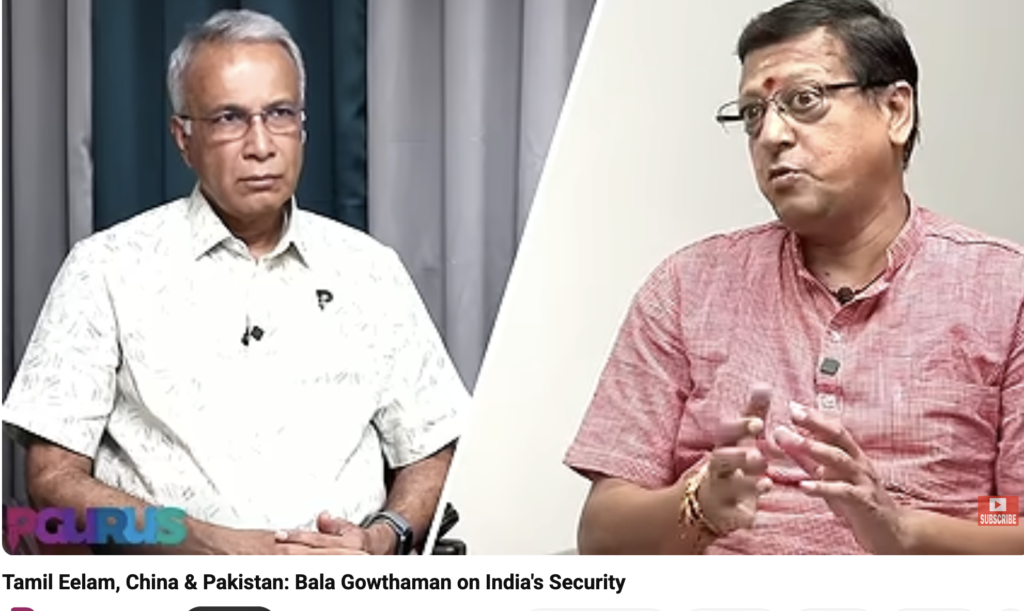
There is a remarkable irony unfolding in Colombo this week. India’s Defence Minister Rajnath Singh is in Sri Lanka, with the visit centred on strengthening defence, maritime and security cooperation. India describes Sri Lanka as a close friend and is going to lengths to promote notion of a shared security environment. At almost the same moment, an Indian discussion circulating online has raised an extraordinary warning.
The subject is a new research initiative at The Chinese University of Hong Kong examining the legal and political questions surrounding the possibility of an independent Tamil State within Sri Lanka. The research is being undertaken in collaboration with the US-based Transnational Government of Tamil Eelam (TGTE), an organisation proscribed by Sri Lanka. Who initiated the collaboration? Who funds the research? Who funds the researcher?
https://www.youtube.com/watch?v=BGNc-iImF50 –
Tamil Eelam, China & Pakistan: Bala Gowthaman on India’s Security
– TGTE Parliament Convenes on May 16th – 18th in Buffalo, U.S.A.
https://resuminder.com/jobs/62235283-postdoctoral-fellow-in-law-at-the-chinese-university-of-hong-kong?
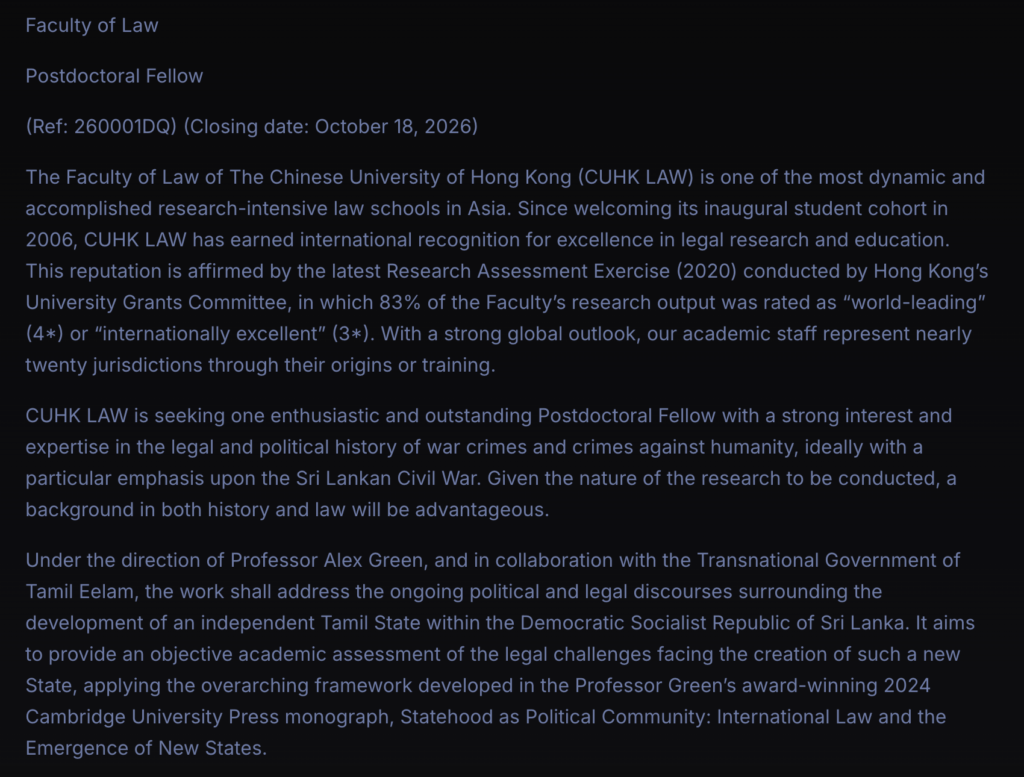
The official CUHK material does indeed say that the project addresses the political and legal discourse surrounding the development of an independent Tamil State and that the research is being conducted in collaboration with TGTE.
Sri Lanka has proscribed TGTE under its terrorism-related regulations and has described it in the context of LTTE-linked international networks
US continues to ban LTTE.
India is a QUAD partner plus India has multiple security agreements signed with US.
The University is not a State University for Chinese Govt to exert any control over.
But if India is concerned, the best approach is to directly address the issue with US Govt over the TGTE commissioning of the research.
LET US TAKE THE INTERVIEW SERIOUSLY
The presenters essentially ask India to consider a chain of possibilities:
- The university is in Hong Kong.
- Hong Kong is now part of China.
- Therefore, China is examining whether Tamil Eelam can be revived as a strategic instrument against Sri Lanka and India.
- Perhaps academic research could eventually become political mobilisation.
- Perhaps the Tamil question could become a geopolitical weapon.
- Perhaps China could exploit the Tamil issue to destabilise Sri Lanka.
- Perhaps it could ultimately affect Tamil Nadu and India itself.
These are serious propositions.
But there is a problem.
A possibility is not evidence of an intention.
The CUHK material establishes the research project and its collaboration with TGTE. It does not, by itself, establish that the Chinese Government commissioned the research, that Beijing is planning a Tamil state, that China intends to destabilise Sri Lanka or that Chinese Govt has any links to TGTE.
That distinction matters.
If we are going to accuse another country of strategic manipulation, we must establish the evidence.
BEFORE ASKING WHAT CHINA MAY DO, LET US ASK WHAT CHINA HAS ACTUALLY DONE
Did China …
- secretly train Sri Lankan Tamil militants?
- establish militant training camps for them in China?
- arm the Tamil militant organisations?
- allow its territory to be used by LTTE terrorists?
- provide sanctuary to armed groups fighting the Sri Lankan State?
- send an army into Sri Lanka?
- conduct military operations inside Sri Lanka?
- drop supplies from aircraft over Jaffna?
- whisk a terrorist & his family in helicopters to China?
- intervene militarily in Sri Lanka’s internal conflict?
- negotiate an agreement that fundamentally altered Sri Lanka’s internal political structure as well as amend its Constitution?
- send troops to implement that agreement?
- use the Tamil question as a direct instrument of intervention in Sri Lanka?
If the answer is “no”, why is China being judged today primarily on a research collaboration that the Govt of China has not commissioned, while India’s historical record is being discussed only selectively?
INDIA’S ROLE IN THE TAMIL MILITANCY IS NOT A THEORY
During the 1980s, India became deeply involved in the Sri Lankan Tamil militant question.
Historical accounts as well as memoirs of Indian Generals deployed at the time document Indian training, support and sanctuary for Tamil militant organisations. Sources including the Jain Commission Report following the assassination of Indian PM Rajiv Gandhi, record training camps in India, including Tamil Nadu.
The question of Indian training and support to Sri Lankan Tamil militant organisations is not a conspiracy theory invented today. It was examined in India’s parliamentary debates.
Tamil Nadu was not simply an audience watching the Eelam struggle from across the Palk Strait.
It became a strategic base for the armed movement.
This distinction is essential.
The political demand for a Tamil Eelam originally emerged in Tamil Nadu. It was articulated in 1949 via the formation of ITAK calling for a separate Tamil State and thereafter via the Vaddukoddai Resolution of 14 May 1976 – goal of a “Free, Sovereign, Secular, Socialist State of Tamil Eelam.” It called upon Tamil youth to participate in the struggle for sovereignty and independence.
Tamil Nadu became the geographical bridge through which an internal Sri Lankan political conflict acquired an external strategic dimension.
THEN CAME THE MOST EXTRAORDINARY CHAPTER
In June 1987, India conducted an airdrop over Jaffna. A month after Prabakaran was cornered by Sri Lankan forces.
This was not a university seminar.
It was not an academic paper.
It was not a cultural exchange.
It was an operation by the Indian Air Force and it took Sri Lanka by surprise.
The arrival came after a stern call by the Indian envoy to Sri Lanka’s leaders not to take any action or face the consequences.
A month later came the Indo-Lanka Accord.
The agreement provided for the surrender of arms by Tamil militants and for the deployment of the Indian Peace Keeping Force in Sri Lanka. The text of the Accord itself records the agreement regarding the surrender of arms and the subsequent Indian role.
India then sent troops into Sri Lanka.
The Indian Peace Keeping Force ultimately fought the LTTE with controversy regarding orders to assassinate Prabakaran.
Thousands of Indian soldiers died. A monument for the fallen was erected only after LTTE was eventually defeated in May 2009 by Sri Lankan Troops.
This was one of the most extraordinary chapters in modern South Asian history:
India first became deeply involved in the Tamil militant question — and subsequently fought the very militants it had once trained while the Indian leader who gifted his bullet proof vest to Prabakaran was ordered to be assassinated by him.
That history cannot simply disappear because the geopolitical environment has changed.
AND THEN CAME THE CONSTITUTIONAL CONSEQUENCE
The Indo-Lanka Accord was not merely a defence arrangement.
It was linked to a fundamental restructuring of Sri Lanka’s internal political architecture.
The 13th Amendment and Provincial Council system emerged from this period. Two provinces were merged. India was also accused of training a separate auxiliary armed group under the Chief Minister. The Chief Minister of the merged province eventually called for unilateral declaration of independence resulting in the annulment of the merged province.
That is an extraordinary record of external involvement in the internal affairs of another sovereign State.
It is therefore perfectly legitimate for Sri Lanka to ask:
If China is being examined through the lens of strategic influence by Indian commentators, why should India’s historical influence be excluded from the same examination?
For Sri Lanka – the concerns relates to Sri Lanka’s sovereignty. India will feel the same if in Sri Lanka’s place.
THE TAMIL QUESTION ALSO CROSSES THE PALK STRAIT
There is another reality that cannot be ignored.
Tamil Nadu has a population roughly 80 million today — while Sri Lanka’s record 2.4 million Sri Lankan Tamils.
That demographic asymmetry matters enormously in any serious geopolitical analysis.
The Palk Strait separates Sri Lanka from a massive Tamil-speaking population in southern India.
The Tamil question therefore has two geographical dimensions:
Sri Lankan Tamil politics — and Tamil Nadu.
And historically, the two became intertwined during the militant period.
Tamil Nadu provided sanctuary and a political environment in which Sri Lankan Tamil militant organisations operated.
So when Indian analysts warn that an external power could use the Sri Lankan Tamil issue to create instability in India.
Sri Lanka is entitled to ask:
Who first demonstrated that the Tamil question could cross the Palk Strait and become a strategic instrument in Sri Lanka’s internal conflict?
History provides the answer.
THIS IS WHY THE CUHK DEVELOPMENT DESERVES SCRUTINY — BUT NOT HYSTERIA
The CUHK project is unusual.
- Who initiated the collaboration?
- Who funds the research?
- Who funds the researcher?
- What is the precise role of TGTE?
- What outputs are contemplated?
- Who are the intended audiences?
- Will the research merely examine international-law questions, or will it develop an advocacy framework for statehood?
Those are legitimate questions.
Where is the evidence that Beijing ordered this project?
At present, the publicly available CUHK material establishes a research project involving Professor Alexander Green and TGTE concerning the legal and political questions surrounding an independent Tamil State. It does not establish that the Chinese Government commissioned the project or that Beijing has adopted Tamil Eelam as a strategic policy.
That distinction is important.
We cannot turn strategic speculation into established fact.
CUKH-TGTE PROJECT SHOULD CONCERN INDIA, CHINA AND SRI LANKA
This project cannot simply be dismissed.
The CUHK–TGTE project should concern Sri Lanka. India, and China.
Why?
Because the issue is no longer simply an academic question about international law.
The TGTE is an organisation that continues to pursue the Tamil Eelam objective internationally.
There is another dimension India cannot ignore.
Eelam aspirations are not confined to diaspora politics. Recent statements by Catholic clergy in Sri Lanka’s North-East have openly reaffirmed the political aspirations of the Eelam Tamil people, while Eelam-oriented voices have also emerged in Tamil Nadu promoted by the same organizers.
If India fears a renewed Eelam project, should it not examine these developments across the Palk Strait rather than assuming that a Hong Kong university project is evidence of a Chinese strategy?
If a renewed Eelam political project develops through diaspora organisations, international advocacy, academic research and transnational networks, who could ultimately be affected?
- Sri Lanka — because the proposed state lies within Sri Lanka.
- India — because Tamil Nadu lies directly across the Palk Strait.
- And China — because any allegation that Chinese institutions are being used in such a project would directly affect China’s strategic relationship with Sri Lanka and India.
So this is not a question that India alone should be asking.
Sri Lanka should ask. India should ask. China should ask too.
But there is an equally important question for India:
If India’s Central Govt is genuinely concerned about the possibility of a renewed Eelam project, why is it looking primarily at what China might do rather than examining the forces that historically made the Tamil question a cross-border security issue?
That history matters.
And it matters especially to India because Tamil Nadu is not geographically or politically distant from Sri Lanka.
A revived Catholic-Eelam project would not be a Sri Lanka-only problem.
INDIA’S INFLUENCE IS NOT LIMITED TO MILITARY OR ECONOMIC POWER
There is another dimension — education, research, academia and think tanks.
A 2021 Indian Council of World Affairs (ICWA) analysis on Sri Lanka recommended building contacts with “prominent think tanks, in the academia and with political researchers who write articles on Sri Lanka,” alongside academic chairs, scholarships and research networks.
India also maintains extensive educational and cultural links with Sri Lanka through the ICCR, universities, scholarships and the Centre for Contemporary Indian Studies.
This doesn’t prove an Indian separatist agenda. But it establishes the principle: academic engagement can also create strategic influence.
So, if a Hong Kong academic engagement with the TGTE is to be examined through that lens, why should the same test not apply to India’s academic and intellectual networks in Sri Lanka?
NOW APPLY THE SAME TEST TO INDIA
Suppose a Chinese university establishes a research project that seeks to ask what India proposes to do.
Then the same questions can be raised.
What about Indian cultural institutions in the North?
What about Indian-funded infrastructure?
What about connectivity between Tamil Nadu and Northern Sri Lanka?
What about ferry links?
What about air connectivity?
What about Kankesanthurai?
What about energy projects?
What about digital financial systems?
What about defence training?
What about naval cooperation?
What about underground mining
What about framing a Chola-invader history
What about scores of Siva Lingams being placed around Sri Lanka
What about mythological tourism being promoted
What about India’s expanding strategic presence in the Indian Ocean?
If Chinese connectivity is automatically called strategic penetration, Indian connectivity can equally be examined as strategic penetration as well.
If Chinese cultural engagement is called influence, Indian cultural engagement must be examined as influence too.
If Chinese academic engagement is called geopolitical positioning, Indian educational and capacity-building networks should also be examined.
If Chinese defence cooperation is called strategic expansion, India’s defence cooperation must also be evaluated through the same lens.
SRI LANKA MUST NOT BECOME THE PROPERTY OF ANY GEOPOLITICAL NARRATIVE
Sri Lanka should not have to choose between an Indian narrative and a Chinese narrative.
Nor should Sri Lanka permit either country to define what constitutes a legitimate strategic activity.
Sri Lanka’s leaders and policy makers need to wake up.
Does it strengthen Sri Lanka’s sovereignty — or create dependency?
Does it respect Sri Lanka’s territorial integrity — or seek leverage over it?
Does it strengthen Sri Lankan institutions — or create external institutional dependence?
Does it respect Sri Lanka’s constitutional order — or seek to reshape it from outside?
Does it create mutual benefit — or strategic asymmetry?
The flag of the foreign power or its size should make no difference.
AND THIS IS WHERE RAJNATH SINGH’S VISIT BECOMES SIGNIFICANT
Rajnath Singh’s September 2026 visit comes 38 years after the previous official visit by an Indian Defence Minister and is explicitly focused on strengthening defence and maritime cooperation.
Today, India presents itself as Sri Lanka’s close friend.
Sri Lanka has every right to have a close friend.
Sri Lanka needs friends.
Sri Lanka needs India.
Sri Lanka needs China.
Sri Lanka needs Japan.
Sri Lanka needs the United States.
Sri Lanka needs Europe.
Sri Lanka needs the Gulf.
Sri Lanka needs the entire world.
But friendship cannot mean surrendering the right to ask questions.
Indeed, a genuine friend should have no objection when Sri Lanka asks:
What are your strategic interests here?
What commitments do you expect from us?
What dependencies are we bound by?
What happens if the relationship changes?
Where does cooperation end and strategic influence begin?
These are not hostile questions.
They are the questions of a sovereign State.
THE MOST IMPORTANT QUESTION OF ALL
The Indian presenters are right about one thing:
Academic ideas can sometimes become political projects.
History has demonstrated that ideas about identity, territory, self-determination and statehood can have consequences far beyond universities.
The Jaffna State University fully funded by the Govt of Sri Lanka honors terrorists annually. Thus, the separatist ideology continues.
That is precisely why Sri Lanka must take the CUHK-TGTE development seriously.
But if that principle is accepted, it must be applied universally.
Sri Lanka cannot say:
Chinese influence must be scrutinised, but Indian influence should be trusted automatically.
Nor:
Chinese connectivity is strategic, but Indian connectivity is merely developmental.
Nor:
Chinese academic engagement is geopolitical, but Indian academic engagement is automatically benign.
Nor:
China’s possible future actions must be judged against Sri Lanka’s sovereignty, while India’s historical actions are forgotten.
That is selective analysis.
THE PALK STRAIT SHOULD NEVER BECOME A ONE-WAY MIRROR
The Tamil Eelam question has already demonstrated how easily Sri Lanka’s internal conflict can acquire a regional and international dimension.
The separatist demand that originated in Tamil Nadu was passed off to Sri Lanka. India secretly trained Tamil militants & supplied weapons & Tamil Nadu became a logistics hub.
India thereafter took on the role of conflict-resolutionist via the Indo-Lanka Accord, IPKF deployment & amendment of Sri Lanka’s Constitution.
After 3 decades of bloodshed the Sri Lankan Troops defeated the LTTE & brought peace.
And today, decades later, another university is examining the legal architecture surrounding the possibility of an independent Tamil State. This compliments the LTTE Diaspora quest taking place globally.
History has changed from militants, training camps, child soldiers to research, international law, advocacy & transnational networks
Sri Lanka has learnt enough from history to know that sovereignty must be defended before a crisis becomes irreversible.
LET INDIA ASK ITS QUESTIONS
Ask whether China is strategically positioning itself in Sri Lanka.
Ask whether China is cultivating influence.
Ask whether Chinese academic, economic, cultural or political networks could someday acquire strategic significance.
Ask whether China could exploit ethnic or territorial questions.
Sri Lanka should ask those questions from India too.
Sri Lanka should turn around and also ask India:
Did China train our militants?
Did China arm our militants?
Did China create militant camps across the Palk Strait?
Did China send an air force over Jaffna?
Did China send an army into Sri Lanka?
Did China become a party to an agreement that transformed Sri Lanka’s internal political structure?
Did China fight a war on Sri Lankan soil?
Did China make the Tamil question a direct instrument of its regional policy?
If the answer is no, then let us be precise about what China is doing today.
And let us be equally precise about what India has done historically.
Was the Chinese Government a creator, trainer, sanctuary provider or political sponsor of the LTTE?
China’s military and diplomatic support strengthened the Sri Lankan State during the final phase of the war that ended the LTTE’s territorial project in 2009.
So if India is now warning that China could somehow revive the Eelam project through an academic collaboration, it must first explain the historical contradiction:
Why would the Chinese Government now seek to revive the very separatist project that it previously helped the Sri Lankan State defeat in 2009?
SRI LANKA DOES NOT NEED TO ATTACK INDIA
India is our closest geographical neighbour.
Our peoples share thousands of years of cultural interaction.
Our economies are interconnected.
Our security environments overlap.
The Palk Strait connects us as much as it separates us.
That makes honest dialogue more important — not less.
Sri Lanka does not need an anti-India foreign policy.
It needs a pro-Sri Lanka foreign policy.
It does not need an anti-China policy.
It needs a pro-sovereignty policy.
And that means one standard for everyone.
India is telling Sri Lanka to watch China.
But Sri Lanka should watch India.
It should watch China
It should watch the United States.
It should watch every power that seeks influence in the Indian Ocean.
Not with paranoia.
Not with hostility.
But with the maturity of a sovereign nation that has already experienced what happens when external strategic interests become entangled with its internal affairs.
Because the real lesson of Sri Lanka’s history is not:
“Beware China.”
Nor is it:
“Trust India.”
The lesson is much more profound:
Never allow another power to define Sri Lanka’s strategic interests for Sri Lanka.
And perhaps that is the question that should accompany every foreign defence minister, every foreign university, every foreign-funded project, every foreign agreement and every foreign strategic initiative that arrives on our shores:
Whose interests are being served — and what happens to Sri Lanka’s sovereignty when the interests of the powerful change?
That is not anti-Indian.
That is not pro-Chinese.
That is not anti-Chinese.
That is not pro-Western.
That is Sri Lankan.
Shenali D Waduge